

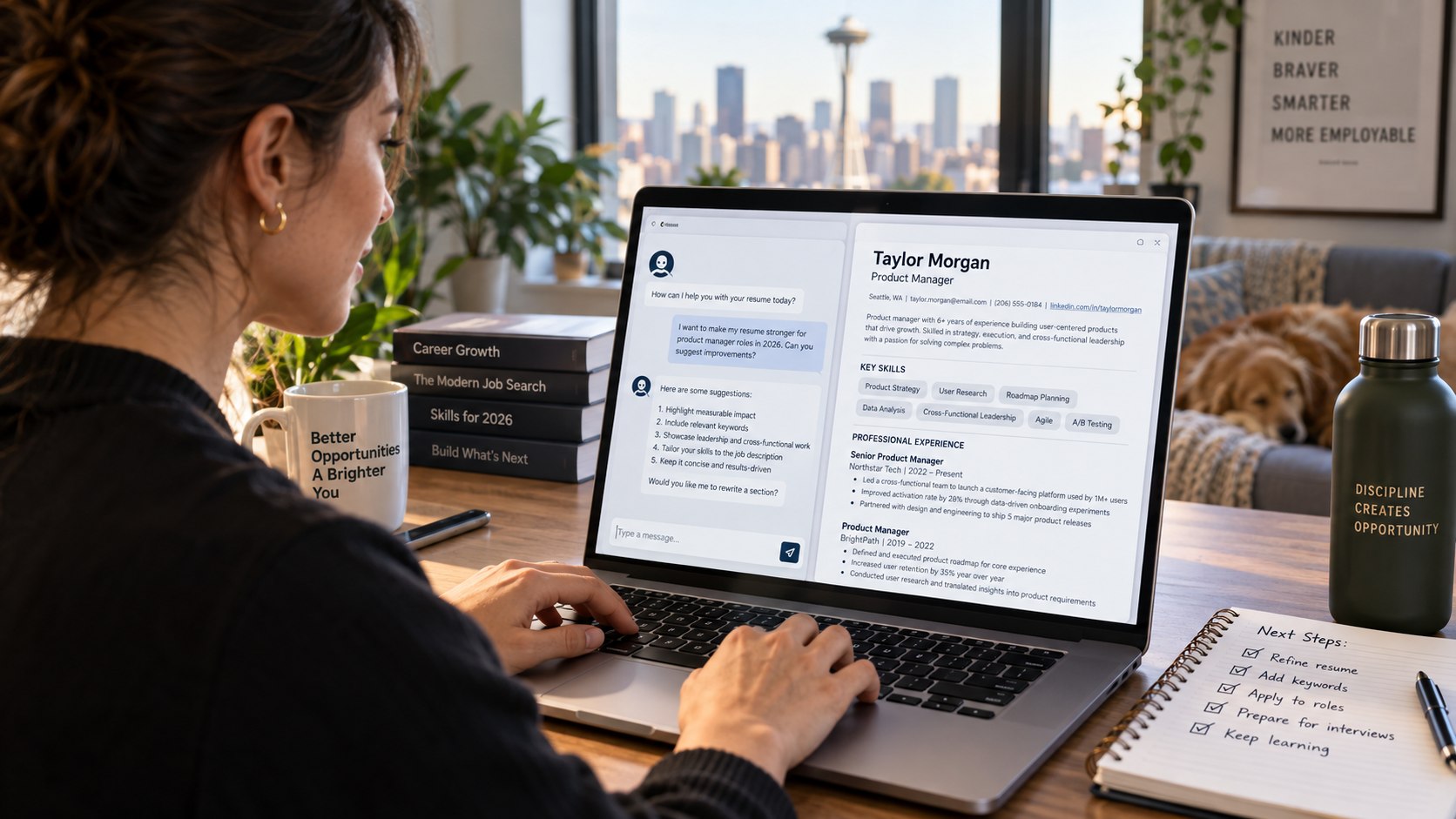
How to use ChatGPT for resumes 2026 starts with one rule: give the tool evidence, not a vague request. With a job posting, work history, and measurable results, a targeted draft can take 20–40 minutes. The process works best when ChatGPT edits verified facts instead of inventing experience, as Baltimore Chronicle notes.
The practical goal is not an “AI resume.” It is a truthful resume shaped around the language employers actually use. ChatGPT can compare documents, identify missing keywords, rewrite bullets, and challenge weak claims.
Key takeaways
- Give ChatGPT the job description and your real achievements before requesting rewritten resume bullets.
- Ask for keyword alignment without copying entire sentences from the employer’s posting.
- Review every number, title, certification, date, and technical skill before sending an application.
The strongest workflow separates extraction, rewriting, editing, and final verification. That reduces invented details and generic language. It also makes revisions easier when applying to several employers. One master resume can support many targeted versions. Each version should still sound like the same person. Human review remains the final step.
What you need
- Your current resume in DOCX, PDF, or plain text.
- The complete job description for the role.
- A list of measurable achievements from recent positions.
- Correct employment dates, titles, certifications, and education details.
- A ChatGPT account and about 30–60 minutes.
ChatGPT can work with common document formats, including DOCX and PDF. OpenAI documents current file support in its official file guide. Free access can handle many basic resume tasks. In 2026, ChatGPT Go is listed at $8 monthly in the United States. ChatGPT Plus remains $20 monthly and offers broader limits and tools. A paid plan is unnecessary for one careful resume rewrite.
The fastest method is to improve one resume section at a time instead of requesting an entire replacement document.
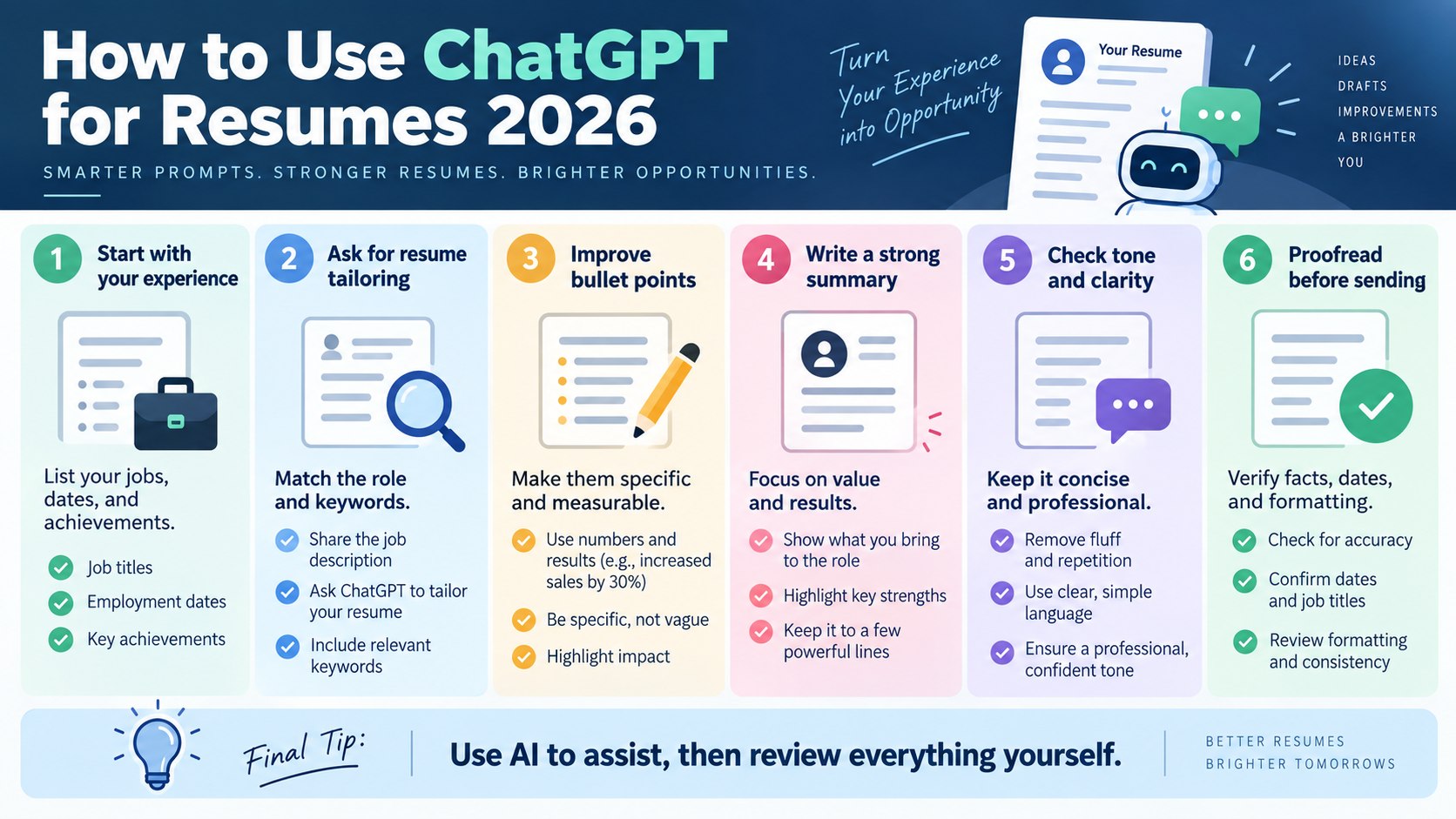
Step 1: Build a fact sheet before asking for resume copy
Start by giving ChatGPT structured facts about your employment history. Include job titles, dates, responsibilities, projects, tools, and measurable outcomes. Leave out sensitive information such as Social Security numbers or account credentials.
“Use only the facts below. Do not invent achievements, numbers, employers, certifications, or responsibilities. Flag missing information instead.”
This instruction matters because polished language can make unsupported claims look credible. A resume must survive interviews, reference checks, and background verification. A common mistake is asking ChatGPT to “make my experience more impressive.” That wording can encourage exaggeration rather than precise editing.
For readers comparing other AI workflows, Baltimore Chronicle has also covered ChatGPT tools for browsing and productivity. Those capabilities can support research, but the resume itself should remain evidence-based.
Step 2: Give ChatGPT the exact job posting
Paste the complete posting after removing unnecessary personal information. Then ask ChatGPT to separate required skills, preferred skills, responsibilities, tools, credentials, and recurring terminology.
For ChatGPT resume prompts, specificity produces better output than instructions such as “optimize my resume.” Ask for a gap analysis before requesting rewritten text. This reveals whether the problem is wording or missing experience.
“Compare this job description with my fact sheet. List matching skills, missing requirements, and keywords I can truthfully use. Do not rewrite anything yet.”
This step matters because job postings often mix essential requirements with secondary preferences. ChatGPT can organize that material faster than manual highlighting. A common mistake is forcing every advertised keyword into the resume. Recruiters can recognize unnatural repetition. Relevant terms should appear only where the candidate’s history supports them.
Step 3: Rewrite experience bullets with evidence
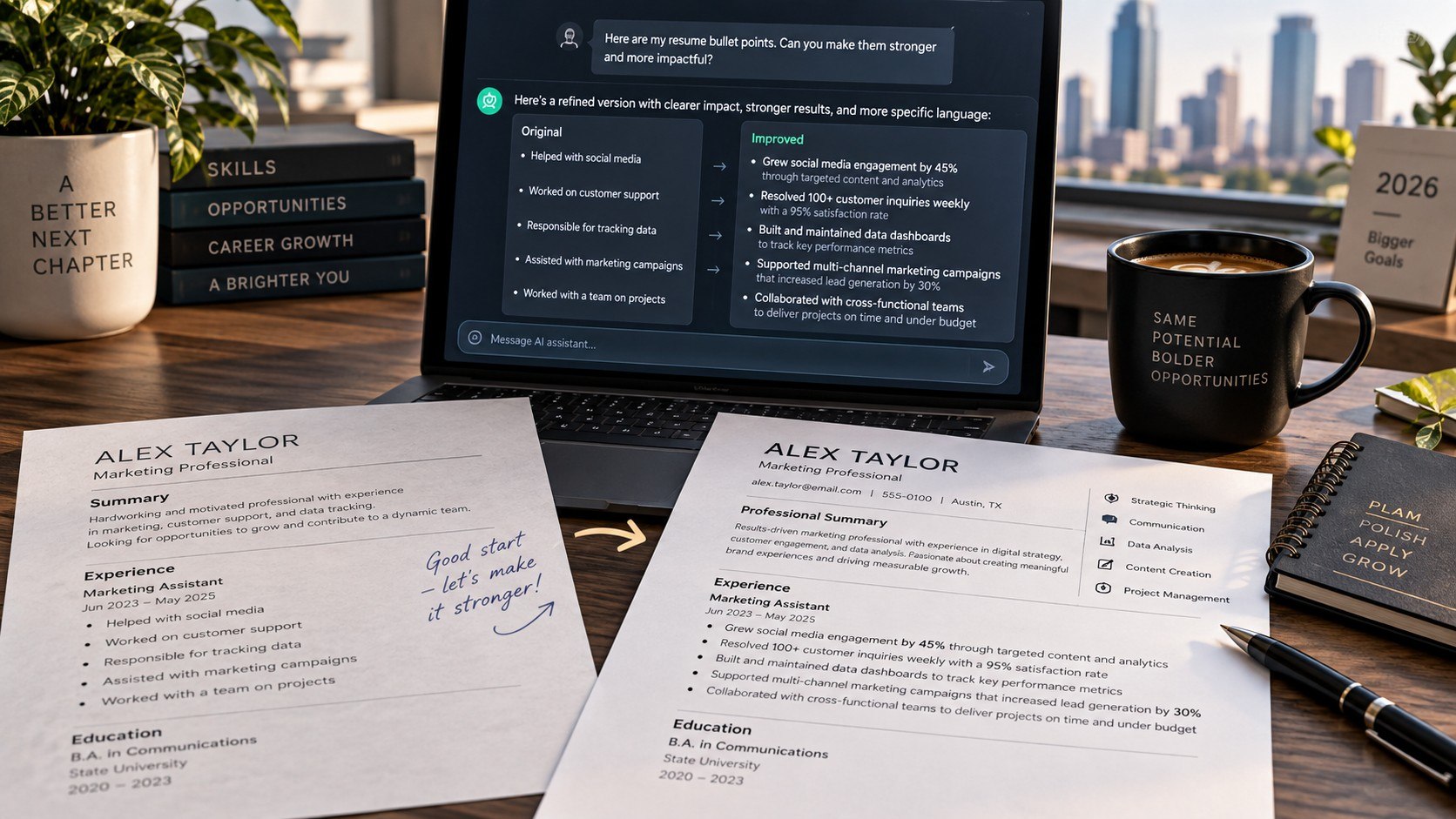
Now work through each role separately. Give ChatGPT the original bullets and the target position. Request stronger verbs, clearer outcomes, and tighter wording without changing factual meaning.
A useful AI resume writing prompt should define length and evidence rules. For example, request bullets between 12 and 24 words. Ask the model to preserve exact technologies, team sizes, dollar values, or percentages provided.
| Weak instruction | Better instruction | Expected result |
|---|---|---|
| Make this sound better | Rewrite using verified outcomes and specific verbs | Sharper, factual bullet |
| Add impressive metrics | Use only numbers provided in my notes | No invented results |
| Make it ATS friendly | Use relevant posting terms where supported | Natural keyword alignment |
| Write my whole resume | Rewrite one role, then explain major edits | Easier verification |
The difference is control. Broad prompts delegate judgment that should remain with the applicant. Narrow prompts make the output easier to audit. Numbers deserve particular attention because generated text may sound plausible. Never allow ChatGPT to estimate revenue, savings, productivity, or team size. If no metric exists, describe scope without manufacturing one. Strong resumes can use concrete responsibilities without percentages.
A credible bullet beats a dramatic bullet that becomes difficult to defend during an interview.
Step 4: Use ChatGPT for ATS keyword alignment
An applicant tracking system can store, search, rank, or route applications depending on the employer’s setup. There is no universal secret score that guarantees an interview.
Use ChatGPT for ATS resume optimization as a language-matching exercise. Ask it to identify terminology already supported by your background. A project manager might legitimately add “stakeholder management” when those duties appear in documented experience.
“Identify 10 important phrases from this posting. Mark each as supported, partly supported, or unsupported by my resume. Suggest edits only for supported phrases.”
This matters because semantic alignment can improve clarity for both software and human reviewers. Keyword stuffing usually makes a resume harder to read. Avoid hidden text, copied job descriptions, or repeated phrases. Keep conventional headings such as Experience, Education, Skills, and Certifications.
Baltimore Chronicle’s coverage of ChatGPT alternatives and competing AI tools also illustrates a useful principle. Different models can produce different wording from identical facts. The safest workflow judges output by accuracy rather than brand.
Step 5: Make the summary sound specific rather than generated
Resume summaries often reveal AI use because they become collections of adjectives. Phrases such as “results-driven professional” consume space without proving anything.
For how to write a resume with ChatGPT, ask for a summary built from role, experience, specialty, and evidence. Remove unsupported personality claims. Avoid first-person pronouns unless the target format requires them.
A strong prompt can say: “Write 3 versions under 55 words. Use only my verified facts. Avoid clichés and adjectives without evidence.” This produces options without surrendering editorial control. Compare the versions and combine only the strongest factual elements.
The common mistake is choosing the smoothest version automatically. Smooth language can also be vague language. Every phrase should help explain professional fit. If it could describe thousands of applicants, delete it.
Step 6: Run a final verification pass
Finish with editing, not generation. Ask ChatGPT to check consistency, repeated verbs, tense, spelling, dates, formatting, and unexplained abbreviations. Then verify the result manually against the original records.
A final ChatGPT resume review should also compare the finished document against the job posting. Ask which requirements are clearly demonstrated and which remain unsupported. Do not ask the system to invent material for missing requirements.
- Confirm every employer name, position, location, and employment date.
- Verify every dollar figure, percentage, certification, and numerical result.
- Check that technical skills reflect tools you can discuss confidently.
- Remove repeated keywords and generic phrases.
- Export the final document and inspect page breaks manually.
- Save a separate copy for each employer.
A verification pass protects against subtle errors introduced during several editing rounds. Dates can shift when sections are reorganized. Similar job titles can become standardized incorrectly. Technical abbreviations may expand into the wrong terms. Formatting can also change during DOCX or PDF conversion. Open the exported file before uploading it anywhere. Keep the verified master resume unchanged for future applications.
OpenAI states that ChatGPT supports document uploads and analysis, although limits vary by account. Current subscription details remain available through OpenAI’s official plan information.
Troubleshooting common ChatGPT resume problems
Most weak results come from poor source material or instructions that give the model too much freedom. These fixes address the most common failures.
- Resume sounds generic: provide specific projects, tools, customers, responsibilities, and measurable outcomes.
- ChatGPT invents numbers: instruct it to use only supplied metrics and mark missing data.
- Too many keywords: request only phrases directly supported by verified experience.
- Bullets become too long: set a maximum word count and request one achievement per bullet.
- Tone feels artificial: request plain US English and remove clichés, filler, and inflated adjectives.
Generic writing is usually a symptom, not the main problem. The model cannot recover achievements that were never provided. Add concrete facts before changing the prompt repeatedly. When a bullet remains weak, return to the underlying work example. Ask what changed because of that work. Then provide the answer as source material. Better evidence produces better writing.
ChatGPT works best as an editor with constraints, not as a substitute for your employment history.
FAQ about using ChatGPT for resumes in 2026
Can ChatGPT write my entire resume?
Yes, but section-by-section editing is safer. Smaller tasks make invented facts, awkward wording, and missing details easier to catch.
Should I upload my current resume to ChatGPT?
You can upload supported documents, including common PDF and DOCX files. Remove sensitive information you do not need for editing.
Can employers detect a ChatGPT-written resume?
No single test reliably proves how every resume sentence was produced. Employers can still notice generic language, inconsistencies, or claims candidates cannot explain.
Does ChatGPT make a resume ATS friendly?
It can improve terminology and structure when given the target posting. It cannot guarantee ranking because employers use different systems and workflows.
What is the best ChatGPT prompt for a resume?
The best prompt includes verified facts, the exact job posting, output limits, and a rule against invented information. Ask for analysis before rewriting.
Is ChatGPT free for resume writing in 2026?
ChatGPT has a free option. Paid US plans include Go at $8 monthly and Plus at $20 monthly, based on 2026 OpenAI information.
Earlier we wrote about DHL Ecommerce or Express in 2026? Speed, Price and USPS Handoffs Explained