

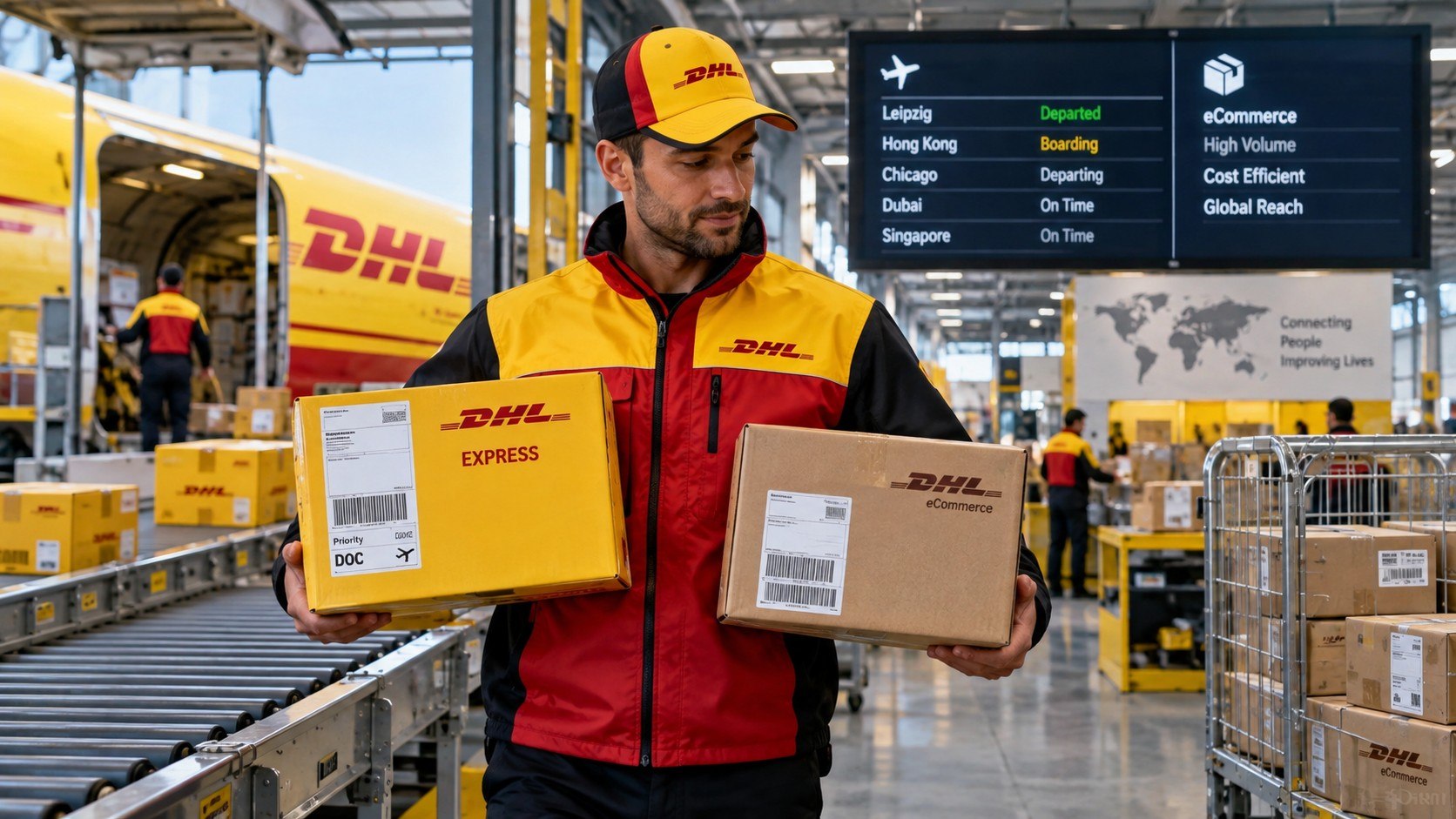
DHL express vs DHL ecommerce 2026 has a simple verdict for most US shippers. Choose Express for deadlines and eCommerce for lower-cost merchant volume, as the editors at Baltimore Chronicle note.
DHL Express can move eligible international shipments on the next possible business day. DHL eCommerce trades that speed for lower-cost parcel logistics and USPS-supported delivery. The second service primarily targets businesses shipping many consumer orders, while occasional household shippers will usually find Express easier to access directly.
Key takeaways
- DHL Express fits urgent international documents, replacement parts, valuable parcels, and shipments with firm arrival deadlines.
- DHL eCommerce fits merchants prioritizing shipping cost, scalable fulfillment, lightweight parcels, and routine residential delivery.
- US shoppers receiving eCommerce parcels may see USPS complete the final mile after DHL handles earlier transportation.
The names can make these services sound more similar than they are. They use different operating models and solve different shipping problems. Express operates an integrated expedited network across more than 220 countries and territories. eCommerce combines DHL processing with postal and delivery partners for many services.
In the United States, USPS remains central to the domestic final-mile model for DHL eCommerce. That operational difference explains much of the gap in delivery speed, tracking behavior, and pricing.
The quickest rule is practical: pay for Express when a late parcel creates a bigger problem than a higher shipping bill.
DHL Express vs DHL Ecommerce 2026: speed and cost
The biggest difference between DHL Express vs DHL Ecommerce 2026 is not the logo on the label. It is the service promise behind that label. Express sells expedited transportation, while eCommerce focuses on economical parcel movement for merchants and online retail.
DHL Express increased standard US shipping rates by an average of 5.9% from January 1, 2026. The final amount still depends on route, weight, dimensions, service level, and surcharges. DHL eCommerce does not publish one nationwide consumer rate comparable with a postal stamp because business pricing depends on shipping volume and commercial agreements.
“Delivery by the end of the next possible business day.”
DHL Express, 2026 US Service & Rate Guide, describing Express Worldwide service.
That wording explains why Express generally costs more. The network is designed around urgent international transportation and customs handling. Express Worldwide supports individual pieces up to 150 lb under published 2026 limits.
DHL also offers earlier delivery products on eligible routes, including Express 12:00 and morning services. Availability depends on origin and destination.
At a glance
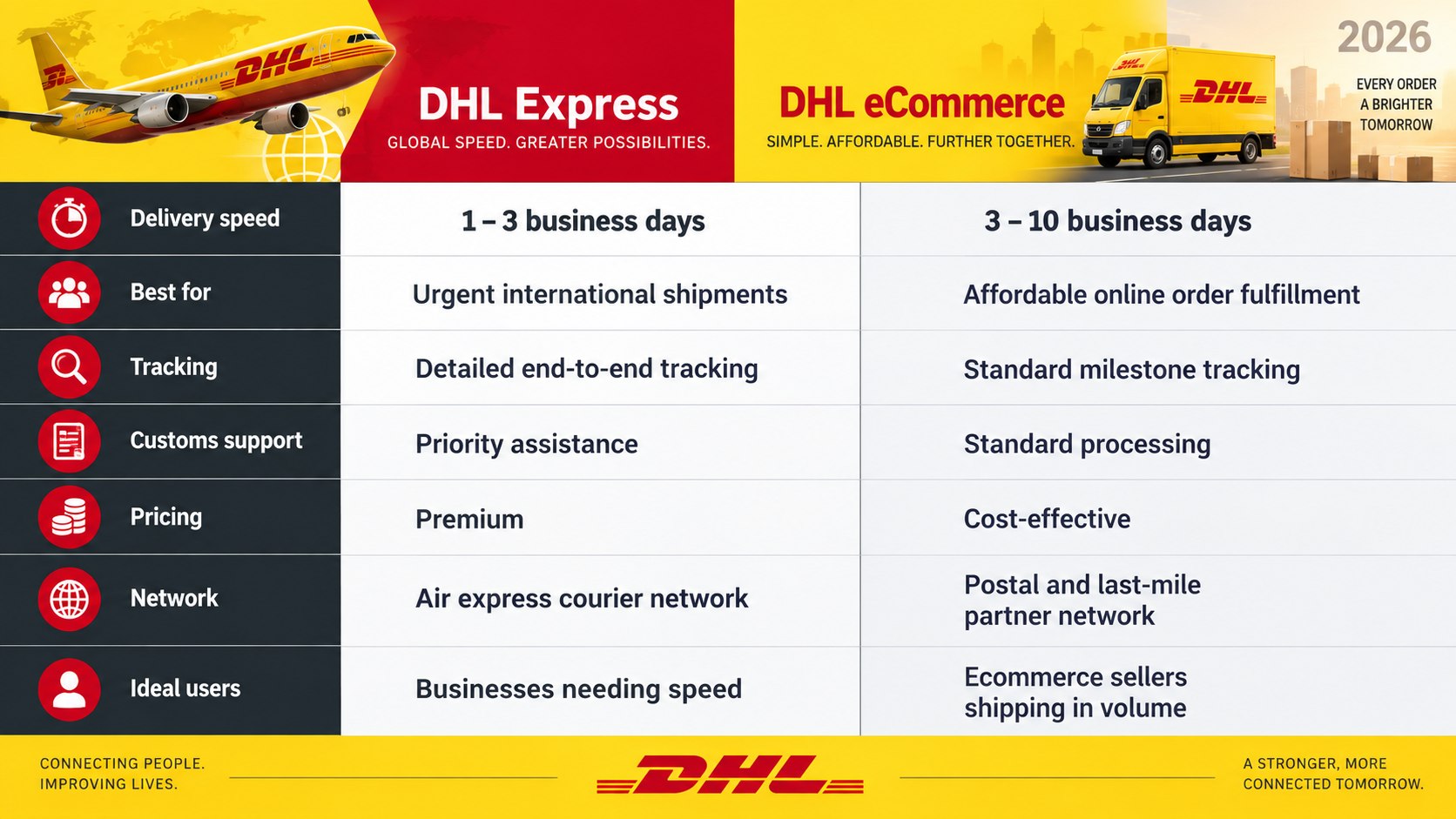
The main differences are easier to see when speed, pricing, tracking, and typical users are compared side by side.
| Factor | DHL Express | DHL eCommerce |
|---|---|---|
| Primary purpose | Urgent international and time-definite shipping | Economical B2C parcel delivery |
| Typical US user | Individuals and businesses | High-volume merchants |
| Speed | Next possible business day on eligible services | Usually several postal or business days |
| Domestic ground timing | Service-dependent | Ground averages 3–8 postal days |
| Faster domestic tier | Express products vary by destination | Expedited Max lists 2–3 postal days |
| International economy timing | Built for expedited delivery | Standard lists 4–8 days to Europe and Canada |
| Tracking model | Integrated Express tracking | DHL tracking with partner handoffs possible |
| US final mile | DHL Express network | USPS commonly handles final delivery |
| Pricing model | Shipment quote plus applicable surcharges | Commercial pricing for business customers |
| Best reason to choose | Deadline matters most | Cost per parcel matters most |
DHL eCommerce lists several US service levels. Expedited Max targets 2–3 postal days. Expedited averages 2–5 postal days, while Ground averages 3–8 postal days.
These delivery windows are not equivalent to DHL Express time-definite products. A merchant should compare the contracted service level rather than relying only on the DHL brand name.
International eCommerce products vary as well. Parcel International Direct lists roughly 3–10 business days for supported destinations. Parcel International Standard lists around 4–8 days for Europe and Canada, while other destinations can require 8–14 business days.
Packet International may reach the destination country within about 4–8 business days. Local processing and final delivery can add more time.
DHL Express works best when time has a price
DHL Express shipping makes sense when the delivery date carries financial or personal consequences. Typical examples include contracts, passports, replacement parts, product samples, business equipment, or gifts tied to a fixed event.
The service can be purchased without opening a DHL Express business account. Customers can enter the origin, destination, package type, dimensions, and weight online, then review available services and estimated transit times.
Customs processing can still affect an international shipment. Weather, public holidays, incomplete paperwork, or restricted goods can also influence the delivery estimate.
DHL Express has several practical advantages:
- direct access for occasional US shippers;
- time-definite international products on eligible routes;
- integrated tracking across the Express network;
- courier pickup and DHL ServicePoint drop-off options;
- customs-focused tools for international shipments.
The disadvantage is cost. Express pricing can change sharply according to weight, dimensions, destination, and optional services. Fuel, remote-area, handling, or other surcharges may also increase the final amount.
A large but lightweight parcel can cost more than expected because dimensional weight can apply. Comparing final quotes is therefore more useful than comparing only advertised base rates.
Shippers considering other nationwide carriers can also read Baltimore Chronicle’s FedEx, UPS and USPS comparison for 2026. That comparison becomes especially relevant when international speed is not the main concern.
DHL eCommerce is built around parcel economics
DHL eCommerce delivery solves a different problem. An online store may ship hundreds or thousands of orders every month. Paying Express rates for every T-shirt, accessory, book, or small household item would make many transactions uneconomical.
DHL positions its US eCommerce operation primarily for high-volume business customers. Parcels move through DHL distribution facilities before transfer to a final delivery provider. In many domestic cases, USPS completes the last mile.
“Value-driven shipping solutions to efficiently connect your business with consumers in the United States.”
DHL eCommerce, US Domestic Shipping Services.
The service is especially suitable for businesses that value lower shipping costs over premium speed.
- Use it for repeat B2C shipments where cost per parcel matters.
- Choose faster eCommerce tiers when standard ground is too slow.
- Use international products when customers accept broader delivery windows.
- Plan for USPS or another partner handoff during the final stage.
- Give customers realistic delivery estimates instead of Express-style promises.
The main trade-off is reduced speed and sometimes less immediate tracking. A carrier handoff can create periods without a new customer-facing scan.
That pause does not automatically mean the shipment is lost. In many cases, the parcel has entered another delivery network and is waiting for the next scan.
Baltimore Chronicle also explains how long DHL eCommerce can take from China to the USA. A separate guide covers how to track a DHL package from China to the USA.
A DHL eCommerce tracking pause near the final mile can reflect a carrier handoff rather than a stationary parcel.
What actually changes the price in 2026
There is no single universal answer to DHL Express vs DHL eCommerce cost. Express produces shipment-specific quotes. DHL eCommerce pricing is primarily commercial and volume-based.
A useful comparison starts with the parcel itself. Before selecting a service, record:
- origin ZIP Code and destination ZIP Code or country;
- packed weight rather than product weight;
- outside length, width, and height;
- declared value and commodity description;
- required delivery date;
- whether duties should be prepaid;
- expected weekly or monthly shipping volume.
Dimensions can change the billed weight even when a box feels light. International shipments may also create duties, taxes, customs charges, or brokerage-related costs depending on the destination.
Optional signatures and special handling can increase the total. Residential delivery conditions may matter for some services, while business accounts can receive negotiated rates unavailable to occasional shippers.
The safest method is to compare complete quotes for the same packed parcel. DHL’s official 2026 US Express Service & Rate Guide explains current Express conditions and charges. DHL also publishes its US eCommerce domestic service options.

Which should you buy in 2026
The choice becomes easier when the shipment has a clear deadline. These practical rules cover most decisions involving DHL Express vs DHL eCommerce speed.
- If delivery tomorrow or very soon matters, price DHL Express first.
- If you ship consumer orders in volume, ask DHL eCommerce about commercial service.
- If the parcel is inexpensive and non-urgent, favor the cheaper delivery window.
- If customs timing matters, compare Express products and documentation requirements carefully.
- If you send one occasional domestic package, compare DHL with USPS, UPS, and FedEx.
A Maryland freelancer sending signed documents to London has a clear reason to pay for speed. A California retailer mailing 500 lightweight accessories has a different priority because predictable cost per parcel matters more.
A parent sending one non-urgent package within the United States may need neither DHL option. USPS, UPS, or FedEx can be simpler depending on destination, dimensions, and delivery expectations.
Service names matter less than deadline, volume, package size, destination, and the financial cost of a delay.
FAQ
Is DHL Express faster than DHL eCommerce?
Yes. DHL Express is designed for expedited and time-definite shipping, especially for international deliveries. DHL eCommerce focuses on economical parcel delivery for merchants.
How long does DHL eCommerce take in the United States?
Published domestic transit times depend on the selected service. Expedited Max lists about 2–3 postal days, while Ground averages roughly 3–8 postal days.
Can an individual use DHL eCommerce to send one package?
DHL positions its US eCommerce operation mainly for higher-volume business customers. Individuals sending one package will usually find DHL Express or standard consumer carriers easier to use.
Does USPS deliver DHL eCommerce packages?
Yes, USPS commonly handles the final mile for DHL eCommerce shipments in the United States. The parcel may first move through DHL facilities before entering the postal network.
Why does DHL eCommerce tracking sometimes stop updating?
A parcel may be transferring between DHL and another delivery network. Tracking gaps can appear while the package waits for the next carrier scan.
Which DHL service is better for an urgent international package?
DHL Express is designed for urgent international shipping. Eligible Express Worldwide shipments can target delivery by the end of the next possible business day.
Earlier we wrote about How to Reupholster a Chair Yourself in 2026: Foam, Fabric and Staple Sizes