

FedEx vs UPS vs USPS 2026 which is best depends on the package, deadline, destination, and how much inconvenience you can tolerate. Most households should start with USPS for small packages, while UPS usually fits heavier ground shipments and FedEx excels when delivery speed matters, as noted by the editors at Baltimore Chronicle citing tygodniksportowy.pl.
There is no universal cheapest carrier. A 12-ounce parcel going across Maryland behaves differently from a 35-pound box traveling from Florida to California. In 2026, dimensional weight, residential surcharges, delivery zones, fuel adjustments, and holiday pricing can change the winner.
Key takeaways
- USPS is usually the first carrier to price-check for lightweight residential parcels, PO Boxes, and straightforward nationwide delivery.
- UPS becomes particularly competitive for heavier boxes, business shipping, scheduled pickups, and packages needing strong recipient controls.
- FedEx deserves the first quote for urgent deliveries, time-sensitive business shipments, and customers using its Express network.
USPS retail Ground Advantage starts at $7.90 for parcels up to 8 ounces in the lowest zones under rates effective July 12, 2026. A Priority Mail Flat Rate Envelope costs $12.90. USPS commercial prices can be lower, so buying postage online may materially change the comparison.
The useful question is not which carrier is cheapest overall, but which carrier is cheapest for the package actually being shipped.
FedEx vs UPS vs USPS 2026 which is best at a glance
The differences become clearer when the carriers are compared by actual use case. Published prices alone cannot determine every shipment because UPS and FedEx calculate many charges using distance, dimensions, service level, and account terms.
| Factor | USPS | UPS | FedEx |
|---|---|---|---|
| Best general use | Small residential parcels | Medium and heavy ground boxes | Urgent and time-sensitive shipments |
| Entry-level 2026 pricing | Ground Advantage from $7.90 retail | Varies by zone, dimensions, and rate type | Varies by zone, dimensions, and service |
| PO Box delivery | Yes | Limited through eligible services | Generally not standard FedEx Ground delivery |
| Residential delivery | Core network function | Residential charges can apply | Residential and area charges can apply |
| Fast domestic options | Priority Mail Express | Next Day Air services | FedEx Express services |
| Ground option | Ground Advantage | UPS Ground | FedEx Ground/Home Delivery |
| Tracking | Included on major parcel services | Detailed package tracking | Detailed package tracking |
| Best for apartments | Strong when mailbox or PO Box access helps | Strong with Access Point options | Strong with Delivery Manager controls |
| 2026 pricing concern | Temporary and seasonal adjustments | Fuel and demand surcharges | Fuel, residential, area, and demand charges |
The price row needs context. UPS distinguishes retail rates from daily rates available to qualifying account customers. FedEx also uses rate structures where negotiated discounts can dramatically change the invoice. USPS provides unusually transparent retail pricing for casual senders.
Package dimensions matter almost as much as weight for private carriers. An oversized but lightweight box can cost more than expected because carriers may bill dimensional weight. Long or unusually shaped packages can also trigger additional-handling charges.
Location changes the calculation again. Rural addresses in Montana, Wyoming, Alaska, and other less-dense areas can attract carrier-specific area charges. USPS already serves those addresses through its national postal network.
Finally, the cheapest label can become expensive after an address correction, pickup fee, or nonstandard-package charge. Comparing the final checkout price is more useful than comparing advertised starting rates.
USPS is strongest for small packages and simple household shipping
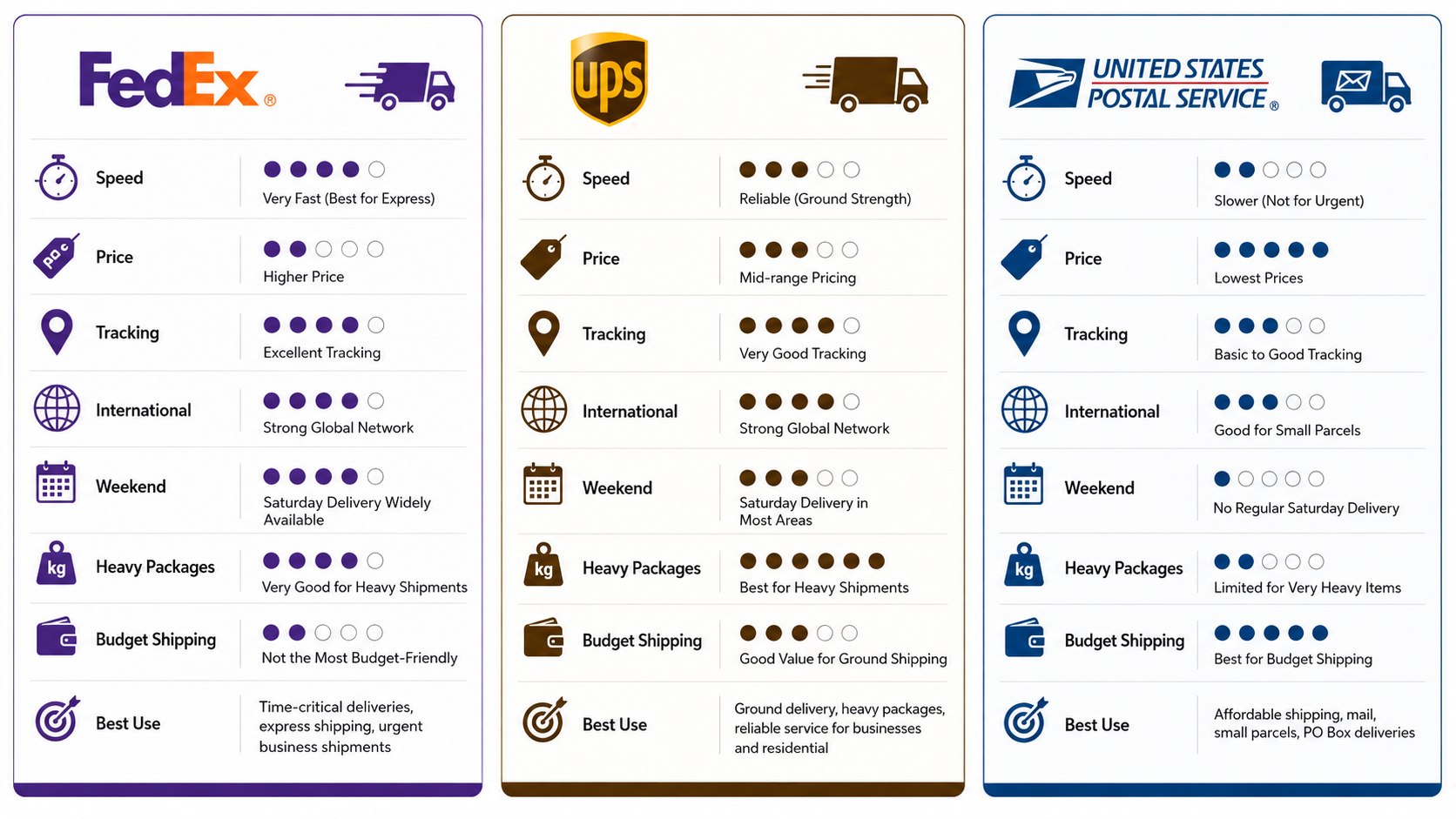
For an occasional seller, parent mailing a care package, or renter returning a small purchase, USPS Ground Advantage 2026 deserves the first quote. USPS lists retail prices from $7.90 for eligible lightweight shipments under its July 12 schedule. Commercial Ground Advantage pricing starts lower.
Priority Mail remains useful when the package fits USPS packaging or when predictable Flat Rate pricing beats zone-based alternatives. The 2026 retail Flat Rate Envelope costs $12.90, while the Medium Flat Rate Box is $24.80. The Large Flat Rate Box is $34.00.
Readers comparing individual services can also use Baltimore Chronicle’s guide to USPS rates for First-Class and Priority Mail. That distinction matters because letters, documents, and parcels follow different pricing structures.
USPS pros
- Direct delivery to PO Boxes and APO/FPO/DPO destinations.
- Competitive pricing for lightweight packages.
- Free USPS packaging for eligible Priority Mail services.
- Broad nationwide residential reach without a private-carrier residential model.
- Ground Advantage and Priority Mail tracking included on standard eligible shipments.
USPS is not automatically cheapest for every box. A heavier parcel traveling several zones can quickly narrow the gap with UPS or FedEx. Large dimensions also affect pricing even when actual weight looks reasonable.
Speed is another distinction. Ground Advantage is intended for economical parcel delivery rather than emergency shipments. Priority Mail Express sits at the faster end but costs substantially more than ordinary ground shipping.
USPS also announced planned temporary holiday increases for Priority Mail, Ground Advantage, and several related services. The proposed period runs from October 4, 2026 through January 17, 2027, subject to regulatory review.
“Providing a nationwide, integrated network for the delivery of mail and packages at least six days a week.”
U.S. Postal Service, August 25, 2026 holiday pricing announcement.
UPS is the practical choice for heavier ground shipments
UPS becomes more attractive when boxes become heavier, business shipping becomes frequent, or scheduled pickup matters. UPS vs USPS shipping cost cannot be reduced to one national price because UPS rates depend on origin, destination, package measurements, and customer status.
UPS explicitly separates retail rates from daily rates. Retail pricing generally applies to infrequent customers without qualifying account arrangements. Daily rates apply to customers with scheduled pickups or eligible contracts.
The practical advantage is a mature ground network paired with detailed delivery controls. Apartment residents may also benefit from UPS Access Point locations. Baltimore Chronicle explains how UPS Access Point works in 2026, including package holds and returns.
UPS pros and trade-offs
- Price-check UPS first for dense, heavy packages that are expensive through postal zone pricing.
- Use an account quote when shipping regularly because retail counter pricing may not reflect available discounts.
- Measure every side accurately before paying because dimensional weight can change the billed amount.
- Check whether residential, area, fuel, or demand charges appear before confirming the shipment.
UPS applies Additional Handling under defined conditions. Its guidance identifies triggers including a longest side above 48 inches or second-longest side above 30 inches. Packages weighing more than 50 pounds can also trigger Additional Handling.
Fuel is another variable. UPS says its U.S. Ground Domestic fuel surcharge is adjusted weekly using national diesel pricing. The surcharge does not apply to certain UPS Ground packages using retail rates in the contiguous 48 states.
“The cost of your shipment will depend on its origin, destination, service, package weight and other considerations.”
UPS, U.S. Shipping Costs and Rates guidance.
FedEx makes the strongest case when the deadline matters
FedEx is difficult to judge by ground pricing alone because its major advantage is the breadth of its time-definite network. FedEx vs UPS delivery speed becomes relevant when arrival time matters more than saving several dollars.
Home Delivery and Ground cover ordinary residential and commercial shipping needs. Express services target shipments where the customer pays more for tighter delivery commitments. The exact quote still depends on ZIP Codes, weight, dimensions, and selected service.
FedEx’s 2026 retail Ground and Home Delivery schedules include residential and delivery-area charges within published rates. Extended residential locations can carry additional delivery-area surcharges.
FedEx also changes selected surcharges during high-demand periods. For 2026, published residential demand charges include seasonal per-package adjustments during the holiday period.
For a birthday gift, replacement laptop, legal document, or business component, paying for predictability can matter more than winning the lowest rate.
Who should choose FedEx
- Businesses sending urgent documents or replacement parts.
- Households needing several express delivery choices.
- Freelancers shipping valuable work under a firm deadline.
- Customers who want residential package-management tools.
- Shippers whose negotiated FedEx rate beats public alternatives.
Residential recipients can manage eligible deliveries through FedEx Delivery Manager. Baltimore Chronicle has a separate guide explaining FedEx Delivery Manager features in 2026.
The weak point is surcharge complexity. A seemingly reasonable base rate can change after delivery-area, handling, fuel, or demand charges. This matters most for oversized packages and rural destinations.
FedEx therefore rewards careful quoting. Enter exact dimensions, not estimates. Compare the final amount against UPS and USPS before printing the label.
Which carrier is cheapest in 2026 by use case
The cheapest shipping carrier in 2026 changes with the shipment. These common examples provide a better starting point than choosing one company by habit.
| Use case | First carrier to check | Reason |
|---|---|---|
| Small package under 1 lb | USPS | Ground Advantage has competitive lightweight pricing |
| Books and qualifying media | USPS | Media Mail can be economical for eligible contents |
| Heavy compact box | UPS | Ground pricing can become competitive as weight rises |
| Urgent overnight shipment | FedEx or UPS | Both maintain extensive time-definite air services |
| PO Box destination | USPS | Direct PO Box delivery is a core postal function |
| Apartment delivery | UPS or FedEx | Access Point and Delivery Manager tools can reduce missed deliveries |
| Regular small-business shipping | Quote all 3 | Commercial and negotiated rates can reverse retail comparisons |
A homeowner sending a 6-ounce package from Baltimore to Philadelphia should usually price USPS first. The same person sending a 45-pound automotive component to Texas should check UPS and FedEx immediately.
A freelancer sending signed documents overnight from New York to California has a different priority. FedEx Express and UPS air services deserve comparison even when USPS costs less.
Parents shipping supplies to a college student should also consider delivery conditions. A campus mailroom, apartment building, or PO Box can affect which carrier is easiest for the recipient.
Online sellers face another variable: commercial pricing. Buying labels through an eligible shipping platform can produce different rates from a Post Office or retail shipping counter.
Holiday timing deserves its own calculation. USPS, FedEx, and UPS may apply seasonal or demand-related adjustments. A quote made in September can differ from the same shipment near Thanksgiving.
Which should you buy in 2026
For most occasional senders, the decision can be made quickly. Get the package packed first, because dimensions can change the result substantially.
- If the parcel is light or going to a PO Box, check USPS first.
- If the box is heavy and traveling by ground, compare UPS with FedEx.
- If arrival tomorrow matters, compare FedEx Express and UPS air services.
- If shipping weekly, compare commercial or negotiated pricing instead of retail counters.
- If the destination is rural, inspect every area surcharge before buying the label.
This process avoids the most common pricing mistake: comparing services that are not equivalent. Ground Advantage should not be judged directly against overnight air unless the deadline permits both.
It also prevents packaging surprises. Measure length, width, and height after sealing the box. Use the carrier’s own calculator with the actual destination ZIP Code.
Check the recipient’s needs before choosing the lowest figure. PO Boxes, apartment access, signature requirements, and pickup availability can matter more than a $3 difference.
For valuable goods, inspect declared-value rules and available coverage. Standard included protection and claims procedures differ between carriers and services.
The final checkout price should decide the cost comparison. Base rates without surcharges tell only part of the story.
FAQ
Is USPS cheaper than UPS in 2026?
USPS often starts strongly for lightweight residential packages. Ground Advantage can be particularly competitive for smaller parcels. Heavy boxes may produce a better UPS quote.
Is FedEx or UPS better for overnight delivery?
Both are serious options for overnight shipping. Compare the exact delivery commitment, final price, pickup deadline, and destination ZIP Code before choosing.
Which carrier is best for a PO Box?
USPS is the straightforward choice because it directly serves Post Office Boxes. Private-carrier restrictions vary by service.
Which shipping company is best for heavy packages?
Best shipping service for heavy packages is often UPS or FedEx, but dimensions can overturn the result. Obtain both quotes using exact measurements and weight.
Does USPS raise prices during the 2026 holiday season?
USPS announced proposed temporary increases for selected parcel products during the 2026 holiday period. Customers should verify the effective rates before shipping.
Should small businesses use FedEx, UPS, or USPS?
Small businesses should price all 3 using commercial or account rates. Shipment volume, package size, delivery zones, pickup needs, and residential surcharges can change the cheapest option.
Earlier we wrote about Renting Out a House in 2026: US Landlord Licenses, Tenant Screening and Tax Rules