

Baltimore voters will decide four bond questions on the Nov. 3 ballot that together would let City Hall borrow up to $280 million for schools, recreation centers, affordable housing, streets and neighborhood development. Questions A through D appear on every city ballot in the general election, and the projects they fund, from school heating systems to a West Baltimore pool, touch nearly every neighborhood.
Below is what each question would pay for, how the borrowing works, what it means for city taxpayers and what else Baltimore voters will see on the back of the ballot.
What are Baltimore’s bond Questions A, B, C and D?
Each question asks voters to authorize a general obligation loan. A vote FOR lets the city borrow up to the listed amount; a vote AGAINST prohibits it. The amounts come from the Baltimore City Department of Planning and the official ballot language.
| Question | Loan | Up to | What it funds |
|---|---|---|---|
| A | Affordable Housing | $22 million | Property acquisition and redevelopment, rental and homeownership projects, home purchase assistance, housing counseling, the Affordable Housing Trust Fund, blight removal |
| B | Schools | $60 million | Building systems such as heating and air conditioning, windows, doors and fire safety; matching state school construction funds |
| C | Community and Economic Development | $50 million | Blight elimination, middle neighborhoods and retail corridors, business and homeownership loans or grants, home repair, culture and tourism |
| D | Public Infrastructure | $148 million | City buildings, Enoch Pratt Free Library branches, parks and rec centers, streets, alleys, sidewalks, trees, IT and equipment |
| Total | $280 million | Covers city fiscal years 2028 and 2029 | |
Which Baltimore projects are on the list?
The city chooses specific projects through its annual Capital Improvement Program, so the ballot does not lock in a full list. But the ballot descriptions and the Baltimore Banner voter guide name several planned uses:
- Schools (Question B): renovations at Edmondson-Westside High School and Benjamin Franklin High School, plus systemic repairs across the district.
- Recreation (Question D): replacing the Lillian Jones Recreation Center and the William McAbee Pool.
- Arts and downtown (Question D): facade restoration at the Bromo Arts Tower.
- Sidewalks (Question D): curb ramp upgrades required under a partial consent decree on accessibility.
How do Baltimore’s general obligation bonds work?
Baltimore must get voter permission before it issues general obligation bonds, which are backed by the city’s full faith and credit. The questions return every two years. Before reaching the ballot, this year’s package was approved by the Planning Commission, the Board of Finance, the Board of Estimates, the city’s delegation in Annapolis and the City Council.
“Borrowed funds that are used for capital projects.”
Baltimore City Department of Planning, describing general obligation bonds
Bond money pays for long-lasting assets, such as buildings, roads and major equipment, not salaries or day-to-day operations.
Will the bond questions raise property taxes?
The ballot questions do not set a new tax or change the city’s property tax rate. The borrowing is repaid over time from the city budget, and the Planning Department notes that the city would use its taxing authority to repay bondholders only in the unlikely event of a default. Approving the questions authorizes borrowing; it does not require the city to issue every dollar at once.
The size of the package is tied to the city’s debt policy, which allows up to $125 million a year in general obligation borrowing starting in fiscal 2026 and $140 million a year starting in fiscal 2028. Two years of $140 million equals this year’s $280 million total. In 2024, voters were asked to authorize $125 million a year for fiscal 2026 and 2027.
What else is on Baltimore’s 2026 ballot?
After the four bond loans, city voters will see five charter amendments, Questions E through I:
- E, Contract Bidding and Awards: removes the charter requirement to award contracts to the lowest bidder, along with tie-bid and bonding provisions.
- F, Legislation, Budget and Board of Estimates: shortens veto timelines, sets new budget deadlines and shifts many Board of Estimates duties to the mayor and the Finance Department.
- G, Franchises and Minor Privileges: adds the stormwater system to city property that cannot be sold as a franchise and changes how permits for things like sidewalk encroachments are granted.
- H, Department of Water and Wastewater: creates a stand-alone water and wastewater department, moving those systems out of the Department of Public Works, effective Jan. 1, 2029.
- I, Baltimore Baby Fund: a petition-driven amendment creating a fund for families with newborns, financed by 3 cents per $100 of taxable property value. The fund is projected to hold about $15 million; the amendment does not spell out how it would be spent.
Statewide, voters will also decide Question 3, the congressional redistricting amendment.
When can Baltimore residents vote?
Early voting begins Oct. 22, and Election Day is Tuesday, Nov. 3. Sample ballots and full question text are posted by the Baltimore City Board of Elections. For mail-in and early voting dates, see our guide to Maryland’s 2026 voting deadlines.
A practical tip: local questions come after the statewide contests near the end of the ballot, so review every page before you turn it in.
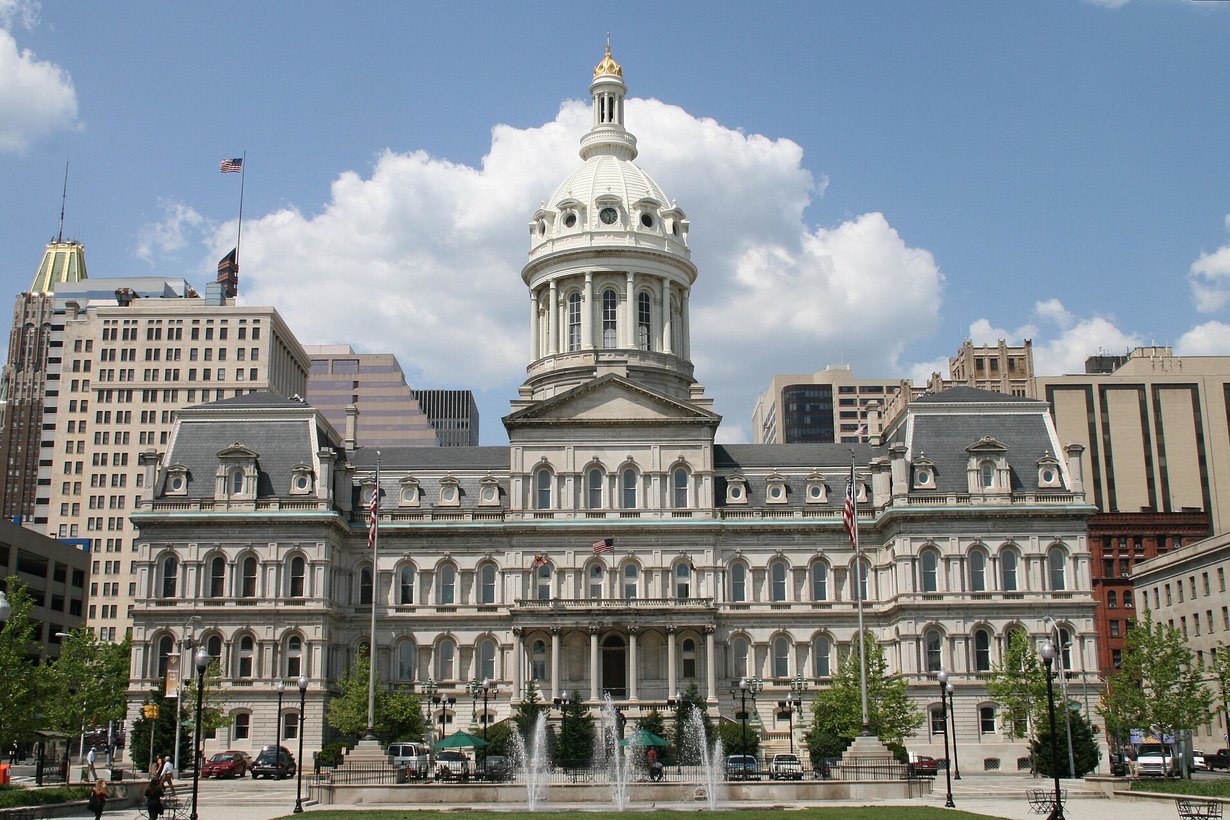
Featured image: Baltimore City Hall. Photo: Marylandstater / Wikimedia Commons, public domain.