

Maryland voters will decide on Nov. 3 whether to change the state constitution’s rules for drawing congressional districts, and a new poll suggests the redistricting measure, Question 3, faces an uphill fight. For Baltimore-area voters, the question matters because it could shape how the region’s U.S. House seats are drawn after this election, even though it does not redraw any map by itself.
Early voting opens Oct. 22, and the deadline to register online or by mail is Tuesday, Oct. 13. Here is what Question 3 says, what a yes or no vote means, how it got on the ballot and what the other two statewide questions would do.
What does Question 3 on the Maryland ballot do?
Question 3, titled “Electoral Districts – General Assembly and Congressional Representatives,” is a proposed constitutional amendment. According to the Maryland State Board of Elections, it would:
- Clarify that certain districting requirements in the state constitution apply only to Maryland Senate and House of Delegates districts.
- Allow the General Assembly to give the Supreme Court of Maryland original jurisdiction to review a congressional districting plan.
- State that the Maryland Constitution sets no criteria for the boundaries of congressional districts.
The state constitution currently says legislative districts should be contiguous and compact and give “due regard” to natural boundaries and political subdivisions, according to a summary by IVN. Congressional maps would still have to follow the U.S. Constitution, federal law including the Voting Rights Act, and Maryland statutes.
The amendment would not redraw Maryland’s congressional districts on its own, the Maryland Association of Counties noted in its summary of the court ruling. It changes the rules lawmakers would work under if they draw a new map.
Why are Maryland Democrats pushing a redistricting amendment now?
Democrats hold seven of Maryland’s eight U.S. House seats. Rep. Andy Harris, whose 1st District includes all of the Eastern Shore, is the delegation’s only Republican.
The question traces back to 2022. That year, Anne Arundel County Senior Judge Lynne Battaglia applied the constitution’s compactness and boundary standards to congressional districts and struck down a Democratic-drawn map. The General Assembly then passed the current 7-1 map. Supporters describe Question 3 as a first step toward drawing a new congressional map; opponents say it removes guardrails, according to IVN’s reporting.
Gov. Wes Moore has framed the measure as Maryland’s response to Republican-led redistricting in other states and has said he will campaign for it, FOX45 reported. Asked whether he would back an 8-0 Democratic map if voters approve, Moore did not answer directly, saying his focus is on passing the measure. Senate President Bill Ferguson initially held back a new congressional map the House approved in February, citing concern about the 2022 ruling, but later backed the special session for the amendment after a U.S. Supreme Court decision weakened the Voting Rights Act, Maryland Matters reported.
Who supports and opposes Question 3?
Supporters include Moore, Ferguson, House Speaker Joseline Peña-Melnyk and a group called Fight Back MD, which says it will campaign statewide for a yes vote. After the court ruling, Ferguson and Peña-Melnyk called it a victory for voters that leaves the redistricting standards up to Marylanders, according to Maryland Matters.
Republicans opposed the bill in the legislature and in court, arguing it could clear the way for a midcycle map that tilts all eight seats toward Democrats. Senate Minority Leader Stephen Hershey, a plaintiff, said the revised ballot language still fails to explain the amendment’s true effect. Protect Maryland Votes, a group formed to oppose the measure, argues the wording obscures what the amendment does. In dissent, Justice Steven Gould wrote that even the court’s rewritten question “remains misleading.”
How did Question 3 get on the ballot?
| Date | Event |
|---|---|
| 2022 | A state judge strikes down a Democratic-drawn congressional map; lawmakers adopt the current 7-1 map |
| August 2026 | General Assembly passes HB 2100 along party lines in a two-day special session |
| Aug. 5, 2026 | Gov. Moore signs the amendment bill |
| August 2026 | Circuit judges in Anne Arundel and Dorchester counties block the question from the ballot |
| Sept. 3, 2026 | Supreme Court of Maryland, in a divided order, restores Question 3 but orders the ballot language rewritten |
| Nov. 3, 2026 | Voters decide |
In Anne Arundel County, Circuit Judge Robert Thompson, whose ruling briefly blocked the amendment in August, found the original ballot language, which called the change a “clarification,” to be misleading, among other problems, IVN reported. In an order written by Chief Justice Matthew Fader, the Supreme Court of Maryland agreed the General Assembly’s wording was misleading but kept the question on the ballot and substituted language based on the bill’s purpose paragraph, according to Maryland Matters and MACo. The state elections board notes on its website that the Question 3 text was updated after that order.
After the ruling, State Administrator of Elections Jared DeMarinis said the decision would let the board meet its deadlines.
“With this ruling, SBE will meet all mail-in ballot delivery deadlines.”
Jared DeMarinis, Maryland State Administrator of Elections, as quoted by the Maryland Association of Counties
What do polls say about Question 3?
A UMBC poll cited by FOX45 on Oct. 7 found 53% of likely voters planned to vote no and 25% supported the measure. Among Democrats, 42% said no and 35% said yes. FOX45 did not report the poll’s sample size or margin of error.
Republican gubernatorial nominee Dan Cox questioned during the governor’s debate whether voters could easily understand the ballot language, according to the same report. Political analyst John Dedie told FOX45 that many voters appear to be reacting to the wording on the ballot itself.
What are Questions 1 and 2?
Two other constitutional amendments are on every Maryland ballot, according to the State Board of Elections:
- Question 1, the “Arbitration Reform for State Employees Act of 2026,” would require the governor’s proposed budget to include funding for state employee contract terms such as pay, hours and benefits, whether those terms were negotiated or set by a neutral decision-maker.
- Question 2, “Temporary Appointments on the Commission on Judicial Disabilities,” would allow temporary replacements on the commission that handles complaints about judges when a member is recused, disqualified or has an expired term.
Baltimore City and Baltimore County ballots may also include local questions. Sample ballots for each jurisdiction are posted on the state elections website.
What should Baltimore voters do before Nov. 3?
- Register or update your address by Tuesday, Oct. 13. Our guide explains how to register to vote in Maryland before the deadline.
- Read the full text of all three questions on the State Board of Elections website before you vote; the Question 3 wording on your ballot is the court-ordered version.
- Early voting runs Oct. 22 through Oct. 29, 7 a.m. to 8 p.m. Mail-in ballot requests sent by mail or fax must be received by Oct. 27.
- Want to help at the polls? See our guide to becoming a Maryland election judge.
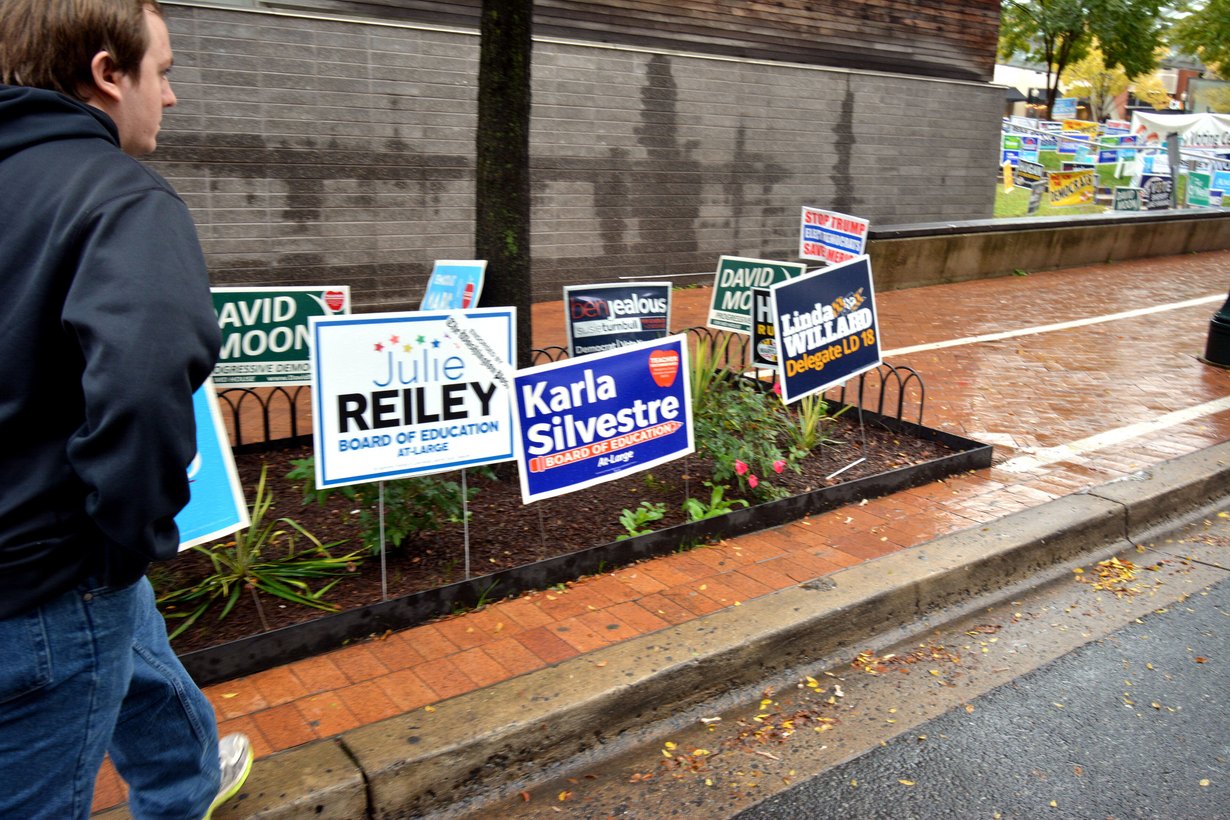
Featured image: A voter walks past campaign signs outside an early voting site in Takoma Park, Maryland. Photo: Edward Kimmel / Wikimedia Commons, CC BY-SA 2.0.