

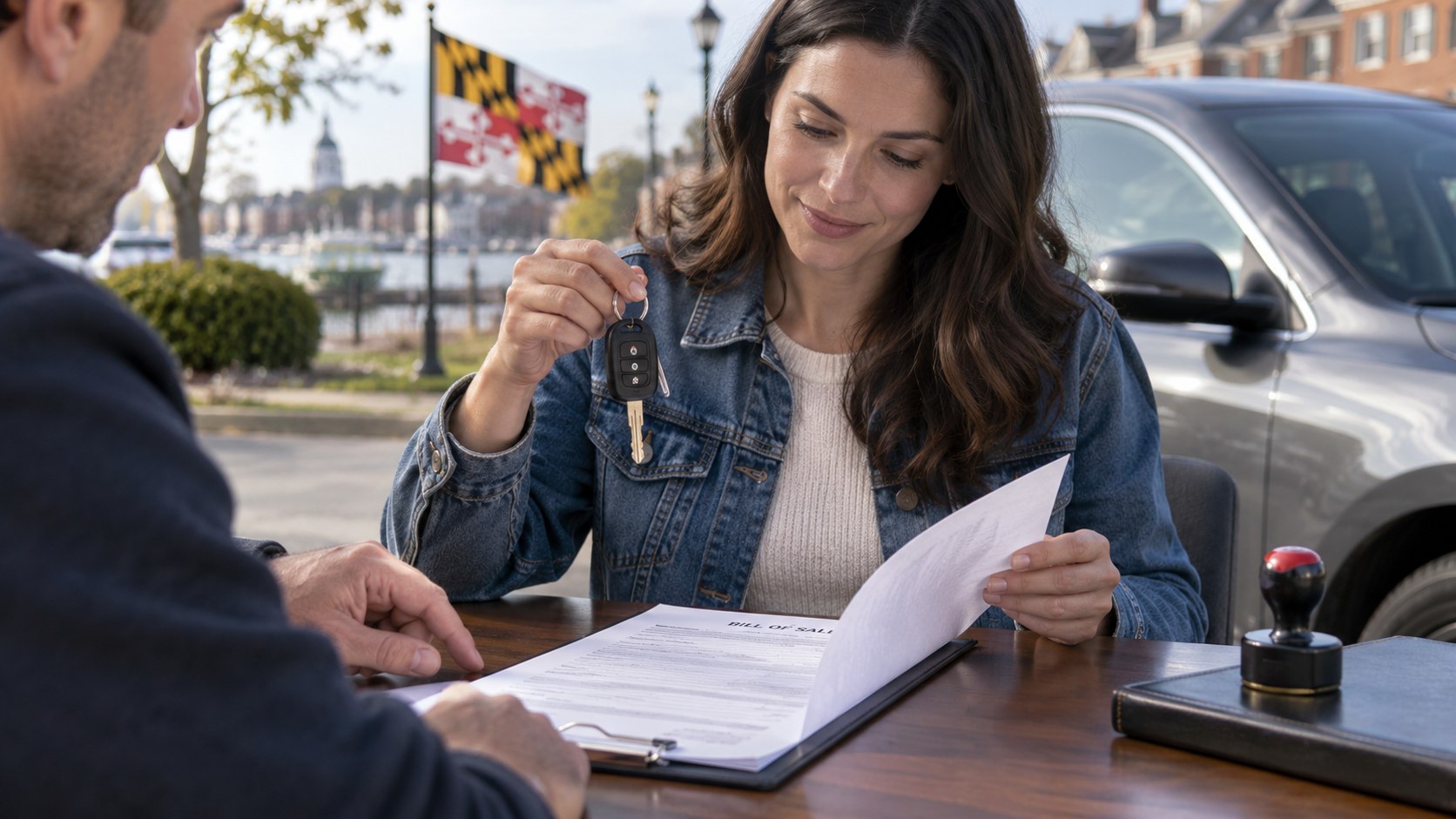
Maryland used car private sale rules became simpler on October 1, 2026. Buyers no longer automatically need a notarized bill of sale for qualifying transactions. The change affects private sales of vehicles less than 7 years old. However, the price reported to the state still matters for taxes, according to Baltimore Chronicle.
The change comes from House Bill 251 and Senate Bill 125. Both measures removed the previous notarization requirement. The new rule took effect on October 1, according to the Maryland General Assembly.
How Maryland calculates tax on a private used car sale
The Maryland Motor Vehicle Administration compares the reported purchase price with the vehicle’s assessed market value.
The agency uses a national used-car valuation publication adopted by the state. MVA guidance refers to the NADA clean retail value when determining vehicle value.
For many private transactions, the calculation now works as follows:
- A price within $500 of the vehicle value can generally be used for taxation.
- A price more than $500 below that value can trigger additional review.
- The buyer may accept taxation based on the state’s vehicle value.
- The buyer can instead provide evidence supporting the lower purchase price.
The change removes paperwork, but it does not remove MVA scrutiny of unusually low sale prices. Buyers should therefore keep records from the transaction.

What documents can support a lower sale price?
The Maryland MVA says supporting evidence may be requested when the reported price is unusually low.
Useful records can include:
- a bill of sale;
- evidence describing the vehicle’s condition;
- financial records showing the payment;
- the original vehicle advertisement;
- messages or other communications with the seller.
These records can explain why a car sold below its standard market valuation. Damage, mechanical problems or other condition issues may affect the actual sale price.
What happens if MVA cannot determine the vehicle value?
Some transactions will still require manual review. An MVA agent may examine the case when a valuation cannot be determined.
The same applies when the buyer disputes the value generated by the system. Supporting documentation may then become especially relevant.
For buyers, the practical rule is straightforward. A notarized document is no longer automatically required, but transaction records remain worth keeping.
Earlier we wrote about New Maryland gun laws take effect: What changes for police, gun dealers and buyers