


How to remove someone from a mortgage in USA usually comes down to 3 practical routes: refinance the loan, obtain a lender-approved assumption, or pay off the mortgage. A quitclaim deed can change ownership on the deed, but it normally does not remove a borrower from the mortgage debt. Most cases take several weeks because the lender must review income, credit, ownership, and loan terms, as the Baltimore Chronicle notes.
If a divorce, separation, inheritance, or ownership change is forcing a decision, contact the mortgage servicer before signing a deed. Ask whether the loan permits an assumption and whether a formal release of liability is available. If not, refinancing into the remaining owner’s name is usually the cleanest option.
Key takeaways
- Removing a name from the deed does not automatically remove that person from the mortgage or promissory note.
- Refinancing replaces the existing loan and is often the most direct way to release a co-borrower.
- FHA and some VA loans may be assumable, but lender approval and formal liability release still matter.
The distinction is important. A mortgage loan creates a debt obligation, while a deed establishes ownership of the property. Those documents can change separately.
The safest result is not simply getting a name off the deed. It is obtaining written confirmation that the departing borrower no longer owes the mortgage.
What you need before contacting the lender
Before requesting a mortgage removal after divorce or another ownership change, collect the documents a lender is likely to request. Having them ready can prevent repeated requests and delays.
You will commonly need:
- your latest mortgage statement and loan number;
- government-issued identification;
- recent pay stubs or other income records;
- recent bank or asset statements;
- a divorce decree or separation agreement, when applicable;
- the current deed and property details;
- homeowners insurance information;
- authorization from the other borrower when required.
Budget for possible lender, appraisal, title, recording, and closing expenses. Costs vary significantly by lender and county in 2026. A refinance can involve substantially more expense than recording a deed because it creates an entirely new loan.
The remaining borrower must generally prove that the mortgage is affordable without the departing borrower’s income. Credit history and existing debts can also affect approval. A strong payment record on the existing mortgage does not guarantee that a refinance or assumption will qualify.
For broader housing coverage, Baltimore Chronicle readers can also follow the site’s real estate and housing reporting. Homeowners comparing borrowing options may also find its mortgage and refinancing coverage useful.
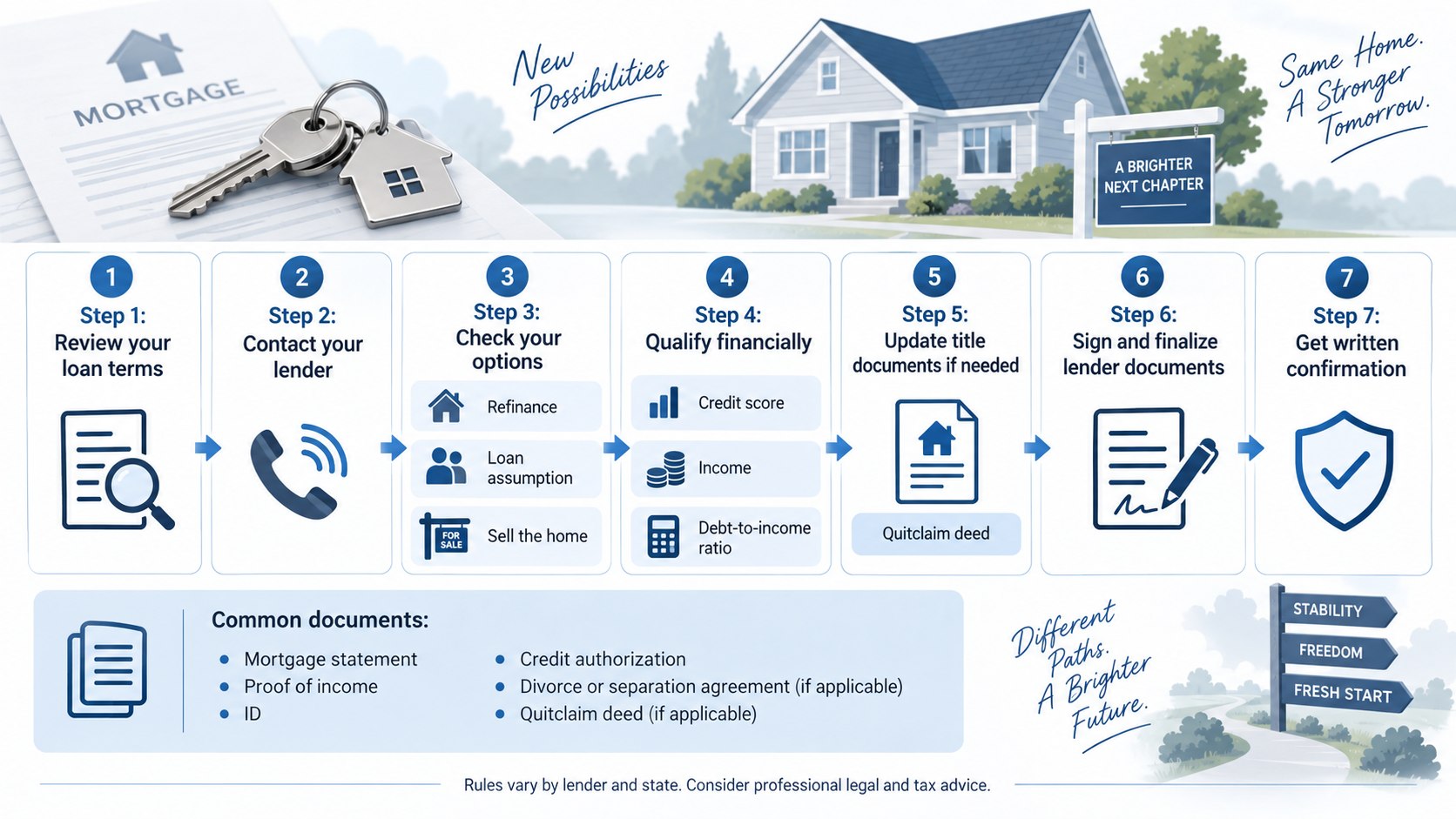
Step 1: Confirm whether you need to change the mortgage, deed, or both
Start by checking whose names appear on the promissory note, mortgage or deed of trust, and property deed. These documents do different jobs.
A person can sometimes appear on the deed without being obligated on the mortgage note. The reverse structure can also occur depending on how the transaction was established.
The common mistake is assuming a signed quitclaim deed solves everything. It may transfer an ownership interest while leaving the departing borrower responsible for the existing loan.
Why does that matter? If future payments are missed, a borrower who remains obligated may face collection activity and credit damage even after giving up ownership.
Ownership can be transferred with a deed, but mortgage liability generally changes only through the lender or by satisfying the existing debt.
Step 2: Ask the servicer whether the loan can be assumed
A mortgage assumption allows an approved borrower to take responsibility for an existing mortgage instead of replacing it with a new loan. Whether this option exists depends heavily on the loan program and mortgage documents.
HUD states in its FHA Single Family Housing Policy Handbook that FHA-insured mortgages are assumable, subject to applicable requirements. For many modern FHA loans, the lender evaluates the proposed assuming borrower and handles the liability-release process. The current HUD FHA guidance explains those rules.
VA-backed loans may also support assumptions under applicable VA requirements. Borrowers should discuss both assumption approval and release of liability with the servicer rather than treating them as the same event.
Conventional mortgages can be more restrictive. Ask the servicer directly whether the loan has an assumption provision and what qualification process applies.
The common mistake is transferring the property privately and continuing payments without formal lender approval. That arrangement may leave the original borrower exposed to the debt.
Step 3: Compare assumption with refinancing
If assumption is unavailable, refinance to remove a borrower is usually the next option. The remaining owner applies for a new mortgage in their own name, and the proceeds pay off the old loan.
The important question is whether that person qualifies alone. The lender may examine credit, income, employment, assets, debt obligations, property value, and other underwriting factors.
Here is how the main approaches differ.
| Method | Changes mortgage liability? | Changes ownership? | New underwriting likely? | Main limitation |
|---|---|---|---|---|
| Refinance | Yes, after old loan payoff | Can be coordinated at closing | Yes | New rate and closing costs |
| Approved assumption | Potentially, with formal release | Usually coordinated with transfer | Usually | Loan must permit assumption |
| Quitclaim deed | No, by itself | Yes | Usually no | Departing owner may still owe loan |
| Sell the property | Yes, after mortgage payoff | Yes | Buyer qualifies separately | Requires a sale |
| Pay loan in full | Yes | Not automatically | No | Requires sufficient funds |
The options can produce very different financial outcomes. A homeowner with a low existing interest rate may prefer an assumption when the loan permits one. Refinancing can be simpler structurally, but the replacement loan uses current terms.
A quitclaim deed is inexpensive compared with a full refinance in many jurisdictions, but price is not the main issue. It solves a title problem, not necessarily a debt problem. County recording requirements and charges differ throughout the United States.
Selling the property is another clean solution when neither person can qualify independently. The mortgage is paid through closing, and remaining equity is distributed according to ownership rights and applicable agreements.
The common mistake is selecting an option based only on paperwork cost. Long-term liability and borrowing capacity can matter far more.
Step 4: Apply in the remaining borrower’s name
For a refinance, the person keeping the home applies much like any other mortgage borrower. The lender may request updated documentation throughout underwriting.
Do not assume the existing property’s history eliminates qualification requirements. The lender is evaluating whether one borrower can support the replacement mortgage.
The process typically includes:
- submitting the mortgage application;
- authorizing credit and income verification;
- providing requested financial records;
- completing an appraisal if required;
- reviewing the lender’s disclosures;
- clearing underwriting conditions;
- signing the new loan and title documents.
Changes in income or new debt during underwriting can create problems. Financing a vehicle or opening a large credit account before closing can alter the applicant’s debt profile.
The same principle applies to an assumption. Approval is not complete merely because both current borrowers agree to the change.
For homeowners comparing the financial consequences of keeping versus selling a property, related US homeownership coverage can provide useful context.
Step 5: Use a quitclaim deed only for its intended purpose
A quitclaim deed and mortgage address different legal relationships. The deed transfers whatever ownership interest the signer holds, subject to state requirements.
Suppose 2 former spouses own a home together and both signed the mortgage. One signs a quitclaim deed giving the other full ownership. Unless the lender also removes that borrower from the debt, both names can remain tied to the mortgage obligation.
That creates an obvious imbalance. The departing person may no longer own part of the house but can still carry responsibility for its loan.
A quitclaim deed may still be part of a properly structured transaction. It is often coordinated with refinancing, assumption, divorce orders, estate planning, or settlement arrangements.
Do not record a deed simply because someone says it will “take your name off the house.” State property rules differ, and transferring ownership can affect legal and financial rights.
The common mistake is signing first and dealing with the lender afterward. The sequence should be coordinated with the mortgage servicer and, when appropriate, a qualified real estate attorney or title professional.
Step 6: Get a formal release of liability
This step is easy to overlook during a mortgage assumption process. Approval to transfer or assume the loan does not always mean the former borrower has automatically received the necessary liability release.
HUD’s FHA guidance specifically distinguishes assumption processing from formal release procedures. Borrowers should request written documentation showing that the departing borrower has been released when the program permits it.
VA borrowers face similar concerns. The Department of Veterans Affairs explains assumption procedures and liability issues in its VA home-loan guidance.
A change in who owns the home should not be treated as proof that a lender released someone from the loan.
The practical rule is simple: keep the lender’s written release with the closing documents. A verbal statement from a representative is not a substitute for formal records.
The common mistake is stopping when the deed records successfully. Check the loan documentation as carefully as the county property record.
Step 7: Verify the mortgage and title after closing
Once the refinance, assumption, sale, or payoff is completed, check the final paperwork rather than assuming every database updated correctly.
Confirm the new loan documents identify the expected borrower. Review the recorded deed to confirm ownership was transferred as intended. Save payoff statements, assumption approvals, release documents, and closing disclosures.
Credit reports may also need time to reflect the changed account status. If an old mortgage continues to appear incorrectly, use the documentation from closing when contacting the servicer or credit bureau.
A divorce decree deserves special attention. A court order can allocate responsibility between former spouses, but the lender’s contractual rights depend on the mortgage documents and applicable law.
The common mistake is discarding records once the transaction closes. Keep permanent copies of documents proving both ownership and debt changes.
Troubleshooting common mortgage-removal problems
Several problems appear repeatedly when borrowers try to change a mortgage after divorce or another ownership change.
- The remaining borrower cannot qualify alone. Consider an approved assumption, sale, additional time to improve finances, or another arrangement permitted by the lender.
- The loan has a very low interest rate. Ask whether assumption is available before refinancing into a different 2026 rate.
- One co-borrower refuses to cooperate. Review any court order or property agreement and obtain legal advice before attempting a transfer.
- A quitclaim deed was already recorded. Contact the servicer immediately to determine who remains contractually liable for the loan.
- The lender approved an assumption but liability is unclear. Request written confirmation identifying exactly which borrowers were released.
These situations require different solutions because title and debt are separate. A lender focuses on the mortgage contract, while a county land record focuses on ownership.
Divorce can add another layer because family-court obligations exist alongside mortgage documents. An order requiring one spouse to make payments does not necessarily rewrite the lender’s contract.
Property law also varies by state. Procedures in California, Texas, Florida, Maryland, and New York can differ regarding deeds, marital interests, recording, and other issues.
Mortgage-servicing procedures can also differ between companies. Ask for the lender’s requirements in writing before paying nonrefundable third-party expenses.
When a transaction involves disputed ownership, significant equity, or unclear court language, professional legal review may be worth the cost.

What removing someone from a mortgage can cost in 2026
There is no single national price for removing a borrower. The method determines most of the expense.
A quitclaim deed may involve document-preparation and county recording charges. Those charges depend on local rules. An assumption can involve lender processing and third-party costs permitted by the loan program.
A refinance is usually broader because it creates a replacement mortgage. Potential expenses can include appraisal, title work, lender charges, recording fees, prepaid taxes, insurance, and other closing items.
Request a written estimate before deciding. Compare the immediate cost with the cost of keeping an unwanted borrower tied to the mortgage.
The existing interest rate matters too. Replacing an older mortgage with a new loan can change monthly payments even if the principal balance barely changes.
For that reason, an assumption deserves serious consideration when it is legally available and the remaining borrower qualifies.
FAQ
Can you remove someone from a mortgage without refinancing?
Yes, sometimes. An approved loan assumption with a formal release of liability may remove a borrower without replacing the mortgage. Availability depends on the loan type and lender requirements.
Does a quitclaim deed remove someone from a mortgage?
No. A quitclaim deed generally changes ownership rights, not the contractual obligation created by the mortgage note.
Can a spouse be removed from a mortgage after divorce?
Potentially. The most common paths are refinancing, lender-approved assumption, selling the property, or paying off the loan. A divorce decree alone generally does not replace the lender’s loan documents.
What happens if one borrower cannot qualify for a refinance?
The owners can ask whether the mortgage is assumable. If that is unavailable, options may include selling the home or delaying the transfer while resolving qualification issues.
How long does it take to remove a person from a mortgage?
Timing depends on the method, servicer, underwriting, appraisal needs, and title work. A refinance or assumption can take several weeks, while more complicated ownership disputes may take longer.
Is removing someone from the deed enough?
No. Check both the deed and the mortgage obligation. A person who gives up ownership can still remain liable for the debt unless the lender releases them or the loan is paid off.
Earlier we wrote about How to Switch Cellular Carriers Without Losing Your Number in 2026: Porting and eSIM Guide