


What is a HELOC and how does it work? A home equity line of credit is a revolving credit account secured by your home, letting you borrow against available equity when needed. Unlike a lump-sum home equity loan, a HELOC usually has a draw period followed by repayment. That distinction matters in 2026 because most HELOC rates are variable, and borrowing costs can change while the account remains open, as noted by Baltimore Chronicle.
For a homeowner considering renovations, emergency expenses, or several large bills spread across 2 or 3 years, a HELOC can offer flexibility. The tradeoff is serious: the house secures the debt. Before signing, compare the index, lender margin, rate cap, draw-period payment formula, fees, and what happens when repayment begins.
Key takeaways
- A HELOC lets homeowners borrow repeatedly against available equity during a defined draw period rather than receiving one lump sum.
- Most HELOCs use variable rates, so a comfortable payment in 2026 can change when the underlying benchmark moves.
- The biggest payment shock can arrive after the draw period, when borrowing stops and principal repayment becomes mandatory.
Those 3 points separate a HELOC from an ordinary personal loan. Flexibility is its main attraction, but that flexibility also makes future borrowing costs less predictable. A homeowner should therefore test payments at a higher rate before accepting a credit line.
It also helps to distinguish the credit limit from the amount actually borrowed. Interest generally applies to the outstanding balance, not the entire unused line. A $100,000 HELOC with only $20,000 drawn is therefore very different from immediately borrowing the full $100,000.
Borrowers comparing other ways to fund property expenses can also review Baltimore Chronicle coverage of home financing options for US homeowners and housing costs and mortgage planning.
In plain English
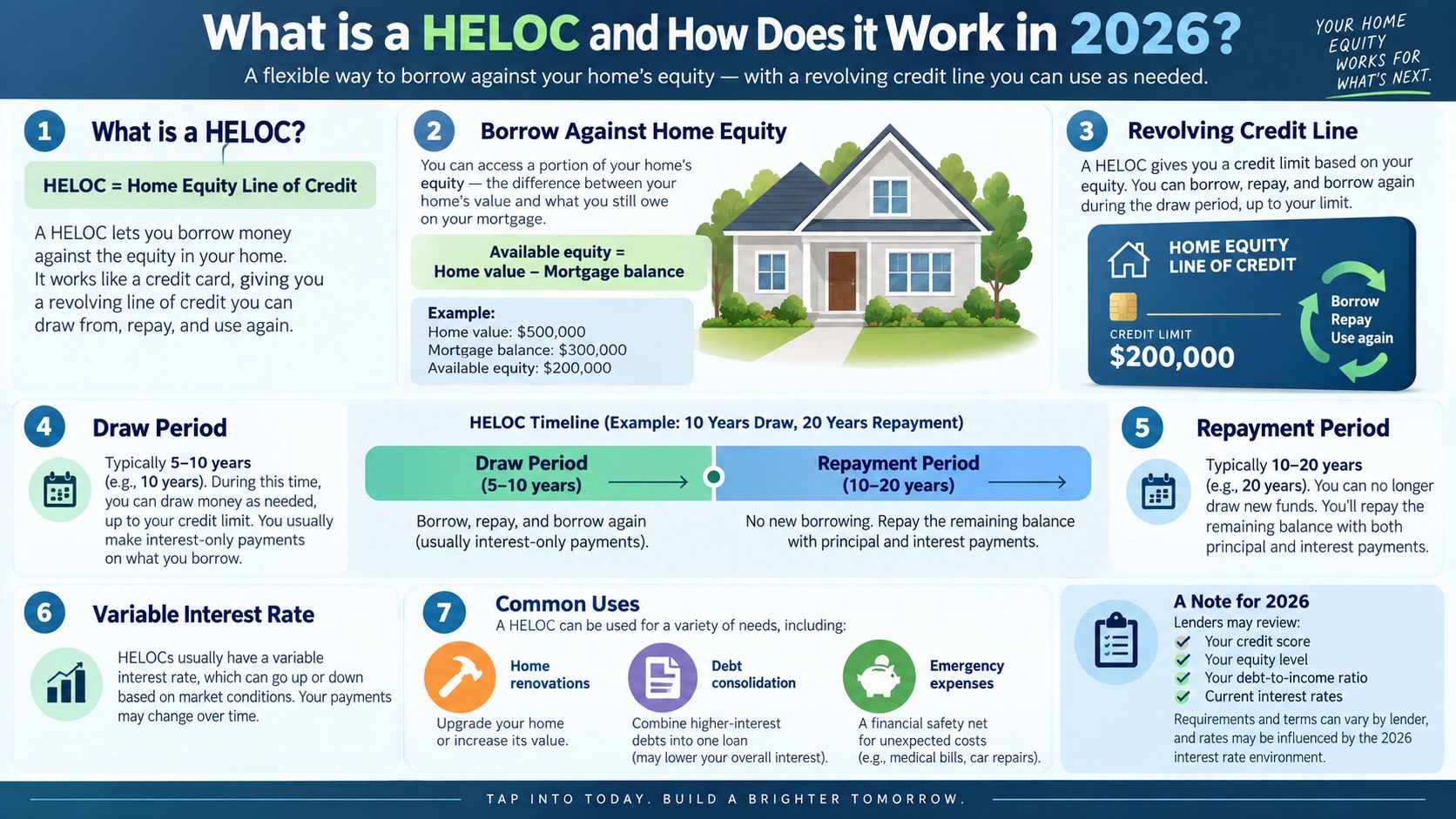
Think of a HELOC as a credit card attached to part of your home’s equity. A lender approves a maximum line, but the homeowner decides how much to draw within the agreement’s rules.
Suppose a house is worth $500,000 and the remaining mortgage balance is $300,000. The homeowner has $200,000 in gross equity. That does not mean a lender will offer a $200,000 line. The lender applies its own combined loan-to-value limits, underwriting standards, income tests, credit requirements, and property valuation.
Home equity is the starting point for the calculation, not a guarantee of how much cash a lender will make available.
A HELOC differs from a credit card in one critical respect. The collateral is real estate. According to the Consumer Financial Protection Bureau, failure to repay can ultimately put the home at risk.
How it actually works
A typical home equity line of credit has 2 major stages. First comes the draw period. Then comes the repayment period.
1. The lender sets the credit line
The lender reviews the home’s value, existing mortgage debt, income, credit profile, and other obligations. An appraisal or another property valuation method may be required. Some lenders also charge closing, appraisal, annual, early-closure, or other account fees.
The approved amount is the maximum line, not necessarily money that must be borrowed immediately. This distinction makes HELOCs useful for projects with uncertain costs, such as a kitchen renovation completed in several stages.
2. The draw period begins
The HELOC draw period is the time when funds can be borrowed, repaid, and sometimes borrowed again. A 10-year draw period is common in the market, although individual products vary.
During this phase, minimum payments depend on the lender’s contract. Some plans permit relatively low payments based mainly on interest. Others require principal as well. Borrowers should never assume that the minimum payment shown during the draw period will continue later.
3. Interest is charged on the balance
Most HELOCs have an adjustable rate. The contract typically combines a publicly available index with a lender margin.
For context, the US bank prime rate was 7.00% for the week ending September 23, 2026, according to Federal Reserve data published through FRED. A particular HELOC can price above or otherwise relative to that benchmark according to its contract. The actual APR offered depends on lender terms and borrower qualifications.
A HELOC rate should be evaluated as a formula, not merely as the introductory number printed on an advertisement.
4. The draw period ends
Once the draw period expires, new borrowing usually stops. The remaining balance moves into repayment under the agreement.
This is where some homeowners encounter a payment increase. Principal that was not aggressively reduced during the draw period must now be repaid. The CFPB notes that repayment periods may last years, while certain contracts can require much faster repayment.
“Monthly payments are often significantly higher once you enter repayment.”
Consumer Financial Protection Bureau, consumer guidance on home equity lines of credit.
HELOC rates in 2026 and why the draw period matters
HELOC rates in 2026 deserve more attention than a single advertised APR. A variable-rate HELOC can become more expensive after opening because the index may change. The lender’s margin, meanwhile, generally follows the contract.
The most useful comparison therefore looks beyond the starting rate. Before applying, homeowners should collect the following terms from each lender:
- The rate index and current index value.
- The lender margin added to that index.
- Any introductory rate and its expiration date.
- Periodic and lifetime rate caps.
- The draw-period payment formula.
- The repayment term after draws stop.
- Annual, appraisal, closing, conversion, or early-closure fees.
A low introductory rate can be useful, but only when its expiration is understood. The permanent pricing formula usually matters more over a multi-year borrowing period.
Rate caps also deserve close reading. They define how far or how quickly an adjustable rate may move under the contract. The payment formula is equally important because 2 HELOCs with similar APRs can produce different minimum payments.
Homeowners should ask whether part of the variable balance can later convert to a fixed rate. Some lenders provide this feature, although conversion terms and charges differ. Baltimore Chronicle readers comparing renovation budgets can also use this guide to planning major home improvement costs before deciding how much credit to request.
HELOC versus home equity loan
The names sound similar, but the borrowing structure is different. A home equity loan generally delivers a lump sum, while a HELOC offers reusable credit during the draw period.
| Feature | HELOC | Home equity loan |
|---|---|---|
| How money arrives | Draw funds when needed, within the available limit | Lump sum at closing |
| Typical rate structure | Usually variable | Often fixed |
| Best suited to | Costs occurring at different times | Known one-time expense |
| Payment predictability | Lower when rates vary | Usually higher with a fixed rate |
| Collateral | Home | Home |
A homeowner replacing a roof with a firm $28,000 contract may prefer the certainty of a lump-sum product. Someone remodeling 3 rooms over 18 months may value a revolving line more.
The comparison should not stop at the monthly payment. Closing costs, unused-line fees, rate adjustments, repayment terms, and early account closure charges can change the total cost.
Both products use home equity as collateral. That makes them fundamentally different from unsecured personal loans. A lower borrowing rate does not eliminate the consequences of missed payments.
It is also possible to keep an existing first mortgage while adding a HELOC. In that situation, the homeowner has another required debt payment alongside the original mortgage.
Who it matters to in 2026
Homeowners planning phased renovations
A HELOC can fit a project where contractors are paid at several milestones. Borrowing only when invoices arrive may prevent interest from accumulating on money that is not yet needed.
Tax treatment requires care. The IRS states that HELOC interest may qualify for a mortgage-interest deduction when proceeds meet applicable rules and are used to buy, build, or substantially improve the home securing the debt. Personal spending does not receive the same treatment.
Owners with large but irregular expenses
A household may want access to liquidity without taking the entire amount upfront. Examples include major repairs or costs spread across several months.
That flexibility should not turn home equity into routine spending money. Using secured debt for short-lived purchases can leave the homeowner repaying those expenses long after their value disappears.
Borrowers approaching the end of an existing draw period
This group faces a different problem. The important question is no longer how much can be borrowed, but what the upcoming repayment payment will be.
Several months before the draw period ends, review the outstanding principal, remaining term, expected rate, and lender’s repayment formula. That gives time to increase principal payments or evaluate alternatives before the payment changes.
A $50,000 HELOC example
Consider a homeowner approved for a $100,000 line who draws $50,000 for renovation work. The credit limit is $100,000, but interest is based on the amount actually outstanding under the contract.
The example below illustrates why rate changes matter. It uses simple interest-only calculations for comparison and does not represent a specific lender offer.
| Outstanding balance | Illustrative annual rate | Approximate monthly interest |
|---|---|---|
| $50,000 | 7% | $292 |
| $50,000 | 8% | $333 |
| $50,000 | 9% | $375 |
| $50,000 | 10% | $417 |
The difference between 7% and 10% is about $125 monthly on a $50,000 balance in this simplified example. Actual required payments can differ because lenders use their own formulas.
Once principal repayment begins, the required payment may be materially higher than the interest-only figures shown above. A borrower should therefore calculate 2 budgets: one for the draw period and another for repayment.
Testing a higher-rate scenario is also useful. If an additional 2 or 3 percentage points would make the payment unmanageable, the credit line may be too large for the household budget.
Borrowers should also examine whether the lender can freeze or reduce access under circumstances permitted by law and the agreement. An unused credit limit should not be treated as guaranteed emergency cash forever.

Common myths about HELOCs
Several assumptions cause homeowners to underestimate the obligations attached to a revolving home-equity line.
- Myth: A HELOC is free money from home equity. It is secured debt that must be repaid with interest.
- Myth: The opening rate stays forever. Most HELOCs use variable pricing, so the rate can change.
- Myth: Payments stay similar after the draw period. Repayment can require substantially larger monthly payments.
- Myth: Every dollar of HELOC interest is tax deductible. Deductibility depends on how proceeds are used and tax rules.
- Myth: An approved line can always be drawn in full later. Access may be restricted under certain contractual and regulatory conditions.
The underlying theme is simple: flexibility does not remove lending risk. It changes when and how that risk appears.
A HELOC works best when the borrower has a defined purpose, a repayment plan, and enough income margin for rate changes. The weakest use case is borrowing simply because home equity is available.
Before closing, read the disclosures rather than relying on an online payment estimate. The draw period, index, margin, caps, minimum-payment formula, and repayment phase determine the practical cost.
Homeowners should also preserve copies of contracts, closing disclosures, and records showing how funds were spent. Those records can matter when reviewing taxes or resolving questions about the account later.
FAQ about HELOCs in 2026
How long is a HELOC draw period?
Terms vary by lender, but a draw period may last around 10 years. The agreement controls the actual term. After it ends, new withdrawals usually stop and repayment begins.
Does a HELOC have a fixed interest rate?
Usually not. Most HELOCs carry variable rates linked to an index plus a lender margin. Some products permit borrowers to convert part of the balance to a fixed-rate segment.
What happens if HELOC rates rise?
A higher variable rate generally increases interest expense and may increase the required monthly payment. The effect depends on the outstanding balance and payment formula.
Can I pay off a HELOC during the draw period?
Generally, borrowers can reduce principal during the draw period, but specific account rules apply. Some lenders impose early-closure charges or other conditions, so the agreement should be checked first.
Is HELOC interest tax deductible in 2026?
It can be under applicable federal rules when qualifying proceeds are used to buy, build, or substantially improve the home securing the debt. Personal expenses do not automatically qualify. Taxpayers should verify current IRS requirements for their circumstances.
Is a HELOC risky?
Yes. The debt is secured by the home, and variable rates can increase borrowing costs. The most important test is whether payments remain affordable after both a rate increase and the transition into repayment.
Earlier we wrote about How to Cancel Washington Post Digital 2026: Phone Support, Retention Offers and the Steps That Stop Renewal