


30 year vs 15 year mortgage usa 2026 comes down to one basic trade-off. A 30-year loan keeps the required payment lower, while a 15-year mortgage can cut lifetime interest sharply. Most buyers should consider 30 years when monthly flexibility matters. A 15-year term fits borrowers who can comfortably handle a much higher payment, as the Baltimore Chronicle editorial team notes.
Using Freddie Mac averages published on September 10, 2026, a $400,000 loan at 6.76% costs about $2,597 per month for principal and interest over 30 years. At the 15-year average of 6.09%, the payment rises to about $3,395. That is roughly $798 more every month, but the lifetime interest difference exceeds $323,000 if both loans remain in place until maturity.
Key takeaways
- A 30-year mortgage lowers the required monthly payment and leaves more room for savings, repairs, childcare, and other expenses.
- A 15-year mortgage usually comes with a lower rate and builds equity faster, but demands considerably more monthly cash.
- Compare official Loan Estimates instead of headline rates because points, lender fees, credit history, and property type affect the real cost.
At a glance
The main differences become clearer when both loans use the same $400,000 balance. The figures below exclude property taxes, homeowners insurance, HOA dues, and mortgage insurance.
| Factor | 30-year fixed mortgage | 15-year fixed mortgage |
|---|---|---|
| Freddie Mac average, Sept. 10, 2026 | 6.76% | 6.09% |
| Example loan | $400,000 | $400,000 |
| Approx. principal and interest | $2,597/month | $3,395/month |
| Approx. lifetime interest | $534,939 | $211,083 |
| Payoff period | 360 payments | 180 payments |
| Equity buildup | Slower | Faster |
| Monthly flexibility | Higher | Lower |
| Typical rate | Higher | Lower |
| Best fit | Cash-flow-focused households | High-income, low-debt households |
These figures show why 30 year vs 15 year mortgage rates cannot be judged by the rate alone. The shorter loan saves money partly because borrowers repay principal much faster.
The 30-year option leaves almost $800 more in monthly cash flow in this example. That money may cover retirement contributions, medical expenses, home repairs, or other priorities. A 15-year borrower directs much more of that cash toward the mortgage.
The cheapest loan over its full lifetime is not automatically the safest choice for a household budget.
Freddie Mac’s Primary Mortgage Market Survey reported averages of 6.76% for 30-year loans and 6.09% for 15-year loans on September 10, 2026. Individual offers may differ based on credit score, points, loan size, occupancy, and lender pricing.
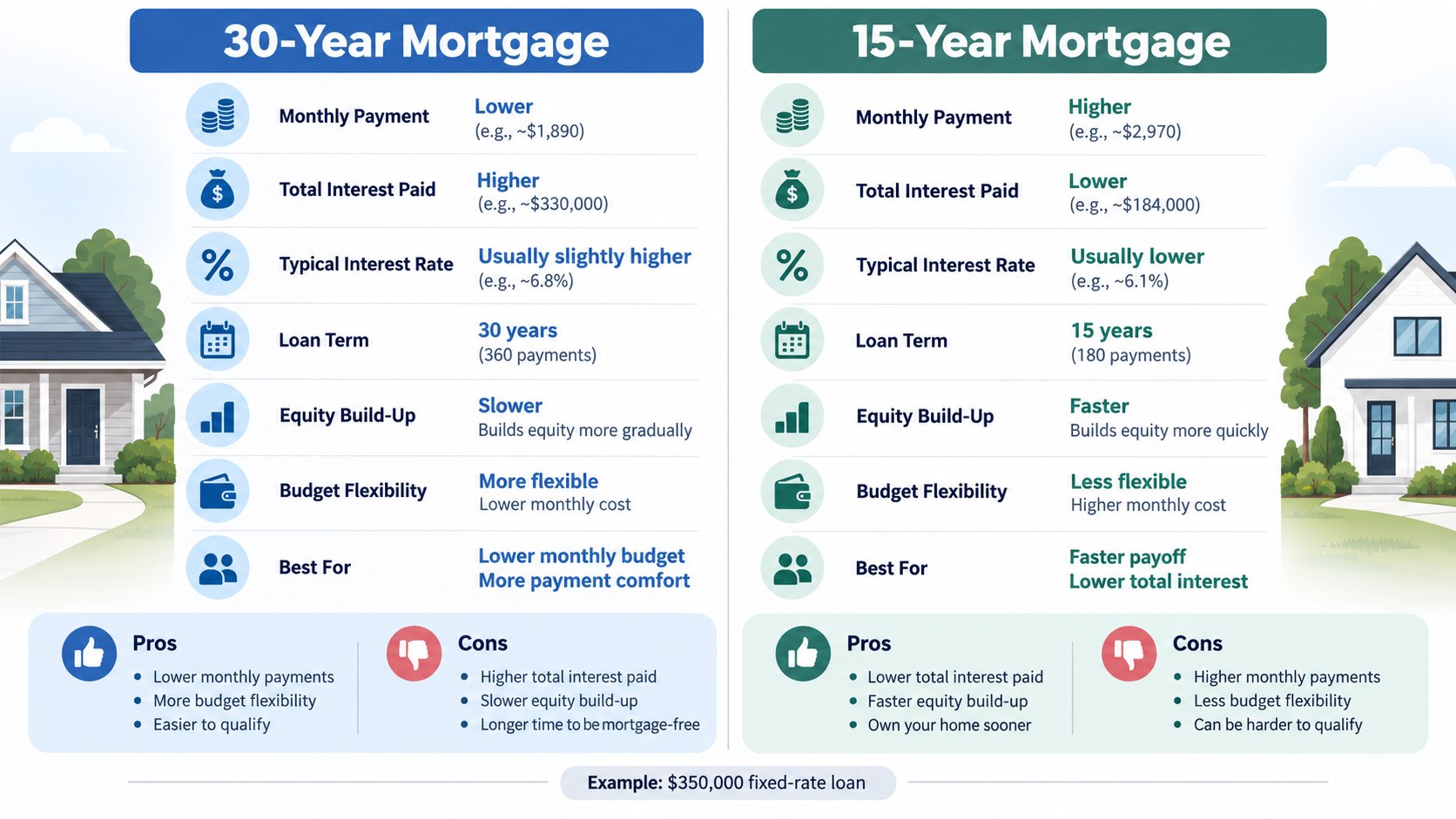
30 Year vs 15 Year Mortgage USA 2026 and the rate gap
The interest-rate difference matters, but loan duration has an even larger effect. A borrower is not only comparing 6.76% with 6.09%. The debt may also remain outstanding for twice as long.
On the $400,000 example, the 30-year borrower pays roughly $934,939 in principal and interest across the scheduled term. The 15-year borrower pays about $611,083.
Those figures assume no refinancing, home sale, extra principal payments, or changes to the original loan. Any of those events can change the final cost.
“Shorter loan terms generally save you money overall, but have higher monthly payments.”
Consumer Financial Protection Bureau, mortgage loan guidance.
The CFPB recommends comparing official Loan Estimates when choosing between mortgage terms. Borrowers can review its mortgage shopping guidance before selecting a lender.
A borrower with weaker credit may see a different rate gap from the national average. Buyers preparing for financing can also review Baltimore Chronicle’s guide to buying a house with bad credit in 2026.
The 30-year mortgage: lower payment and more flexibility
A 30 year fixed mortgage 2026 remains attractive because it reduces the mandatory monthly payment. That can matter when housing costs compete with insurance, property taxes, student loans, car payments, and family expenses.
Consider a household earning $110,000 per year before taxes. An additional $798 in monthly mortgage payments equals $9,576 annually. Choosing the longer term can preserve a sizable financial buffer.
The main advantages include:
- lower required principal-and-interest payments;
- more room for emergency savings;
- greater flexibility when income changes;
- easier adjustment to higher insurance or property-tax bills;
- the ability to make extra principal payments when cash flow allows.
These factors can be especially important for freelancers, commission-based workers, and households paying for childcare. A mortgage payment remains due even during a weaker income month.
The longer term may also appeal to buyers in expensive markets such as California, New York, Maryland, Massachusetts, and Washington. Large mortgage balances make the payment gap between 15-year and 30-year financing more visible.
The downside is straightforward. Paying only the scheduled amount creates slower equity growth and considerably more lifetime interest.
Borrowers should also plan for costs beyond financing. Baltimore Chronicle’s guide to title insurance costs and coverage explains another expense that may appear at closing.
Choosing a 30-year mortgage does not mean the borrower must keep the debt for 30 years.
Extra principal payments can shorten the payoff period when the loan terms allow them. This gives homeowners a lower required payment while preserving the option to accelerate repayment during stronger financial years.
The 15-year mortgage: higher payment and lower lifetime cost
A 15 year mortgage payment can look expensive beside a 30-year quote. The higher payment is also the reason principal falls much faster.
With the $400,000 example, the difference is about $798 per month. The loan also disappears 15 years earlier when both mortgages follow their original schedules.
A 15-year term often makes the most sense for borrowers with stable income, low consumer debt, strong emergency savings, and enough room in the budget for retirement contributions. It can also suit homeowners refinancing a smaller remaining balance.
The main advantages are easy to identify:
- Principal falls faster from the first years of repayment.
- The interest rate is usually lower than on a comparable 30-year mortgage.
- Lifetime interest can be dramatically lower.
- Home equity builds more quickly.
- The mortgage ends much sooner.
The fifth point comes with a cost. The required monthly payment is substantially higher.
Saving interest offers little benefit if the payment forces a household to rely on credit cards or stop building emergency reserves. Homeowners still need money for roofing, HVAC systems, plumbing, insurance deductibles, and unexpected repairs.
Military borrowers face another set of financing choices. Baltimore Chronicle’s guide to VA loan eligibility requirements for 2026 explains service rules and Certificate of Eligibility requirements.
“Shopping around for the best mortgage rate and getting multiple quotes can potentially save them thousands.”
Freddie Mac, September 2026 mortgage-rate release.
Monthly payment versus total interest
The most useful comparison begins with household cash flow rather than the largest mortgage a lender approves. Approval means a loan meets underwriting standards. It does not guarantee that the payment fits every personal financial goal.
A $400,000 loan illustrates the difference clearly.
| Budget impact | 30-year at 6.76% | 15-year at 6.09% |
|---|---|---|
| Monthly principal and interest | $2,597 | $3,395 |
| Annual principal and interest | $31,165 | $40,739 |
| Monthly difference | Baseline | +$798 |
| Annual difference | Baseline | +$9,574 |
| Approx. total interest | $534,939 | $211,083 |
| Approx. interest saved with 15-year | — | $323,855 |
The figures explain 15 vs 30 year mortgage total interest better than rate percentages alone. The 15-year option requires much more cash now but sharply reduces long-term borrowing costs.
The calculation still excludes taxes and insurance. A $3,395 principal-and-interest payment can become much larger after property taxes, homeowners insurance, HOA charges, and mortgage insurance.
Those costs vary significantly by location. A homeowner in Texas may face a different property-tax burden from a buyer in Florida, Maryland, or California.
Borrowers should therefore calculate the full housing payment before choosing a term. Lenders can provide both 15-year and 30-year Loan Estimates for the same property, loan amount, and down payment.
The practical question is not only how much the shorter loan saves, but whether the higher payment remains comfortable every month.
How to compare real mortgage offers
National averages are useful benchmarks, not personalized quotes. Mortgage pricing can vary between lenders on the same day.
For a fair comparison, keep the loan amount, down payment, lock period, and loan type consistent. Then review:
- interest rate;
- APR;
- lender fees;
- discount points;
- monthly principal and interest;
- mortgage insurance;
- cash required at closing;
- the five-year borrowing cost shown on the Loan Estimate.
A zero-point 30-year mortgage should not be compared directly with a 15-year offer that requires expensive discount points. The lower advertised rate may require thousands of dollars upfront.
Banks, credit unions, mortgage brokers, and large national lenders may quote different terms to the same borrower. Multiple quotes make those differences easier to identify.
A mortgage term comparison USA should also consider how long the homeowner expects to keep the property. Lifetime interest becomes less important when the buyer expects to sell after 5 or 6 years.
Refinancing should not be treated as guaranteed. Future rates may be higher or lower, and refinancing usually involves closing costs. A mortgage chosen in 2026 should be affordable without depending on a later refinance.
Which should you buy in 2026
The decision can usually be reduced to a few practical tests. Monthly affordability comes first, followed by savings, debt levels, income stability, and long-term plans.
- If the 15-year payment would weaken emergency savings, a 30-year mortgage provides more flexibility.
- If the 15-year payment remains comfortable after retirement contributions and other obligations, the shorter term can substantially reduce interest.
- If income changes from month to month, a 30-year loan creates a lower mandatory payment.
- If refinancing a modest remaining balance, a 15-year loan may offer a faster payoff schedule.
- If both choices appear affordable, request Loan Estimates for each term and compare total costs.
Another option is to take a 30-year mortgage and voluntarily pay extra principal. This does not reproduce the lower interest rate of a 15-year mortgage.
It can still reduce interest and shorten the payoff period. The advantage is that the borrower keeps the lower contractual payment during financially difficult months.
Borrowers should confirm how their servicer processes additional payments. Extra money should generally be applied to principal rather than treated as an early future payment.

FAQ
Is a 15-year mortgage always cheaper than a 30-year mortgage?
It usually produces lower lifetime interest when both loans remain outstanding for their full scheduled terms. The shorter mortgage also often receives a lower interest rate.
The monthly payment is much higher. Closing costs, points, and individual lender pricing can change the comparison.
How much higher is a 15-year mortgage payment in 2026?
There is no universal percentage. On a $400,000 loan using Freddie Mac averages from September 10, 2026, payments are approximately $3,395 and $2,597.
That is a difference of roughly $798 per month before taxes and insurance.
Can extra payments make a 30-year mortgage similar to a 15-year loan?
Extra principal payments can shorten the repayment period and reduce interest. The 30-year mortgage may still carry a higher interest rate.
Its main advantage is flexibility because the required payment remains lower.
Is a 15-year mortgage better for refinancing?
It can work well when the remaining balance is manageable and the higher payment fits comfortably within the household budget. Homeowners should compare refinancing costs with expected interest savings.
A shorter term should not create a cash-flow problem simply to accelerate payoff.
Should first-time buyers choose a 30-year mortgage?
Many first-time buyers prefer the smaller required payment because homeownership introduces new expenses. Repairs, insurance, taxes, maintenance, and appliance replacement can arrive unexpectedly.
Buyers with strong income and substantial reserves can still consider a 15-year mortgage.
What mortgage rates should borrowers compare in 2026?
Use current quotes from several lenders rather than assuming a national average will apply personally. Freddie Mac reported averages of 6.76% for 30-year mortgages and 6.09% for 15-year mortgages on September 10, 2026.
Earlier we wrote about How to Cancel Grubhub Plus 2026: 7 Steps to Stop the Next $9.99 Charge