


VA loan eligibility requirements 2026 determine whether your military service opens access to a VA-backed mortgage. Most applicants need qualifying service, a Certificate of Eligibility, sufficient entitlement, acceptable finances, and a home intended as their primary residence, as the Baltimore Chronicle editorial team notes.
A VA loan is a mortgage issued by a private lender and partly guaranteed by the Department of Veterans Affairs.
For many active-duty members, 90 continuous days of service can meet the initial requirement. Veterans, National Guard members, reservists, and surviving spouses follow different rules. Getting a COE confirms eligibility, but it does not guarantee mortgage approval.
Key takeaways
- A Certificate of Eligibility confirms military qualification but does not replace the lender’s financial review.
- Full entitlement may support zero-down financing without a VA loan limit.
- Previously used entitlement may reduce buying power or create a down payment requirement.
In plain English
Think of VA eligibility as an admission ticket rather than a prepaid house. Your service record gets you through the first door. The lender still decides how much you can safely borrow.
The Department of Veterans Affairs usually does not provide the purchase money. Banks, credit unions, and mortgage companies issue most VA-backed loans. The VA protects the lender against part of a possible loss.
That guaranty can support zero-down financing, competitive rates, and no monthly private mortgage insurance. However, it does not remove closing costs, property taxes, insurance, or repayment obligations.
A borrower can receive a valid COE but still fail underwriting. Another borrower may have excellent credit but insufficient qualifying service. Both military eligibility and financial approval must be satisfied.
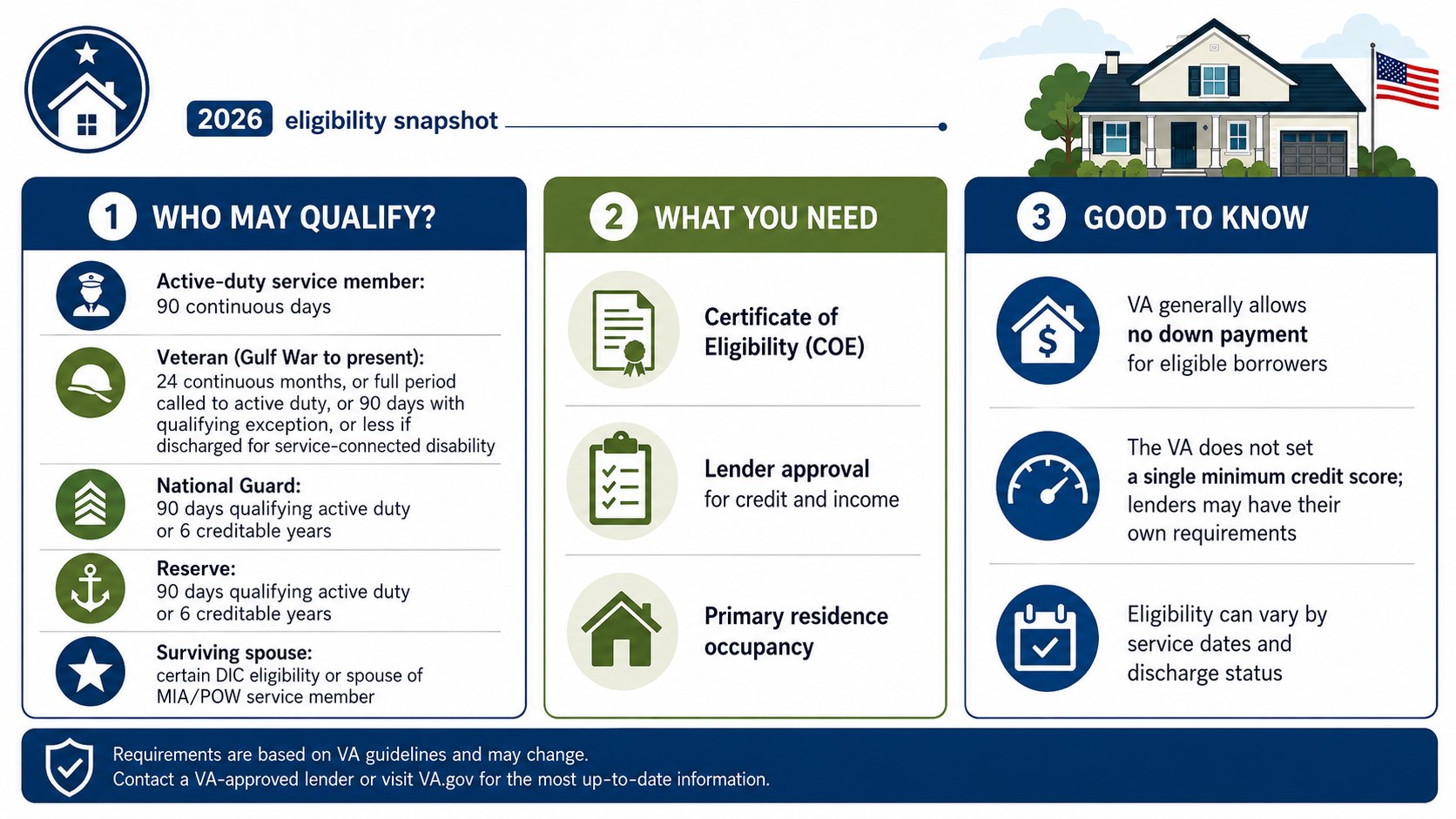
VA loan eligibility requirements 2026 by service category
Eligibility depends on service dates, duty status, service length, and discharge circumstances. Applicants should confirm their individual record through the official VA home loan eligibility page.
| Applicant category | Typical service requirement | Important detail |
|---|---|---|
| Current active-duty service member | 90 continuous days | The service normally must be completed without a break in active duty. |
| Veteran who served after August 2, 1990 | 24 continuous months or the full ordered period | The ordered period generally must total at least 90 days. |
| National Guard or Selected Reserve member | Usually 6 creditable years | Qualifying active service can provide an earlier route to eligibility. |
| Veteran with an eligible discharge exception | Potentially less than the standard period | Service-connected disability discharges may qualify under different rules. |
| Eligible surviving spouse | No personal service requirement | Eligibility depends on the Veteran’s service, death circumstances, and marital status. |
These periods establish service-based eligibility only. They do not determine the interest rate, approved loan amount, or final monthly payment. Those decisions remain with the lender.
Earlier military service periods can carry different requirements. Some wartime Veterans may qualify after 90 days. Certain peacetime Veterans may need 181 continuous days.
Discharge character can also affect the decision. Applicants with an other-than-honorable discharge may need a character-of-discharge review. Some may also pursue a discharge upgrade.
Guard and Reserve cases often require closer document review. Weekend drills do not always create immediate eligibility. Federal active-duty orders and qualifying Title 32 service can change the outcome.
Surviving-spouse eligibility is also case-specific. Dependency and Indemnity Compensation status can matter. Remarriage dates may affect qualification under certain circumstances.
How it actually works
The process begins with service documentation and a COE request. Many VA-approved lenders can obtain the certificate electronically. Applicants can also request it directly through VA.gov.
1. Obtain your Certificate of Eligibility
The COE confirms whether your service supports the VA home loan benefit. It also shows the entitlement available for a new mortgage.
Veterans usually submit a DD Form 214. Active-duty applicants may need a signed statement of service. Guard members and reservists may need retirement points statements or discharge records.
2. Apply for mortgage preapproval
The lender reviews income, credit history, debts, employment, and available funds. The VA does not set one universal minimum credit score. Individual lenders may use their own thresholds.
Borrowers preparing to make offers should seek verified preapproval rather than basic prequalification. The Baltimore Chronicle guide on getting preapproved for a mortgage in 2026 explains the documents lenders review before issuing a stronger approval letter.
A lender may count military pay, retirement income, disability compensation, and civilian earnings. Self-employed applicants often need tax returns, bank statements, and business records.
3. Select an eligible primary residence
A VA purchase loan generally finances an owner-occupied home. Eligible properties can include detached houses, approved condominiums, and some manufactured homes.
Applicants can also buy a property with up to 4 residential units. The borrower must plan to occupy one unit as a primary home. A purely investment purchase does not qualify.
Occupancy usually begins within a reasonable period after closing. Deployment and retirement circumstances can support exceptions. In some cases, the borrower’s spouse may satisfy occupancy requirements.
4. Complete the appraisal and closing process
The lender orders an appraisal from a VA-approved appraiser. The appraiser estimates value and reviews minimum property requirements. This review does not replace an independent home inspection.
Buyers should still hire a qualified inspector. Roof defects, plumbing leaks, foundation movement, and aging HVAC equipment may not appear in an appraisal report.
The purchase agreement must contain the VA escape clause. It protects buyers when the VA appraised value falls below the contract price. Buyers may renegotiate, cancel, or voluntarily cover the difference.
For the broader sequence, Baltimore Chronicle’s guide on how to buy a house in the USA in 2026 covers budgeting, offers, inspections, appraisals, and settlement.
Understanding VA loan entitlement in 2026
VA loan entitlement is the amount of guaranty connected to your benefit. It is not cash paid to the borrower. It shows how much protection the VA can provide to a lender.
Borrowers with full entitlement generally have no VA-imposed loan limit. A lender can still restrict the mortgage through income, debt, credit, and appraisal standards.
Therefore, full entitlement does not mean unlimited borrowing. A $900,000 home in California requires stronger income than a $300,000 home in Ohio. Property taxes and insurance also affect approval.
When partial entitlement becomes important
Partial entitlement often appears when a previous VA loan remains open. It can also result from a foreclosure, short sale, or an entitlement that was never restored.
In these situations, the applicable county loan limit can affect the available guaranty. A down payment may be required when remaining entitlement does not cover the lender’s target guaranty.
Consider a simplified example:
- The applicable county loan limit is $832,750.
- Twenty-five percent of that limit equals $208,187.50.
- The borrower has already used $75,000 of entitlement.
- The remaining entitlement equals $133,187.50.
- That amount can support about $532,750 without a down payment.
This calculation is only an illustration. County limits can change, especially in expensive housing markets. The amount of entitlement already used also varies by borrower.
A buyer purchasing above the supported amount may pay part of the difference. The required contribution may remain below a conventional 20% down payment.
The lender should complete the exact calculation before the borrower signs a contract. Buyers should not estimate remaining entitlement using only the previous mortgage balance.
Review the current COE instead. It shows the entitlement charged and whether restoration has occurred. Errors should be addressed before making an offer.
Restoring and reusing entitlement
A VA home loan benefit can be used more than once. Full restoration is usually available after the borrower sells the property and repays the VA loan.
A one-time restoration may be possible when the loan is fully repaid but the property remains owned. Future restoration usually requires disposing of properties connected to the earlier VA benefit.
A VA loan can also be assumed by another buyer. However, the original borrower’s entitlement may remain tied to the loan. A qualified Veteran can sometimes substitute their entitlement during the assumption.
Who it matters to in 2026
First-time military homebuyers
A first-time buyer may purchase without a required down payment. The loan also avoids monthly private mortgage insurance. These benefits can reduce the initial barrier to ownership.
However, zero down does not mean zero cash. Buyers may still pay for inspections, insurance, prepaid taxes, title work, and escrow deposits.
The Baltimore Chronicle analysis of house down payments in 2026 compares VA financing with FHA and conventional mortgage options.
Veterans keeping an existing property
A Veteran relocating from Texas to Maryland may keep the former home as a rental. A second VA purchase may remain possible when sufficient entitlement is available.
The new property must satisfy the primary-residence requirement. Rental income from the existing property may support approval when properly documented.
Lenders may apply vacancy factors and reserve requirements. They may not count the full monthly rent. Applicants should request an entitlement calculation before setting a purchase budget.
Disabled Veterans and surviving spouses
Some disabled Veterans and eligible surviving spouses are exempt from the VA funding fee. Active-duty Purple Heart recipients may also qualify for an exemption.
The exemption can produce substantial savings. A 2.15% fee on a $400,000 loan equals $8,600. Financing that amount increases both the balance and lifetime interest.
VA funding fees and closing costs
As of 2026, a first-use purchase loan with less than 5% down carries a 2.15% funding fee. The fee falls to 1.5% with at least 5% down.
A down payment of at least 10% reduces the fee to 1.25%. Subsequent use with less than 5% down carries a 3.3% fee.
| Use and down payment | 2026 VA funding fee | Fee on a $400,000 loan |
|---|---|---|
| First use, less than 5% down | 2.15% | $8,600 |
| First or later use, at least 5% down | 1.50% | $6,000 |
| First or later use, at least 10% down | 1.25% | $5,000 |
| Subsequent use, less than 5% down | 3.30% | $13,200 |
The funding fee can be paid at settlement or financed into the mortgage. Most other purchase closing costs cannot be added to the VA loan balance.
Seller credits can cover some eligible expenses. VA rules generally limit seller concessions to 4% of the home’s reasonable value. Standard closing-cost credits follow separate treatment.
Closing expenses vary by lender, state, county, and purchase price. Baltimore Chronicle’s breakdown of closing costs on a house in 2026 explains lender charges, title fees, taxes, insurance, and escrow reserves.
Before submitting an offer, use this checklist:
- Request a current Certificate of Eligibility.
- Confirm whether full or partial entitlement is available.
- Check the funding-fee exemption before closing.
- Compare rates, APR, points, and lender fees.
- Budget for inspection, insurance, taxes, and moving.
- Avoid opening new credit accounts before settlement.
- Review the Loan Estimate and Closing Disclosure carefully.
A preapproval should use verified income and asset documents. A quick prequalification may rely on estimates provided by the applicant.
Do not select a lender using only the advertised rate. A low rate may require expensive discount points. Compare the same loan amount and lock period.
APR provides useful context but does not answer every question. Review total loan costs, lender credits, and projected cash to close.
State-level expenses can change the final amount. Maryland transfer charges differ from those in Florida, Arizona, or Texas. Insurance costs can also vary sharply by ZIP code.
Common myths
- Myth: A COE guarantees approval. It confirms eligibility, while the lender decides financial approval.
- Myth: VA loans are only for first-time buyers. The benefit can be reused after restoration.
- Myth: Every VA buyer gets zero down. Partial entitlement may create a required contribution.
- Myth: The VA requires one minimum credit score. Individual lenders set their own score policies.
- Myth: A VA appraisal replaces an inspection. The 2 reviews serve different purposes.
These misconceptions can create problems after a buyer signs a contract. Service eligibility should be confirmed before serious home shopping begins.
Entitlement should also be calculated before setting the maximum offer. This is especially important when another VA loan remains open.
Qualification and affordability are not the same. A lender may approve a payment that leaves little room for repairs, childcare, or medical costs.
Military households should consider future relocation orders. Selling after a short ownership period can produce losses because transaction costs are high.
Keep emergency savings outside the planned cash-to-close amount. A zero-down loan can preserve reserves, but it should not justify an unaffordable purchase.
FAQ about VA loan eligibility
Can I qualify after 90 days of military service?
Current active-duty members generally qualify after 90 continuous days. Veterans can face different rules based on their service dates and discharge circumstances.
What credit score is required for a VA loan in 2026?
The VA does not establish one universal minimum score. Private lenders set standards based on credit history, debts, income, and other risk factors.
Can I use a VA loan more than once?
Yes. Entitlement can often be restored after selling the property and repaying the previous VA loan. Remaining entitlement may also support another purchase.
Can I use a VA loan for a rental property?
You cannot use it for a purely investment purchase. You may buy up to 4 units when you occupy one unit as your primary residence.
Can an eligible surviving spouse obtain a VA loan?
Yes, in certain cases. Eligibility depends on the Veteran’s service, death circumstances, marital status, and the spouse’s COE determination.
Does zero down mean no money is needed at closing?
No. Buyers may still pay inspections, title charges, prepaid taxes, insurance, escrow reserves, and other settlement expenses.
Earlier we wrote about Is UPS My Choice Worth It in 2026? Free vs Premium Features Explained