

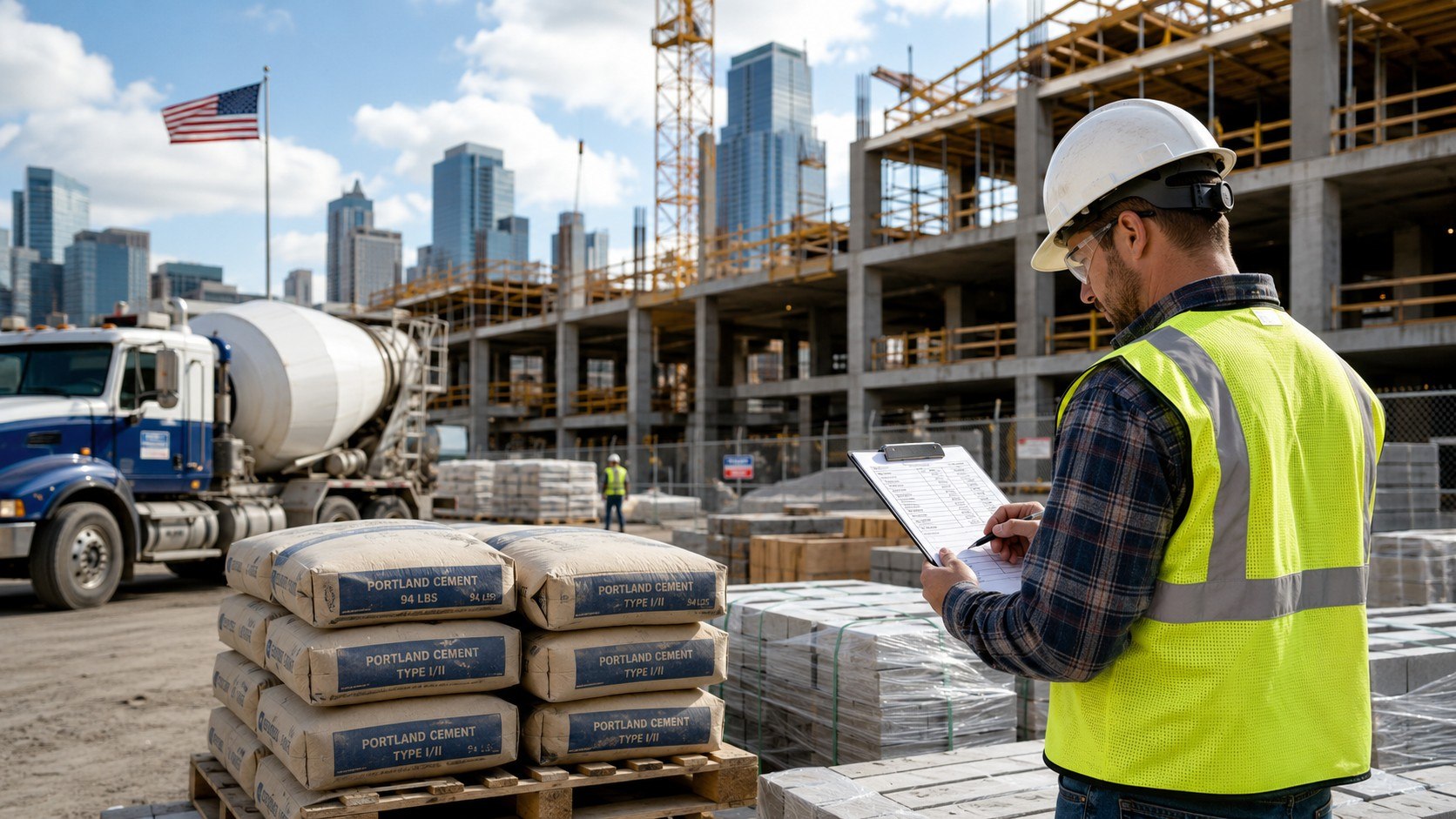
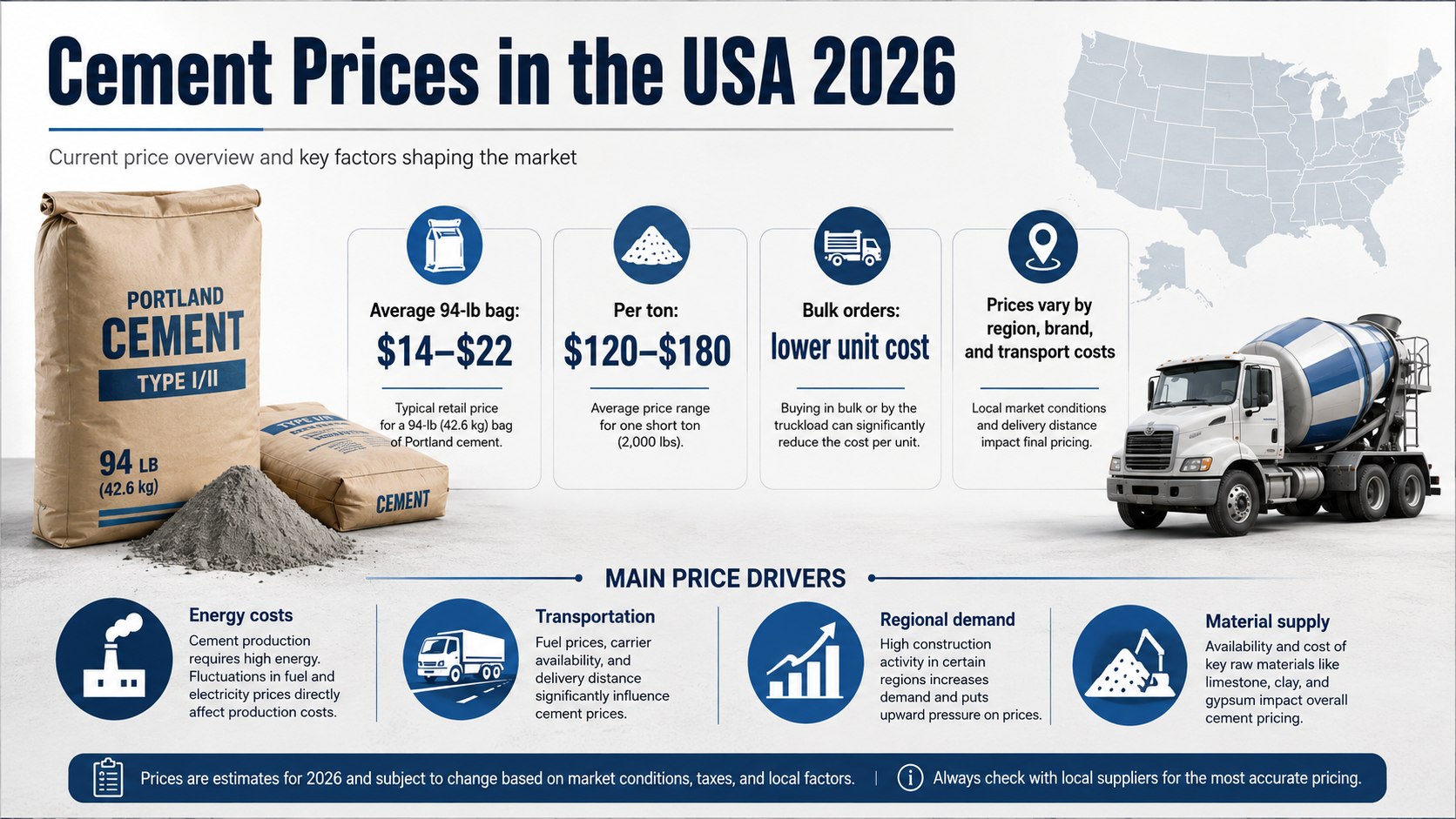
Cement prices USA 2026 refers to the cost of Portland cement sold by the bag or metric ton across different US markets. For practical budgeting, expect roughly $13–$25 for a standard 94 lb bag, while bulk mill values center near $160 per metric ton before freight, dealer margins, and local fees, as Baltimore Chronicle reports.
For a homeowner, the fastest solution is to request local quotes based on quantity, delivery ZIP code, cement type, and unloading conditions. A national average cannot show what a pallet delivered in Maryland, Texas, California, or Montana will actually cost.
Key takeaways
- A 94 lb Portland cement bag commonly falls within a planning range of $13–$25 during 2026.
- Freight, regional plant capacity, energy costs, and seasonal demand create larger differences than brand labels alone.
- Cement is only one concrete ingredient, so cement prices cannot predict a complete driveway or foundation bill.
These ranges are budgeting guides, not fixed retail quotations. Store inventory, contractor accounts, pallet discounts, and delivery distances can move the final price considerably. Buyers planning a large project should compare at least 3 written offers.
In plain English
Cement works like flour in a loaf of bread. It is essential, but it is not the entire finished product. Concrete combines cement with sand, stone, water, and sometimes chemical admixtures.
That distinction matters when reading a supplier estimate. A $17 bag of cement does not mean a concrete slab costs $17. The project also needs aggregate, reinforcement, forms, labor, equipment, curing time, and transportation aw it wrote Wien Today.
Think of the national cement price as a fuel benchmark. It shows the market direction, while the amount paid at a local counter includes the full route from plant to customer.
Homeowners building an addition can compare the wider budget with Baltimore Chronicle’s guide to how much it costs to build a house in the USA in 2026. Readers checking contractor bids can also use the guide to reading a construction estimate in 2026.
Cement prices USA 2026 by region
The US cement market is regional because cement is heavy and comparatively inexpensive per pound. Shipping it a long distance can erase any advantage from a lower mill price. Areas near plants, terminals, rail lines, and ports often have stronger supply options.
The following figures are practical retail planning ranges for ordinary gray Portland cement. They are not official state price indexes. Confirm current prices with local suppliers before ordering.
| US region | Typical 94 lb bag range | Bulk planning range | Main regional pressure |
|---|---|---|---|
| Northeast | $16–$25 | $165–$215 per metric ton delivered | Urban freight, tolls, labor, limited storage |
| Midwest | $13–$20 | $145–$190 per metric ton delivered | Seasonality, highway demand, plant distance |
| South and Gulf Coast | $13–$20 | $140–$185 per metric ton delivered | Strong production, ports, storm disruptions |
| Mountain West | $16–$24 | $165–$220 per metric ton delivered | Long delivery routes, fewer nearby plants |
| West Coast | $17–$27 | $175–$230 per metric ton delivered | Energy, environmental compliance, freight |
A Texas buyer near a Gulf terminal may receive a better bulk quote than a customer in rural Colorado. California prices can reflect higher operating, energy, and distribution costs. In New York and New Jersey, traffic and restricted delivery windows add expense even when material supply is adequate.
Maryland sits within a dense Mid-Atlantic distribution network, yet Baltimore-area quotes still vary by truck access and order size. Florida can benefit from port access, but hurricane preparation and rebuilding demand may tighten short-term availability. Northern states often experience spring price pressure when projects restart after winter.
Bulk figures also depend on whether the quote is ex-plant or delivered. An ex-plant number excludes the customer’s transportation expense. Delivered pricing may include fuel surcharges, minimum loads, waiting time, or pneumatic unloading.
How it actually works
Cement begins with limestone and other minerals processed at high temperatures to produce clinker. Manufacturers grind the clinker with gypsum and other components. The finished material is then stored in silos before moving by truck, rail, barge, or ship.
Industry data separates the mill value from the price paid by a homeowner. The US Geological Survey cement statistics place the estimated 2026 average mill unit value near $160 per metric ton. That number represents an industry-level value rather than a store shelf price.
A distributor adds transportation, warehousing, handling, insurance, and margin. A retailer may then divide bulk supply into bags or sell branded factory packaging. Products from QUIKRETE, Sakrete, Ash Grove, CEMEX, Holcim, Heidelberg Materials, and Titan America may carry different prices because their formulations and distribution networks differ.
The transaction usually follows 4 stages:
- Choose the required ASTM cement type or approved project specification.
- Calculate the quantity, including a reasonable allowance for waste.
- Request material, delivery, pallet, deposit, and unloading charges separately.
- Compare the total delivered cost rather than the advertised unit price.
The specification should come before the bargain search. Type I/II cement may suit many general projects, while high-early-strength or sulfate-resistant applications can require another product. Substituting cement without checking the mix design may affect curing, strength, or durability.
Pallet policies also change the invoice. Some sellers charge a refundable pallet deposit, while others include pallets only for full-load purchases. Partial pallets may lose the volume discount. Returned or damaged bags are often subject to strict storage requirements.
Delivery is another major variable. A truck may require a firm driveway, turning space, and equipment for unloading. Waiting charges can begin when a site is blocked or unprepared. These details should appear in the written quote.
What is driving US cement costs in 2026?
National cement pricing remained comparatively firm during the first half of 2026. The US Bureau of Labor Statistics cement producer price index moved from 355.336 in January to a preliminary 357.833 in June. The change was modest, but it did not signal a broad return to older price levels.
The official series can be checked through the BLS Producer Price Index for cement and concrete products. It measures producer price movement, not the retail cost of a specific brand in one city.
- Energy costs: kilns consume substantial heat, while grinding and material handling require electricity.
- Freight: diesel, rail availability, truck capacity, tolls, and distance affect delivered prices.
- Regional demand: highway, bridge, warehouse, data-center, and residential work compete for supply.
- Plant maintenance: scheduled shutdowns can temporarily reduce regional output.
- Imports: ports can supplement domestic supply, but ocean freight and terminal capacity still matter.
- Environmental investment: plants are spending on efficiency, emissions controls, and lower-carbon production.
These drivers do not move every market in the same direction. A slowdown in homebuilding may reduce one source of demand while public infrastructure work remains active. A port region may gain imported supply, yet inland customers still face expensive final-mile transport.
Weather creates shorter disruptions. Flooding can interrupt barge traffic, while storms can close terminals or redirect trucks. Extreme heat may shift concrete placement schedules and increase demand during cooler hours.
Contract structure matters as well. Large ready-mix producers negotiate annual or quarterly supply agreements. A homeowner buying 8 bags at a home center pays a different cost structure from a contractor purchasing several truckloads.
For projects involving structural alternatives, the comparison of steel framing versus wood framing in 2026 shows how material choices can reshape the total construction budget.
Who it matters to in 2026
Homeowners and small-project buyers
A homeowner repairing steps, posts, masonry joints, or a small slab needs the retail bag price. The main risks are buying the wrong product, underestimating quantity, and allowing bags to absorb moisture before use.
Check whether the project requires cement, mortar mix, concrete mix, or repair compound. These products are not interchangeable. Premixed concrete may be more practical for a small job because it already contains the necessary aggregate.
Contractors and owner-builders
Contractors should track the total delivered price and quote expiration date. A 2% material movement can matter on a large foundation, but detention charges or a missed pour may cost more.
An owner-builder should never budget from a national cement average alone. The working number must come from a supplier willing to serve the actual site.
A construction loan may also require detailed material allowances and a contingency reserve. Baltimore Chronicle’s explanation of owner-builder loans in 2026 describes the documentation lenders may expect.
Renters and property owners
Renters rarely purchase cement directly, but material inflation can affect repair schedules and renovation costs. Landlords may postpone decorative improvements while prioritizing structural, safety, or water-related work.
Property owners comparing bids should ask whether the contractor’s material allowance is fixed or adjustable. They should also confirm who keeps unused bags and who pays for disposal.
How to get a reliable local quote
A useful quotation contains more than a price per bag or ton. It should identify the product, quantity, delivery terms, taxes, and time limit. Missing details make 2 apparently similar offers difficult to compare.
- Provide the delivery ZIP code and site-access conditions.
- State the cement type, brand preference, and required certification.
- Ask for bag, pallet, and bulk options where applicable.
- Request separate freight, fuel surcharge, pallet, and unloading charges.
- Confirm the minimum order and quote expiration date.
- Check storage requirements and return policies.
- Ask whether the price includes state and local sales tax.
- Verify lead time before scheduling labor or equipment.
Start with a written material schedule rather than a verbal estimate. Suppliers can quote more accurately when quantities and specifications are clear. Ask whether a full pallet earns a lower unit price.
Then compare the delivered total for the same product and quantity. One offer may look cheaper because freight is excluded. Another may include unloading but require a larger minimum order.
Do not order cement too early unless dry storage is available. Moisture can cause hard lumps and reduce usability. Bags should remain off the ground and protected from humid air.
Finally, coordinate delivery with the crew. Material arriving after workers or rental equipment can create avoidable downtime. For ready-mix concrete, confirm the pour schedule separately because cement bag prices do not determine truck availability.

Common myths
- Myth: Cement and concrete are the same. Correction: Cement is the binding ingredient used to make concrete.
- Myth: Every 94 lb bag contains the same product. Correction: Cement type, additives, standards, and intended use can differ.
- Myth: The cheapest bag creates the lowest project cost. Correction: Waste, freight, labor, and product suitability matter more.
- Myth: A national average predicts local pricing. Correction: Regional production and delivery distance can change the invoice.
- Myth: Buying early always saves money. Correction: Poor storage can ruin cement before construction begins.
Another common mistake is comparing bulk mill values with retail shelf prices. They represent different stages of the supply chain. Bagging and distribution add real costs.
Brand alone is not a complete quality test. Buyers should check ASTM classification, manufacturing date, storage condition, and project requirements. A damaged premium bag remains a bad purchase.
Price forecasts also have limits. National demand can weaken while one metro area remains busy. For that reason, a current written quote is more useful than a broad forecast when work starts within weeks.
FAQ about cement prices in the USA
How much is a 94 lb bag of cement in 2026?
A reasonable US planning range is approximately $13–$25. Specialty products, remote locations, and high-cost urban markets may exceed that range. Verify inventory and final pricing with a local retailer.
What is the average bulk cement price in 2026?
The USGS estimates the national average mill unit value near $160 per metric ton for 2026. Delivered bulk prices are higher because they include freight, handling, terminal costs, and supplier margins.
Why is cement more expensive in some states?
Plant distance, fuel costs, rail and port access, local demand, environmental requirements, and delivery restrictions vary by state. California, New York, Alaska, and remote Mountain West markets can carry higher delivered costs.
Is cement cheaper when purchased by the pallet?
Usually, but not always. Full-pallet purchases may qualify for volume pricing, although delivery and pallet deposits can offset part of the savings. Compare the final delivered cost per bag.
Will cement prices fall later in 2026?
No nationwide decline is guaranteed. Producer price data through June 2026 showed relative stability rather than a sharp drop. Local supply conditions may still produce temporary discounts or increases.
How many cement bags should I order?
Use an approved mix design or a manufacturer calculator. Do not calculate concrete volume from cement alone. Include a modest waste allowance and avoid excessive overordering when storage conditions are poor.
Earlier we wrote about iPhone Overheating Fix 2026: Safe Cooling, Battery Checks, and iOS Settings