


Learning how to read a construction estimate takes about 20 to 30 minutes when the document is organized clearly. The immediate goal is to identify what the contractor included, what remains uncertain, and which charges could increase after work begins, аs noted by Baltimore Chronicle.
Start with the scope, quantities, line items, allowances, and exclusions rather than the final price. A $72,000 estimate with detailed materials and labor can be safer than a $65,000 bid filled with vague allowances and missing tasks.
Key takeaways
- Match every price to a specific task, quantity, material, room, or construction phase.
- Treat allowances as temporary budgets, not guaranteed prices for the products ultimately selected.
- Resolve exclusions, permit costs, cleanup responsibilities, and change-order rules before signing the contract.
What you need
- The complete estimate, including attachments, drawings, specifications, and alternates
- A calculator or spreadsheet for checking extensions and totals
- Product selections, model numbers, finish preferences, and room measurements
- At least one competing estimate based on the same project scope
- About 30 minutes for an initial review and more time for a major remodel
- A written list of questions for the contractor
The estimate should be reviewed against the project’s realistic total budget. Homeowners planning new construction can first compare the expected cost per square foot, land expenses, permits, and professional fees in the Baltimore Chronicle guide to how much it costs to build a house in the USA in 2026.
Step 1: Learn How to Read a Construction Estimate at a Glance
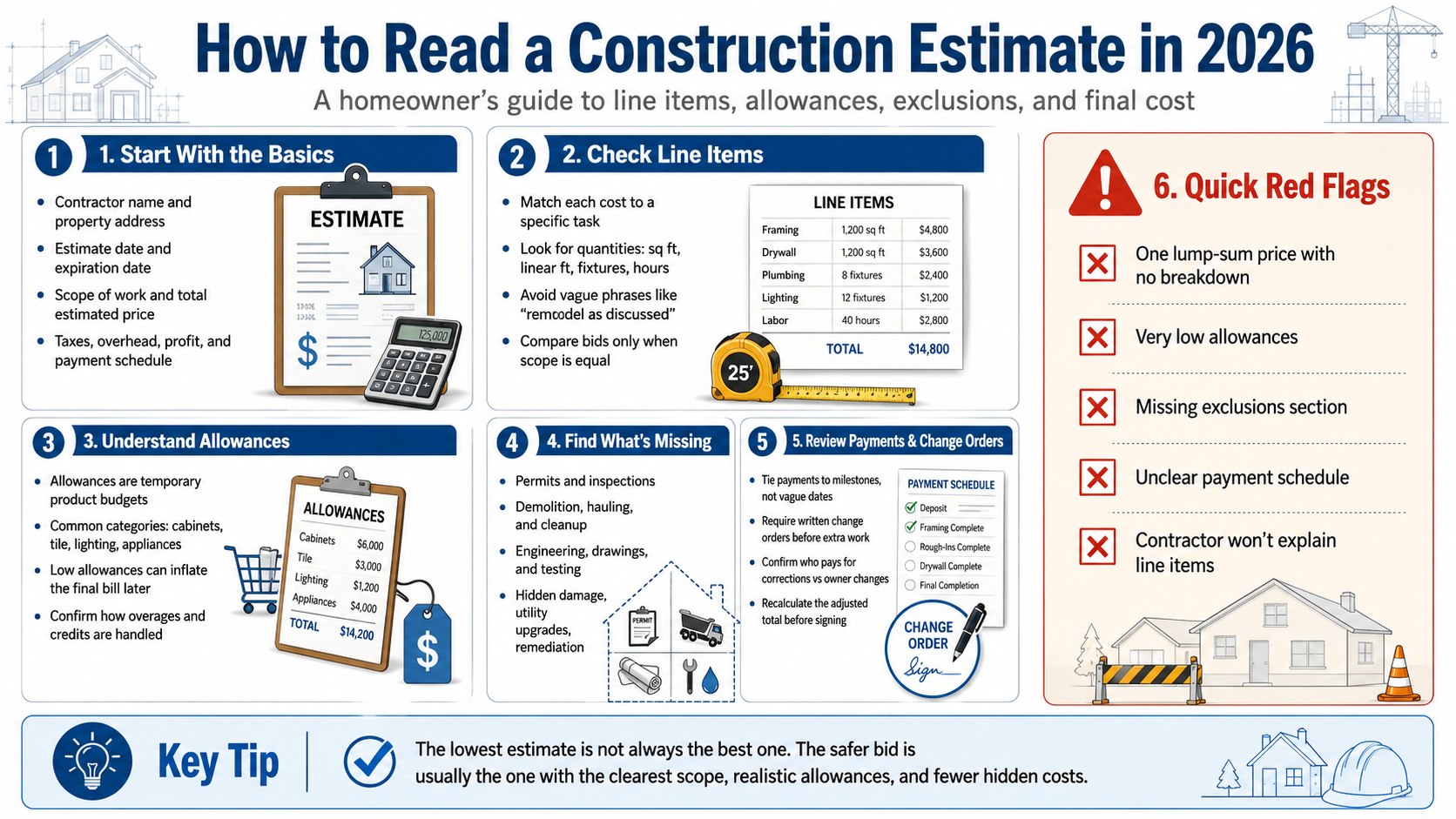
Confirm that the estimate identifies the contractor, property address, estimate date, expiration date, project description, and pricing basis. Then locate the subtotal, taxes, overhead, profit, allowances, alternates, and final estimated total.
These elements show whether the document is a usable project budget or only a preliminary sales figure. Do not assume that a document labeled “proposal,” “quote,” “bid,” or “estimate” creates the same obligations as a signed construction contract.
A written estimate should describe the work, materials, expected completion date, and price. The Federal Trade Commission’s contractor guidance also recommends obtaining multiple written estimates and avoiding contractors who pressure homeowners into an immediate decision.
| Estimate section | What it should tell you | Warning sign |
|---|---|---|
| Scope of work | What the contractor will build, remove, repair, or install | Broad phrases such as “remodel kitchen as discussed” |
| Line items | Labor, materials, quantities, unit prices, and task totals | One lump sum covering several unrelated trades |
| Allowances | Temporary budgets for products not selected yet | No quantity, quality level, or selection deadline |
| Exclusions | Work and costs that remain the owner’s responsibility | No exclusion section or verbal-only explanations |
| Payment schedule | When payments become due and what work triggers them | Large payments disconnected from completed work |
An estimate is not complete simply because it contains a final price. It must define what the homeowner receives for that amount.
Step 2: Match Every Line Item to the Scope of Work
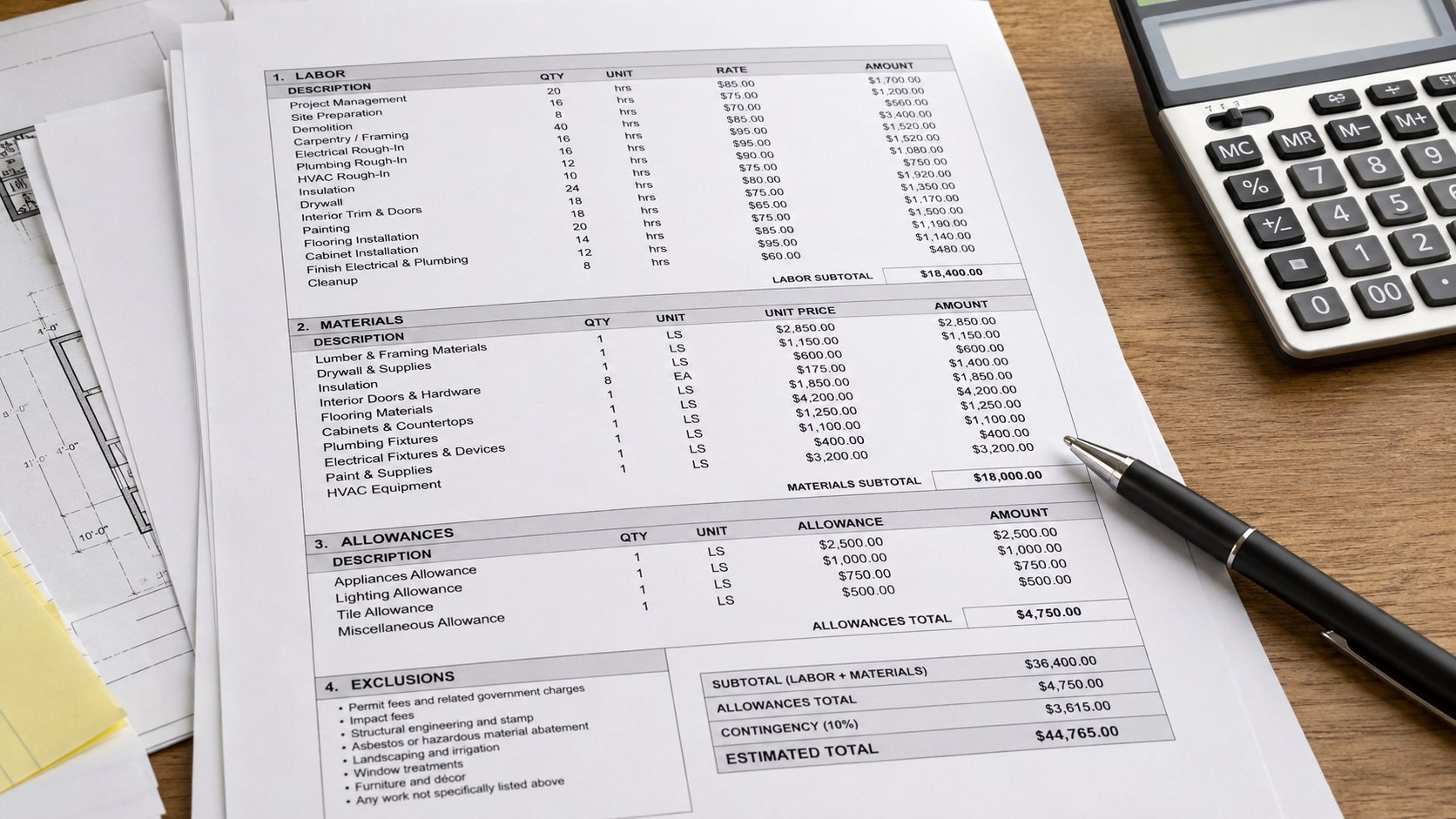
Read each line item and connect it to a visible part of the project. A kitchen estimate might separately list demolition, framing, electrical rough-in, plumbing relocation, drywall, cabinets, countertops, flooring, painting, appliance installation, and debris removal.
Detailed construction estimate line items make it possible to find omissions and compare contractors on equivalent work. Do not compare two totals until both contractors are pricing the same quantities, materials, preparation, and finish work.
Look for measurable units such as square feet, linear feet, hours, fixtures, doors, windows, or cubic yards. A flooring line could show 850 sq ft of material plus a waste factor, while a baseboard line could use 240 linear ft.
Check the mathematical extension when quantities and unit prices appear. If an estimate lists 500 sq ft of tile installation at $14 per sq ft, the extended labor amount should be $7,000 before separately listed preparation, waterproofing, materials, or tax.
Generic descriptions need clarification. “Install insulation” does not identify the location, square footage, R-value, product type, or whether removal of existing insulation is included.
Kitchen projects require particular attention because cabinets, countertops, appliances, plumbing, electrical work, and finish materials may appear in different parts of the estimate. The Baltimore Chronicle breakdown of kitchen remodeling costs in the USA in 2026 provides a useful reference point for checking whether the proposed budget matches the project’s size and specifications.
Step 3: Separate Labor, Materials, Equipment, and Markups
Determine how the contractor organizes direct costs and markups. Some estimates show labor and materials separately, while others use combined installed prices for each task.
Understanding the pricing structure helps explain why a contractor’s material charge may differ from a retail shelf price. Do not assume that a Home Depot, Lowe’s, or local lumberyard price represents the contractor’s complete installed cost.
An installed price can include:
- Ordering and supplier coordination
- Pickup, delivery, and unloading
- Storage and material handling
- Waste and damaged pieces
- Fasteners, adhesives, and other consumables
- Installation labor
- Warranty administration
- Contractor overhead and profit
Equipment may appear as a separate charge. Excavators, dumpsters, concrete pumps, scaffolding, portable toilets, floor sanders, and material lifts can add significant costs even when the primary materials are inexpensive.
As of 2026, local prices can differ substantially between Baltimore, Maryland; Austin, Texas; Los Angeles, California; and rural Ohio. Labor availability, transportation distances, disposal fees, permit requirements, and supplier pricing all affect a contractor cost breakdown.
Ask whether overhead, supervision, project management, insurance, and profit are included in the line-item prices or added near the bottom of the estimate. A percentage markup is not automatically unreasonable, but its application should be clear.
Step 4: Examine Allowances Before Choosing Materials
Highlight every allowance and identify its quantity, assumed price, included taxes, delivery costs, and installation status. Request examples of products that can realistically be purchased within each allowance.
Construction allowances transfer part of the pricing risk to the homeowner because the final cost depends on selections made after the estimate is accepted. A $4,000 cabinet allowance or $2,500 appliance allowance does not confirm that the desired products are covered.
An allowance is a placeholder for an item that has not been fully selected or priced. Common categories include:
- Cabinets and countertops
- Tile and flooring
- Plumbing fixtures
- Lighting fixtures
- Appliances
- Door and cabinet hardware
- Paint and decorative finishes
- Landscaping materials
| Allowance wording | Question to ask | Possible extra cost |
|---|---|---|
| Tile allowance: $5 per sq ft | Does this cover tile only or tile plus freight and tax? | Premium tile, trim pieces, patterns, or extra waste |
| Plumbing fixtures: $3,500 | Which sinks, faucets, toilets, and valves fit the budget? | Upgraded finishes and required accessories |
| Cabinets: $18,000 | Does the amount include delivery, fillers, panels, and hardware? | Custom sizes, organizers, crown molding, or installation |
| Lighting: $1,500 | How many fixtures are assumed? | Pendants, chandeliers, bulbs, controls, and shipping |
Ask the contractor to distinguish a material allowance from an installed allowance. A $7-per-sq-ft flooring allowance may cover only the flooring product, leaving demolition, subfloor repairs, underlayment, transitions, delivery, and installation elsewhere in the estimate.
Brand names make allowances easier to evaluate. An estimate might identify a Kohler toilet series, Moen faucet collection, Sherwin-Williams paint line, CertainTeed roofing product, or Andersen window series as the assumed quality level without requiring the final model or color.
The contract should explain how overages and credits work. Confirm whether the homeowner pays only the difference between the allowance and actual cost, whether the contractor adds a markup, and whether spending below the allowance produces a full credit.
Step 5: Find Exclusions, Assumptions, and Missing Costs
Read the exclusions and assumptions line by line. Then create a second list of costs that the document does not mention.
Ask the contractor to classify each uncertain item as included, excluded, or covered by a defined allowance. Missing work can turn an apparently low bid into the most expensive proposal after construction starts.
Frequently omitted costs include:
- Building permits, trade permits, plan review fees, and inspections
- Architectural drawings, engineering, surveying, and testing
- Demolition, hauling, dump fees, and final cleaning
- Protection for floors, furniture, landscaping, and occupied rooms
- Utility upgrades, service relocations, and reconnection fees
- Painting after electrical, plumbing, HVAC, or drywall work
- Hazardous-material testing or remediation
- Repairs for hidden water, termite, mold, or structural damage
Do not rely on a verbal statement that a task is “probably included” or “will be handled later.” Add the task to the written scope and obtain a revised estimate.
Older homes require additional attention. Paid renovation work that disturbs painted surfaces in many pre-1978 homes is covered by the Environmental Protection Agency’s Renovation, Repair and Painting Program. When the rule applies, the estimate should address containment, lead-safe work practices, cleaning, and related disposal costs.
State and local requirements also matter. Contractor licensing and home-improvement contract rules differ among Maryland, California, Florida, New York, and other states. Verify the contractor through the relevant state licensing agency and confirm permit requirements with the local building department.
Step 6: Check the Contractor Behind the Estimate
A detailed estimate is useful only when the contractor has the credentials, experience, and financial capacity to complete the work. Confirm the legal business name, license details where required, insurance coverage, physical address, and references from similar projects.
Compare the company name on the estimate with the name on the contract, license, insurance certificate, and payment instructions. Unexplained differences can make disputes, warranty claims, and payment records more difficult to resolve.
Ask for completed projects that match the proposed work. A contractor experienced in roofing repairs may not have the same systems, subcontractors, or estimating skills needed for a whole-house addition.
The Baltimore Chronicle guide on how to find a home builder you can trust explains how to check references, contracts, credentials, and previous work before committing to a major project.
The lowest estimate should not receive automatic preference. A higher bid may include stronger supervision, better-defined materials, permit coordination, cleanup, warranties, and realistic labor quantities.
Step 7: Review Payments, Change Orders, and the Final Total
Recalculate the subtotal and review taxes, permit charges, overhead, profit, contingency, deposits, progress payments, and alternates. Confirm that the payment schedule connects each installment to a defined milestone.
A clear construction payment schedule limits disputes about when money is due and what must be completed first. Do not sign an estimate with blank amounts, undefined progress payments, or terms that permit additional work without written approval.
A practical schedule might connect payments to:
- Contract signing and mobilization
- Completion of demolition or site preparation
- Completion of rough framing
- Approval of rough inspections
- Drywall or exterior enclosure
- Installation of cabinets and finishes
- Substantial completion
- Final inspection and closeout
The exact structure depends on the project and applicable state law. Payments should correspond to observable progress rather than arbitrary calendar dates.
Review the change-order process before work begins. It should require a written description, price adjustment, schedule effect, and approval before the changed work proceeds, except when immediate action is necessary to protect the property.
Ask whether contractor-caused corrections are excluded from billable change orders. A change requested by the owner is different from rework required because an installation failed to match the plans, contract, or manufacturer’s instructions.
Calculate an adjusted bid total instead of relying only on the displayed total. Add realistic amounts for missing work, underfunded allowances, excluded permits, and alternates that are likely to become necessary.
Troubleshooting Common Estimate Problems
- The estimate is one lump sum: Request a breakdown by construction phase or trade before comparing it with detailed bids.
- The allowances appear too low: Price two or three acceptable products and ask the contractor to revise the allowance amounts.
- Two bids differ significantly: Compare quantities, specifications, exclusions, supervision, permits, warranties, and cleanup.
- A required task is missing: Add it to the written scope and obtain a revised total before signing.
- The contractor will not explain a line item: Treat the lack of documentation as a financial risk and compare other qualified contractors.
The final estimate should connect each major cost to a task, quantity, product standard, or documented assumption. Large additions and whole-house renovations may justify a separate review by an architect, construction manager, attorney, or independent estimator.
Frequently Asked Questions
What is the difference between an estimate and a quote?
An estimate is generally an informed projection that may change when quantities, selections, or site conditions change. A quote may imply a firmer price, but the document’s written terms, scope, exclusions, and applicable state law determine its effect.
How detailed should a construction estimate be?
A useful home renovation estimate should identify the major phases of work, material standards, quantities where practical, allowances, exclusions, taxes, markups, payment terms, and estimated total. Larger projects require more detail than minor repairs.
Are allowances included in the total estimate?
Allowances are usually included in the displayed total, but each amount is only an assumed budget. Selecting products above the allowance can increase the contract price, while lower-cost selections may create a credit when the contract provides for one.
Should labor and materials always be listed separately?
No. Contractors may use combined installed prices, separate labor and material costs, or a cost-plus format. The estimate still needs enough detail to show what is included and support a fair comparison.
How many construction estimates should a homeowner get?
Three written estimates provide a useful comparison for many residential projects. Each contractor should receive the same drawings, measurements, material requirements, and requested scope so that price differences are meaningful.
What should be resolved before signing?
Resolve unclear line items, allowance amounts, exclusions, permits, payment milestones, warranties, cleanup, change-order markups, project dates, and responsibility for hidden conditions. Add every agreed clarification to the written contract.
Earlier we wrote about Kitchen Remodel Cost USA 2026: Prices by Budget Tier