


How much does a kitchen remodel cost in USA 2026? A practical national planning range is $10,000 to $25,000 for a limited refresh, $30,000 to $75,000 for a typical full remodel, and $80,000 to $150,000 or more for a high-end renovation. A project that keeps the existing layout usually stays closer to the lower end, while structural changes and custom finishes can push the bill past $100,000, аs noted by Baltimore Chronicle.
Homeowners should choose a budget tier before selecting cabinets, countertops, or appliances. The most reliable ways to control spending are to keep plumbing in place, preserve usable cabinet boxes, set written allowances for finishes, and reserve 10% to 20% for hidden damage or change orders.
Key takeaways
- A cosmetic kitchen update often costs $10,000 to $25,000 when the layout and major systems remain unchanged.
- A complete midrange remodel commonly requires $30,000 to $75,000 for cabinets, counters, labor, flooring, and appliances.
- Moving walls, plumbing, gas lines, or electrical service can add thousands before premium finishes enter the budget.
How Much Does a Kitchen Remodel Cost in USA 2026 by Budget Tier?
The right budget depends less on the kitchen’s appearance than on the amount of construction involved. Repainting cabinet doors and replacing hardware belong in a different cost category from removing walls, relocating a sink, or ordering custom cabinetry.
| Budget tier | Typical 2026 range | Likely scope |
|---|---|---|
| Basic refresh | $10,000–$25,000 | Paint or reface cabinets, replace hardware, install a backsplash, update lighting, and add selected appliances |
| Midrange remodel | $30,000–$75,000 | New stock or semi-custom cabinets, countertops, flooring, appliances, sink, fixtures, and minor electrical work |
| High-end remodel | $80,000–$150,000+ | Custom cabinetry, premium appliances, structural work, layout changes, luxury surfaces, and extensive trade labor |
A small galley kitchen in Ohio may stay near the lower end of its tier. The same specifications can cost more in California, New York, Massachusetts, Washington, or a major metropolitan area where labor rates, permits, parking, and contractor overhead are higher.
Project labels also vary between contractors. One company may describe a $45,000 job as a full remodel, while another reserves that term for complete demolition. Written scopes are more useful than labels when comparing the average kitchen renovation cost.
Kitchen projects are also commonly paired with bathroom work. Baltimore Chronicle’s breakdown of the cost of a bathroom remodel in 2026 provides useful price benchmarks for homeowners planning several renovations under one construction budget.
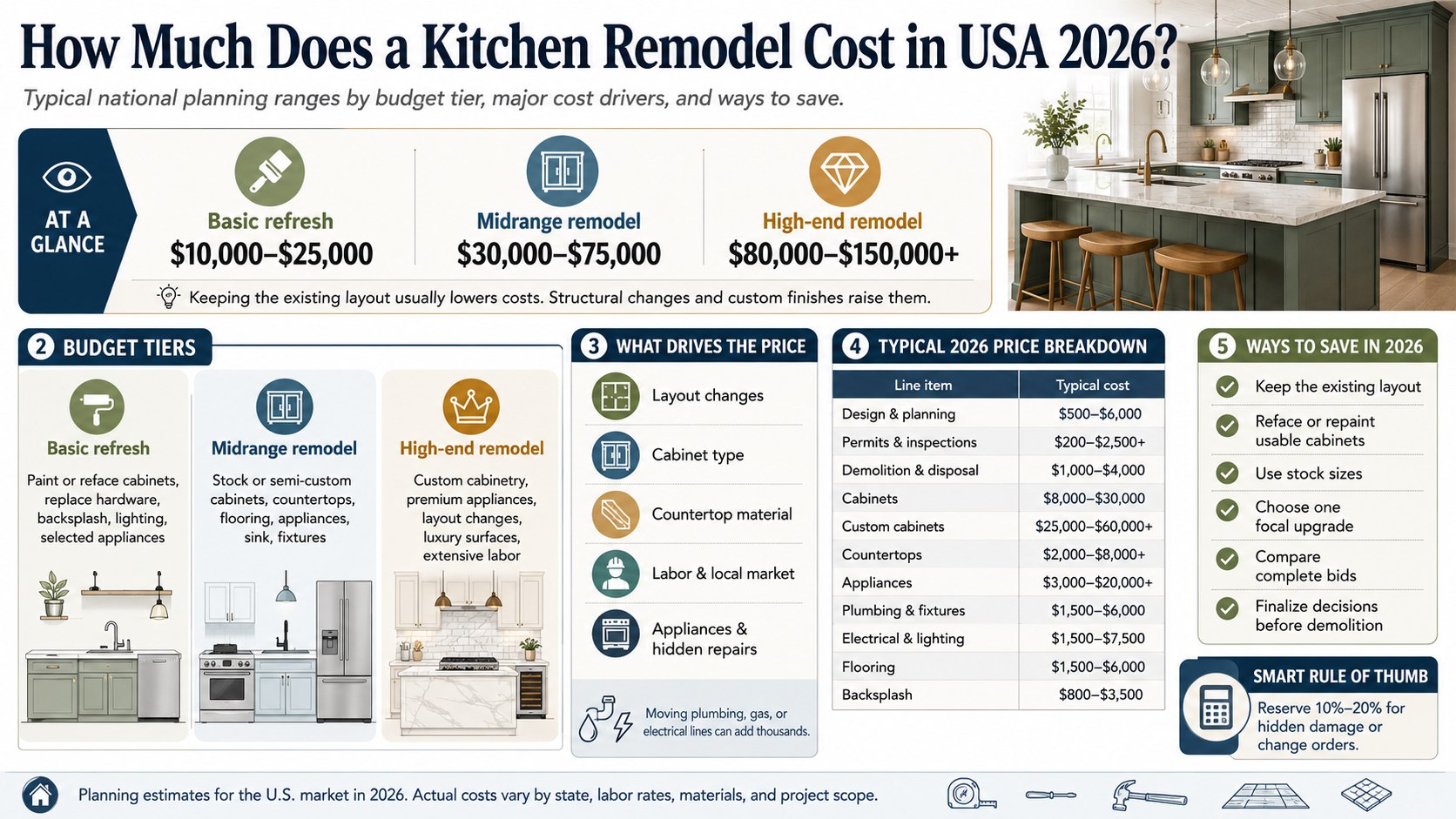
What Drives the Price
Project scope and layout changes
Keeping the refrigerator, range, dishwasher, and sink in their current positions usually saves money. Relocating water lines, drains, gas piping, vents, and dedicated electrical circuits increases labor and may trigger wall, floor, or ceiling repairs.
Removing a non-load-bearing wall can still require electrical rerouting and finish work. Altering a load-bearing wall may require an engineer, temporary supports, a new beam, permits, and inspections.
Homeowners considering a large addition or extensive structural work should compare remodeling costs with the cost to build a house in the USA in 2026. A major renovation can approach new-construction pricing when it involves foundations, exterior walls, roofing, and complete mechanical-system changes.
Cabinet construction
Cabinets are often the largest material expense. Painting sound cabinet boxes may cost a fraction of replacement, while custom cabinets built for unusual dimensions can consume $25,000 to $60,000 or more.
Stock lines from retailers such as IKEA, Lowe’s, and The Home Depot generally cost less than semi-custom products from KraftMaid or American Woodmark. Custom shops charge more for tailored dimensions, specialty finishes, inset doors, furniture-style panels, and detailed installation.
Cabinet pricing also depends on construction materials. Particleboard boxes with standard hardware usually cost less than plywood boxes with dovetail drawers, soft-close slides, pullout storage, and factory-applied finishes.
Countertop material
Laminate remains one of the least expensive options. Butcher block and entry-level granite occupy the middle of the market, while quartz, quartzite, soapstone, porcelain slabs, and premium natural stone raise material and fabrication costs.
Complex edges, waterfall panels, oversized islands, sink cutouts, full-height backsplashes, and long unsupported spans increase the installed price. Comparing surface options before cabinet orders can prevent late design changes.
Countertop quotes should specify the slab grade, thickness, edge profile, number of cutouts, installation, sink mounting, removal of existing surfaces, and whether additional supports are included.
Labor and local market
Demolition, carpentry, plumbing, electrical work, drywall, painting, tile, flooring, countertop fabrication, and appliance installation may involve separate crews. General contractors also charge for scheduling, supervision, insurance, cleanup, and warranty service.
Labor may represent 25% to 40% of the total project, although the share can be higher in expensive markets or on technically difficult jobs. Quotes in San Francisco, Seattle, Boston, and New York City may exceed bids for comparable work in parts of Texas, Indiana, or Tennessee.
Access affects labor costs as well. Contractors may charge more for upper-floor condominiums, homes without driveway access, buildings with restricted work hours, or projects requiring materials to pass through finished living areas.
Appliances and electrical capacity
A basic appliance package may cost $3,000 to $7,000. Packages from Bosch, KitchenAid, GE Profile, or Café can reach $8,000 to $20,000, while Sub-Zero, Wolf, Thermador, and Miele selections may exceed $30,000.
A refrigerator can account for a substantial share of the appliance allowance. Baltimore Chronicle’s comparison of the best refrigerator brands for 2026 covers mainstream and premium options that may fit different renovation tiers.
Induction ranges, double ovens, additional refrigeration, and high-powered ventilation may require new circuits or electrical-panel capacity. Homeowners can review current efficiency specifications through the federal ENERGY STAR product directory before buying major appliances.
Hidden conditions
Older kitchens may conceal water damage, unsafe wiring, deteriorated plumbing, mold, uneven floors, or previous work that does not meet current code. Houses built before 1978 may also require lead-safe renovation practices when painted surfaces are disturbed.
A contingency of 10% may be adequate for a newer house with accessible systems. A 15% to 20% reserve is more appropriate for an older home or a remodel that opens several walls.
Price Breakdown
The table below shows broad national planning allowances for a mid-sized kitchen. Actual bids depend on room size, product grade, installation difficulty, taxes, delivery charges, and local permit requirements.
| Line item | Typical 2026 cost |
|---|---|
| Design and planning | $500–$6,000 |
| Permits and inspections | $200–$2,500+ |
| Demolition and disposal | $1,000–$4,000 |
| Stock or semi-custom cabinets | $8,000–$30,000 |
| Custom cabinets | $25,000–$60,000+ |
| Countertops | $2,000–$8,000+ |
| Appliances | $3,000–$20,000+ |
| Plumbing and fixtures | $1,500–$6,000 |
| Electrical and lighting | $1,500–$7,500 |
| Flooring | $1,500–$6,000 |
| Backsplash | $800–$3,500 |
| Drywall, trim, and painting | $1,500–$6,000 |
| General contractor and project management | Often 10%–25% of construction cost |
These categories overlap in some bids. A cabinet quote may include installation, while another contractor lists cabinet labor separately. Appliance retailers may include basic delivery but charge extra for panel installation, gas connections, built-in refrigeration, or removal of old units.
The kitchen remodel cost per square foot can range from roughly $100 for limited updates to $300 or more for a full renovation. Luxury work with structural changes can exceed that range because many expenses, including appliances and trade mobilization, do not shrink in direct proportion to room size.
Inline image idea: A top-down editorial photograph of cabinet doors, quartz samples, tile, hardware, and a printed remodeling budget arranged on a kitchen island.
Ways to Save in 2026
- Keep the existing layout. Preserving appliance, sink, and gas-line locations reduces plumbing, electrical, flooring, and wall repairs.
- Reface or repaint usable cabinets. Solid boxes can receive new doors, drawer fronts, hardware, and paint without the cost of full replacement.
- Use stock sizes strategically. Standard cabinet widths cost less than custom construction. Fillers and trim can resolve small dimensional gaps.
- Choose one focal upgrade. Spend on a durable countertop or strong ventilation rather than selecting premium finishes for every surface.
- Compare complete bids. Ask each contractor to price the same drawings, specifications, allowances, demolition, disposal, permits, and cleanup.
- Order materials before demolition. Confirm that cabinets, appliances, sinks, faucets, and tile are available before removing the working kitchen.
- Perform low-risk work yourself. Painting, hardware replacement, and final cleanup may be reasonable DIY tasks. Electrical, gas, structural, and complex plumbing work should remain with qualified professionals.
- Avoid change orders. Finalize outlets, lighting, hardware, cabinet accessories, and appliance models before construction begins.
Careful sequencing can reduce temporary housing and restaurant expenses. A basic refrigerator, microwave, coffee maker, and portable induction burner can create a temporary food-preparation area outside the construction zone.
The lowest contractor proposal is not automatically the least expensive. A cheap bid may omit permits, finish materials, disposal, appliance connections, painting, or electrical upgrades that appear later as change orders.
The U.S. Bureau of Labor Statistics tracks changes in household furnishings and related consumer costs through its Consumer Price Index. Material and labor quotes remain time-sensitive because suppliers may change prices between the estimate and the order date.

When Paying More Makes Sense
Cabinets will receive heavy daily use
Better drawer slides, hinges, plywood boxes, finishes, and internal storage can justify a higher cabinet allowance. This matters most for households that cook frequently and plan to remain in the home for many years.
Ventilation requires a proper solution
A well-sized range hood with an appropriate duct route can improve odor, moisture, and grease control. Paying for exterior venting may be more useful than buying a decorative hood that only recirculates air.
Existing systems are unsafe or inadequate
Old wiring, overloaded circuits, corroded plumbing, poor shutoff access, and damaged subfloors should be addressed while walls and cabinets are open. Covering these conditions with new finishes can lead to expensive repairs later.
The layout creates a functional problem
Moving a doorway, widening an aisle, adding landing space, or relocating an appliance may justify the added construction cost when the existing arrangement obstructs cooking or circulation. Layout changes should solve a measurable problem rather than follow a short-lived design preference.
Inline image idea: A documentary-style photo of a contractor and homeowner measuring a kitchen aisle beside installed base cabinets during renovation.
Planning the Budget Before Requesting Quotes
Start with the maximum amount available without relying on optimistic resale assumptions. Subtract the contingency reserve, design expenses, permits, temporary kitchen costs, and financing charges. The remaining figure is the working construction budget.
A useful request for proposal should include a floor plan, cabinet style, countertop category, appliance list, flooring choice, lighting plan, and clear definition of who buys each item. Contractors cannot produce comparable estimates when one bid assumes laminate counters and another assumes premium quartz.
Collect at least three detailed proposals for a large remodel. Verify licensing and insurance where required, review recent local projects, and confirm how deposits, progress payments, substitutions, delays, and change orders will be handled.
A written scope should identify exclusions as clearly as inclusions. Common omissions include appliance delivery, structural engineering, asbestos testing, painting adjacent rooms, repairing hidden damage, and upgrading the main electrical panel.
Kitchen Remodel Cost FAQ
What is a realistic budget for a kitchen remodel in 2026?
A realistic national budget is $10,000 to $25,000 for cosmetic work, $30,000 to $75,000 for a standard full remodel, and at least $80,000 for a high-end or structurally complex project. Local labor rates and material choices can move the final price outside these ranges.
Can a kitchen be remodeled for $20,000?
Yes, when the project keeps the current layout and limits replacement. A $20,000 plan may include cabinet painting or refacing, affordable countertops, a backsplash, lighting, hardware, and selected appliances. Full custom cabinets and extensive trade work are unlikely to fit.
What is the most expensive part of a kitchen remodel?
Cabinetry is commonly the largest single category, particularly when the project uses semi-custom or custom products. Appliances, labor, countertops, and structural changes can overtake cabinets in premium projects.
How much should be reserved for unexpected costs?
Reserve 10% to 20% of the project budget. Newer homes with limited demolition may need less, while older homes and projects involving wall removal should use the higher end of the range.
Does a kitchen remodel require permits?
Cosmetic changes may not require a permit, but structural alterations, new circuits, plumbing relocation, gas work, and major ventilation changes commonly do. Requirements and fees differ by city and county, so the local building department should confirm its 2026 rules before work begins.
How long does a full kitchen remodel take?
On-site construction often lasts six to twelve weeks after materials arrive. Custom cabinets, structural changes, inspections, damaged components, or backordered appliances can extend the schedule. Planning, design, bidding, and ordering may add several months before demolition starts.
Earlier we wrote about Samsung vs LG vs Whirlpool Refrigerators 2026: Prices, Features, Reliability and Repair Costs