


How to remove a collection from credit report 2026 starts with one decision: determine whether the account is inaccurate or legitimately yours. Dispute incorrect, duplicated, outdated, or unverifiable data before discussing payment. For an accurate collection, request a written pay-for-delete agreement before paying, but understand that collectors are not legally required to accept it. Preparing the case usually takes 30–60 minutes, while bureau investigations generally take about 30 days, as the Baltimore Chronicle editorial team notes.
A collection can affect mortgage underwriting, apartment applications, auto financing, insurance pricing, and some employment screenings. Paying it may improve the file’s appearance, but payment alone does not automatically delete an accurate account.
Key takeaways
- Dispute collections that are inaccurate, duplicated, too old, or unsupported by the collector’s records.
- Negotiate deletion before payment and require the collector’s promise in writing before sending money.
- Check Equifax, Experian, and TransUnion separately because the collection may appear differently on each report.
The safest sequence is verification, dispute, negotiation, payment, and follow-up. Skipping directly to payment can eliminate your strongest bargaining position without removing the entry.
What you need before contacting the collection agency
Build a complete file before calling Midland Credit Management, Portfolio Recovery Associates, LVNV Funding, Radius Global Solutions, or another collector. Your documents should show exactly what appears on each report and what you can prove.
You will need:
- Current Equifax, Experian, and TransUnion credit reports.
- The collector’s name, account number, balance, and reporting dates.
- Original creditor statements, payment receipts, and settlement letters.
- Debt validation notices and previous correspondence.
- Government-issued identification and proof of address.
- A secure email account, printer, envelopes, and tracked-mail access.
- 30–60 minutes for preparation and several weeks for follow-up.
- Money for a settlement only after the terms are documented.
Download the reports rather than relying only on a score shown by Credit Karma, a bank, or a credit card app. Consumer dashboards may summarize an account without displaying every reported field.
Compare the balance, original creditor, account status, date of first delinquency, and ownership information. Save every document in one folder using clear names, such as “Capital-One-Collection-July-2026.pdf.”
Anyone preparing for a mortgage should also review the Baltimore Chronicle guide to credit score requirements for buying a house in 2026. Removing an error can matter more during underwriting than chasing a score displayed by a consumer app.
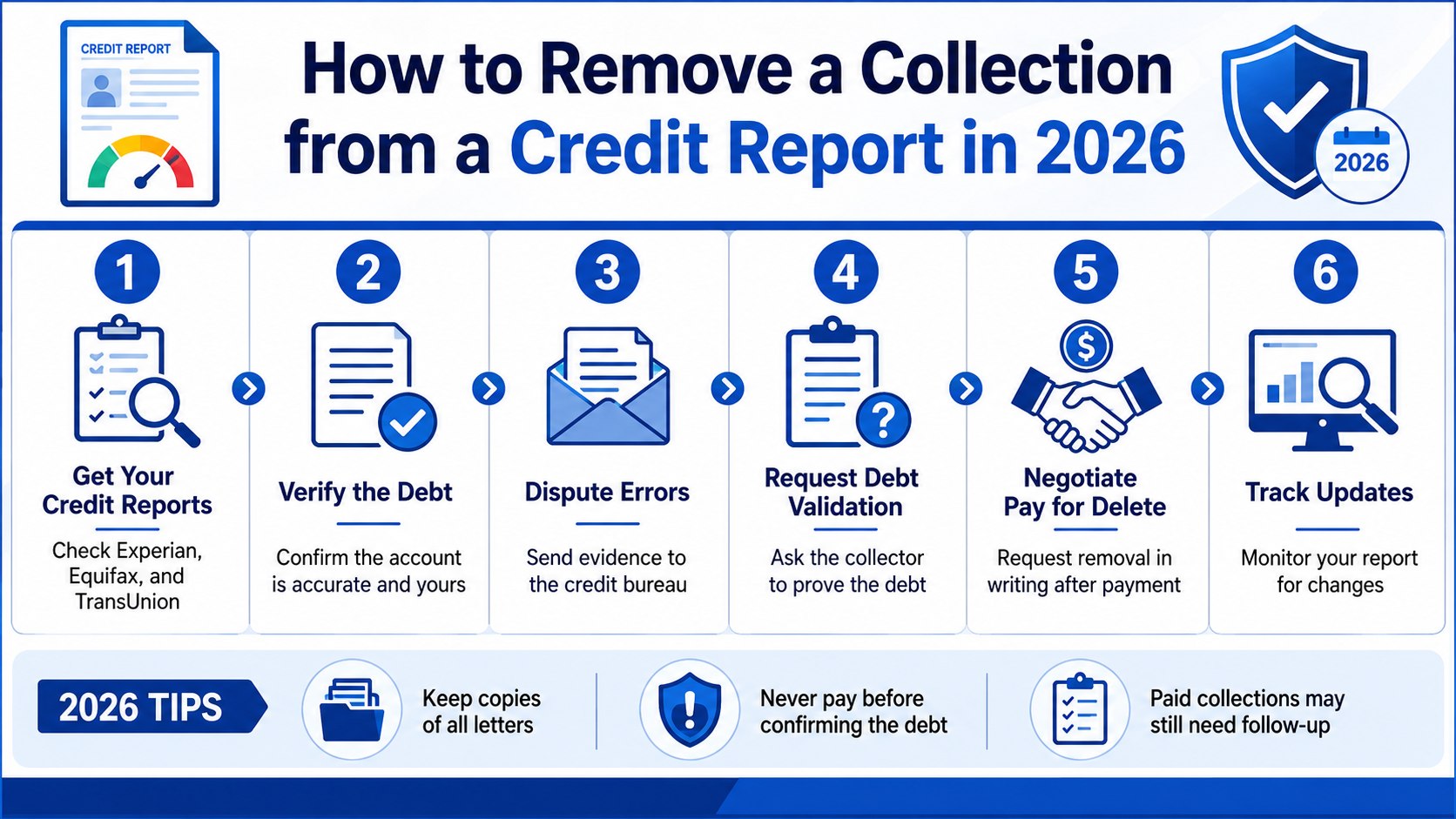
How to remove a collection from credit report 2026 through pay for delete
A pay-for-delete agreement is a negotiated arrangement. You pay all or part of a collection, and the debt collector agrees to ask the credit bureaus to delete its tradeline.
Federal law does not require collectors to offer this arrangement. Credit reporting standards generally favor complete and accurate reporting, so some agencies refuse deletion and only update the balance to $0.
Do not send payment based on a verbal promise. A representative’s statement during a telephone call may be difficult to enforce after the account is settled.
| Possible outcome | What the report may show | Main consideration |
|---|---|---|
| Full deletion | Collector’s tradeline disappears | Best negotiated outcome, but not guaranteed |
| Paid in full | $0 balance with paid status | Account may remain until the reporting period ends |
| Settled for less | $0 balance with settled status | May be viewed differently by lenders |
| Dispute deletion | Entry disappears after failed verification | Appropriate only when information is inaccurate or unverifiable |
| No agreement | Original collection remains | Consumer keeps funds and can consider another strategy |
Deletion offers vary by agency, creditor contract, account age, balance, and internal policy. One collector may accept a lump-sum settlement, while another will report only “paid” or “settled.”
Pay-for-delete negotiations also do not erase the original creditor’s charge-off. A credit card issuer and a collection company can maintain separate tradelines connected to the same debt.
Before agreeing, identify which company is reporting the collection. Ask whether the proposed deletion covers all 3 bureaus or only the reports where the agency currently furnishes data.
A borrower planning a home purchase can use Baltimore Chronicle’s guide to getting pre-approved for a mortgage to understand why lenders inspect the complete file, not one score.
Step 1: Pull and compare all 3 credit reports
Obtain reports from Equifax, Experian, and TransUnion. Mark every collection and record the balance, account number, creditor name, status, and dates.
This matters because credit bureaus maintain separate databases. A deletion from Experian does not guarantee removal from Equifax or TransUnion.
A common mistake is checking only one report or using a credit-monitoring alert as proof. Review the underlying tradeline on every file.
Step 2: Verify the account before admitting or paying it
Compare the reported collection with your statements and correspondence. Confirm that the debt belongs to you, the amount is correct, and the collector has authority to collect it.
If the collector recently contacted you, review the validation notice. A written dispute sent within 30 days of the initial validation notice generally requires the collector to pause collection activity until verification is provided.
Do not casually acknowledge an old debt before checking state law. In states such as Maryland, Texas, California, and New York, limitation periods and revival rules can differ.
Step 3: Dispute inaccurate or unverifiable information
File a focused dispute with every bureau displaying an error. State the exact field that is wrong, explain the correct information, and attach supporting records.
Valid reasons may include mistaken identity, an incorrect balance, duplicate reporting, an impossible delinquency date, or an account already paid. The Consumer Financial Protection Bureau’s dispute guidance lists current submission channels for Equifax, Experian, and TransUnion.
A common mistake is writing only “not mine” or “please delete.” Specific evidence gives the bureau and furnisher a clear factual issue to investigate.
For a fuller paper-trail process, see Baltimore Chronicle’s guide to disputing a credit report error in 2026.
Step 4: Decide whether pay for delete is worth pursuing
If the debt is accurate and still reportable, decide whether deletion is more valuable than a basic paid or settled status. Mortgage applicants may have different priorities from renters or consumers rebuilding credit over several years.
Review your available cash before making an offer. A collector may discuss a lump sum, several payments, or the full balance, but no universal settlement percentage applies.
The common mistake is draining an emergency fund to improve a report immediately. Keep enough money for rent, mortgage payments, utilities, food, insurance, and transportation.
Step 5: Send a written pay-for-delete proposal
Contact the collector using the address shown on its notice or official website. Identify the account without providing unnecessary personal information.
Your proposal should state the amount you will pay, the deadline, and the reporting action requested. Ask the agency to delete its tradeline from Equifax, Experian, and TransUnion after cleared payment.
The letter should describe a conditional offer, not an immediate admission accompanied by money. Payment should follow only after authorized written acceptance.
A common mistake is sending a postdated check or giving unrestricted access to a checking account. Use a traceable payment method with clear authorization limits.
Step 6: Review the agreement before paying
Confirm that the response identifies the correct account, accepted amount, payment deadline, and deletion terms. Verify that the person signing or sending the agreement represents the collection agency.
Look for vague language such as “we may request an update” or “the account will be resolved.” That wording does not necessarily promise deletion.
A common mistake is assuming “paid,” “closed,” and “deleted” mean the same thing. Require the agreement to state the exact reporting action.
Step 7: Pay through a traceable method
Pay only after receiving acceptable terms. Save the agreement, payment confirmation, bank record, receipt, and correspondence.
This documentation matters if the collector updates the balance but fails to request deletion. It also helps if the account is sold or transferred unexpectedly.
Avoid paying by cash, gift card, cryptocurrency, or another method that produces a weak paper trail. Legitimate collectors should provide standard payment options.
Step 8: Check the reports and escalate failures
Allow time for the collector and bureaus to process the update, then pull all 3 reports again. Compare the new reports with the written agreement.
If the account remains, contact the collector with the agreement and payment proof. You may also dispute the remaining tradeline with each bureau displaying it.
A common mistake is monitoring only the credit score. Confirm whether the collection itself was deleted, updated, re-aged, or moved to another company.
“You generally cannot have negative information removed from your credit report if it is accurate.”
Consumer Financial Protection Bureau, consumer guidance on accurate negative credit information.

Troubleshooting collection removal problems
Collection cases often stall because the consumer used the wrong process, paid too early, or failed to preserve evidence. Match the response to the actual problem.
- The collector refuses pay for delete: negotiate a paid or settled status, or wait for lawful expiration.
- The collection is not yours: dispute ownership and consider the identity-theft process if fraud is involved.
- The balance is wrong: request an itemization and dispute the exact dollar discrepancy.
- The collector broke its written promise: send the agreement and payment proof to the collector and bureaus.
- The collection disappeared and returned: preserve earlier reports and challenge unsupported reinsertion.
A refusal does not make the collection inaccurate. Do not file a false dispute merely because a collector declined your offer.
Accurate negative information can generally remain for about 7 years from the applicable delinquency date. Paying the account does not restart the federal credit-reporting period.
State statutes of limitations govern lawsuits and can differ from credit-reporting periods. Before making statements or payments on an old account, check the law in your state or consult a consumer attorney.
The Federal Trade Commission warns consumers against companies promising guaranteed deletion of accurate information. Its credit repair guidance explains that legitimate disputes can be completed without paying a credit repair company.
FAQ about collection removal in 2026
Does paying a collection remove it from a credit report?
No. Payment usually changes the balance to $0 and may change the status to paid or settled. Deletion requires a separate reporting decision, a successful dispute, or expiration of the reporting period.
Is pay for delete legal in 2026?
Consumers may negotiate payment terms, including a deletion request. However, collectors are not legally required to accept, and many follow policies against deleting accurate information.
How much should I offer for pay for delete?
There is no standard percentage. The amount depends on the balance, age, owner, collector policy, and your ability to make a lump-sum payment.
Can I remove a collection without paying?
Yes, when the information is inaccurate, duplicated, obsolete, belongs to someone else, or cannot be verified. Accurate and timely information generally cannot be deleted simply because it is damaging.
How long does collection removal take?
A credit bureau investigation generally takes about 30 days, with some cases extending to 45 days. Negotiated deletion timing depends on the collector and its reporting cycle.
Will removing a collection increase my credit score?
It may, but no specific increase is guaranteed. The result depends on the scoring model, age of the collection, other derogatory accounts, balances, payment history, and overall file.
Earlier we wrote about How to Install a Ceiling Fan Yourself in 2026: Wiring and Mounting Steps