

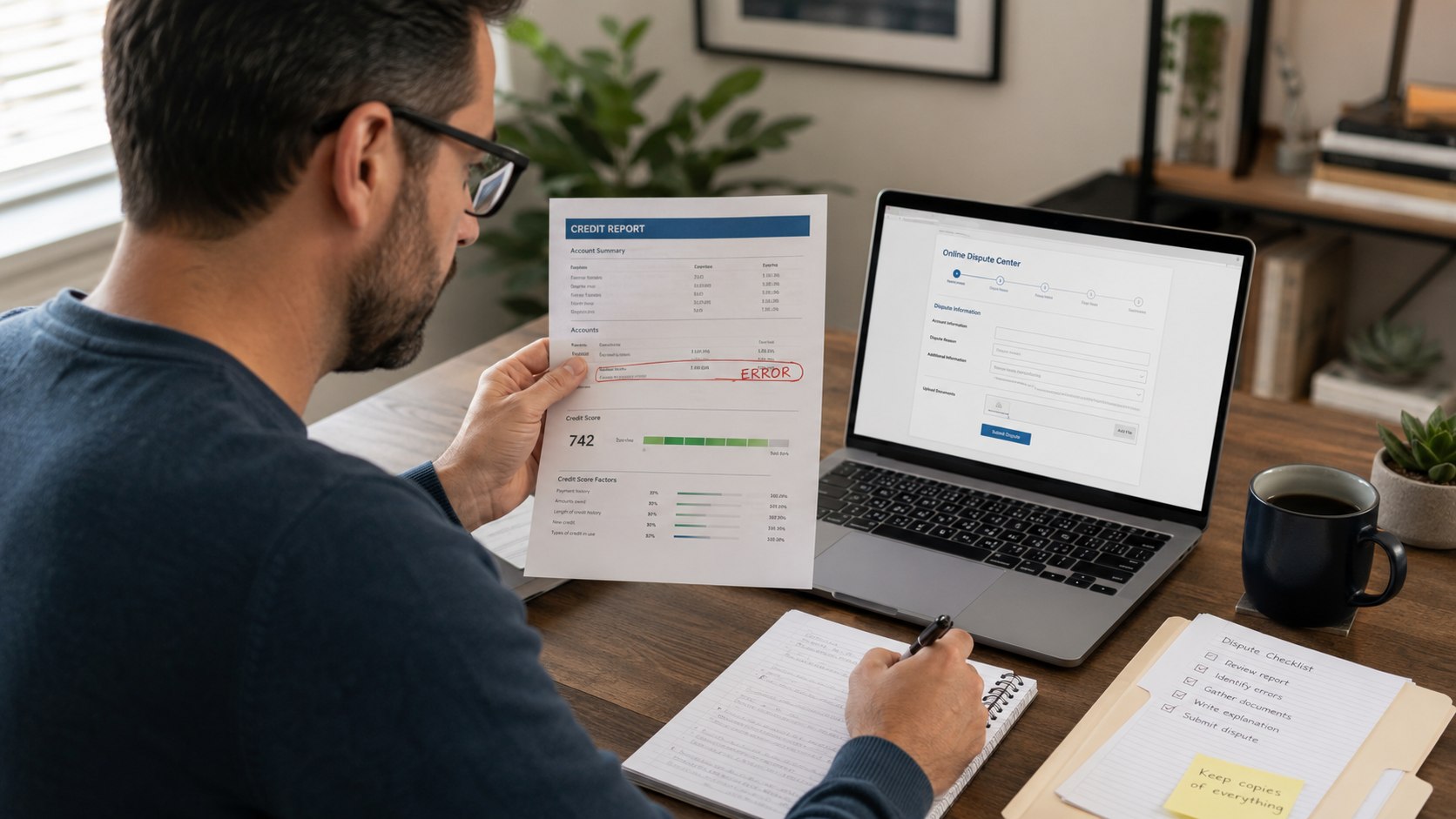
How to dispute a credit report error 2026 starts with identifying the exact inaccurate entry, collecting proof, and filing separate disputes with the credit bureau and the company that supplied the data. An online dispute may take 20–40 minutes, while a mailed dispute requires printing, tracking, and several delivery days, as the Baltimore Chronicle editorial team notes.
You do not need a credit repair company or a paid subscription. Disputing inaccurate or incomplete information is free. Credit bureaus generally must investigate a dispute within 30 days, although some cases may take up to 45 days.
Key takeaways
- Dispute the same error with every bureau displaying it because Equifax, Experian, and TransUnion maintain separate files.
- Send focused evidence, including statements, receipts, court records, identity documents, or account correspondence.
- Track every submission date because the investigation period begins when the credit bureau receives your dispute.
A dispute can correct a mixed credit file, duplicate account, false late payment, incorrect balance, unauthorized hard inquiry, or identity-theft account. It cannot lawfully erase negative information merely because that information damages your score.
Accurate late payments and collections usually remain until the applicable reporting period expires. A legitimate dispute focuses on information that is wrong, incomplete, duplicated, outdated, or unverifiable.
Before contacting a bureau, review this guide to checking your credit score and reports for free.
What you need before filing a credit report dispute
Build a small evidence file before opening an online dispute portal or mailing anything. Organized documentation makes your position easier to understand and reduces the risk of an automated rejection.
You may need:
- a current credit report from Equifax, Experian, or TransUnion;
- the report or confirmation number shown on that report;
- a government-issued ID, such as a driver’s license or state ID;
- proof of address, including a utility bill or bank statement;
- account statements, payment confirmations, canceled checks, or settlement letters;
- bankruptcy orders, court records, police reports, or identity-theft records;
- access to a secure online account or a printer and envelopes;
- about 30–60 minutes for preparation and later follow-up.
Use copies rather than original documents for a mailed dispute. Save digital records as clearly named PDF files, such as “Chase-June-2026-payment-confirmation.pdf.”
Black out unrelated account numbers and transactions where possible. Leave visible only the information required to verify your claim.
Keep the final dispute concise enough for an investigator to identify the problem immediately. Store the report, evidence, confirmation, and every response in one folder.
An effective dispute does not argue that an entry is unfair. It identifies what is inaccurate, explains the correct information, and proves the difference.
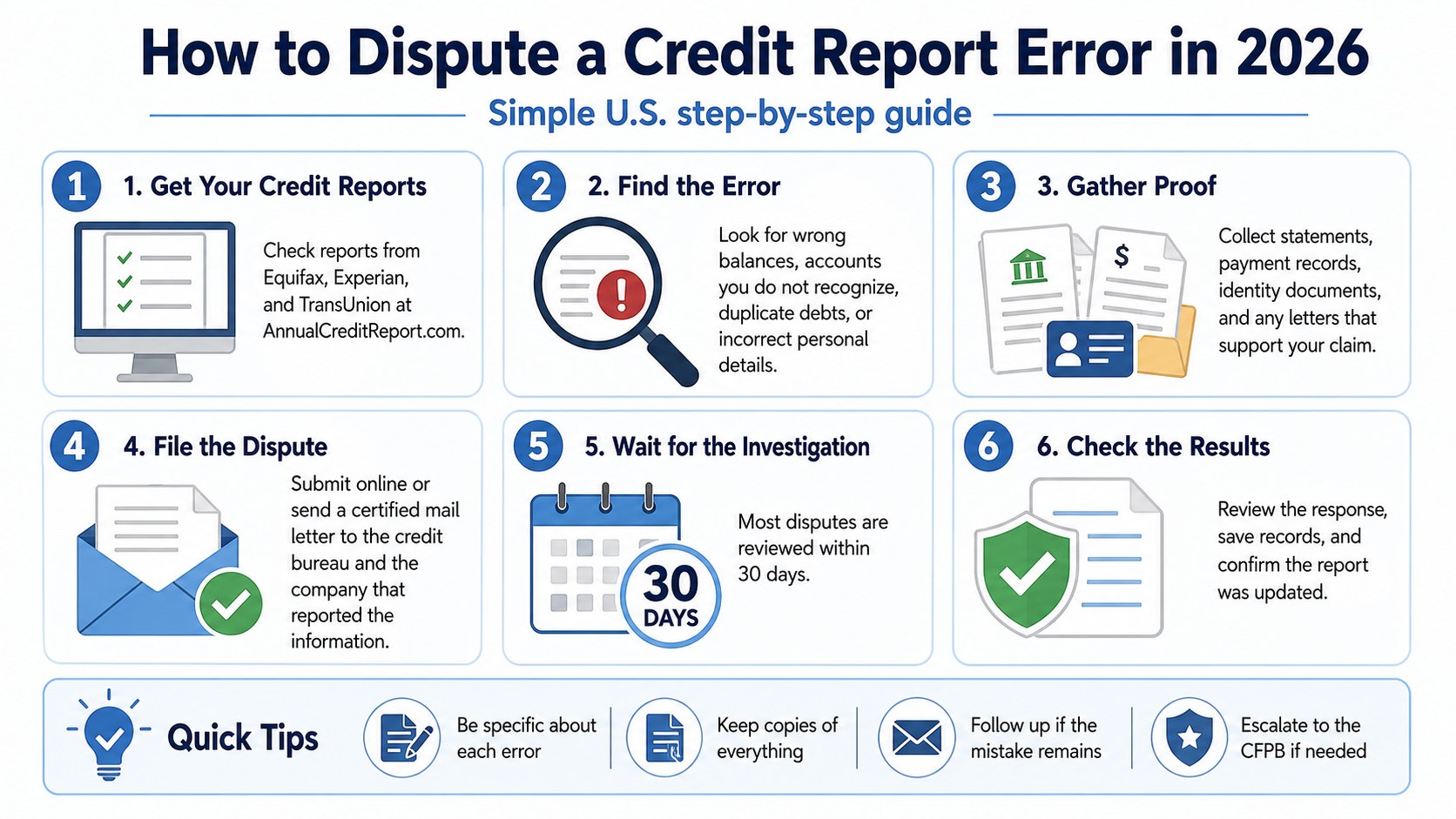
Step 1: Pull all 3 credit reports
Obtain reports from Equifax, Experian, and TransUnion because an error may appear on 1 report but not the others. Compare names, addresses, employers, account numbers, balances, payment histories, inquiries, collections, and public records.
This matters because filing with Experian will not automatically open a dispute at Equifax or TransUnion.
A common mistake is checking only the score shown inside a banking app. Such apps may not display the underlying report entry or all information used by lenders.
Step 2: Identify the exact error and requested correction
Write down the creditor name, partial account number, disputed field, current value, correct value, and reason for the correction.
For example:
“The report shows a 30-day late payment for March 2026, but the attached statement confirms payment before the due date.”
Precision matters because broad complaints can be treated as vague or unsupported. Avoid writing only “This account is wrong” without identifying the specific problem.
State whether the dispute concerns ownership, payment status, balance, account dates, duplication, or another field.
Readers preparing for a home purchase should also review credit score requirements for buying a house in 2026. Correcting a material error before mortgage preapproval may prevent avoidable underwriting or pricing problems.
Step 3: Choose an online or mail dispute
Online filing is faster and usually provides an immediate confirmation number. Mail creates a physical record and gives you greater control over the wording, attachments, and order of documents.
| Method | Best for | Main advantage | Primary risk |
|---|---|---|---|
| Online portal | Simple balance, status, or identity errors | Fast upload and status tracking | Limited categories or explanation fields |
| Certified mail | Complex disputes with extensive evidence | Detailed paper trail and delivery proof | Longer preparation and delivery time |
| Both methods | Escalation after an incomplete response | Multiple documented contact points | Duplicate submissions may cause confusion |
| Direct furnisher dispute | Errors created by a lender or collector | Reaches the original data source | Does not replace bureau disputes |
Neither method guarantees a better result in every case. Online portals work well when the issue matches one of the available dispute categories.
Mail is often stronger when the explanation requires a timeline or several records. Certified Mail provides evidence of delivery, while a return receipt may provide additional confirmation.
Do not send simultaneous duplicate disputes unless later correspondence is clearly marked as supplemental evidence. Multiple identical submissions can complicate tracking and create inconsistent responses.
Choose the method that best matches the complexity of the error and the amount of evidence.
Step 4: File the dispute with each credit bureau
Open the dispute portal shown on the bureau’s official website or use the mailing address printed on your current report.
Your submission should include:
- your full legal name and current address;
- enough identification to confirm your identity;
- the report or confirmation number;
- the creditor name and partial account number;
- a clear description of the error;
- the correction you are requesting;
- copies of supporting evidence.
The Consumer Financial Protection Bureau publishes current bureau contact methods and explains the process on its official credit report dispute page.
Mailing addresses and telephone numbers can change. Verify the current contact details before sending a 2026 dispute.
Submit a separate dispute to every bureau reporting the error. A common mistake is selecting a generic reason from an online menu without attaching evidence or adding a factual explanation.
Step 5: Contact the company that reported the information
Send a direct dispute to the bank, credit card issuer, auto lender, mortgage servicer, landlord screening company, collection agency, or other data furnisher.
State which bureau displays the error and provide the same core evidence.
This matters because both the credit bureau and the company supplying the data have responsibilities regarding inaccurate or incomplete reporting.
For example, a Wells Fargo, Chase, Capital One, Bank of America, or Synchrony account may appear differently across reports. Review the name of the actual issuer before sending correspondence.
Do not send the dispute only to a retail store when the account is issued and reported by a partner bank. The correct data furnisher is usually identified on the credit report.
Step 6: Keep proof and track the investigation deadline
Record the submission date, delivery date, confirmation number, bureau name, disputed item, and expected response date.
Save screenshots of every online confirmation page before closing the browser. For mailed disputes, keep the postal receipt and tracking record.
A credit bureau generally has 30 days after receiving the dispute to investigate. The period may extend to 45 days in certain situations, including when additional relevant information arrives during the initial review.
After completing the investigation, the bureau generally has 5 business days to notify you of the result.
“A credit reporting company generally must investigate the dispute within 30 days of receiving it.”
Consumer Financial Protection Bureau, guidance on credit report investigations.
Do not assume that a disappearing credit-score alert means the underlying report was corrected. Wait for the investigation result and inspect a new report.
Step 7: Review the result and verify all 3 reports
Read the investigation notice carefully. The result may state that the information was deleted, updated, verified as accurate, or considered unrelated to the dispute.
Check the revised account status, balance, payment history, dates, ownership information, and comments. One field may be corrected while another inaccurate field remains.
Avoid relying only on a score increase. Credit scores can change because of balances, inquiries, account age, and differences between scoring models.
Home buyers can compare the corrected file with the options described in this guide to buying a house with bad credit in 2026.
Mortgage lenders may use scoring models that differ from those shown by free consumer services. The report itself is therefore more important than a single app score.
Step 8: Escalate an unresolved or reinserted error
If the result is incorrect, send a new dispute that directly addresses the bureau’s stated reason for verification.
Add evidence that was not previously considered. Explain why the first investigation did not resolve the factual conflict.
You may also submit a CFPB complaint after first disputing directly with the credit reporting company. The CFPB generally expects consumers to complete that direct dispute process before filing a complaint about inaccurate report information.
You can request that a statement of dispute be added to your file when the investigation remains unresolved.
Consider consulting a consumer attorney when a serious error causes:
- a mortgage denial;
- a rental rejection;
- an employment problem;
- an insurance price increase;
- repeated financial losses;
- continued reporting after several documented disputes.
Avoid companies promising a “credit sweep” or guaranteed deletion. Accurate negative information cannot lawfully be removed merely because a consumer pays a third party.

Troubleshooting common credit report dispute problems
Many unsuccessful disputes fail because of incomplete evidence, incorrect recipients, or unclear wording.
- The bureau says the account was verified: ask what information was reviewed and submit records showing the exact contradiction.
- The error appears again: preserve the earlier deletion notice and dispute the reinsertion with that notice attached.
- The online upload fails: reduce the PDF size, use a supported format, or send the package by tracked mail.
- The account resulted from identity theft: use the official identity-theft process and include the required report and identification.
- A lender decision is approaching: notify the lender, but do not assume the bureau can complete an investigation immediately.
A new dispute should add substance instead of repeating the original claim. Number every attachment and refer to that number in your letter.
Keep the chronology clear, especially when several payments, transfers, or ownership changes are involved. If a creditor changed ownership, verify which company currently reports the account.
Escalate only after preserving the earlier submission, evidence, response, and delivery confirmation.
FAQ about disputing credit report errors in 2026
Does it cost money to dispute a credit report error?
No. Filing a dispute with a credit bureau or data furnisher is free.
A company charging hundreds of dollars does not receive dispute rights that are unavailable to consumers.
Is an online dispute better than certified mail?
Online filing is usually faster for straightforward errors. Certified mail may be preferable for complex cases involving detailed explanations, multiple records, or proof of delivery.
The most appropriate method depends on the complexity of the error.
Will filing a dispute lower my credit score?
Submitting a dispute does not function like a hard credit inquiry.
The score may change after an investigation if account information is corrected, deleted, or updated.
Can I remove an accurate late payment through a dispute?
Generally, no. Accurate negative information cannot be removed only because it damages your score.
You may dispute the account when another part is wrong, such as the payment date, balance, account ownership, or duplicate reporting.
What happens if the bureau calls my dispute frivolous?
Review whether the claim identifies a specific error and includes relevant evidence.
Resubmit only after correcting the weakness, adding new documentation, or explaining the factual issue more clearly.
Should I dispute directly with the creditor?
Yes, when the creditor, lender, or collector supplied the incorrect information.
Contacting the furnisher does not replace filing with every bureau displaying the error.
Earlier we wrote about Should You Sell Your House Without a Realtor in 2026? Costs and Risks Compared