


Best motivational quotes for buying first home should calm the decision, not push buyers into a mortgage they cannot afford. This 2026 list favors lines about home, restraint, independence, and practical ownership, as noted by the Baltimore Chronicle editorial team.
A good quote can steady a buyer before an offer, inspection, or closing. It cannot replace a budget. The CFPB says closing costs typically run 2% to 5% of the purchase price, excluding the down payment. Buyers should therefore treat motivation as fuel for preparation, not permission to stretch finances.
Key takeaways
- The strongest home-buying quotes encourage patience, independence, and realistic spending rather than emotional bidding.
- In 2026, mortgage rates and closing costs make disciplined budgeting more useful than waiting for a perfect moment.
- First-time buyers should connect inspiration with pre-approval, cash reserves, inspections, and lender comparisons.
Buying a first home usually mixes excitement with uncertainty. That tension is normal because the decision affects years of monthly cash flow. A quote works best when it points toward a useful action. Some encourage patience before making an offer, while others remind buyers that the value of a home extends beyond square footage.
Why home-buying motivation feels different in 2026
The American housing market still makes small financial decisions matter. Mortgage rates remain a major factor in affordability, and even a small difference can affect the monthly payment over a 30-year loan.
Cash at closing creates another pressure point. The Consumer Financial Protection Bureau recommends estimating closing costs before deciding the maximum down payment. Its planning range is generally 2% to 5% of the purchase price.
For a first-time buyer, the most useful motivation is not “buy at any cost.” It is “prepare until the numbers and the home both make sense.”
That distinction matters in California, Texas, Florida, Maryland, or Ohio alike. Property taxes, insurance, HOA charges, and local prices can change the real monthly cost. The right quote should support financial preparation, not distract from it.
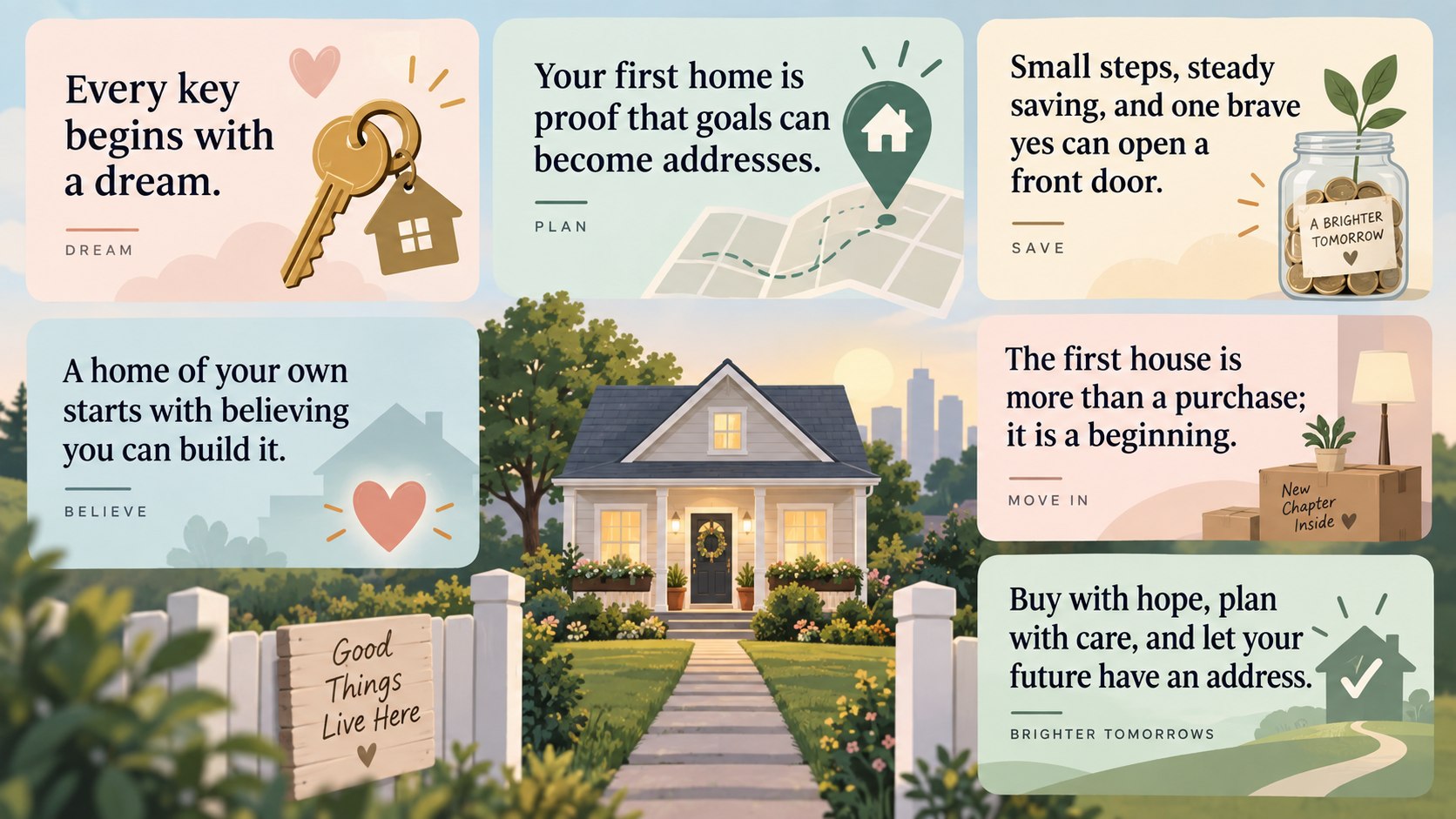
Best motivational quotes for buying first home: 8 picks for 2026
1. “There is nothing like staying at home for real comfort.” — Jane Austen
“There is nothing like staying at home for real comfort.”
Jane Austen put the line in Emma, first published in 1815. The sentence still captures a reason people buy: control over a personal living space.
It stands out in 2026 because buyers can become fixated on rates, listings, and resale estimates. Comfort remains part of the purchase. A cheaper property that fits daily life may serve a household better than a larger home that strains its budget.
2. “Nothing is cheap that we do not want.” — attributed to Benjamin Franklin
Lydia Maria Child included this maxim in The American Frugal Housewife in 1832 and attributed it to Franklin.
The idea belongs on any list of first-time home buyer quotes. A discounted appliance, upgraded countertop, or larger house is not a bargain when it solves no real need. That lesson is especially useful after closing, when new owners often face furniture, repairs, and moving expenses at once.
3. “It is better to go without, than to have them at too great a cost.” — Ralph Waldo Emerson
“It is better to go without, than to have them at too great a cost.”
Emerson wrote the line while discussing economy and the pressures created by expensive domestic expectations. His argument was broader than mortgages, but the principle translates neatly.
In 2026, bidding another $15,000 for a house can affect more than the sale price. Financing magnifies that choice through interest, taxes, and possibly insurance. The quote stands out because walking away can be a financially successful decision.
4. “Insist on yourself; never imitate.” — Ralph Waldo Emerson
Emerson’s short instruction appears in his essay “Self-Reliance.” In housing terms, it challenges a familiar trap: buying the house other people expect rather than the property that fits actual needs.
A freelancer may value an office more than a formal dining room. Parents may prioritize a shorter school commute. A household with 2 cars may need off-street parking more than an extra bedroom. That makes this one of the more useful pieces of homeownership motivation for 2026.
5. “The word home has in it the elements of love, rest, permanency, and liberty.” — Harriet Beecher Stowe
Stowe explored the difference between merely keeping a house and creating a home in House and Home Papers. Her description links home with emotional qualities rather than market value.
That distinction can help during a listing search. Granite counters photograph well, but neighborhood noise, commute time, storage, layout, and outdoor space often shape daily satisfaction more strongly. In 2026, the quote is useful because it pushes buyers beyond listing-page aesthetics.
6. “The ornaments of a home are the friends who frequent it.” — attributed to Emerson
The line has long circulated under Emerson’s name and appears with that attribution in early quotation collections. Its appeal is practical even without treating décor as irrelevant.
A first house does not need to look finished on moving day. Leaving cash available for repairs can matter more than immediately filling every room. That makes the line useful first home buying advice for households tempted to spend heavily after receiving the keys.
7. “Owning a home can give you stability and security.” — CFPB
“Owning a home can give you stability and security.”
The CFPB uses similar language in consumer home-buying guidance. The agency also stresses responsibilities such as repairs, property taxes, insurance, and possible HOA dues.
That pairing makes the message useful in 2026. It offers encouragement without pretending ownership is free after closing. Stability comes from a payment structure a household can continue carrying when the water heater fails or an insurance premium rises.
8. “Your down payment can be as low as 3.5% of the purchase price.” — HUD
This is less poetic, but sometimes a concrete fact motivates more effectively than a slogan. HUD states that qualifying FHA borrowers can have a down payment as low as 3.5% on eligible properties.
The Department of Housing and Urban Development also notes that state and local programs may help with down payments. That matters for buyers who assume 20% down is always required. FHA financing still involves qualification rules and mortgage insurance, so the lowest upfront percentage is not automatically the cheapest long-term option.
How to turn a good quote into a first-home plan
Motivation becomes useful when it changes the next decision. Before saving another property on Zillow, Redfin, or Realtor.com, attach the quote to a specific financial task.
- Set a maximum monthly housing payment that includes taxes, insurance, mortgage insurance, and HOA dues.
- Keep closing cash separate from the emergency fund and moving budget.
- Request comparable Loan Estimates from multiple lenders using the same loan assumptions.
- Get pre-approved before treating any listing price as affordable.
- Budget for inspection findings rather than assuming the seller will repair everything.
- Review escrow, insurance, and tax obligations before signing final documents.
A lender’s approval ceiling is not a household spending target. The monthly payment should still leave room for groceries, transportation, retirement savings, and repairs. New furniture can wait after closing. Emergency plumbing usually cannot.
Comparing lenders deserves time because rate, points, origination fees, and mortgage insurance can differ. CFPB rules generally require a lender to provide a Loan Estimate within 3 business days after receiving the required application information.
A home inspection should remain separate from the emotional appeal of the property. Roof age, drainage, HVAC condition, foundation issues, and electrical work can change the real cost. Buyers should also verify flood or wildfire exposure where relevant. Insurance availability deserves attention before the closing date.
Finally, the quote should survive a bad listing. If one house disappears, the buying plan should remain intact. That is stronger motivation than falling in love with an address before underwriting is finished.
What first-time buyers should compare before making an offer
The listing price is only one number. A useful comparison includes cash needed today, recurring costs, and financial flexibility after closing.
| Decision | What to compare | Why it matters in 2026 |
|---|---|---|
| Mortgage | Rate, APR, points, lender fees | Small pricing differences can change long-term borrowing costs |
| Down payment | Cash required versus monthly cost | Lower down payments can preserve savings but may add insurance costs |
| Closing | Estimated cash to close | CFPB guidance commonly uses roughly 2% to 5% before down payment |
| Property | Inspection, roof, HVAC, plumbing | Deferred repairs can consume cash shortly after moving |
| Location | Taxes, insurance, commute, HOA | Similar sale prices can produce very different monthly bills |
A $350,000 listing is not automatically more affordable than another $350,000 property. Local taxes can change the monthly payment considerably. Insurance can produce another large difference between states and counties. HOA dues may sit outside the mortgage payment. Repairs can arrive before a buyer rebuilds depleted savings.
The best first home is not necessarily the maximum house a lender will finance. It is the home whose payment still leaves room for ordinary life.
This is where motivational quotes for new homeowners should remain grounded. Inspiration can encourage saving another month. It can support walking away from a bidding war. It can also remind buyers why they started searching. None of those benefits require turning caution into fear.

Honorable mentions
Some lines deserve a place on the refrigerator rather than a mortgage worksheet. These 3 work best as reminders about the meaning of home.
- “Stay, stay at home, my heart, and rest.” — Henry Wadsworth Longfellow.
- “Home is the grandest of all institutions.” — attributed to Charles Spurgeon.
- “Begin humbly.” — Lydia Maria Child.
The common theme is restraint rather than status. A starter home does not need to impress everyone. It needs to work for the people paying for it. The same principle applies to furnishings after closing. Ownership becomes easier when cash reserves survive moving day.
FAQ
What is a good motivational quote for buying a first home?
Jane Austen’s “There is nothing like staying at home for real comfort” works because it focuses on the purpose of housing. Buyers seeking a financial reminder may prefer Emerson’s warning against obtaining things “at too great a cost.”
How much should a first-time buyer save before purchasing?
There is no single dollar amount for every buyer. Savings may need to cover the down payment, closing expenses, moving costs, inspections, immediate repairs, and an emergency reserve. CFPB guidance places typical closing costs around 2% to 5% of the purchase price, excluding the down payment.
Do first-time home buyers need 20% down in 2026?
No. HUD says eligible FHA borrowers may qualify with a 3.5% down payment. Conventional, VA, USDA, and state programs have different requirements, so buyers should compare total loan costs rather than only the minimum down payment.
Can motivational quotes actually help with home buying?
They can help frame a decision, but they do not determine affordability. The useful ones reinforce patience, realistic spending, and the reasons a household wants a home. Financial documents should decide whether a specific property fits the budget.
What should a buyer do before making an offer in 2026?
Set a complete housing budget, obtain mortgage pre-approval, compare lenders, and keep enough cash for closing and emergencies. Then evaluate taxes, insurance, HOA fees, inspection risks, and the neighborhood before deciding the offer price.
Earlier we wrote about Which Apple Watch Is Worth Buying in 2026? Series 11 and Ultra 3 Prices, Sizes and Battery Compared