


How to find a primary care doctor in USA 2026 comes down to 3 checks: confirm the doctor is in your insurance network, verify the office accepts new patients, and compare practical details before booking. A focused search can take 30–60 minutes, although the first available appointment may be days or weeks later. That distinction matters because an insurer’s directory can list a physician without confirming current availability, as the Baltimore Chronicle editorial team notes.
Start with the directory inside your insurance account, not a general Google search. Then call the doctor’s office and ask staff to verify your exact plan, including the network name printed on your insurance card. Reviews can help assess communication and office management, but they should come after insurance status and medical fit.
Key takeaways
- Search your insurer’s network first, then confirm participation directly with the medical office before scheduling an appointment.
- Compare appointment access, hospital affiliation, location, telehealth options, and review patterns instead of choosing by star rating alone.
- Ask what a new-patient visit may cost under your plan, especially if you have a deductible or use self-pay.
These checks prevent 2 common problems: discovering that a doctor is unavailable after completing registration, or receiving an unexpected out-of-network bill. HMO, PPO, EPO, Medicare Advantage, Medicaid, and employer plans can use different provider networks even within the same insurance company. A physician who accepts one Aetna or UnitedHealthcare plan may not participate in another.
Insurance rules also affect referrals. An HMO or POS plan may require a designated primary care provider before specialist care. PPO plans usually offer more flexibility, although using an out-of-network physician can raise the patient’s share of the bill. The Baltimore Chronicle guide to PPO and HMO plans in 2026 explains those network differences in more detail.
The best primary care doctor is not necessarily the physician with the highest online rating. Access, insurance participation, clinical fit, and reliable follow-up matter more.
What you need before searching
Collect the basic information first. It makes insurer searches faster and gives office staff enough detail to confirm coverage correctly.
- Your current insurance card and member ID.
- The exact plan name, such as HMO, PPO, EPO, Medicare Advantage, or Medicaid managed care.
- Your ZIP code and acceptable driving distance.
- A list of ongoing medications and major medical conditions.
- Names of preferred hospitals or health systems, if relevant.
- Your preferred doctor type, language, gender, office hours, or telehealth availability.
- 30–60 minutes for searching and phone verification.
Do not rely only on the insurance brand printed prominently on the card. Large carriers operate multiple networks in the same state. The network or product name may determine whether the visit receives in-network pricing.
People moving between states should be especially careful. A plan used in Maryland may have different provider access than coverage in Texas, California, Florida, or New York. Marketplace plans can also have narrower regional networks than some employer-sponsored PPOs.
“You can choose any available primary care provider in your insurance plan’s network.”
HealthCare.gov, U.S. Centers for Medicare & Medicaid Services, guidance on doctor choice and network protections.
The federal HealthCare.gov doctor-choice guidance confirms that patients generally may select an available primary care provider within their plan’s network.
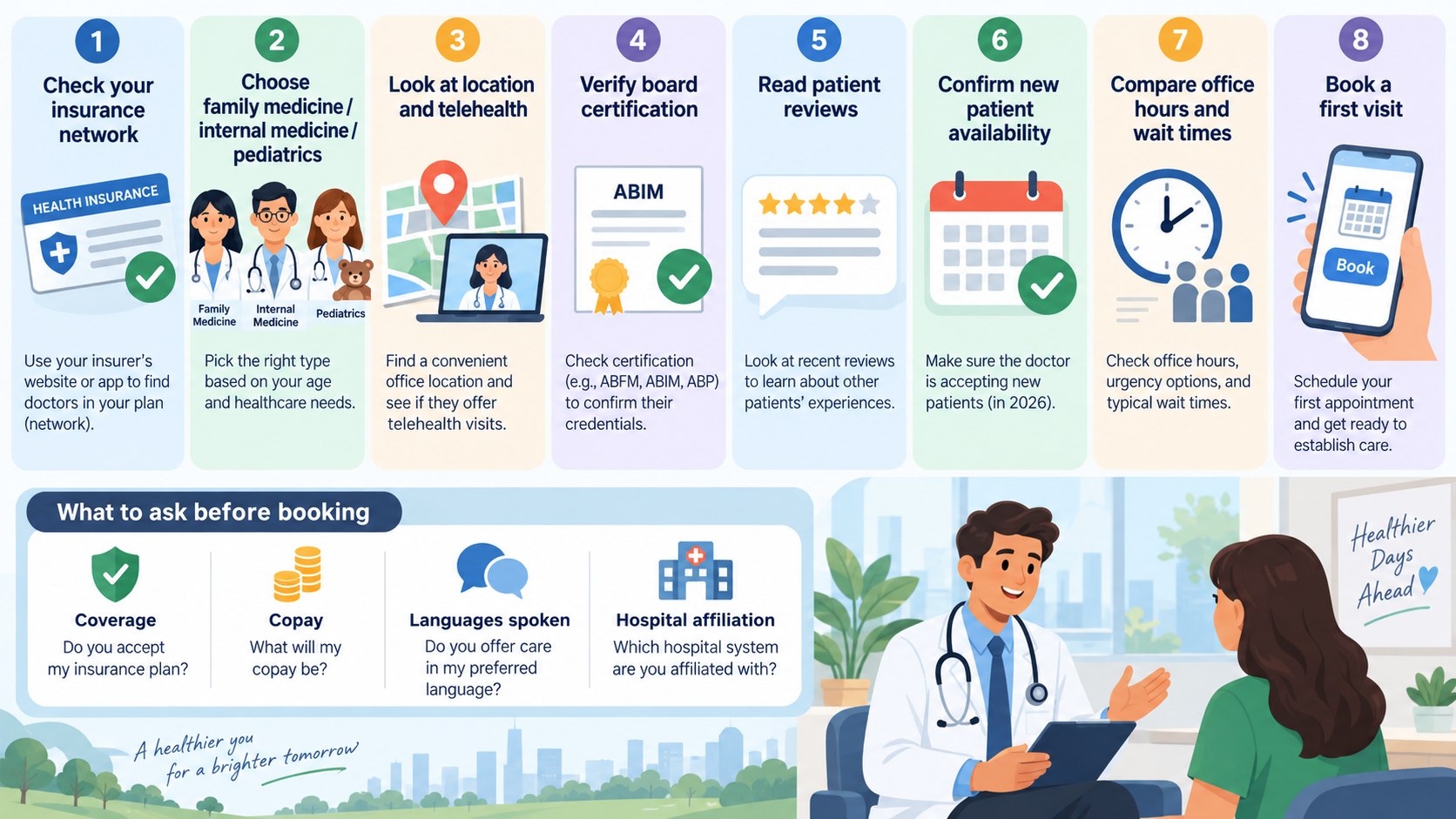
Step 1: Start with your insurance provider directory
Log in to the insurer’s website or mobile app and search for family medicine, internal medicine, general practice, or primary care. Common national brands include Aetna, Cigna, UnitedHealthcare, Humana, and Blue Cross Blue Shield companies, while availability varies by state and plan.
This step matters because the insurer’s network determines the negotiated rate for most covered services. A physician appearing on Google Maps does not prove that your specific policy covers the visit.
A common mistake is searching only the insurance company’s name. Confirm the full plan and network with the physician’s billing staff before the appointment.
Step 2: Choose the right type of primary care provider
Primary care is broader than one medical specialty. HealthCare.gov defines a primary care provider as a professional who provides or coordinates a range of health services, subject to state law and plan terms. That may include physicians and certain advanced-practice clinicians.
| Provider type | Typical fit | Useful when |
|---|---|---|
| Family medicine | Adults and children | A household wants broad care from one practice |
| Internal medicine | Adults | You have several adult health conditions or medications |
| Pediatrics | Children and teenagers | You need a primary doctor for a child |
| Geriatric medicine | Older adults | Medication management and age-related conditions are priorities |
| Nurse practitioner or physician assistant | Varies by practice and state | You want routine primary care with potentially broader appointment access |
The specialty should match the patient’s actual needs. An adult with diabetes, hypertension, and several prescriptions may prefer internal medicine. A parent seeking one practice for several family members may favor family medicine.
Provider credentials also deserve a quick check. State medical boards provide licensing information, while practices usually publish education, specialty, and hospital affiliations. Board certification can add useful context, but it should not become the only selection criterion.
Location becomes important after the first visit. A highly rated doctor 45 miles away may be inconvenient for routine labs, prescription questions, or same-week illness appointments. A reliable practice 10 minutes from home can be more useful over several years.
For readers comparing large medical systems, the Baltimore Chronicle’s guide to Baltimore hospitals and specialist networks in 2026 shows why physician participation and hospital participation should be checked separately.
Step 3: Call the office before you book
Ask the receptionist or billing team to confirm your exact insurance plan. Give them the insurer, network name, and member information when requested.
- Ask whether the physician is accepting new patients.
- Confirm your exact insurance network is accepted.
- Ask for the earliest routine new-patient appointment.
- Check whether another clinician in the same practice can see you sooner.
- Ask whether telehealth is available for appropriate follow-up visits.
- Confirm whether referrals are handled electronically.
This phone call matters because directories can lag behind staffing changes, closed patient panels, and network updates. Medicare itself advises users to contact offices and verify practical information, including whether clinicians accept new Medicare patients.
Ask about appointment length if your medical history is complicated. Some offices separate annual preventive visits from visits addressing new symptoms. Mixing both purposes can also affect billing.
Do not assume that every clinician inside one building participates in the same plans. Hospital systems can employ hundreds of physicians under different contracts. Confirm the individual clinician whenever possible.
Keep the name of the staff member who confirmed coverage. It does not override the insurance contract, but it creates a useful record if conflicting information appears later.
Step 4: Check costs before the first visit
Insurance acceptance and in-network status are not the same question. Ask whether the doctor is in your exact network, not merely whether the office “takes” your insurer.
A routine visit can involve a copay, coinsurance, deductible responsibility, or no patient charge for qualifying preventive services. The amount depends on the contract, so there is no single national 2026 price for a primary care appointment.
Check your Summary of Benefits and Coverage for labels such as “primary care visit,” “specialist visit,” and “preventive care.” A plan might show a fixed copay, while another requires the patient to meet a deductible before coinsurance applies.
Self-pay patients should request the office’s cash price before booking. When a patient is not using insurance, federal rules generally require providers to provide a Good Faith Estimate when requested or when qualifying care is scheduled in advance. The exact estimate should come from the provider.
If a bill later differs from expectations, compare it with the insurer’s Explanation of Benefits before paying. The Baltimore Chronicle guide on how to negotiate medical bills in 2026 explains how itemized statements and insurer records can uncover billing problems.
Step 5: Read reviews without letting reviews choose for you
How to choose a primary care physician is partly a reputation question, but star averages are a weak shortcut. Google, Healthgrades, Zocdoc, Yelp, and hospital profiles may reveal repeated patterns, yet each platform captures a different patient population.
Look for themes across recent reviews. Repeated complaints about unanswered messages, rushed appointments, billing confusion, or 90-minute waits may signal an office-management problem. Repeated comments about careful explanations and reliable callbacks can be more useful than one emotional review.
Separate criticism of the doctor from criticism of parking, hospital billing, or insurer denials. Those problems may matter, but they do not measure clinical judgment.
Also check review dates. A practice that changed ownership, moved offices, or replaced front-desk staff in 2026 may operate differently from its 2022 profile.
“Call to verify general information, like office location, if they’re accepting new patients with Medicare, and if you need a referral.”
Medicare Care Compare, Centers for Medicare & Medicaid Services, guidance displayed with physician listings.
Step 6: Compare the finalists on practical details
Reduce the list to 2–4 candidates. Then compare the factors that will affect ordinary visits rather than concentrating only on credentials.
| Question | Why it matters | What to verify |
|---|---|---|
| Is the doctor in-network? | Changes patient cost | Confirm with insurer and office |
| Are new patients accepted? | Directory listings may remain visible | Call the practice |
| How soon is the first appointment? | Access can outweigh small rating differences | Ask for the actual next date |
| What hospital is used? | Important for coordinated care | Check hospital affiliation |
| How are urgent questions handled? | Matters between scheduled visits | Ask about portal messages and same-day care |
| Is telehealth offered? | Can reduce travel for suitable follow-ups | Confirm availability and insurance coverage |
No single answer needs to be perfect. A doctor who offers excellent access may work better than one whose next new-patient appointment is months away.
Parents may prioritize pediatric coordination and after-hours advice. Freelancers with high-deductible plans may care more about transparent pricing. Older adults may prefer a practice connected to their cardiologist, pharmacy records, and hospital system.
People who move frequently should ask how records are transferred. Electronic records do not automatically guarantee that every health system can retrieve the complete chart.
Distance should also be judged realistically. A 7-mile drive can mean very different travel times in rural Montana, suburban Texas, or central Los Angeles.
This comparison is where find an in-network primary care doctor becomes more useful than simply searching for the highest-rated physician nearby.
Step 7: Use the first appointment as the final test
Bring your insurance card, identification, medication list, allergies, vaccination records when available, and contact information for important specialists. Upload forms before arrival if the practice offers a patient portal.
During the visit, notice whether the clinician reviews medications, explains decisions clearly, and gives a workable plan for follow-up. Also check whether the office communicates test results through the portal, phone, or another method.
A primary care relationship is operational as much as medical. A skilled doctor is less useful when prescriptions, referrals, and messages repeatedly disappear inside the office system.
Do not feel locked into the first doctor you try. Patients can change primary care physicians, although some HMO and Medicare Advantage plans require the new PCP selection to be recorded with the insurer.
The practical goal is continuity. A good primary care office should make routine care, preventive screening, medication management, and specialist coordination easier over time.

Troubleshooting common problems
Finding a physician can stall even after a careful search. These are the most common situations and the next action that usually makes sense.
- No primary care doctors accepting new patients: expand the radius and ask large health systems for recently opened practices or newly hired clinicians.
- Insurer says in-network, office says otherwise: call the insurer and ask for confirmation using the physician’s name, address, and NPI when available.
- Next appointment is months away: ask about another doctor, nurse practitioner, or physician assistant within the same primary care group.
- Reviews are contradictory: focus on recurring recent patterns rather than isolated ratings or old complaints.
- You have Medicare: use Medicare Care Compare and confirm directly that the office accepts new patients under your coverage.
A network shortage may require several calls, especially in rural areas or fast-growing communities. Asking the insurer for help can produce options that do not appear near the top of a consumer search engine.
Patients with ongoing prescriptions should not wait until medication is nearly exhausted. Ask the previous clinician about an appropriate transition supply when moving or changing practices.
If several offices give conflicting network information, keep notes with dates and names. Insurance member services can often search by the provider’s National Provider Identifier.
Urgent symptoms should not be delayed while searching for a permanent PCP. Urgent care, telehealth, or emergency services may be appropriate depending on the severity of the problem.
For Medicare beneficiaries, the official Medicare Care Compare tool can search doctors and clinicians and provides location, specialty, affiliation, and other available information.
FAQ
How do I find a primary care doctor who takes my insurance?
Start inside your insurer’s provider directory. Search by ZIP code and primary care specialty, then call the medical office to confirm your exact network and new-patient status before booking.
What is the difference between family medicine and internal medicine?
Family physicians commonly care for children and adults. Internal medicine physicians primarily treat adults and may be a practical choice for people managing several adult medical conditions.
Can I choose a PCP outside my insurance network?
That depends on the plan. PPO coverage may include out-of-network benefits at a higher cost, while many HMO and EPO plans generally restrict nonemergency coverage to network providers.
How much does a primary care visit cost in the USA in 2026?
There is no reliable national price for every patient. Costs depend on negotiated insurance rates, copays, deductibles, coinsurance, visit complexity, tests, and location. Verify the amount with your insurer and medical office.
Should I trust Google reviews when choosing a doctor?
Use them as one input. Recent patterns involving communication, waiting times, billing, and follow-up can be useful, but ratings cannot confirm clinical quality or insurance participation.
What if every nearby primary care doctor has a long waiting list?
Expand the search radius and contact large medical groups. Ask whether another clinician in the practice has earlier appointments, including qualified nurse practitioners or physician assistants where appropriate.
Earlier we wrote about Best Interior Paint Brands 2026 USA: Sherwin-Williams Emerald Tops $100 as Behr Marquee Starts Near $54