

DHL clearance event on hold meaning is simple: your international package has reached customs processing, but clearance cannot move forward yet. The first step is to open DHL tracking, read the latest customs update, and check your email or phone for a request. Missing documents, unpaid import charges, an inspection, or incomplete shipment data are common causes, as the editors at Baltimore Chronicle note.
A hold does not automatically mean the parcel is lost or seized. It usually means DHL, U.S. Customs and Border Protection, or another government agency needs information, payment, additional time, or a compliance decision before release.
Key takeaways
The tracking message can look alarming, but the practical response is usually straightforward. Start with the shipment details rather than contacting several agencies at once.
- Check DHL tracking and messages first because the shipment may already show what is required for customs release.
- Prepare the commercial invoice, product description, declared value, country of origin, and proof of purchase if DHL requests them.
- Budget for duties and possible DHL customs-service charges because a clearance hold can involve additional costs.
Do not send documents to an address found in an unsolicited text message. Open DHL’s official website or use contact details connected to your authenticated shipment record. Customs requests can involve personal information, so verifying the request matters.
A seller may also be part of the solution. Incorrect invoices, vague product descriptions, and wrong declared values often require information from the shipper. For shipments arriving from Asia, Baltimore Chronicle’s guide to tracking a DHL package from China to the USA explains how international scans differ from domestic delivery updates.
Keep screenshots of the status and copies of documents you submit. Those records can help if the shipment later requires a merchant dispute or customs correction.
- A customs hold is usually a processing problem to solve, not proof that the shipment has disappeared.*
In plain English
Think of customs clearance like an airport document checkpoint for merchandise. The parcel may already be physically inside a DHL facility, but it cannot enter the normal delivery network until its import paperwork receives the required clearance.
The phrase DHL customs clearance on hold therefore describes a process status rather than a delivery location. A package can remain in the same warehouse while its documents move between DHL, CBP, the importer, and another government agency.
“Shipments may be held by customs authorities for several reasons such as missing or incorrect information or documentation.”
DHL Express, U.S. customs-clearance guidance.
DHL also lists security checks, physical inspections, and unpaid duties among possible reasons for a customs hold. Its guidance says clearance timing depends on the shipment, documentation, origin, value, and the customs authority involved. DHL’s official customs guidance explains the process in more detail.
This distinction matters when comparing DHL Express with slower merchant services. Baltimore Chronicle’s DHL Express versus DHL eCommerce comparison explains why the 2 networks can produce very different transit patterns.
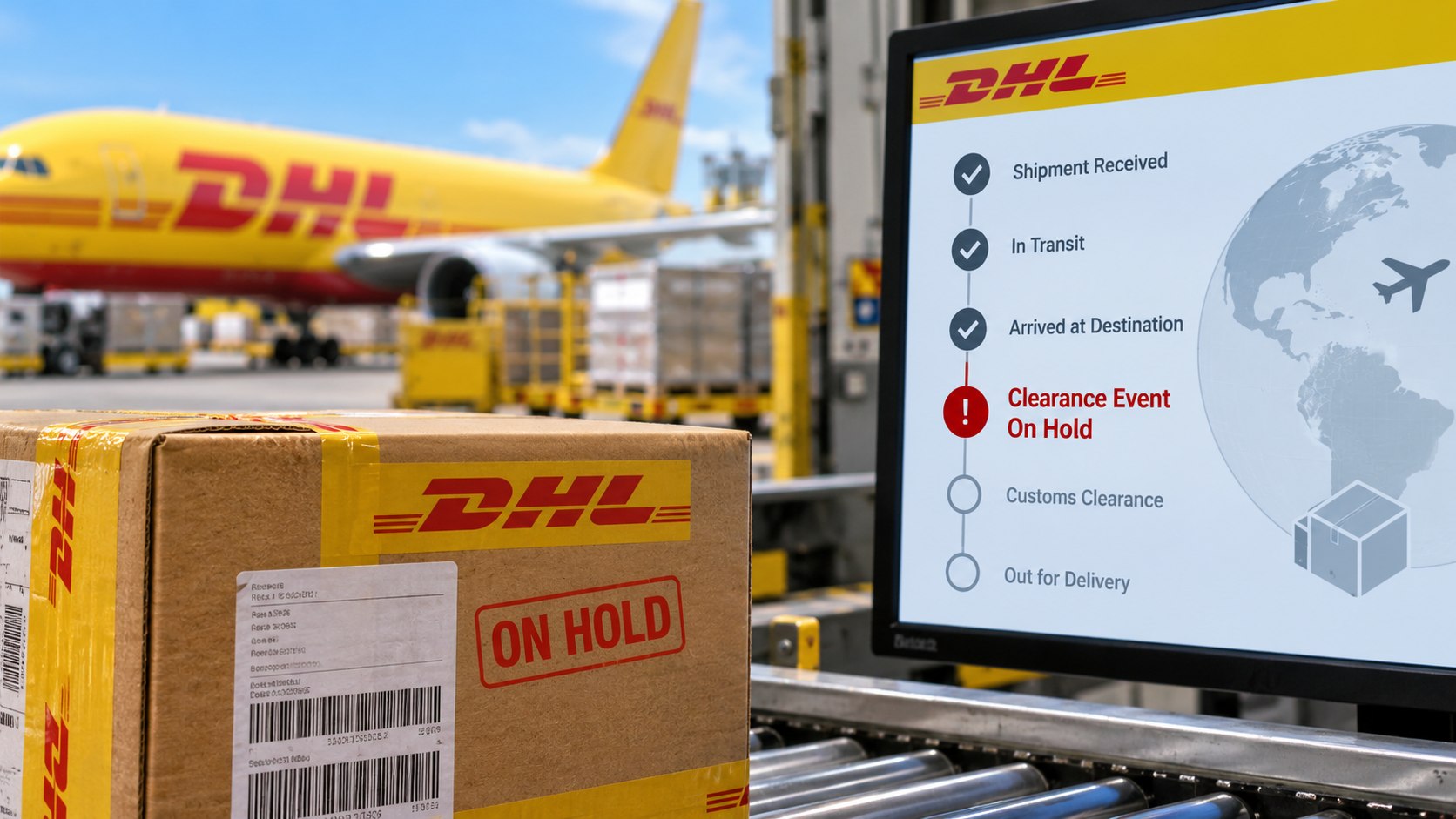
DHL clearance event on hold meaning and what to do
The safest response follows a fixed order. Do not assume that paying a random customs invoice will release the shipment immediately.
- Open the official DHL tracking record and note the latest location, time, and customs message.
- Check email, voicemail, and SMS for a legitimate DHL request tied to the same tracking number.
- Gather your invoice, order confirmation, payment receipt, and a precise description of the goods.
- Pay legitimate duties or taxes through an official DHL payment channel when payment is requested.
- Contact DHL if the status repeats without explaining what information or payment is missing.
- Ask the seller for corrected paperwork when the declared value, contents, or country of origin appears wrong.
The commercial invoice deserves particular attention. DHL says customs data normally includes the goods description, value, quantity, classification, country of origin, and shipper and receiver information. Vague descriptions such as “parts” can create problems because customs needs enough detail to identify the merchandise.
For example, “2 cotton men’s T-shirts, made in Vietnam, $35 each” gives customs more useful information than “clothing.” A laptop replacement battery may also face requirements that do not apply to an ordinary shirt.
The importer may need to provide identifying information for certain formal entries. DHL states that a U.S. ultimate consignee can be asked for an EIN or Social Security number when required for the customs filing.
Do not email sensitive information merely because someone knows your tracking number. Confirm the request through DHL’s official customer-service path first.
Once the missing issue is resolved, tracking may show another customs update before the parcel physically leaves the facility. That intermediate scan does not necessarily indicate another problem.
How it actually works
International clearance can begin before the aircraft carrying your package reaches the United States. DHL transmits shipment data electronically so customs review can start while the parcel remains in transit.
If the information is complete, the shipment may clear with little visible delay. If something does not match, the DHL clearance delay can continue until DHL receives corrected data or customs completes its review.
CBP can also require an inspection. Products regulated by agencies such as the Food and Drug Administration or Environmental Protection Agency may involve additional controls. Cosmetics, food, medical devices, and certain electronics can require more processing than ordinary consumer goods.
After release, DHL returns the shipment to its normal transportation network. A cleared parcel may then move through a regional hub before reaching the local courier.
What different tracking situations usually suggest
The wording on a tracking page can change as the shipment progresses. These practical distinctions help identify the next step without treating every update as an emergency.
| Status or situation | Likely meaning | Practical response |
|---|---|---|
| Clearance event | Customs processing activity is occurring | Monitor tracking unless DHL requests action |
| Clearance on hold | Processing cannot currently continue | Check for documents, payment, or contact requests |
| Customs inspection | Authorities selected the shipment for review | Wait unless additional information is requested |
| Duty or tax payment required | Charges must be settled before release | Pay through an authenticated DHL channel |
| Missing shipment information | Customs data is incomplete or inconsistent | Provide or correct the requested documentation |
Repeated clearance updates are not necessarily repeated failures. A shipment can receive several electronic events while information passes between different systems.
A weekend can also make the tracking history look static. Government processing, broker operations, and facility schedules do not always match normal parcel movement.
The location displayed deserves context as well. A customs event can refer to electronic processing connected with a gateway rather than a new physical scan.
Customers should focus on requests for action. A status without an accompanying request often requires monitoring rather than intervention.
If DHL requests information, however, responding quickly can prevent the administrative delay from becoming longer.
What can a DHL customs hold cost in 2026?
A DHL shipment held in customs does not have one fixed fee. The final amount can combine government duties with DHL service charges triggered by the way the shipment must be processed.
DHL’s U.S. customs-service schedule effective in 2026 lists several relevant charges. The amounts below are examples from DHL’s published pricing and do not apply to every package.
| 2026 U.S. DHL customs service | Published charge | When it may apply |
|---|---|---|
| Clearance Processing | $15 per shipment | Additional processing linked to government requirements |
| Customs Physical Intervention | $20 per shipment | Non-routine physical customs inspection |
| Non-Routine Entry | $35 per shipment | Goods outside routine clearance procedures |
| Broker Notification | $55 per shipment | Importer chooses another customs broker |
| Permits and Licenses | $28 per shipment | Selected regulated products need agency filings |
| Bonded Storage | $30 daily plus $0.08 per kg | Applies under DHL’s published storage conditions |
| Duty Tax Processing | $17.50 or 2.5% | DHL advances duties or taxes; the higher amount applies |
These charges come from DHL’s U.S. customs-services schedule. Other surcharges and government assessments can also apply, depending on the shipment.
The largest bill may still come from government duties rather than DHL. The rate depends on product classification, country of origin, declared value, and applicable U.S. trade measures.
A seller promising “free shipping” does not automatically mean import charges are prepaid. Check whether the order uses Delivered Duty Paid terms or makes the recipient responsible for duties and taxes.
Likewise, “duty-free” does not always mean fee-free. Processing, regulatory, brokerage, or storage charges can still exist in some situations.
Before paying, compare the request with the tracking number and shipment contents. A legitimate charge should connect clearly to the actual import.
Who it matters to in 2026
Online shoppers importing goods
U.S. shoppers ordering clothing, electronics, collectibles, auto parts, or beauty products from overseas face different import conditions in 2026. CBP says duty-free de minimis treatment for shipments valued at $800 or less was suspended for imports from all countries effective August 29, 2025.
That means a relatively inexpensive international purchase can still generate import charges. CBP says non-postal shipments are subject to applicable duties, taxes, and fees under the relevant entry process. CBP’s current de minimis guidance explains the change.
Freelancers and small businesses
A delayed replacement part or product sample can affect a client deadline. Small businesses should keep supplier invoices, accurate descriptions, HS classifications, and origin information accessible before the shipment reaches customs.
Businesses comparing carriers can also review Baltimore Chronicle’s FedEx, UPS, and USPS comparison for 2026 when choosing a domestic shipping option.
People receiving gifts or personal shipments
A gift label does not automatically eliminate customs requirements. The package still needs an accurate value and description, while customs treatment depends on current U.S. import rules.
Calling merchandise a “gift” or reducing its declared value can create a larger clearance problem rather than a cheaper shipment.
Common myths about DHL clearance holds
Several assumptions make customs delays more confusing than they need to be. The most common ones confuse a processing status with a final customs decision.
- DHL package stuck in customs means it is lost. Correction: the parcel may simply be waiting for paperwork or release.
- Every clearance hold creates a fee. Correction: some holds end after documentation review without an extra DHL service charge.
- Paying customs guarantees immediate delivery. Correction: the parcel may still require release and transportation scans afterward.
- DHL decides every import duty. Correction: duties come from customs rules, while DHL may collect them and add applicable service charges.
- A low-value package is automatically duty-free. Correction: U.S. de minimis rules changed before 2026.
Another misconception concerns the word “event.” It sounds unusual because consumers usually see tracking terms such as “arrived” or “departed.” In customs systems, an event can simply mean a new processing record.
The distinction between carrier and customs authority also matters. DHL can submit information, collect payments, and communicate with the importer, but the government controls customs release.
That is why customer service cannot always provide an exact release time. Some decisions depend on government review.
The useful question is not whether the parcel moved today. It is whether DHL or customs needs something from the importer.
Once that question is answered, most customers know whether to act or continue monitoring.
FAQ
How long can a DHL clearance event stay on hold?
There is no universal time limit. A simple document correction may clear quickly, while inspections or agency reviews can take longer. DHL says timing depends on the shipment and customs authority.
Should I call DHL when clearance is on hold?
Check tracking and messages first. Contact DHL when the status identifies a problem without explaining how to resolve it, or when requested information has already been submitted.
Does “clearance event” mean I must pay customs fees?
No. It means customs processing is occurring. Payment is only one possible reason for a hold. Missing documents, inspections, or regulatory checks can also cause one.
Why did DHL ask for my Social Security number?
Certain U.S. customs entries require identification of the ultimate consignee. Verify any request directly with DHL before transmitting sensitive personal information.
Can DHL deliver before customs clearance finishes?
Normally, no. International merchandise must receive the required customs release before entering the final delivery stage.
What should I do if the seller declared the wrong value?
Contact the seller and DHL promptly. Customs documentation should show the true transaction value and accurate goods information rather than an artificially reduced amount.
Earlier we wrote about How to List a Car on Turo 2026: Requirements, Earnings and 6 Steps for US Hosts