


Warm vs cool light bulb difference comes down mainly to color temperature, measured in Kelvin, not brightness. Most homes work best with 2700K–3000K warm light, while 3500K–5000K is better for kitchens, work areas, and detailed tasks, as noted by Baltimore Chronicle.
Most readers should pick warm white LEDs for bedrooms, living rooms, and evening use. Cool or neutral white makes more sense where visibility and color distinction matter more than atmosphere.
Key takeaways
- Choose 2700K–3000K when the goal is a relaxed, familiar residential look with warmer wood and fabric tones.
- Choose 3500K–5000K for kitchens, garages, home offices, laundry areas, and spaces used for detailed work.
- Do not confuse Kelvin with brightness. Lumens measure visible light output, while Kelvin describes whether white light looks warmer or cooler.
The Kelvin number is usually printed on an LED bulb’s package. Two 800-lumen bulbs can provide similar brightness yet make the same room look completely different. Wall color, flooring, countertops, furniture, and daylight also change how that light is perceived. A 5000K bulb does not automatically provide more usable light than a 2700K bulb. For many homes, matching the color temperature to the room matters more than buying the highest Kelvin number.
The simplest rule is practical: use warmer light where people relax and more neutral light where people need to see details clearly.
At a glance
Warm and cool bulbs can use identical LED technology, sockets, wattages, and lumen outputs. The meaningful distinction is the appearance of their white light and how that appearance interacts with the room.
| Factor | Warm light | Cool light |
|---|---|---|
| Typical Kelvin range | 2700K–3000K | 3500K–5000K+ |
| Visual appearance | Yellowish, softer white | Neutral to bluish white |
| Best rooms | Bedrooms, living rooms, dining rooms | Kitchens, offices, garages, laundry rooms |
| Furniture pairing | Wood, beige, cream, warm textiles | White, gray, chrome, cool finishes |
| Typical bulb cost | Usually similar for equivalent LED specifications | Usually similar for equivalent LED specifications |
| Installation | No special installation based on Kelvin alone | No special installation based on Kelvin alone |
| Expected lifespan | Depends on bulb design, not warmth | Depends on bulb design, not coolness |
| Repair or replacement | Replace bulb unless fixture uses integrated LEDs | Replace bulb unless fixture uses integrated LEDs |
| Best time of day | Evening and relaxed use | Daytime and task-focused use |
The comparison exposes an important purchasing mistake. Warm and cool are not different lighting technologies. They are different color appearances produced by a light source. An LED’s lifespan depends more on electronics, thermal management, manufacturing quality, and operating conditions. Installation also remains unchanged when the socket and bulb type match. Buyers therefore should compare lumens, Kelvin, CRI, dimming support, and fixture compatibility separately.
Room finishes can make those differences more obvious. Baltimore Chronicle’s guide to paint colors for small rooms in 2026 shows how lighting conditions change the appearance of whites, greiges, blues, and greens.
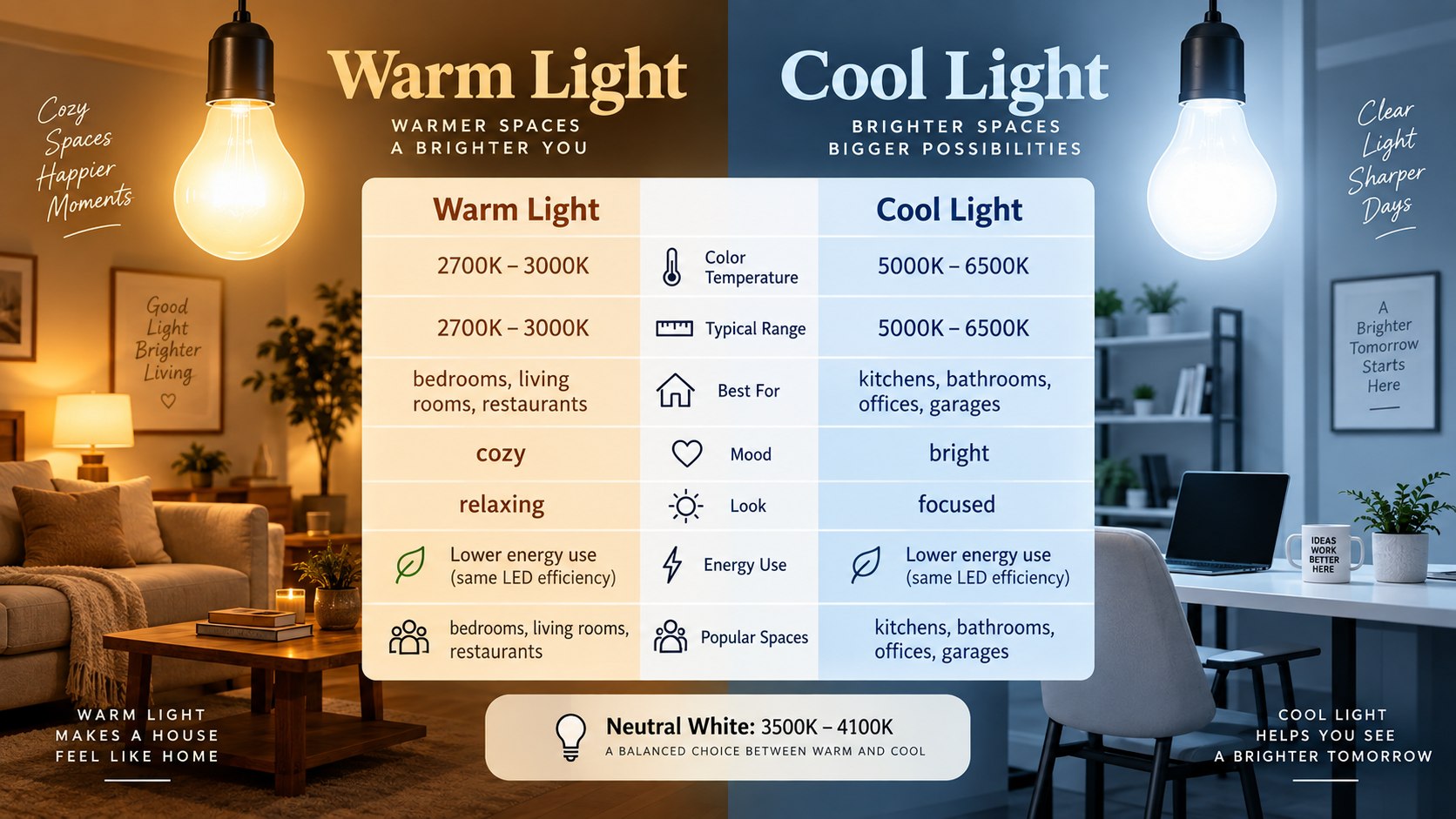
Warm vs cool light bulb difference on the Kelvin scale
The Kelvin scale for light bulbs describes correlated color temperature, usually abbreviated CCT. Lower values appear warmer and more yellow. Higher values appear whiter and eventually more blue.
The U.S. Department of Energy identifies 2700K as a common warm residential color temperature. Its guidance describes 3000K as warm and pleasing, while 4100K creates a cooler appearance. These numbers describe the color of the light, not the physical temperature of the bulb.
“Lower Kelvin numbers mean the light appears more yellow or ‘warmer’; higher Kelvin numbers mean the light will appear whiter or bluer.”
ENERGY STAR, official guidance on correlated color temperature for residential lighting.
A 2700K LED resembles the familiar tone associated with traditional incandescent lighting. At 3000K, white becomes slightly cleaner while retaining warmth. Around 3500K, the difference becomes more neutral. A 4000K source often looks crisp against white cabinets or paper. At 5000K and above, the blue component becomes increasingly visible.
This matters when several fixtures share one sightline. A 2700K table lamp beside a 5000K ceiling fixture can look mismatched even when both provide similar lumens. Open-plan homes usually appear more coherent when adjoining fixtures stay within a reasonably consistent Kelvin range.
Warm light bulbs: best for comfort and residential finishes
Warm white light bulbs generally sit between 2700K and 3000K. They work particularly well with walnut, oak, cream upholstery, beige walls, brass hardware, and other warm-toned finishes.
Bedrooms are the most obvious application. A softer white also suits living rooms and dining areas where the main purpose is conversation, television, reading, or evening relaxation. Warm lighting tends to preserve the familiar appearance many Americans associate with incandescent bulbs.
Warm bulbs make sense when:
- the room is primarily used after sunset;
- furniture includes warm wood or brown leather;
- walls have cream, beige, terracotta, or warm-gray undertones;
- the fixture is decorative rather than task-focused;
- the room connects directly with other spaces already using 2700K lighting.
Warm light is not automatically dim. An 800-lumen 2700K bulb can produce roughly the same total visible output as an 800-lumen 4000K bulb. The difference is how that light looks on surrounding surfaces. Warm light can make white walls appear creamier. It can also reduce the cold appearance of gray flooring or stainless accents. The main drawback appears when precise visual work requires stronger color separation.
A comfortable living room rarely needs the whitest bulb available; it needs a color temperature that works with the materials already inside it.
Cool light bulbs: better for tasks and crisp interiors
Cool white LED bulbs generally begin around 3500K or 4000K, depending on manufacturer labeling. At 5000K, the appearance becomes much closer to daylight-style lighting than traditional residential incandescent light.
Kitchens provide a useful example. Neutral or cooler light can make white counters, printed labels, cutting surfaces, and cleaning tasks easier to distinguish. The same logic applies to garages, utility spaces, craft rooms, and workbenches.
Cooler bulbs are usually better when:
- the space is used mainly for detailed daytime work;
- white or cool-gray surfaces dominate the interior;
- accurate visual contrast matters more than atmosphere;
- the room already receives cool daylight through large windows;
- the lighting serves a desk, workbench, vanity, or preparation surface.
Cool light can also expose dirt and surface imperfections more clearly. That can be helpful in laundry areas and utility rooms. However, very high Kelvin values can feel visually severe in a bedroom or traditional living room. A 5000K ceiling bulb beside 2700K lamps can create obvious color inconsistency. Matching multiple sources often produces a better room than simply choosing the coolest bulb. The best result usually comes from selecting Kelvin for the activity and finishes together.
For desks, Baltimore Chronicle’s 2026 home-office lighting guide recommends considering direction, glare, lumens, and color temperature as separate factors.
Why brightness and Kelvin are not the same thing
One persistent lighting mistake is buying a higher Kelvin bulb because it appears “brighter.” The eye may perceive cooler white as sharper in some surroundings, but Kelvin does not measure light output.
Lumens describe visible light emitted by the source. ENERGY STAR consumer guidance uses roughly 800 lumens as a traditional replacement level for a 60-watt incandescent bulb. It also places warmer indoor lighting toward the lower end of the Kelvin scale.
That means a shopper should check at least 4 specifications before buying:
- lumens for actual light output;
- Kelvin for warm or cool appearance;
- CRI for how accurately colors appear;
- dimming compatibility when the fixture uses a dimmer.
These specifications solve different problems. High lumens cannot correct an unpleasant color temperature. A preferred Kelvin rating cannot compensate for insufficient output. CRI becomes relevant when food, clothing, artwork, makeup, or materials need natural-looking colors. Dimmer compatibility matters because some LED and wall-control combinations flicker or perform poorly. Checking all 4 avoids replacing a bulb that technically works but feels wrong in the room.
What 2700K, 3000K, 4000K and 5000K look like at home
The practical 2700K vs 3000K vs 4000K choice becomes easier when each temperature is linked to a familiar room. Labels such as “soft white” and “daylight” vary between manufacturers, so the printed Kelvin number is more useful.
| Kelvin | Typical appearance | Useful locations | Main caution |
|---|---|---|---|
| 2700K | Warm, slightly yellow | Bedrooms, living rooms, dining rooms | Can make cool white paint look creamier |
| 3000K | Warm but cleaner | Kitchens, bathrooms, transitional interiors | May still feel warm beside strong daylight |
| 3500K | Neutral white | Multipurpose rooms, offices | Less widely stocked in some bulb lines |
| 4000K | Crisp neutral-cool white | Offices, kitchens, garages | Can feel clinical beside warm furnishings |
| 5000K | Cool daylight-style white | Workshops, detailed tasks | Often harsh for evening living spaces |
A home’s architecture also changes the result. North-facing rooms often receive cooler daylight than south-facing rooms. A warm bulb can soften that effect without increasing brightness. White kitchens may tolerate 3000K or 4000K comfortably, depending on countertops and flooring. Dark wood interiors usually look more natural under warmer light. Testing one bulb before replacing 10 fixtures can prevent an expensive mismatch.
Lighting decisions also become important during larger renovations. Anyone replacing fixtures during a bathroom project can compare sequencing and installation considerations in Baltimore Chronicle’s bathroom remodel timeline for 2026.
Fixed Kelvin vs tunable white bulbs in 2026
A fixed-color LED is usually the simplest option when a room serves one purpose. Tunable white bulbs make more sense when the same space changes function during the day.
Philips Hue is one prominent example. Its White Ambiance 1100-lumen E26 2-pack was listed at $54.99 on the official U.S. Philips Hue store in October 2026. The bulbs can shift between warm and cool white through app or voice controls.
That price is far above many ordinary fixed-white LEDs. The extra cost pays for controls and adjustable color temperature rather than simply more brightness. A home office that becomes a guest room can benefit from this flexibility. Daytime work might use a cleaner white, followed by warmer light at night. A hallway or seldom-used closet receives much less benefit from tunable lighting.
The U.S. Department of Energy also recognizes color-tunable LED products, including systems that change color temperature as they dim. These products separate the question of color from the traditional fixed-bulb approach.
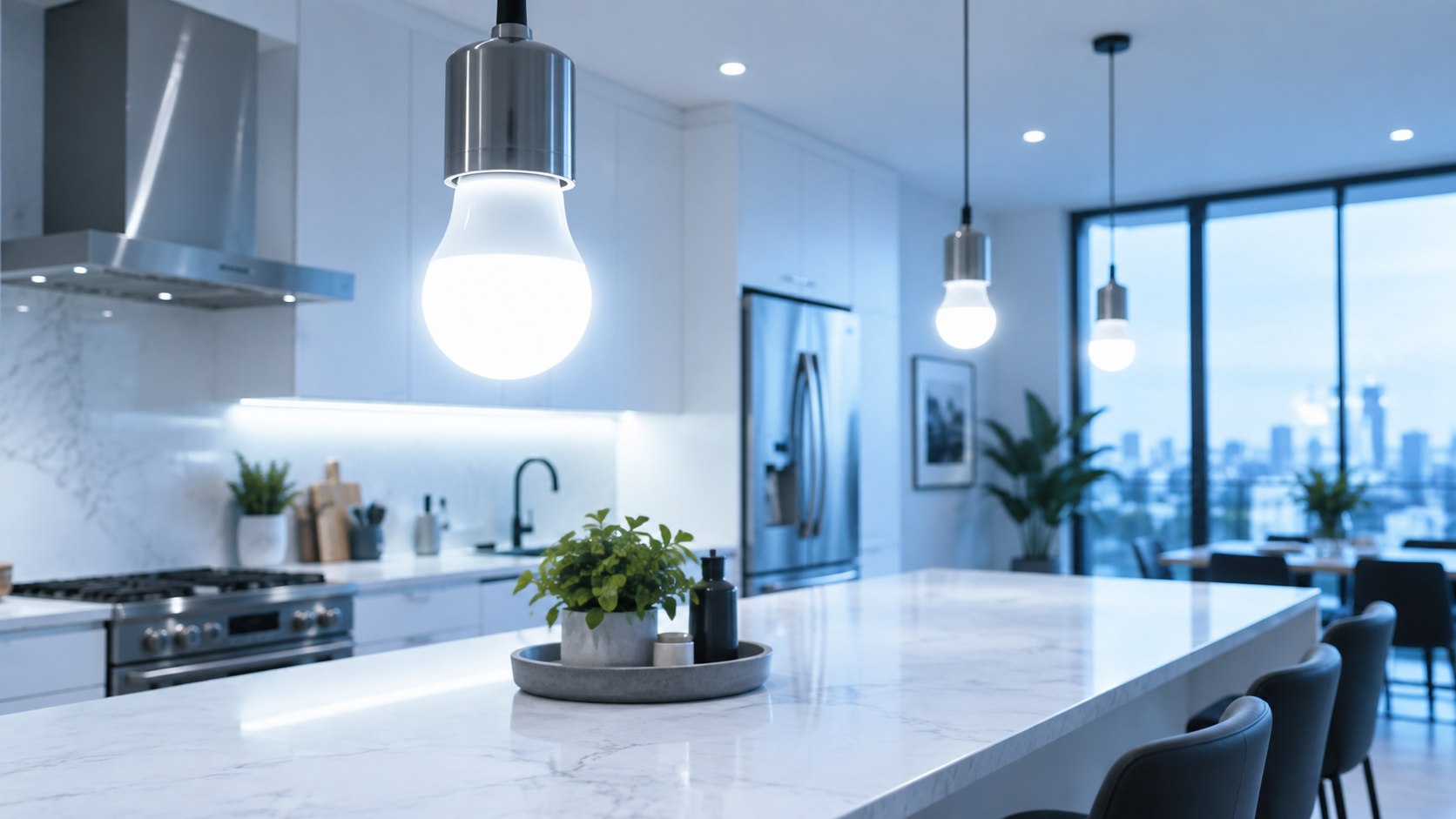
Which should you buy in 2026
For most homes, there is no reason to choose one Kelvin value for every room. A room-by-room approach costs no more when comparable fixed-white bulbs are available.
- If the room is for sleeping, relaxing, or dining, choose 2700K–3000K.
- If the room combines relaxation with practical work, start around 3000K–3500K.
- If the space is a kitchen, office, laundry room, or garage, consider 3500K–4000K.
- If detailed work dominates the space, 4000K–5000K may be more useful.
- If one room changes purpose throughout the day, consider a tunable white LED.
Then check lumens instead of relying on the Kelvin number. Compare the bulb’s base with the fixture before ordering. Verify dimmer compatibility when a wall dimmer is installed. Keep visible fixtures in adjoining rooms close in color temperature unless contrast is intentional. Buy one test bulb first when paint or furniture colors are difficult to judge.
FAQ about warm and cool light bulbs
Is warm light or cool light better for a living room?
Warm light between 2700K and 3000K usually fits living rooms better. It complements wood, textiles, skin tones, and evening activities without creating a stark appearance.
Is 3000K warm or cool?
3000K is generally considered warm white. It looks slightly cleaner than 2700K but remains warmer than neutral 3500K or 4000K lighting.
Is 4000K too cool for a house?
Not necessarily. 4000K can work well in kitchens, offices, bathrooms, garages, and modern interiors. It may look harsh in bedrooms with traditional warm finishes.
Does a higher Kelvin bulb use more electricity?
No. Kelvin alone does not determine electricity use. Check the bulb’s wattage for power consumption and lumens for visible light output.
Should every bulb in one room have the same Kelvin rating?
Usually, yes. Matching Kelvin values creates a consistent appearance. Mixed temperatures can work intentionally, but accidental differences often make fixtures look mismatched.
What Kelvin is closest to old incandescent bulbs?
About 2700K is the usual reference point for the familiar warm appearance of household incandescent lighting. That makes 2700K LEDs an easy replacement choice.
Earlier we wrote about Why Your DHL Package Is Stuck at Customs in 2026: Clearance Holds, New U.S. Import Rules and What to Do Next