

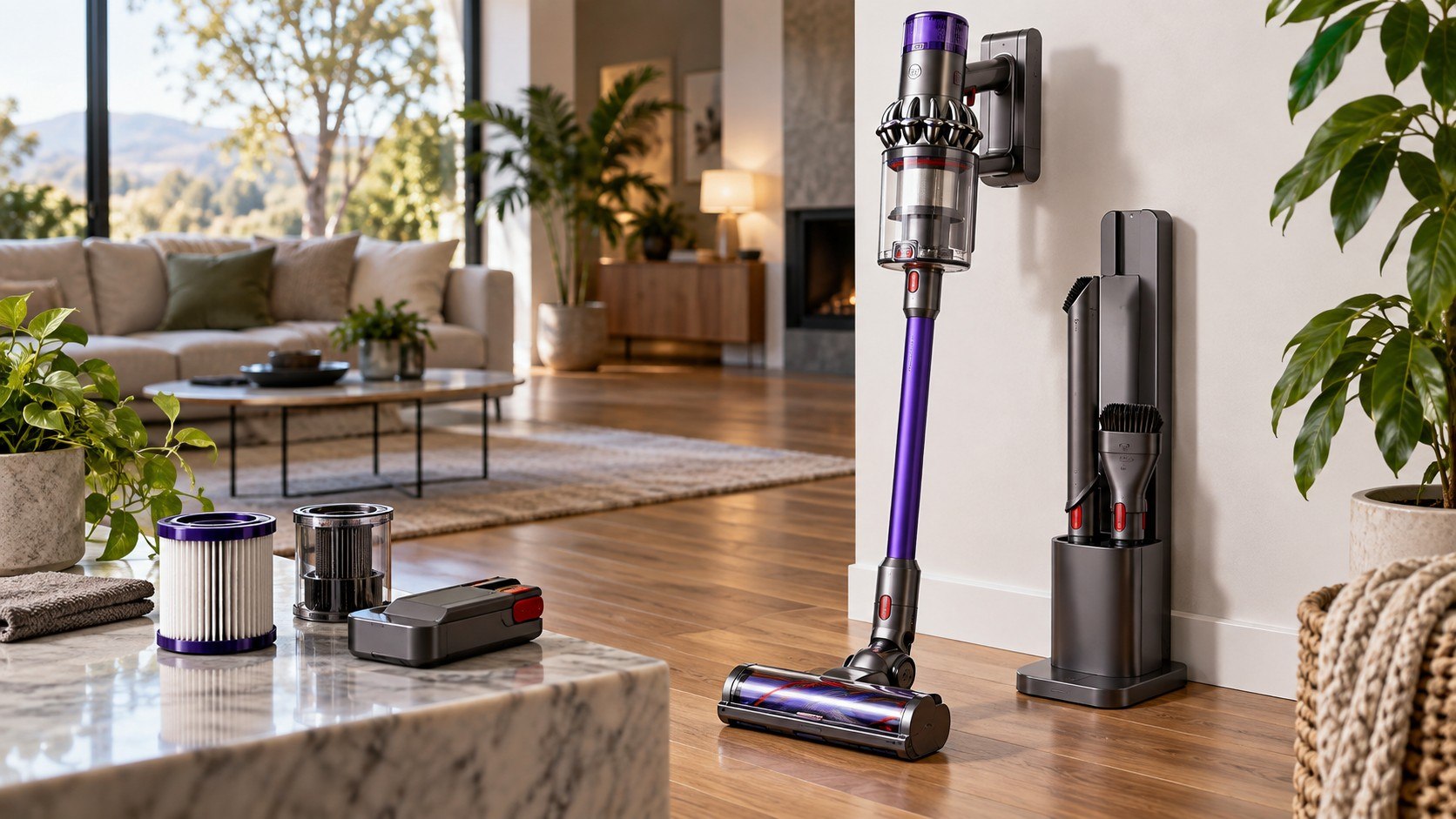
How long do Dyson vacuums last 2026 is a practical lifespan question with 2 different answers. The vacuum body can remain useful for years, while a cordless lithium-ion battery often becomes the first costly wear item. Dyson itself does not assign its batteries a fixed lifespan in years. Reduced runtime outside Max or Boost mode is the more useful warning sign, as the Baltimore Chronicle editorial team notes.
For an owner deciding whether to repair or replace a Dyson, start with the battery. A machine that still has strong suction, an intact motor, and available parts may need only a battery rather than a new vacuum. In 2026, genuine US replacement batteries listed by Dyson include examples around $99.99 to $129.99, depending on the model and battery design. Availability can vary.
Key takeaways
- A weak battery does not automatically mean the entire Dyson vacuum has reached the end of its useful life.
- Dyson says heat, storage conditions, power mode, charging habits, and normal battery degradation all affect cordless runtime.
- Before spending several hundred dollars on another vacuum, compare battery cost with the condition of the motor, cleaner head, and bin.
That distinction matters because replacement economics have changed. Current premium cordless machines can cost several hundred dollars, while a compatible genuine battery may cost far less.
The broader comparison is covered in Baltimore Chronicle’s Dyson, Shark and Miele vacuum comparison for 2026. Battery replacement changes the equation because a cordless vacuum is partly an appliance and partly a rechargeable power tool.
In plain English
Think of a cordless Dyson like a laptop. Its motor, housing, electronics, and attachments can remain functional after the rechargeable battery loses part of its original capacity.
A laptop that runs for 90 minutes instead of 5 hours is not necessarily broken. The same logic applies to Dyson cordless vacuum lifespan. The battery may deteriorate sooner than the main machine, especially after frequent high-power cleaning.
Dyson says battery life depends on factors including maintenance and storage, rather than a predetermined number of years.
Official Dyson battery-care guidance: Dyson Support.
That is why a claim that every Dyson battery lasts exactly 3, 5, or 7 years is too precise. Lithium-ion cells age through use and time, but households place very different demands on them. A small apartment cleaned twice weekly presents a different workload from a large pet-friendly home cleaned daily.
The useful question is not simply how old the vacuum is, but whether the expensive parts around the battery are still working properly.
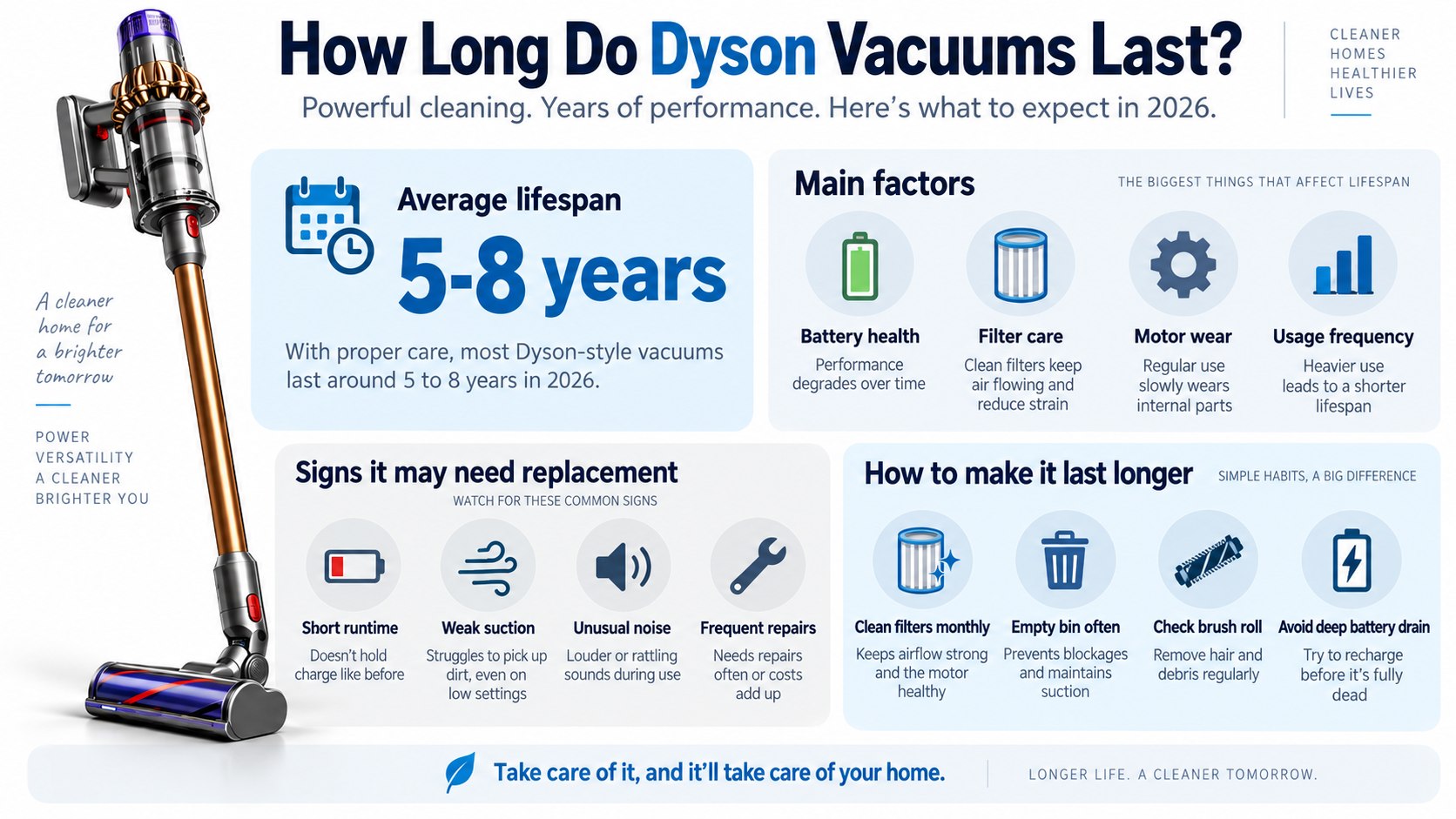
How Long Do Dyson Vacuums Last 2026 in Real Use?
There is no official Dyson figure promising a specific total vacuum lifespan. Owners should separate 3 components when judging how long a Dyson vacuum lasts: battery condition, mechanical condition, and parts availability.
A battery is a consumable component. Filters also require cleaning and eventually may need replacement. Cleaner heads, seals, bins, hoses, and switches face ordinary mechanical wear.
| Component | What usually changes with age | Repair decision |
|---|---|---|
| Battery | Runtime falls or charging behavior changes | Replace if the machine is otherwise healthy |
| Filter | Airflow can fall when dirty or damaged | Clean correctly or replace when necessary |
| Cleaner head | Brush bars, bearings, or joints can wear | Compare part cost with vacuum value |
| Bin and seals | Cracks or poor seals can reduce performance | Usually a parts issue rather than motor failure |
| Motor or electronics | Faults can make repair less economical | Get a proper diagnosis before buying parts |
This breakdown prevents an expensive mistake. A short-running cordless vacuum may still have years of mechanical usefulness left. Conversely, a new battery makes less sense when the cleaner head, bin, controls, and motor also need work.
Age alone therefore gives an incomplete answer. Condition is more useful than the date printed on the receipt.
Parts availability also deserves attention. Dyson continues to support many earlier cordless ranges, including V7, V8, V10, and V11 machines. However, individual parts can be unavailable or discontinued at different times.
The 5 checks below give a clearer picture than age alone:
- Charge the vacuum fully and test it in Normal, Auto, or Eco mode.
- Check whether runtime has fallen sharply without using Max or Boost.
- Inspect and clean the filter according to the model instructions.
- Look for blockages in the wand, cleaner head, airways, and bin inlet.
- Confirm the exact model and battery type before ordering a replacement.
A clean airflow path matters because a blocked vacuum can imitate a power problem. The motor may pulse, suction can drop, and cleaning time can become shorter.
Battery type also matters. Some Dyson V11 machines use a screw-in battery, while others use a click-in design. Ordering by the product name alone can therefore create a compatibility problem.
Use the serial number when uncertainty remains. Dyson’s US support system allows owners to identify their machine before selecting parts.
Do not assume an inexpensive third-party battery is equivalent to the original. Battery packs include cells, electronics, thermal controls, and a housing designed around a specific machine.
A $100 battery can be a sensible repair when it restores an otherwise sound vacuum that would cost several times more to replace.
How it actually works
A cordless Dyson stores energy in a lithium-ion battery pack. During cleaning, that pack supplies the motor and powered cleaner head. Higher power demands drain the available energy faster.
Battery chemistry changes gradually as cells age. Usable capacity can decline, so a charge that once completed the whole house may later cover only part of it.
Dyson specifically advises limiting routine use of Max or Boost modes. Those settings are intended for intensive cleaning bursts. The company says frequent high-power use speeds battery degradation.
Temperature also matters. Dyson recommends storing cordless vacuums at roughly 64°F to 82°F. It warns that hot environments accelerate battery aging and says machines will not operate or charge below 37°F.
This can be relevant across the United States. A vacuum stored in an Arizona garage faces different summer conditions from one kept inside an air-conditioned bedroom. A Minnesota mudroom can create the opposite temperature problem during winter.
What replacement costs look like in 2026
Official US prices show why diagnosis matters before replacing the entire machine. In 2026, genuine Dyson replacement batteries for common cordless models can cost roughly $95.99 to $129.99, depending on model and stock status.
| Dyson battery example | Approximate 2026 price | Important detail |
|---|---|---|
| V7 replacement battery | About $95.99 | Model compatibility must be confirmed |
| V8 replacement battery | About $129.99 | Stock status may change |
| V10 replacement battery | About $129.99 | Official replacement pack |
| V11/V15 click-in battery | About $99.99 | Only for compatible click-in machines |
Those prices are snapshots rather than permanent retail guarantees. Dyson can change prices or stock status.
Availability deserves as much attention as price. Some battery versions may be readily available, while others can move in and out of stock.
A homeowner should therefore identify the exact model before making a repair-versus-replacement calculation. A battery bargain is irrelevant if it does not fit the machine.
Dyson states that its cordless machines and batteries carry a 2-year initial warranty. Replacement tools, accessories, and spare parts purchased separately can carry different warranty terms.
Who it matters to in 2026
Owners whose vacuum suddenly runs for only minutes
Start by eliminating blockages, dirty filters, and inappropriate power settings. If runtime remains significantly reduced in standard cleaning mode, the battery becomes a stronger suspect.
Buyers considering a used Dyson
Battery health should influence the purchase price. A used V8 or V10 can appear inexpensive until another $100 or more is required for a genuine replacement pack.
Ask the seller to demonstrate runtime away from Max mode. Also inspect the charging connector, cleaner head, filter, bin latch, and battery casing.
Pet owners and larger households
Daily cleaning creates more battery cycles than occasional apartment use. Hair and debris can also load the cleaner head and filter faster.
For these homes, Dyson battery replacement is best treated as an ownership cost rather than an exceptional failure. A removable click-in pack can also reduce downtime on compatible models.
Signs the battery may be the problem
No single symptom proves battery failure. Several symptoms together make the diagnosis more convincing, especially after filters and airways are checked.
- Runtime has dropped noticeably during Normal, Auto, or Eco cleaning.
- The vacuum stops much sooner than it did after a full charge.
- The battery will not hold enough charge for ordinary cleaning.
- Charging behavior becomes abnormal despite a working outlet and charger.
- The machine performs normally with another known-good compatible battery.
- Dyson’s model-specific troubleshooting identifies the battery as the likely fault.
Reduced runtime in Max mode alone is poor evidence. That mode deliberately consumes energy much faster.
A dirty filter deserves equal suspicion when suction feels weaker. Air resistance can change how the machine behaves under load.
Pulsing is another symptom that owners can misread. Dyson vacuums may pulse when airflow is restricted, so checking the wand and cleaner head can prevent an unnecessary battery purchase.
Physical damage changes the situation. A swollen, cracked, leaking, unusually hot, or otherwise damaged lithium-ion pack should not be treated as a routine runtime problem.
Disposal also requires care. Dyson directs owners to remove old batteries before disposal and recycle them according to applicable local rules. Requirements can vary by state and municipality.
Common myths
Internet discussions often turn Dyson vacuum battery life into a fixed countdown. The manufacturer’s own guidance is more conditional.
- Myth: Every Dyson battery lasts a fixed number of years. Correction: Dyson says lifespan depends on maintenance, storage, and use.
- Myth: Short runtime means the motor is dying. Correction: Battery condition, power mode, filters, and blockages can produce similar symptoms.
- Myth: Max mode is the normal setting. Correction: Dyson describes Max and Boost as intensive modes for limited use.
- Myth: Any battery with the right voltage will fit. Correction: Model, connector, housing, and battery design must match.
- Myth: An old cordless Dyson should always be replaced. Correction: A healthy machine may justify a battery replacement.
Another misconception concerns charging memory. Dyson says its lithium-ion batteries do not have the traditional memory effect associated with some older rechargeable chemistries.
This means short charging sessions do not train the pack to accept only a smaller charge. Normal chemical aging still occurs over time.
Heat remains more consequential. Leaving the vacuum near a radiator or in strong sunlight can accelerate deterioration.
Regular Boost use creates another avoidable stress. Standard modes are better suited to routine floor cleaning.
The practical goal is not to preserve a battery forever. It is to avoid conditions that shorten its useful service unnecessarily.
When replacement makes more sense than another battery
A replacement battery has the strongest case when the rest of the vacuum works properly. The calculation becomes weaker as several expensive faults appear together.
Consider replacing the machine rather than the battery when 3 or more problems are present:
- The motor or main electronics have a confirmed fault.
- The cleaner head needs costly replacement at the same time.
- The bin, seals, or housing have significant damage.
- The correct genuine battery is unavailable for an older model.
- Total repair cost approaches the price of a suitable newer vacuum.
- The current machine no longer fits the home’s cleaning needs.
Do the arithmetic before shopping. A $99.99 battery for a mechanically sound vacuum is a different decision from a battery plus a cleaner head and damaged bin.
Age should still influence the calculation, but it should not make the decision alone. Parts condition and repair availability are stronger evidence.
Households with stairs, pets, or large floor areas should also compare runtime requirements. Replacing an old battery may restore original performance without increasing the machine’s original capacity.
A newer vacuum may offer longer runtime or a removable pack, depending on model. Those improvements matter only when they solve an actual cleaning limitation.
The cheapest immediate option and the lowest long-term cost are not always the same purchase.
FAQ
How many years should a Dyson vacuum last?
Dyson does not publish one fixed lifespan for an entire vacuum. The battery, motor, cleaner head, filters, seals, and attachments wear at different rates. Maintenance and usage can substantially change the useful life.
How long does a Dyson battery last before replacement?
There is no official fixed replacement age. Dyson says battery lifespan depends on factors including use, storage, temperature, and maintenance. Declining runtime during normal power modes is more useful than age alone.
Is it worth replacing a Dyson battery?
Often, yes, when the motor, cleaner head, bin, and controls are still in good condition. Genuine replacement batteries examined in 2026 ranged from about $95.99 to $129.99 for several common cordless models.
Why is my Dyson battery dying so quickly?
Possible causes include battery aging, frequent Max or Boost use, heat exposure, airflow restrictions, dirty filters, or another fault. Troubleshoot the complete machine before buying a battery.
Can a Dyson battery be replaced at home?
Many cordless models use replaceable batteries. Some packs are secured with screws, while others use a click-in release. The correct procedure depends on the exact model and battery version.
Does Dyson cover batteries under warranty?
Dyson states that its 2-year cordless machine warranty includes the original battery. Owners should verify coverage using the serial number and purchase date before ordering a replacement.
Earlier we wrote about Which Apple Watch Is Worth Buying in 2026? Series 11 and Ultra 3 Prices, Sizes and Battery Compared