

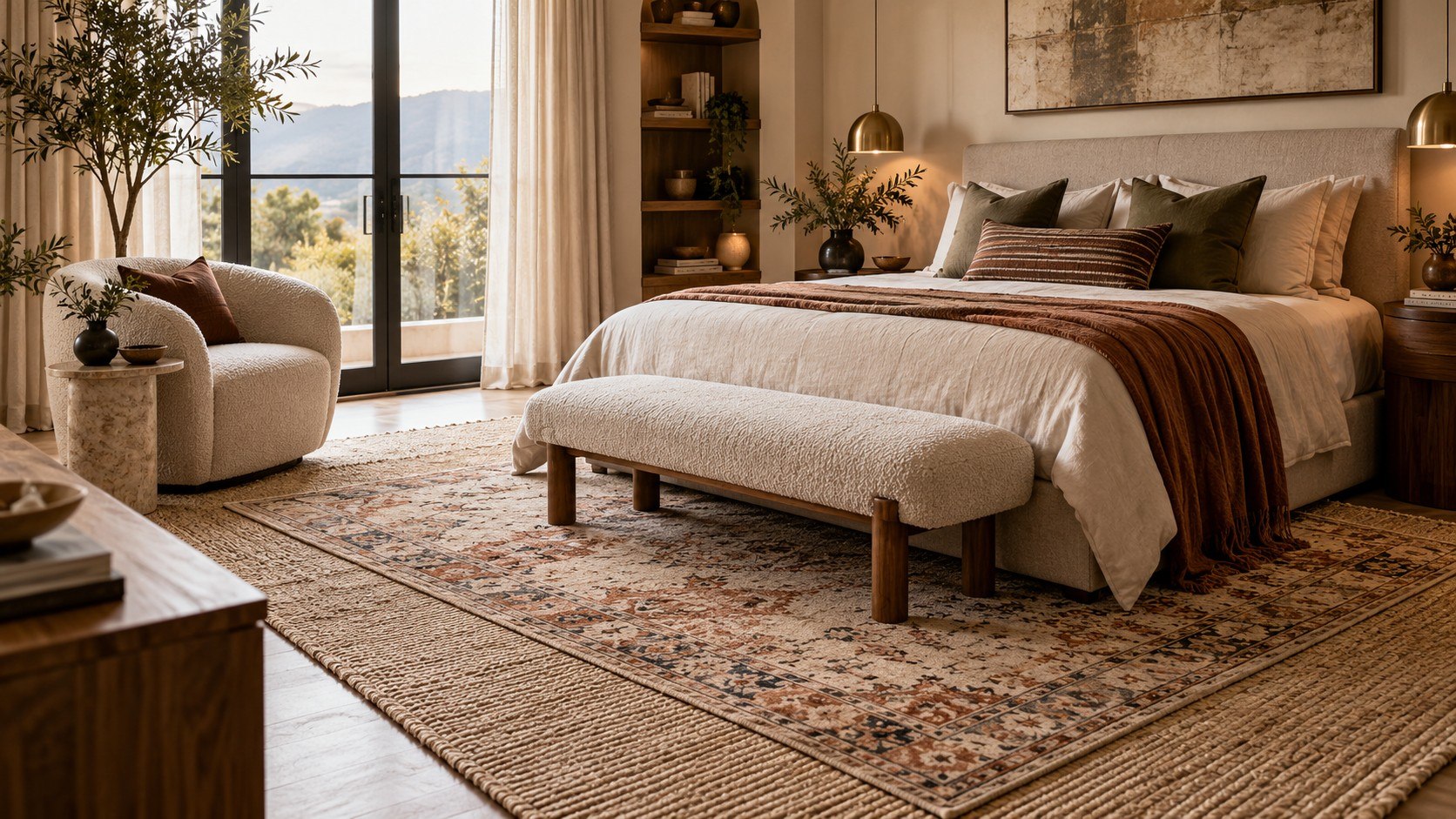
How to layer rugs like a designer comes down to 3 decisions: size the base correctly, limit competing patterns, and create texture contrast. Most rooms can be measured and arranged within 30–60 minutes, without replacing major furniture, as Baltimore Chronicle notes.
The safest formula is a large, quiet base rug with a smaller, more expressive rug above it. An 8 x 10 ft base often works with a 5 x 7 ft accent rug. A 9 x 12 ft base can support a 6 x 9 ft top layer. The furniture should still connect visually with the larger rug.
Key takeaways
- Start with a low-profile base large enough to anchor the main furniture rather than simply filling empty floor space.
- Use pattern on one dominant layer, then create interest through wool, jute, sisal, cotton, or different pile heights.
- Secure both layers before styling furniture, because curled corners and shifting rugs can turn decoration into a walking hazard.
The lower rug should read as the room’s foundation. The upper rug should look deliberately smaller, not accidentally undersized. Pattern works best when one layer carries most of the visual activity. Texture can then provide contrast without making the floor look chaotic. Furniture placement finally ties the composition together.
- A successful layered arrangement looks intentional before anyone notices that 2 separate rugs are creating the effect.*
What you need before layering rugs
Rug layering requires fewer supplies than most room updates. Measuring first matters more than buying expensive materials. Existing rugs can often be reused when their proportions make sense.
- Measuring tape
- Painter’s tape for marking rug dimensions
- A large flatwoven, low-pile, jute, sisal, or wool base rug
- A smaller accent rug
- A floor-compatible nonslip rug pad
- Vacuum and clean floor surface
- 30–60 minutes for measuring and placement
- A realistic 2026 budget based on the rugs already owned
Measure the furniture zone rather than the entire room. Record the sofa width and the spacing between chairs. Mark proposed rug corners with painter’s tape. Walk around the taped area before buying anything. Open doors and check nearby traffic routes. The exercise quickly exposes rugs that looked large online but will feel undersized at home.
Budget also changes dramatically with material and scale. On the IKEA US rug catalog, October 2026 prices show that large rugs can range widely. A TIPHEDE flatwoven rug around 7 x 9 ft was listed near $39.99. A roughly 8 x 10 ft STOENSE was listed at $249.99. Premium handwoven or larger styles can reach several hundred dollars.
Readers planning a wider room refresh can also compare the cost logic with Baltimore Chronicle’s guide to budget renovation planning. Layering often makes a smaller vintage or wool rug useful without paying for that material across 80–100 sq ft.
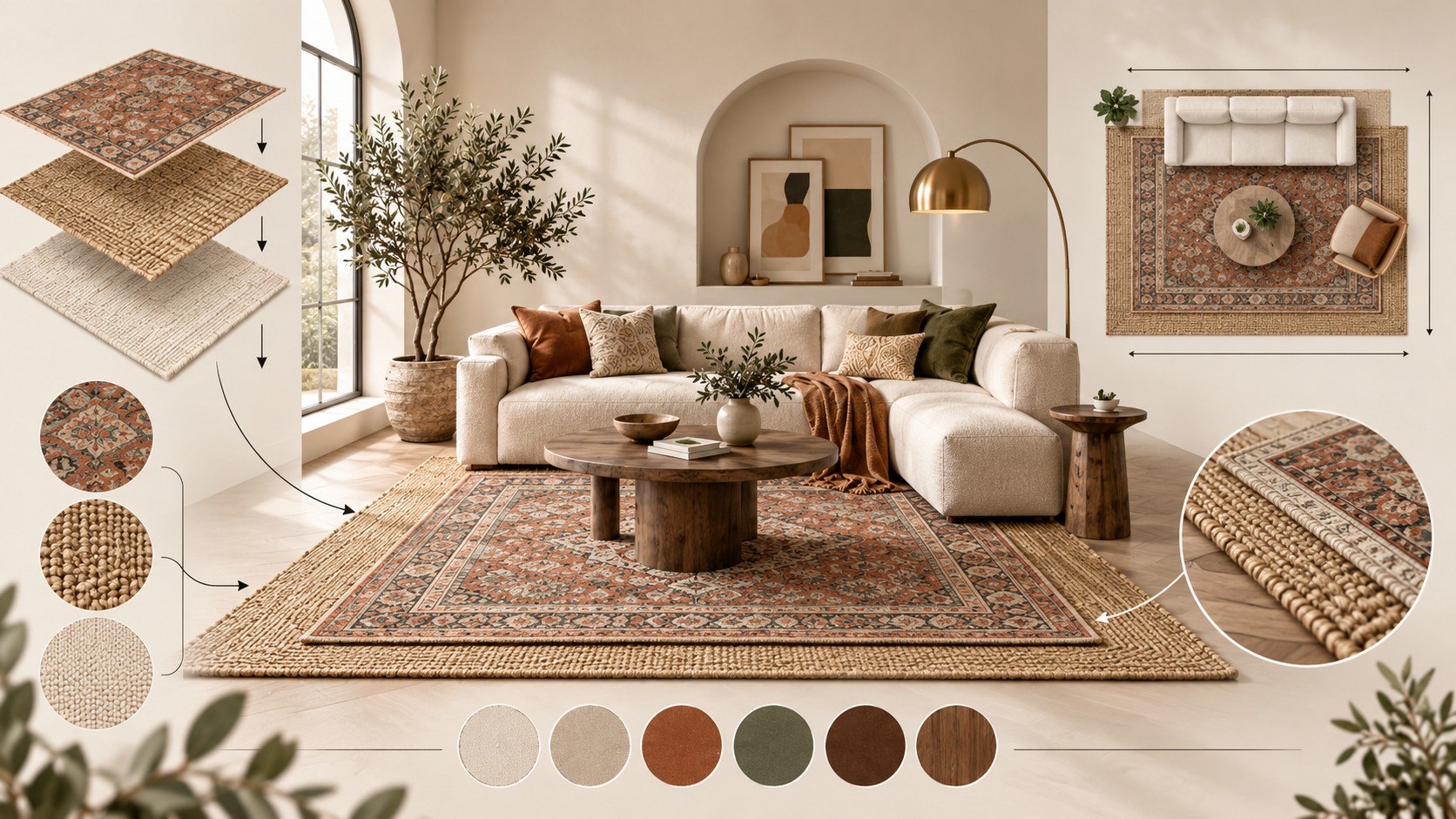
Step 1: How to layer rugs like a designer starts with size
Measure the seating group and choose the base rug before thinking about color. In a living room, the front legs of the main sofa and chairs should usually reach the base.
This matters because layered rug sizing establishes the visual boundary of the room. A small foundation makes even an expensive top rug appear disconnected.
Avoid measuring only around the coffee table. That common mistake produces a floating rectangle surrounded by furniture instead of an anchored seating zone.
| Base rug | Useful top-rug starting point | Typical use |
|---|---|---|
| 6 x 9 ft | 4 x 6 ft | Small apartment seating area |
| 8 x 10 ft | 5 x 7 ft or 5 x 8 ft | Standard living room |
| 9 x 12 ft | 6 x 9 ft | Larger living room |
| 10 x 14 ft | 8 x 10 ft | Large open seating zone |
These combinations are starting points rather than fixed design laws. Furniture dimensions can change the useful proportions. Leave enough visible base material to create a clear frame around the accent rug. About 12–18 inches can work in many arrangements. Very narrow exposed edges can make 2 similar rectangles look like a sizing error. Wider margins usually give the top layer more visual independence.
Step 2: Choose a quiet base before adding pattern
The base carries more square footage, so its pattern has greater visual weight. Solid wool, subtle flatweave, jute, and sisal are dependable foundations for layering area rugs.
This matters because 2 equally assertive patterns compete across the same floor plane. Pattern mixing becomes easier when one rug behaves almost like a solid from standing height.
Avoid buying 2 intricate rugs simply because their colors match. Repeated color cannot always overcome competing borders, medallions, stripes, and geometric motifs.
Think of the lower rug as architecture and the upper rug as artwork. The base establishes scale; the accent supplies the stronger visual idea.
There is another practical advantage. A restrained base remains usable when sofas, paint colors, or accessories change. Baltimore Chronicle’s 2026 guide to interior paint choices shows how strongly wall color affects a room. A natural rug is less dependent on one particular palette.
Step 3: Control pattern by changing scale
If both rugs contain visible designs, make their scales clearly different. Pair a broad stripe with a small geometric motif, for example. Another option is a faded vintage pattern above a nearly solid weave.
This approach makes mixing rug patterns easier because the eye does not process both surfaces at the same intensity. Shared colors can provide a connection without producing a matching set.
Avoid 2 designs with similar line thickness, repeat size, and contrast. They can create visual vibration, especially beneath furniture with busy upholstery.
- Identify the dominant rug first.
- Choose 1 or 2 colors worth repeating.
- Change the scale of any secondary pattern.
- Keep surrounding pillows and throws calmer when both rugs contain detail.
- Photograph the room before removing tags from a new purchase.
The photograph test is useful because a phone image compresses the room into a single frame. Competing patterns become easier to detect. Check the arrangement in daylight and after lamps are switched on. Warm bulbs can make beige, rust, and cream appear closer than expected. Strong black-and-white motifs remain visually dominant under most lighting. When uncertainty remains, remove pattern from the larger layer first.
Pattern should create hierarchy, not force every surface in the room to demand attention at the same time.
Step 4: Build contrast with texture
Texture is where rug layering ideas become more convincing. A flat jute foundation under wool creates more depth than 2 rugs with identical surfaces.
This matters because texture registers even when the palette stays neutral. Cream over tan can still look layered when the fibers, pile, and weave behave differently.
Avoid placing a heavy, unstable rug over deep shag. The upper layer may shift, buckle, or sit unevenly around furniture legs.
| Base texture | Top texture | Effect | Best location |
|---|---|---|---|
| Jute | Low-pile wool | Warm, structured contrast | Living room |
| Sisal | Vintage-style wool | Crisp base with softer detail | Dining or sitting area |
| Flatwoven wool | Plush wool | Subtle material contrast | Bedroom |
| Low-pile neutral rug | Irregular hide-style shape | Strong shape contrast | Office or reading area |
Texture must still match household use. Rough sisal may be less comfortable where children regularly play on the floor. Thick pile can complicate dining-chair movement. Pet claws can catch on some loose or open weaves. Entry areas usually benefit from lower profiles that are easier to vacuum. Bedrooms allow softer materials because traffic is often lighter.
Step 5: Position the top rug with a clear purpose
Centering is not mandatory. A smaller rug can sit beneath the coffee table, shift toward the sofa, or turn slightly within the base.
This matters because designer rug placement responds to furniture rather than an imaginary grid. An offset layer can balance a chaise, reading chair, fireplace, or asymmetrical room.
Avoid arbitrary angles. A diagonal rug should correspond with furniture or circulation, not look as though someone kicked it sideways.
A rectangular 5 x 7 ft rug centered on an 8 x 10 ft base creates a formal effect. Shifting the smaller layer toward a sofa feels more relaxed. Turning it slightly can work in casual rooms. However, the exposed base should remain visible enough to explain the composition.
Furniture should be adjusted after both rugs are placed. Baltimore Chronicle’s guide to buying a sofa online also emphasizes measuring furniture relationships before committing. Rug edges, sofa depth, and coffee-table clearance all influence the same floor plan.
Step 6: Secure both layers before the room is finished
Vacuum the floor, flatten curled rug edges, then use an underlay compatible with the flooring. The upper rug may also need stabilization when foot traffic crosses its edge.
This matters because how to keep layered rugs from slipping is not merely an appearance question. Movement creates wrinkles and raised corners exactly where people walk.
Avoid assuming heavy furniture will secure every section. Unanchored corners can still creep, particularly on smooth hard flooring.
IKEA’s US site lists STOPP and STOPP FILT anti-slip underlays. In October 2026, listed prices ranged from $7.99 for STOPP to $19.99 for a larger STOPP FILT size. IKEA states that these products help reduce rug movement and can be trimmed to fit.
Rug pads should remain inside the rug perimeter. Exposed padding changes the outline and creates another edge in the walking path.
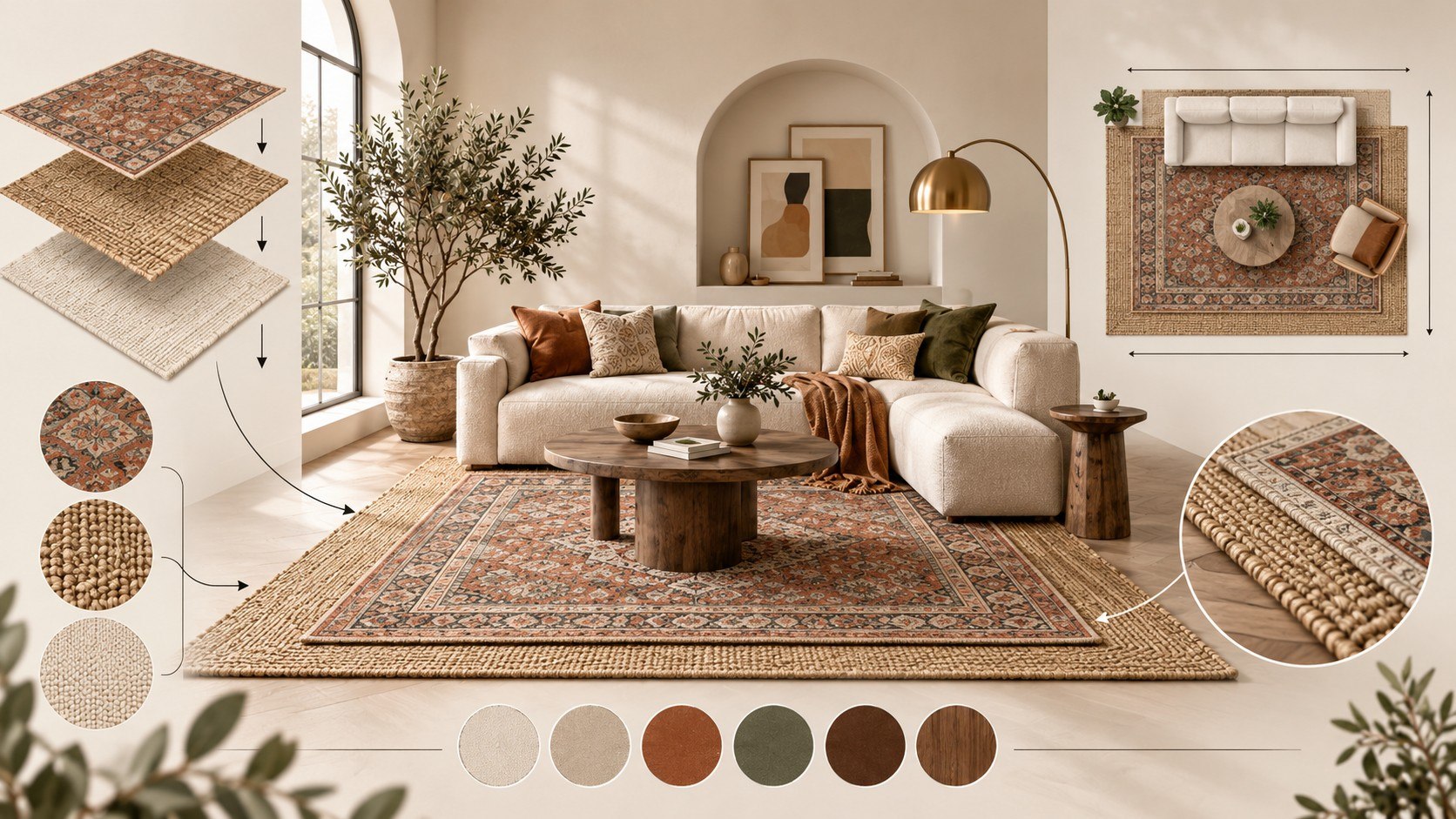
Troubleshooting layered rugs that do not look right
Most failed arrangements are proportion problems rather than style problems. Before returning a rug, change its position and expose more of the base.
- The room looks too busy: replace the larger patterned rug with a solid or low-contrast foundation.
- The top rug looks tiny: move up one standard size or reduce the visible base border.
- The layers look accidental: create clearer contrast in size, texture, pattern scale, or shape.
- The upper rug keeps moving: check the underlay, floor compatibility, curled edges, and furniture contact points.
- The room feels smaller: enlarge the base so the seating group sits within one defined floor zone.
Change one variable at a time. Start with size before changing color. Then test the top rug’s orientation. Remove decorative pillows temporarily if the room remains visually crowded. A complex sofa fabric can also compete with patterned flooring. The goal is a clear hierarchy between furniture, base rug, and accent layer. Buying another rug should be the last correction, not the first.
FAQ
Can you layer an area rug over carpet?
Yes, especially over firm, low-pile carpet. Choose a top rug with enough texture or color contrast to remain visually distinct. Check movement carefully because rug-on-carpet setups can shift differently from rugs on hard flooring.
What size rug should go on top of an 8 x 10 ft rug?
A 5 x 7 ft or 5 x 8 ft rug is a practical starting point. A 6 x 9 ft rug creates a narrower border. Measure the furniture before choosing either option.
Can you layer 2 patterned rugs?
Yes, but change the pattern scale and keep at least 1 shared color. One pattern should dominate. Two equally strong geometric designs are harder to balance.
Should a jute rug always go on the bottom?
No, but jute commonly works well as a base because it is textured and visually quiet. A wool or patterned accent rug then provides softness and detail.
Does the top rug have to be centered?
No. Slightly offset placement can work with sectional sofas, fireplaces, reading chairs, or asymmetrical layouts. The position should respond to furniture rather than appear random.
How much does it cost to layer rugs in 2026?
The cost can be $0 when existing rugs work together. Buying new pieces can range from under $100 to several hundred dollars. Material, dimensions, construction, and brand create the largest differences.
Earlier we wrote about Amazon Returns Without a Printer in 2026: Whole Foods and Kohl’s QR Codes Explained