

Maryland voters will choose between Democratic Attorney General Anthony Brown and Republican challenger Jim Rutledge on Nov. 3 in a low-profile race that will decide who leads the state’s legal fights with Washington, oversees investigations of police-involved deaths and runs the state’s top consumer protection office. For Baltimore residents, that office shapes everything from police accountability cases in the city to multistate lawsuits over federal money for Maryland schools and transportation.
Neither candidate had a primary opponent this year, so the general election will be the first time voters weigh in on either man, Maryland Matters reported Tuesday. The contest sits below the governor’s race on the ballot and has drawn far less advertising and debate.
Who is running for Maryland attorney general in 2026?
Anthony G. Brown, a Democrat, is seeking a second four-year term. He took office in January 2023 and is the state’s first Black attorney general. His political career spans almost 30 years: two terms in the House of Delegates from Prince George’s County beginning in 1999, eight years as lieutenant governor under Gov. Martin O’Malley, a 2014 loss to Republican Larry Hogan in the governor’s race and three terms in Congress representing the 4th District before running for attorney general.
James B. “Jim” Rutledge III, the Republican nominee, is a lawyer who has practiced for four decades and has a law office in Harford County. He was elected a Bel Air town commissioner in November 2023 and served until October 2025, when he stepped down to handle a family matter, according to Maryland Matters. He is endorsed by the Fraternal Order of Police. Both candidates are 64.
| Anthony Brown (D) | Jim Rutledge (R) | |
|---|---|---|
| Status | Incumbent, first term | Challenger |
| Background | Delegate, lieutenant governor, congressman | Attorney; former Bel Air town commissioner |
| 2026 primary votes (unopposed) | 568,685 | 161,800 |
| Lawsuits against federal policy | Leads or joins multistate challenges | Opposes suing over policy disagreements |
| Notable endorsement | Labor and advocacy groups | Fraternal Order of Police |
Where do Brown and Rutledge differ on suing the Trump administration?
This is the sharpest dividing line. Since President Donald Trump began his second term in 2025, Maryland has led or signed on to more than 150 lawsuits, court briefs and advisory letters with other states, Maryland Matters reported. Brown argues the office only takes on fights that hit Marylanders’ budgets and services, and he credits that work with preserving millions of dollars, including $110 million in education funding the White House tried to freeze.
Rutledge says he would keep the office out of the business of suing the federal government over policy disputes, pointing to the supremacy of federal law under the state constitution.
“We need to focus on Maryland, and litigating against Washington, D.C., or the powers that be in Washington, shouldn’t be a knee-jerk reaction.”
Jim Rutledge, Republican nominee for attorney general, to Maryland Matters
What does the race mean for policing in Baltimore?
Under Brown, the attorney general’s Independent Investigations Division gained authority to prosecute cases involving deaths caused by police. Its first charges came in December 2024 against two Anne Arundel County officers over a fatal high-speed chase; both were cleared in September 2025. Brown told Maryland Matters that criminal charges are only one level of accountability and that reforms such as body-worn cameras have reduced excessive-force incidents.
Rutledge says the office should show more support for law enforcement. He backs an FOP-endorsed proposal that would bar prosecutors from placing officers on so-called “do not call” lists — rosters of officers whose credibility as witnesses is in question — without the officers’ knowledge. Those lists became public after the 2021 passage of Anton’s Law, which opened police misconduct and personnel records under the Maryland Public Information Act. Rutledge argues listed officers lose the ability to testify even in serious cases, using a Baltimore street as his example.
What else is on each candidate’s agenda?
- Brown points to the office’s investigation of abuse in the Archdiocese of Baltimore, which produced a 463-page report weeks into his term, and to new authority to bring class-action suits in civil rights cases.
- Rutledge says the office should take a harder line against New York and Pennsylvania over pollution flowing down the Susquehanna River, the largest source of fresh water for the Chesapeake Bay.
Can a Republican win statewide in Maryland?
The math is steep. As of September, Maryland had about 2.2 million registered Democrats, just over 1 million Republicans and about 1 million unaffiliated voters, according to Maryland Matters. Brown knows upsets are possible: he lost the 2014 governor’s race to Hogan. But St. Mary’s College of Maryland political scientist Todd Eberly told the outlet he expects Brown to win about 60% of the vote to roughly 36% for Rutledge, arguing Republicans not named Hogan struggle to raise the money a statewide race requires.
When and how can Baltimore residents vote?
Key dates from the Maryland State Board of Elections:
- Oct. 13: Deadline to register online or by mail (mailed forms must be postmarked by this date). Here is how registration works in Baltimore.
- Oct. 22–29: Early voting, 7 a.m. to 8 p.m. daily.
- Oct. 27: Deadline for the board to receive a mail-in ballot request sent by mail or fax, or submitted online for a mailed ballot.
- Oct. 30: Deadline to request a mail-in ballot online for delivery by email.
- Nov. 3: Election Day, polls open 7 a.m. to 8 p.m.; same-day registration is available. Mail-in ballots must be postmarked by Nov. 3 or placed in an official drop box by 8 p.m.
The attorney general appears on every Maryland ballot, so Baltimore City and Baltimore County voters will see Brown and Rutledge listed below the governor’s race.
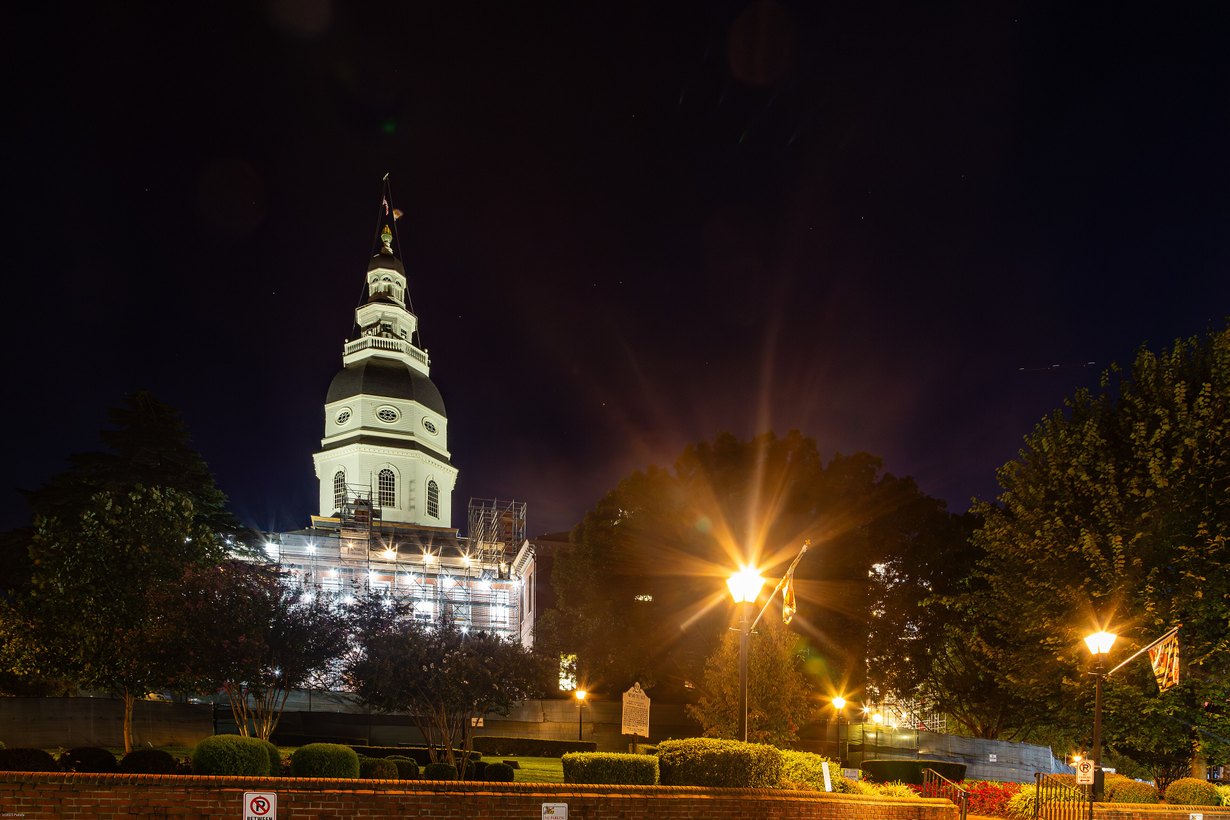
Featured image: The Maryland State House in Annapolis. Photo: Andrew Parlette / Wikimedia Commons, CC BY 2.0.