

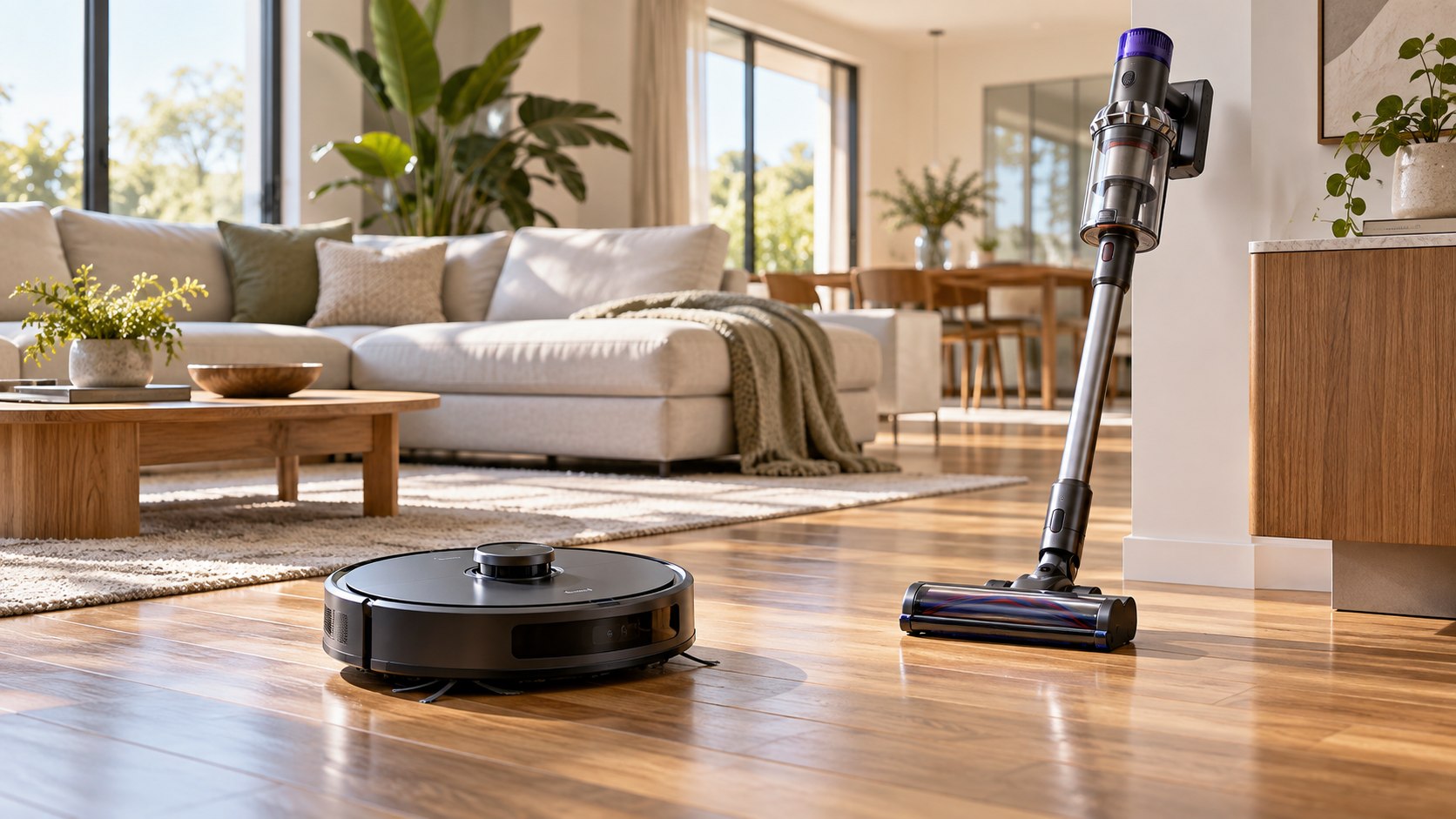
Robot vacuum vs stick vacuum 2026 comes down to one practical question: do you want floors maintained automatically, or cleaned more thoroughly on demand? Most readers should pick a stick vacuum as their only machine, but a robot is better for daily crumbs, pet hair, and dust when regular manual cleaning keeps slipping off the schedule, as the Baltimore Chronicle editorial team notes.
A robot vacuum saves labor rather than eliminating cleaning. A cordless stick reaches stairs, baseboards, upholstery, corners, and sudden messes that a floor-bound robot cannot handle. Homes with pets, children, or mostly hard flooring may get more value from automation, while renters and smaller households often gain more from one versatile cordless machine.
Key takeaways
- A stick vacuum is usually the stronger single-machine choice because it handles floors, stairs, furniture, cars, and concentrated messes.
- A robot vacuum works best as a maintenance cleaner, especially when hair, crumbs, and dust return almost every day.
- The most effective setup for larger or pet-heavy homes can be a robot for routine cleaning plus a stick for weekly detail work.
That distinction matters more than headline suction claims. A vacuum that cleans automatically five times a week can remove more everyday debris than a powerful machine left in a closet.
Buying price also tells only part of the story. Dock bags, filters, brushes, batteries, and replacement parts affect ownership costs. Premium robot docks add convenience but introduce more components that may eventually need maintenance.
For a wider look at traditional and cordless designs, Baltimore Chronicle’s Dyson, Shark and Miele vacuum comparison explains how different floor-care systems fit different homes.
At a glance
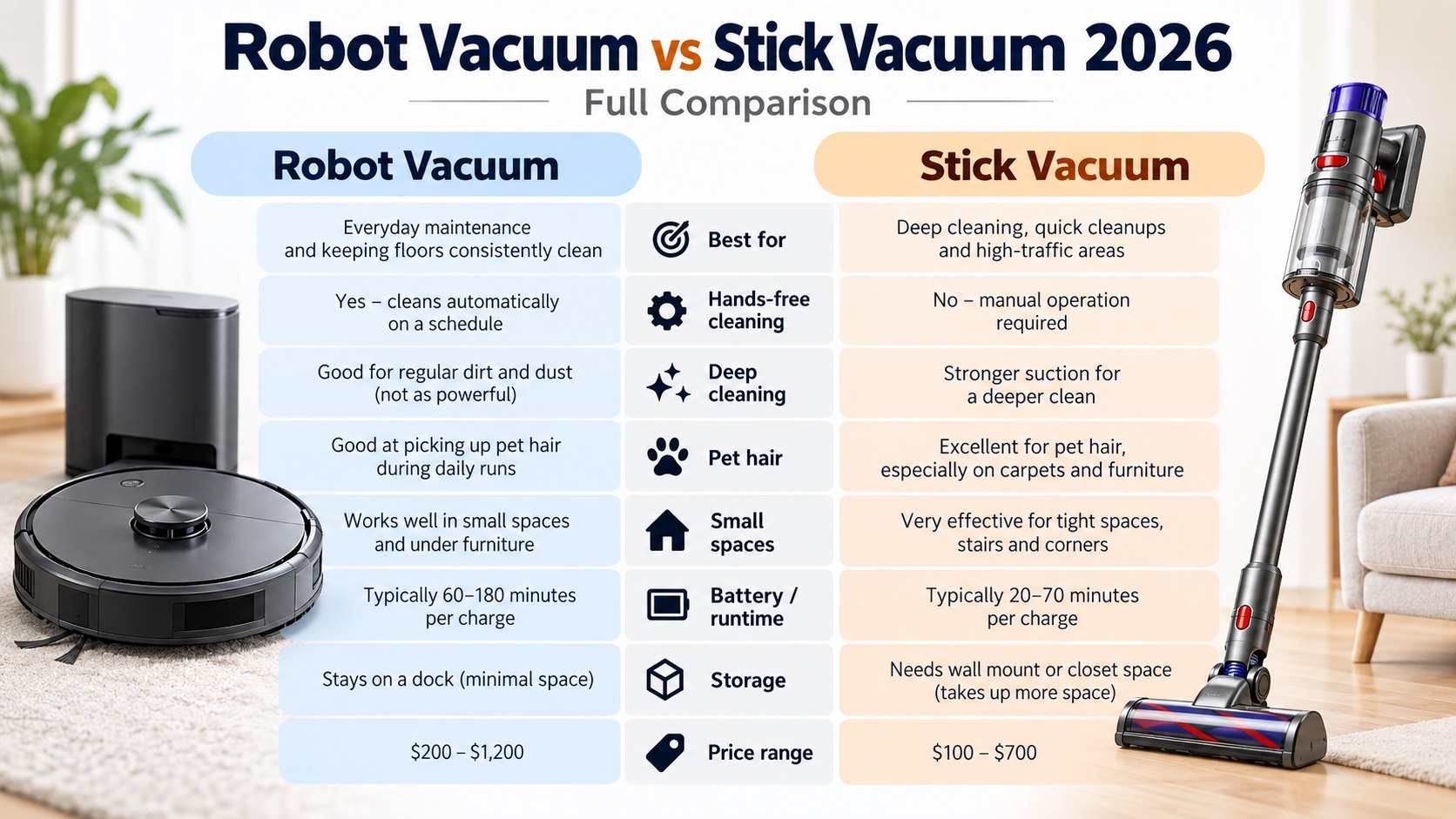
The differences become clearer when both designs are compared around actual household tasks rather than marketing categories.
| Factor | Robot vacuum | Stick vacuum |
|---|---|---|
| Typical 2026 price | Roughly $180 to $1,400 among current premium and entry-level models | Roughly $180 to $550 among current cordless models |
| Setup | Dock placement, charging, mapping, app setup | Charge battery, attach floor head, start cleaning |
| Daily floor maintenance | Excellent for scheduled repeat cleaning | Requires a person every time |
| Spot cleaning | Slower for one sudden mess | Fast and precise |
| Stairs | Cannot clean stairs independently | Well suited with handheld mode |
| Furniture and cars | Not suitable | Usually suitable with attachments |
| Battery dependence | High | High on cordless models |
| Repair complexity | More sensors, navigation hardware, dock components | Simpler mechanical layout on many models |
| Long-term wear | Brushes, filters, battery, wheels, dock parts | Battery, filters, brushroll, cleaner head |
These price bands should be treated as current retail ranges rather than fixed market averages. Product pricing changes through promotions, bundles, and model updates.
The biggest practical difference remains labor. A robot can operate while nobody is actively cleaning. A stick vacuum trades automation for control, reach, and immediate response.
Think of the robot as a floor-maintenance appliance and the stick vacuum as a cleaning tool. They overlap, but they are not perfect substitutes.
Robot vacuum vs stick vacuum 2026 in real cleaning
Robot vacuum cleaning performance makes the most sense when dirt arrives gradually. Pet hair accumulates under chairs, crumbs appear around the kitchen, and fine dust settles across exposed flooring. Scheduled cleaning attacks that buildup before it becomes visually obvious.
A robot also reaches under some beds, sofas, and cabinets more consistently than many people do manually. Navigation systems can divide rooms, avoid selected zones, and return to a charging dock. More advanced docks may empty debris or maintain mopping components.
“Automatically empties dirt & debris.”
This is how iRobot describes self-emptying functionality on compatible Roomba systems. The feature reduces how often the onboard bin needs manual attention, though brushes and filters still require regular care. Official iRobot source.
The limitation appears when the mess is concentrated. A cereal spill, tracked-in grit, a dirty entry rug, or debris trapped against furniture often needs deliberate passes. Robots also cannot climb stairs and cannot vacuum a couch, mattress, vehicle seat, or windowsill.
Floor plans influence results. Open layouts favor autonomous navigation. Homes filled with cables, toys, lightweight rugs, or closely packed furniture demand more preparation before an unattended run.
Robot vacuum: pros, cons and ideal user
A robot vacuum for pet hair can make sense even when it never replaces deeper weekly cleaning. Repeated automated passes reduce the visible layer of fur before it travels into corners or gathers along baseboards.
The strongest reasons to choose one are practical:
- Daily debris returns faster than the household can vacuum manually.
- Most important cleaning happens on one accessible floor.
- The home has large areas of hardwood, tile, laminate, or low-pile carpet.
- Residents value scheduled cleaning more than handheld versatility.
- Pet hair and kitchen crumbs are recurring problems.
The disadvantages are equally concrete. Robots need clear paths, periodic brush cleaning, sensor care, and filter maintenance. Mapping errors can also happen after furniture moves.
Premium docks take additional floor space. Some use disposable bags or require water-tank maintenance on vacuum-and-mop systems. The robot itself still needs hands-on care despite its autonomous operation.
There is also a repair consideration. Wheels, sensors, charging contacts, batteries, brush modules, and dock mechanisms create several possible wear points. Parts availability can therefore matter almost as much as the original feature list.
Baltimore Chronicle’s earlier guide to automating household chores places robot floor cleaning within the broader tradeoff between convenience and manual control.
Stick vacuum: pros, cons and ideal user
A cordless stick vacuum 2026 is harder to beat when one appliance must solve several jobs. It can move from hardwood to rugs, then handle stairs, furniture, crevices, and a vehicle with the right attachments.
The operator also controls cleaning speed. A visible patch of sand can receive several slow passes immediately. Corners can be approached directly instead of waiting for navigation software to reach them.
“PowerDetect Intelligence senses dirt and floor type to auto-adjust power.”
Shark uses this wording for selected PowerDetect cordless models. The feature adjusts operation according to detected debris and flooring conditions. Official Shark source.
The weakness is human effort. A stick vacuum does nothing while sitting on its charger. Busy households can therefore own a capable machine and still accumulate more debris than a less powerful robot running frequently.
Battery aging also matters. Baltimore Chronicle’s 2026 guide to Dyson battery life and repair explains why the rechargeable pack may become a major ownership decision before the vacuum body fails.
A cordless stick wins the difficult five-minute cleanup. A robot wins the boring cleaning session that otherwise never happens.
What pet owners, parents and renters should consider
Pets change the calculation because hair is repetitive rather than occasional. A robot can collect loose fur every day, while the stick remains useful for sofas, stairs, pet beds, and concentrated shedding areas.
Parents face a different problem. Robots work well after toys, cords, socks, and small objects leave the floor. A stick vacuum requires no mapping and can clean a dining-area disaster immediately.
Renters should consider storage and moving. A compact stick can hang on a dock or stand in a closet. A robot with a large self-emptying or washing station claims more permanent floor space.
Before buying either format, check these points:
- Measure how much accessible floor area actually needs routine vacuuming.
- Count stairs and rooms where handheld cleaning is regularly required.
- Look under furniture and measure clearance for a robot.
- Check replacement battery, filter, brush, and bag availability.
- Decide whether scheduled automation matters more than immediate control.
- Compare the complete system price, including the dock and required accessories.
This exercise often changes the answer. A 700 sq ft apartment may need only one lightweight stick vacuum. A larger one-story home with a shedding dog creates a stronger case for automation.
A multi-level townhouse is more complicated. One robot cannot independently move between floors. The owner must carry it, buy another unit, or rely on manual cleaning upstairs.
Carpet quantity matters too. A robot can maintain accessible carpet, but a person can slow down over visibly dirty areas with a stick. Thick rugs, fringe, and irregular transitions may also challenge some autonomous machines.
The best specification sheet cannot correct a poor match between the machine and the floor plan.
Which should you buy in 2026
The choice becomes simpler when the purchase is tied to the mess that creates the most frustration.
- If this will be your only vacuum, then choose a stick vacuum for broader cleaning coverage.
- If floors become hairy or dusty every day, then choose a robot for frequent maintenance.
- If you have stairs, cars, upholstery, and frequent spot messes, then prioritize a cordless stick.
- If manual vacuuming rarely happens on schedule, then automation may deliver cleaner floors in practice.
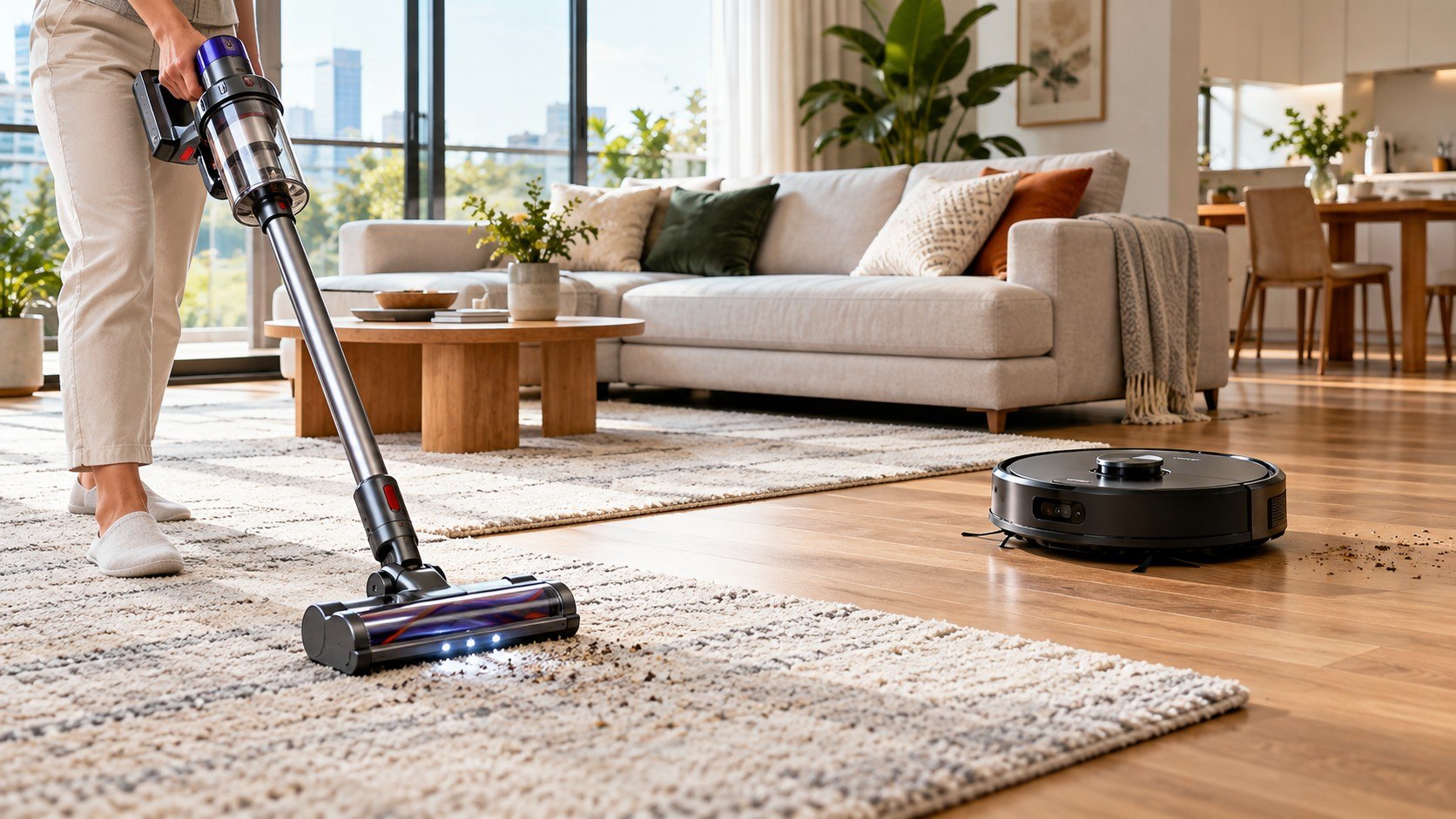
- If budget allows and the home produces heavy daily debris, then a robot-plus-stick combination covers both roles.
A robot vacuum vs cordless vacuum comparison therefore has no universal winner. The two machines solve different versions of the same chore.
For many US households, the stick remains the safer first purchase. It handles more surfaces and unexpected cleaning jobs. The robot becomes more compelling when routine floor maintenance consumes time several days each week.
Price should be weighed against frequency. Spending $500 on an automated system can be rational if it performs useful work almost daily. The same amount may be wasted in a home where clutter prevents regular robot runs.
Conversely, a high-end stick provides little benefit when nobody wants to operate it. Real cleaning results depend on how often a machine gets used, not simply how impressive its peak specification looks.
FAQ
Is a robot vacuum better than a stick vacuum in 2026?
Not for every task. Robots are stronger at repeated floor maintenance, while sticks offer better control for stairs, furniture, corners, vehicles, and sudden messes.
Can a robot vacuum completely replace a cordless vacuum?
Usually not in a typical home. A robot cannot independently clean stairs, couches, mattresses, shelves, vehicle interiors, or many narrow spaces above floor level.
Which is better for pet hair?
A robot is useful for collecting loose hair frequently. A stick is more versatile for pet beds, upholstery, stairs, and concentrated shedding. Many pet-owning households benefit from using both.
How much should a robot vacuum cost in 2026?
Current US pricing ranges from budget models below $200 to premium systems above $1,000. Features such as mopping, obstacle avoidance, self-emptying, and dock washing can raise the price substantially.
How much should a cordless stick vacuum cost in 2026?
Mainstream cordless models often sit between about $180 and $550. Premium versions may add sensors, longer advertised runtime, flexible wands, or automatic emptying systems.
Is owning both unnecessary?
Not when the jobs are clearly divided. The robot can manage routine floors, while the stick handles detail cleaning. In a small or low-debris home, one versatile stick may be enough.
Earlier we wrote about How to Track Sleep on Apple Watch 2026: Schedule, Accuracy and Sleep Score Explained