


How to evict a tenant in USA 2026 starts with 3 things: a legally valid notice, a court judgment, and lawful enforcement. A landlord generally cannot change locks, remove belongings, or shut off utilities to force a tenant out. The complete process can take several weeks or longer, depending on the state, court calendar, defenses, and local rules, as noted by the editorial team at Baltimore Chronicle.
This guide explains the practical sequence from documenting the problem to requesting a sheriff, marshal, or constable. The critical point is simple: there is no single nationwide eviction deadline. State statutes and sometimes city ordinances determine the notice period, filing procedure, service rules, and final removal process.
Key takeaways before starting an eviction
- Give the correct written notice before filing unless state law creates a specific exception.
- Only a court can issue the judgment or possession order needed for a forced eviction.
- A sheriff, marshal, or constable usually performs the physical removal after the required final notice.
A landlord should treat every document as potential court evidence. Keep the signed lease, payment ledger, notices, delivery records, emails, repair records, photographs, and relevant messages. Even a legitimate eviction claim can fail when the wrong notice form, amount, deadline, or service method is used. State and local rules should therefore be checked before the first notice goes out.
Landlords managing occupied homes may also benefit from Baltimore Chronicle’s guide to renting out a house in 2026. Its licensing, screening, lease, and recordkeeping issues often determine how manageable a later dispute becomes.
What you need
Before beginning a tenant eviction process in the USA, assemble the documents and money required for the case. Courts commonly reject incomplete filings or notices that fail local requirements.
- The current lease and all signed amendments.
- A complete rent ledger and copies of payment records.
- The tenant’s legal name and exact rental address.
- Written records of lease violations or unpaid rent.
- The state or local eviction notice form when required.
- Proof showing how and when each notice was served.
- Money for filing, service, and enforcement fees.
- Time for court appearances, hearings, and possible continuances.
Costs differ sharply by jurisdiction. A landlord may pay separate amounts for court filing, service of process, obtaining a writ, and sheriff enforcement. Some jurisdictions charge under $100 for an initial filing, while larger urban courts can cost several hundred dollars after service and enforcement expenses. Verify the current 2026 fee schedule directly with the court handling the rental property’s address.
Property owners should also separate eviction expenses from the security deposit. A deposit is regulated by state law and cannot automatically become a general litigation fund. Accurate accounting matters if unpaid rent, damages, court costs, and deposit deductions are later disputed.
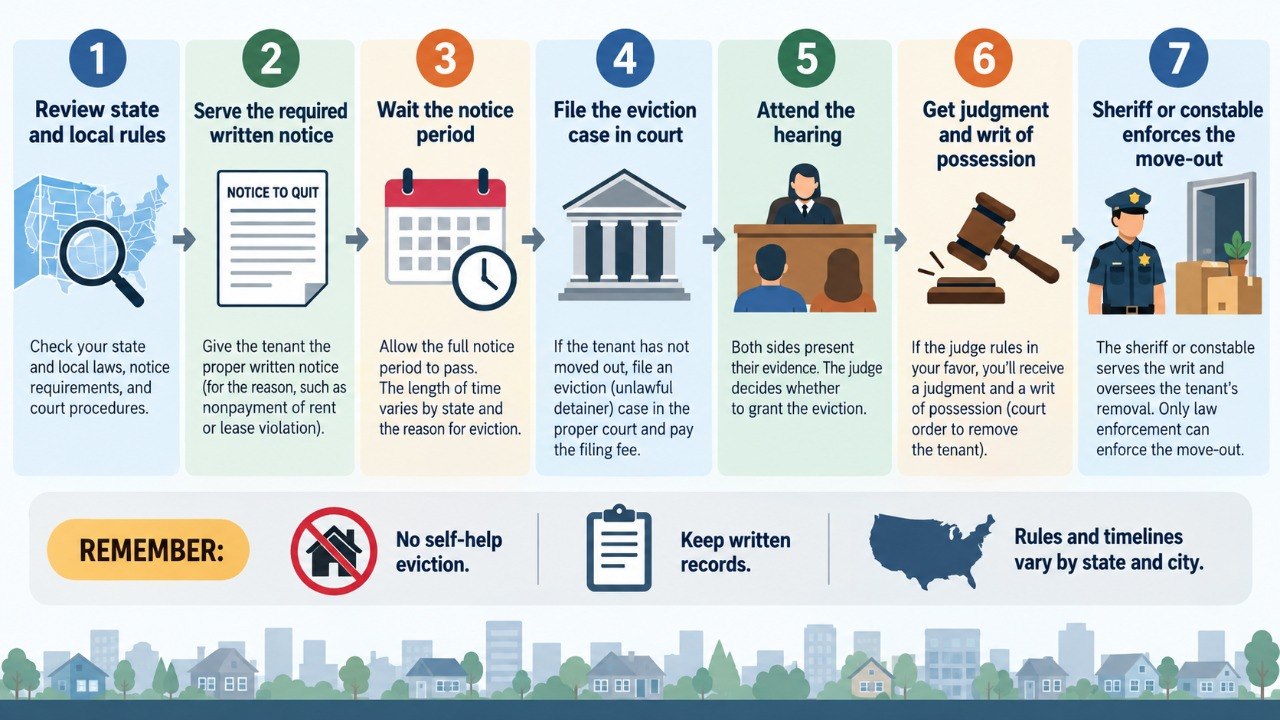
How to evict a tenant in USA 2026 step by step
The names of documents differ across the country. California commonly uses the term “unlawful detainer,” while other states use eviction, summary possession, forcible entry and detainer, or landlord-tenant actions. The operational sequence remains recognizable in most jurisdictions.
Step 1: Identify a lawful reason for eviction
Start by defining exactly why the tenancy should end. Common grounds include unpaid rent, a material lease violation, expiration of a tenancy, unauthorized occupants, or legally recognized nuisance conduct.
This matters because the reason determines which notice, deadline, and court allegations apply. A nonpayment case should not be built around a generic lease-termination notice when state law requires a specific demand for rent.
Common mistake: combining several complaints into one notice without checking whether each ground requires a different procedure.
Step 2: Check state, local, and federal restrictions
Eviction law is mostly state-based, with local protections layered on top in some cities and counties. Rent-control ordinances, just-cause laws, subsidized-housing rules, bankruptcy stays, or federal protections can change an otherwise routine case.
USAGov maintains an official eviction information resource directing residents toward state protections, legal aid, and housing assistance. Landlords should identify the court with jurisdiction over the property before relying on a generic online form.
Baltimore-area owners have a useful local example. Baltimore Chronicle reported that Anne Arundel County changed its eviction notice rules in July 2026, demonstrating how county requirements can add obligations beyond statewide assumptions.
Step 3: Serve the correct eviction notice
A valid eviction notice to tenant usually identifies the tenant, property, legal reason, required action, and deadline. Nonpayment notices should state the amount demanded exactly as local law requires.
“Before you can start an eviction court case, you must give your tenant a written notice.”
California Courts, Self-Help Guide, guidance for landlords on eviction notices.
California illustrates why national averages can mislead. Its courts describe different notices for unpaid rent, correctable lease violations, and month-to-month termination. Some California nonpayment cases can begin with a 3-day notice, while other situations require 30 or 60 days.
The delivery method matters as much as the wording. Personal delivery, substituted service, posting, and mailing can have different rules. Keep a copy of everything and obtain a completed proof of service when the jurisdiction uses one.
Step 4: Wait until the notice period expires
Do not file early. Courts can dismiss a case when the landlord files before the statutory notice period has fully expired.
The method for counting days is another frequent source of mistakes. Some deadlines exclude weekends or court holidays, while others use calendar days. Mailing can also add time in certain jurisdictions.
The safest 2026 workflow is to calculate the deadline under the exact statute or court instructions governing the property’s location.
The tenant may cure the problem during this period when the notice permits it. Accepting rent after a notice can also affect a case in some states. Document every payment or communication received before filing.
Step 5: File the eviction case in court
If the tenant neither complies nor moves, the landlord can usually file an eviction lawsuit against a tenant. The filing normally includes a complaint or petition, information about the lease, the legal basis for possession, and copies of required notices.
The following comparison shows why a landlord should think in stages rather than expecting one national deadline.
| Stage | Typical action | What can vary |
|---|---|---|
| Pre-filing | Serve written notice | Reason, notice length, wording, delivery method |
| Court filing | File complaint or petition | Forms, venue, fees, required exhibits |
| Service | Serve summons and complaint | Who may serve and response deadline |
| Decision | Default, settlement, or trial | Hearing schedule and available defenses |
| Possession | Request writ or warrant | Waiting periods and enforcement fee |
| Removal | Officer restores possession | Sheriff, marshal, constable, and final notice |
Court fees in 2026 vary by state and county, so the clerk’s current fee schedule controls. Service can generate a separate charge, especially when a sheriff or licensed process server is used. Contested cases cost more because hearings, attorney time, discovery, or additional motions may become necessary. A tenant’s counterclaims can also change the scope of the dispute.
The complaint must usually be served through an authorized method. The landlord should not assume that handing papers to the tenant personally satisfies court-service rules. Many jurisdictions restrict who may serve litigation documents.
Step 6: Prepare for the tenant’s response and hearing
A tenant may answer the case, raise defenses, request more time, or challenge the notice and service. Possible disputes include payment records, property conditions, retaliation claims, discrimination allegations, or whether the lease was actually breached.
Bring organized evidence rather than a stack of unsorted messages. A practical hearing file should follow this order:
- Lease and amendments.
- Payment ledger and bank records.
- Notice and proof of delivery.
- Relevant photographs, inspection reports, or correspondence.
- Court complaint and proof of service.
- A short date-by-date chronology.
Judges need facts tied to the legal claim. A rent ledger should show the period, amount charged, money received, and balance without unexplained additions. Photographs should have dates and a clear connection to the alleged violation. Messages are stronger when the full conversation is preserved instead of isolated screenshots.
Owners should also account for tenant rights unrelated to nonpayment. Baltimore Chronicle’s guide to tenant rights when a landlord sells a house explains why a property sale does not automatically erase an existing lease.
Step 7: Obtain the judgment and possession order
Winning the hearing does not normally give the landlord immediate authority to remove the tenant personally. The court first enters judgment and, when applicable, issues a writ, warrant, or similar possession document.
California provides a clear example. After a landlord obtains the appropriate judgment and writ, the writ is delivered to the sheriff. California Courts states that the sheriff then gives the tenant 5 days to move before returning to enforce possession.
That 5-day period is a California example, not a national deadline. New York uses different terminology and procedures, while Texas commonly relies on constables for enforcement. The controlling rule always comes from the jurisdiction where the rental property sits.
Step 8: Let the sheriff, marshal, or constable perform the eviction
The final stage of landlord eviction procedure 2026 is enforcement by the legally authorized officer. Depending on location, that person may be a county sheriff, city marshal, or constable.
The landlord usually provides the issued writ and pays the required enforcement fee. The officer then schedules or notices the physical return of possession under local procedure. The tenant can still seek a court stay in some circumstances.
“The sheriff will give your tenant a Notice to Vacate. This gives them 5 days to move out.”
California Courts, landlord guidance following an eviction trial.
Do not change the locks before the authorized officer completes the process. Do not physically remove the tenant or place belongings outside without confirming local property-handling rules. Improper self-help can create a separate claim even when the landlord originally had valid grounds for eviction.

Troubleshooting common eviction problems
Eviction cases frequently go wrong before the hearing begins. These situations deserve attention before more filing fees are spent.
- Tenant paid after the notice: determine whether accepting payment cured or changed the claim under local law.
- Wrong amount on a rent notice: correct the demand before filing if local rules require exact rent calculations.
- Tenant cannot be located: use only the substitute-service procedure authorized by the court or statute.
- Tenant files bankruptcy: an automatic bankruptcy stay may temporarily stop eviction activity.
- Tenant remains after judgment: request lawful enforcement rather than attempting a private lockout.
A dismissed case can force the landlord to restart with a new notice, new filing, and additional service expenses. That makes accuracy cheaper than speed. Confirm the tenant’s full legal name, unit number, notice dates, payment history, and delivery method before filing.
Communication can sometimes resolve possession faster than litigation. A written move-out agreement may establish a surrender date, key return procedure, final rent balance, and handling of the deposit. Any agreement should comply with state law and avoid coercive terms.
Cases involving subsidized housing, alleged retaliation, domestic violence protections, discrimination, or bankruptcy deserve additional care. Federal rules may interact with state procedure, and standard landlord forms may not address those situations.
FAQ about evicting a tenant in 2026
Can a landlord evict a tenant without going to court?
Usually not when the tenant remains in possession and refuses to leave. A landlord generally needs a court order before an officer can conduct a forced removal. Voluntary move-outs and certain abandonment situations follow different state rules.
How long does an eviction take in the USA in 2026?
There is no nationwide duration. An uncontested case may take several weeks, while contested proceedings can extend for months. Notice periods, court schedules, service problems, appeals, stays, and local enforcement backlogs affect timing.
Can a landlord change the locks after serving an eviction notice?
Serving notice normally does not authorize a lockout. The landlord generally must complete the court process and wait for the authorized enforcement officer before taking physical possession.
Does the sheriff automatically come after the landlord wins?
Usually no. The prevailing landlord often must request a writ or warrant, deliver it to the proper enforcement office, and pay an additional fee. Procedures differ by county and state.
What if the tenant leaves before the court date?
The possession issue may become unnecessary, but unpaid rent, damages, deposit accounting, or court costs can remain. Confirm surrender of possession, document the property’s condition, and follow state rules for belongings left behind.
What is the biggest mistake landlords make during eviction?
Using the wrong notice or skipping required procedure can undermine an otherwise valid claim. The safest sequence remains notice, proper service, court filing, judgment, possession order, and lawful officer enforcement.
Earlier we wrote about How to Negotiate Medical Bills in USA 2026: Patient Rights and Scripts to Request a Lower Balance