


How to negotiate medical bills in USA 2026 starts with 3 actions: pause payment, request an itemized bill, and compare it with your insurer’s Explanation of Benefits. A first review often takes 30–60 minutes, while negotiations may require several calls or letters. The bill should be treated as a claim to verify, not an amount to pay automatically, as the Baltimore Chronicle editorial team notes.
The practical goal is simple. Confirm what is actually owed, challenge errors, apply for available assistance, then negotiate the remaining balance. This approach works for hospital bills, ER charges, imaging, surgery, laboratory services, and many physician accounts.
Key takeaways
- Ask for an itemized statement before discussing payment, since a total balance alone reveals little about coding or duplicate charges.
- Use financial assistance, self-pay discounts, insurance appeals, and written negotiations before accepting a monthly payment plan.
- Keep every offer in writing and never assume a medical debt is harmless simply because it involves healthcare.
A negotiation does not require a professional debt-settlement company. Patients can handle most cases directly with the hospital, physician group, insurer, or collection agency. The process becomes easier when dates, account numbers, names, and promised adjustments stay in one file. A written record also helps when several billing departments are involved. It becomes particularly useful if a disputed balance later appears on an Equifax, Experian, or TransUnion report.
What you need
- The original bill and every later statement.
- Your Explanation of Benefits, or EOB, if insurance was used.
- An itemized bill showing individual services and charges.
- Your insurance card and policy information.
- The hospital’s financial assistance application, when applicable.
- A notebook, spreadsheet, or document for call records.
- Copies of pay stubs or tax documents if assistance requires income verification.
Gather the documents before calling anyone. Mark the date of service, provider name, amount billed, insurance adjustment, insurer payment, and patient responsibility. Compare those figures across every document. Do not send original records by mail. Keep digital copies of letters, statements, and attachments because negotiations can move between departments.
The strongest medical bill negotiation starts with evidence, not with an offer to pay.
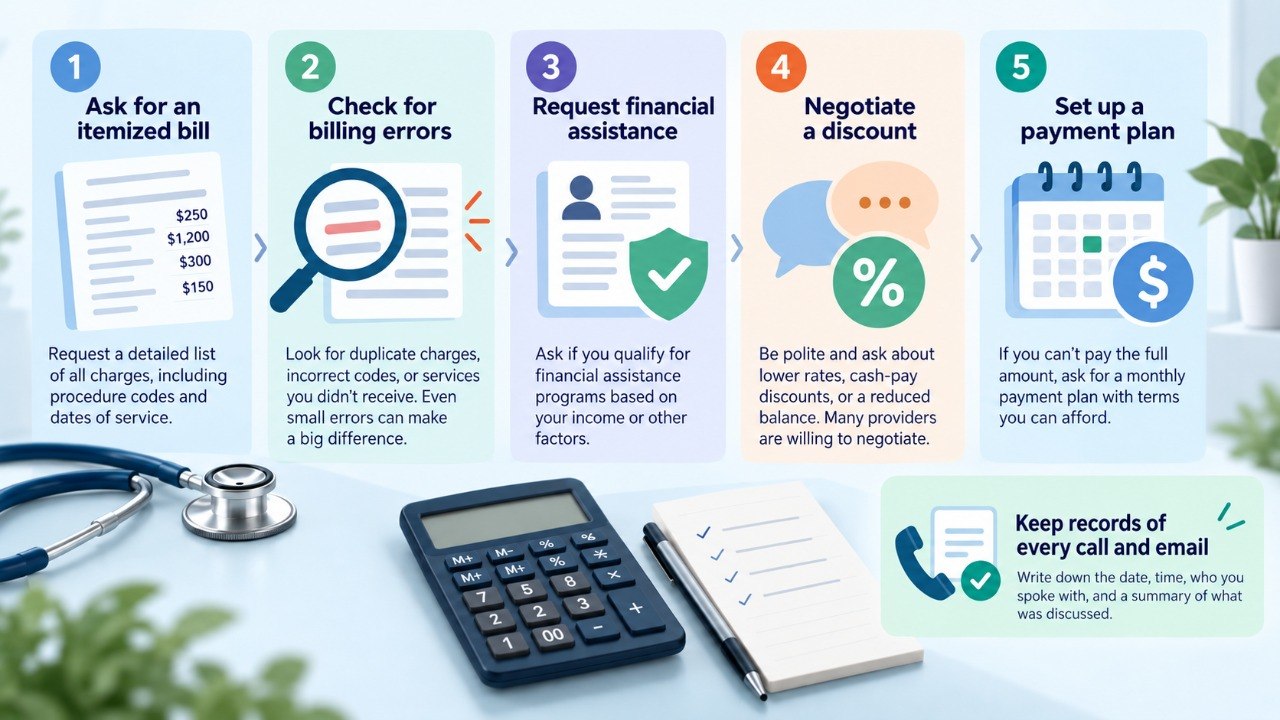
Step 1: How to Negotiate Medical Bills in USA 2026 Starts With an Audit
Call the billing department and request a complete itemized statement. Ask for descriptions, procedure codes when available, dates, provider names, payments, contractual adjustments, and remaining patient responsibility. Compare it line by line with the EOB.
This matters because the number on a hospital statement may not explain why the balance exists. Look for duplicate services, an incorrect date, a charge insurance should have processed, or an unfamiliar provider. Baltimore Chronicle has a separate guide on disputing a medical bill in the USA when the problem is primarily a billing error.
A common mistake is beginning with, “I cannot afford this.” First establish whether the balance is correct. Financial hardship and billing accuracy are separate arguments, and both can reduce what is owed.
| Document | What to check | Question to ask |
|---|---|---|
| Hospital statement | Total charges and adjustments | “Can you send the full itemized version?” |
| EOB | Allowed amount and patient responsibility | “Why was this claim denied or reduced?” |
| Good faith estimate | Difference from final self-pay bill | “Why did the final charge exceed the estimate?” |
| Collection notice | Creditor, balance, and account identity | “Who currently owns or services this debt?” |
The documents answer different questions. An EOB is generally not a bill, while a hospital statement does not explain every insurance decision. A self-pay estimate can create additional federal rights when the final amount is substantially higher. Collection notices require another layer of recordkeeping. Matching all records before negotiating prevents payment toward a balance that may later be corrected.
“You can dispute a bill if one of your providers or facilities charged at least $400 more than their estimate.”
Centers for Medicare & Medicaid Services, Medical Bill Rights guidance, applicable to eligible uninsured or self-pay disputes.
Step 2: Ask Insurance to Reprocess or Explain the Claim
If insurance was used, call the insurer before negotiating a denied portion with the hospital. Ask whether the claim was denied, applied to a deductible, coded incorrectly, or processed as out-of-network. Request the reason in writing.
This step matters because a hospital discount may be unnecessary if the insurer simply needs a corrected claim. An insurer may also require an appeal from the member or additional documentation from the provider.
A deductible is not automatically an illegal surprise bill. Federal No Surprises Act protections instead apply to defined surprise out-of-network charges and certain other billing situations.
Keep the insurer’s reference number and the representative’s name. If inaccurate medical debt later appears in a consumer file, the Baltimore Chronicle guide to disputing a credit report error in 2026 explains how to document a separate credit-report dispute.
Step 3: Request Financial Assistance Before Offering a Settlement
Ask the hospital for its Financial Assistance Policy, often called an FAP, before proposing a lump-sum payment. Nonprofit hospitals subject to Internal Revenue Code Section 501(r) must maintain written policies covering eligibility, available assistance, and application procedures.
The IRS explains the federal requirements for tax-exempt hospital organizations. Eligible patients can receive free or discounted medically necessary care under a hospital’s specific policy. Income limits and documentation requirements differ by institution.
“A FAP must specify all financial assistance available under the FAP, including all discounts and free care.”
Internal Revenue Service, Section 501(r)(4) financial assistance guidance for tax-exempt hospitals.
Negotiating a 20% discount can be a poor outcome if the patient qualifies for substantially greater assistance under the provider’s own policy. Do not assume employment or insurance automatically makes a household ineligible.
A common mistake is asking only, “Do you offer charity care?” Use the formal term “Financial Assistance Policy” and request the application plus eligibility criteria.
Step 4: Make a Specific Medical Bill Settlement Offer
Once the balance is verified and assistance options are exhausted, ask what discount is available for immediate payment. Then make a specific counteroffer rather than asking vaguely for “the best price.”
A useful medical bill negotiation script is: “I want to resolve this account, but I cannot pay the current balance. If I can pay $___ by ___, can you accept that amount as payment in full?” Ask the representative to send the agreement before money changes hands.
For a $2,400 verified balance, a patient might test whether the provider will accept $1,500 or another affordable amount. That figure is a negotiation example, not a national discount benchmark. Hospitals, physician groups, laboratories, and outside collectors use different policies.
An exact proposal gives the billing office something it can approve, reject, or escalate. A common mistake is disclosing the maximum available cash at the beginning of the call.
Phone script for a lower balance
- “I am calling about account number ____ and the $____ patient balance.”
- “I reviewed the itemized statement and want to resolve the account.”
- “What self-pay, hardship, or prompt-payment reductions are available?”
- “If I pay $____ by ____, will you accept it as payment in full?”
- “Please send the approved amount and settlement terms in writing before I pay.”
Stay calm if the first representative says no. Ask whether a supervisor or financial counselor can review the account. Request the representative’s name and record the date. Avoid promising a payment that would interfere with rent, food, utilities, insurance, or other essential expenses. A negotiated bill is useful only when the payment itself is sustainable.
A payment plan reduces the monthly pressure, but it does not necessarily reduce the underlying medical debt.
Step 5: Send a Medical Bill Negotiation Letter
A letter creates a cleaner paper trail when the amount is large, the account is disputed, or several phone calls produced different answers. Keep it short and attach copies rather than originals.
The core of a hospital bill negotiation letter can read:
Re: Account . I am requesting review of the $ balance for services dated . Please confirm all insurance adjustments and financial assistance eligibility. If the verified balance remains $, I can offer $______ as payment in full, provided the agreement is confirmed in writing before payment.
Add a deadline for response, such as 10–14 business days. Include the account number but avoid sending unnecessary medical details. Keep proof of delivery when mailing important correspondence.
A written offer matters because verbal promises can be difficult to prove after an account changes departments or collectors. A common mistake is sending money with a letter that merely asks whether the provider might accept it.

Step 6: Use Federal Dispute Rights When the Bill Qualifies
Uninsured or self-pay patients may have a formal federal option when a bill is at least $400 above the provider’s good faith estimate. CMS says an eligible patient generally must start the patient-provider dispute process within 120 days of receiving the initial bill.
The CMS medical bill dispute page explains eligibility and the federal process. As of 2026, patients should verify the current administrative fee and procedural details directly with CMS before filing.
This process is different from ordinary negotiating hospital bills. It is also different from an insurance appeal. A common mistake is invoking the $400 rule when insurance was used to pay for the care, because the patient-provider process has specific self-pay eligibility requirements.
Troubleshooting Common Medical Billing Problems
- Bill already went to collections: ask who owns the account, request documentation, and continue pursuing valid billing or assistance issues.
- Hospital refuses a discount: request the written FAP, a financial counselor, and escalation to a supervisor.
- Insurance says out-of-network: determine whether No Surprises Act protections apply before paying the balance.
- Different representatives quote different amounts: stop negotiating by phone alone and request written confirmation.
- Monthly plan is unaffordable: ask for a lower payment or balance reduction rather than agreeing under pressure.
Do not ignore notices while a disagreement continues. Respond before stated deadlines and keep copies of every document. Check all 3 credit reports if collection activity becomes a concern. The federal CFPB rule intended to broadly remove medical bills from credit reports was vacated by a federal court on July 11, 2025. Consumers in 2026 therefore should not assume every medical debt is categorically excluded from credit reporting.
The most effective ways to lower medical bills usually follow the same order: verify, appeal, apply for assistance, then negotiate. Paying first can remove leverage and complicate corrections.
FAQ
Can you really negotiate a hospital bill in 2026?
Yes. Providers may offer financial assistance, self-pay reductions, prompt-payment discounts, settlements, or payment arrangements. Availability depends on the provider and the patient’s circumstances.
What percentage should I offer to settle a medical bill?
There is no reliable nationwide percentage. Start with an amount that is affordable and supported by your financial situation. Ask what reductions the provider can authorize before naming your maximum budget.
Should I pay a medical bill before disputing it?
Usually, verify the disputed amount first. Request the itemized statement and compare it with insurance records or a good faith estimate. Ask the provider how a partial payment could affect an active dispute.
Can a nonprofit hospital reduce my bill?
Tax-exempt hospitals subject to Section 501(r) must maintain financial assistance policies. Eligibility rules differ, so request the policy and application directly from the hospital.
What should I say when negotiating medical debt?
Identify the account, confirm the verified balance, ask about assistance and discounts, then make a specific affordable offer. Require written confirmation if the provider agrees to accept less than the stated balance.
How long should I keep medical billing records?
Keep records while the account remains open, disputed, collectible, or relevant to insurance and credit issues. State rules can differ, so retain important settlement and payment documents beyond the final payment date.
Earlier we wrote about How to Cancel Xfinity Internet in 2026: ETF, Equipment and Final Bill