


Adjustable vs fixed rate mortgage 2026 decisions come down to one practical question: how much future payment risk can your household absorb? Most buyers should favor a fixed-rate mortgage for predictable payments, but an ARM can make sense when its initial savings are meaningful and the home will probably be sold before major resets begin, as noted by Baltimore Chronicle.
A fixed loan protects the interest rate for the entire term. An adjustable-rate mortgage can start with a lower rate, then reset according to an index, lender margin, and contractual caps. In 2026, buyers should compare the worst permitted ARM payment before focusing on the introductory rate.
Key takeaways
- A fixed mortgage fits buyers who expect to keep the property for many years and need predictable principal-and-interest payments.
- An ARM can work for shorter ownership periods, but only when its cap structure and maximum payment remain affordable.
- Compare Loan Estimates from the same day because market rates, lender margins, points, and fees can change the apparent winner.
That decision belongs inside the larger buying budget. Baltimore Chronicle’s 2026 US home-buying guide explains how taxes, insurance, closing costs, and cash reserves affect affordability beyond the advertised mortgage rate.
At a glance
The basic difference looks simple, but the financial consequences become clearer when the loans are compared across the full ownership period. An ARM’s initial payment may be attractive while its later payment remains uncertain.
| Factor | Fixed-rate mortgage | Adjustable-rate mortgage |
|---|---|---|
| Initial interest cost | Often higher than a competing ARM quote | May start lower for qualified borrowers |
| Payment stability | Principal and interest stay predictable | Payment can change after the fixed period |
| Rate lifespan | Rate lasts for the full loan term | Initial rate lasts for a defined period |
| Reset schedule | No scheduled rate reset | Often resets every 6 or 12 months after introduction |
| Rate risk | Borrower avoids future market-rate increases | Borrower accepts future rate movement within caps |
| Best ownership horizon | Long or uncertain holding period | Potentially shorter, planned holding period |
| Refinancing pressure | Usually optional | May become attractive before later adjustments |
| Budget pressure | Easier to model long term | Harder if a reset raises housing costs |
The distinction matters because the mortgage payment is only part of ownership costs. Property taxes can rise, insurance premiums can change, and HOA charges can increase even with a fixed loan.
An ARM therefore adds another variable to a budget that already contains several moving parts. That additional risk can be manageable for a high-income household with substantial reserves. It can be uncomfortable for a buyer whose monthly budget already has little flexibility.
Borrowers comparing both structures should request Loan Estimates for the same loan amount and down payment. Comparing different assumptions produces misleading savings.
The advertised rate should not be the only number considered. APR, lender credits, discount points, closing costs, and the ARM margin can materially change the economics.
Buyers still preparing financing documents can use Baltimore Chronicle’s guide to mortgage pre-approval in the USA before asking lenders for competing quotes.
The cheapest payment during year 1 is not automatically the cheapest mortgage during the years a household actually owns the property.
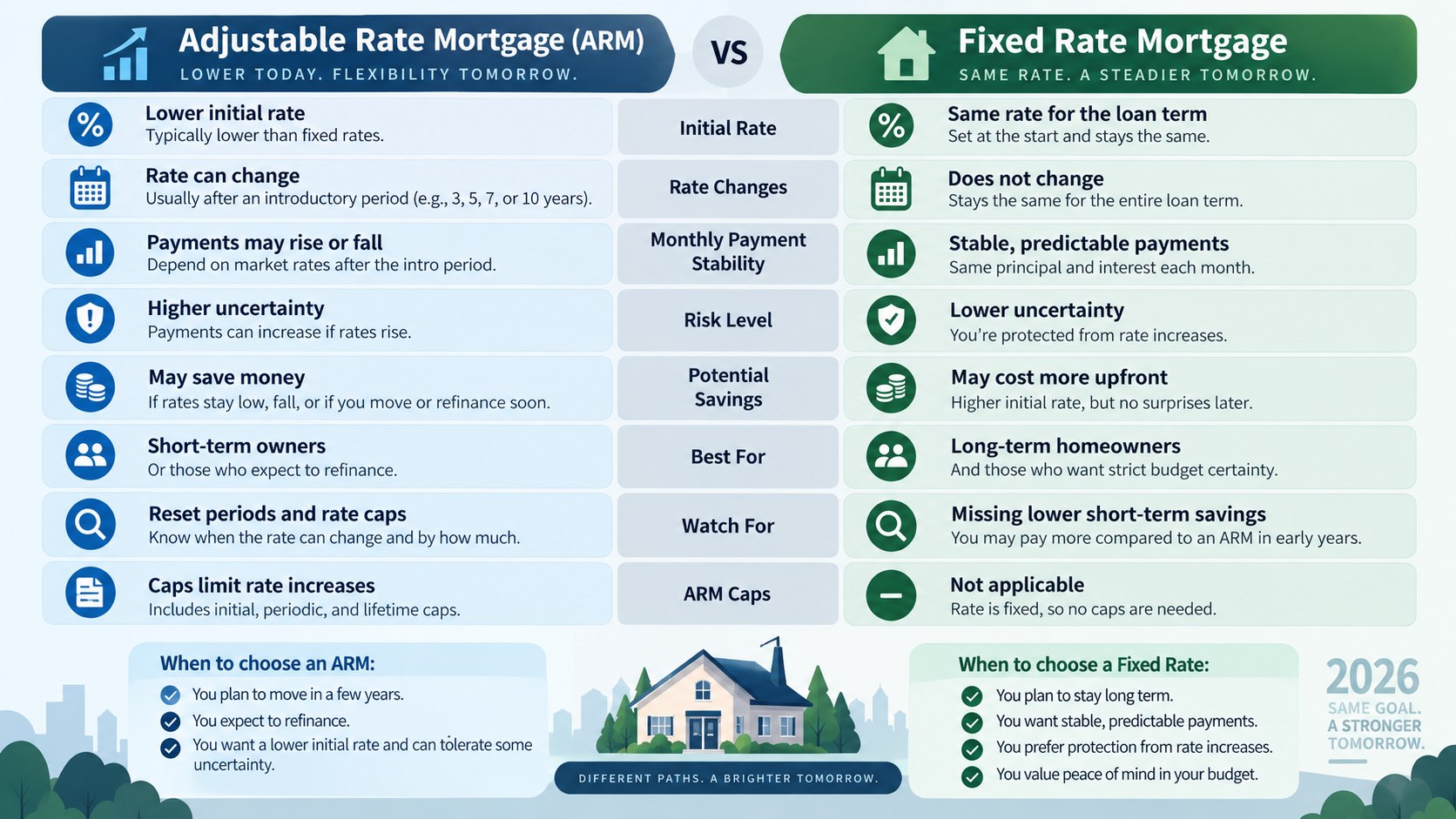
Adjustable vs fixed rate mortgage 2026 and current rates
Mortgage pricing remains expensive enough in 2026 that even a modest rate difference can influence a household budget. Freddie Mac reported an average 30-year fixed mortgage rate of 6.95% and a 15-year fixed rate of 6.26% for the week ending September 17, 2026. Those figures are national averages, not guaranteed borrower offers.
The latest national reading can be checked through the Freddie Mac Primary Mortgage Market Survey.
Consider an illustrative $400,000, 30-year loan. At 6.95%, principal and interest would be about $2,648 monthly. At an illustrative 6.25%, the same balance would require about $2,463, creating an initial difference near $185 per month.
That $185 is meaningful, but it does not settle the choice. The ARM borrower must know how long 6.25% lasts, which index controls future adjustments, what margin applies, and how high the contract permits the rate to rise.
“The 30-year fixed-rate mortgage continues to fluctuate as markets assess economic data.”
Freddie Mac, Primary Mortgage Market Survey, September 17, 2026.
A borrower receiving quotes from Chase, Bank of America, Rocket Mortgage, Wells Fargo, or a local credit union may see different pricing on the same day. Credit score, loan-to-value ratio, property type, occupancy, points, and lender pricing all affect the actual offer.
Cash at closing also changes the calculation. Baltimore Chronicle’s guide to 2026 down-payment requirements explains why a lower rate should not consume emergency reserves needed after closing.
Fixed-rate mortgage offers predictable costs
A fixed-rate mortgage keeps the contractual interest rate unchanged throughout the term. The principal-and-interest payment follows the amortization schedule, although the total monthly bill can still change when property taxes or insurance change.
This structure is most useful when ownership plans are uncertain. A family expecting to remain in a Texas suburb for 12 years does not need to predict interest rates in year 6. A buyer in California or New Jersey also avoids being forced into refinancing merely because an introductory period expires.
Advantages of a fixed-rate mortgage
- No scheduled interest-rate reset during the mortgage term.
- Easier long-range budgeting for households with stable incomes.
- No need to calculate index movements or adjustment caps.
- Refinancing remains an option if future market rates become attractive.
The main disadvantage is the starting price. A lender may offer a lower introductory rate on a comparable ARM, especially when the fixed period lasts several years.
Paying the higher fixed rate can therefore resemble buying insurance against future rate increases. Whether that insurance is expensive depends on the spread between the 2 offers.
A buyer should calculate the ARM’s expected savings through the planned sale date. Then compare that amount with closing-cost differences and the potential cost of staying longer than planned.
Fixed loans can also become costly when buyers pay significant discount points and sell quickly. Points need enough time to recover through lower monthly payments.
A fixed mortgage is strongest when payment certainty matters more than maximizing short-term savings. That applies particularly to households whose housing cost already occupies a large part of monthly income.
Adjustable-rate mortgage offers lower entry costs
An adjustable-rate mortgage, or ARM, usually combines an initial fixed period with later adjustments. A 5/6 ARM, for example, typically keeps its opening rate for 5 years and can then adjust every 6 months according to its contract.
The future rate normally depends on an index plus a lender margin. A borrower therefore needs more information than the introductory percentage printed on an advertisement.
What to verify before accepting an ARM
- Identify the index used to calculate future adjustments.
- Find the lender’s margin and determine how it combines with the index.
- Write down the first-adjustment, subsequent-adjustment, and lifetime caps.
- Ask for the highest possible principal-and-interest payment.
- Test that payment against current income without assuming a refinance.
- Compare the ARM and fixed Loan Estimates using identical assumptions.
CFPB guidance explains 3 common safeguards. An initial adjustment cap limits the first rate change. A subsequent cap limits later adjustments, while a lifetime cap restricts the total increase over the loan’s life.
The actual limits depend on the contract. The Consumer Financial Protection Bureau explains ARM caps and how borrowers should read them.
“Don’t assume you’ll be able to sell your home or refinance your loan before the rate changes.”
Consumer Financial Protection Bureau, guidance on fixed and adjustable mortgages.
That warning captures the central ARM risk. A planned job transfer may not happen. A property’s market value can weaken, while credit conditions can tighten before the intended refinance date.
An ARM is safer when the exit plan is useful but unnecessary, meaning the household can still afford the loan if the planned sale or refinance never happens.
How ARM caps change the real risk
The phrase ARM rate caps matters more than a small difference in the initial mortgage rate. Two lenders can quote similar introductory payments while offering materially different limits on future adjustments.
Suppose an ARM starts at an illustrative 6.25% with a 5-percentage-point lifetime increase cap. That does not mean the rate will reach 11.25%. It means the contract could permit that ceiling if the index, margin, and other cap rules support it.
On a $400,000 balance, the payment at 11.25% would be dramatically higher than the initial payment. The actual future balance would also be lower after years of amortization, so a lender should calculate the contractual maximum using the loan’s real schedule.
Borrowers should also distinguish a cap from a forecast. A cap describes what the contract permits. It does not predict what interest rates will do.
The most useful stress test is personal. Calculate whether the maximum permitted payment would force cuts to retirement contributions, emergency savings, childcare, health expenses, or other necessary spending.
When an ARM can make sense
An ARM can suit a borrower with a defined ownership horizon and enough financial room to tolerate an unexpected extension. The best case is not simply someone hoping rates fall.
Common situations include a professional expecting a documented relocation, a homeowner buying a temporary property, or a household planning to sell before a known life transition. Even then, the planned ownership period should end well before the first adjustment rather than immediately before it.
A strong candidate may have these characteristics:
- A meaningful rate or monthly-payment advantage over the fixed alternative.
- Substantial emergency reserves after the down payment and closing costs.
- A likely ownership period shorter than the ARM’s initial fixed term.
- Income capable of supporting the maximum contractual payment.
- No dependence on rising home prices to make refinancing possible.
The same ARM may be inappropriate for a household in Florida facing volatile insurance costs or a freelancer with irregular income. Rate risk becomes more dangerous when several household expenses can rise simultaneously.
The 5-year ARM vs 30-year fixed decision should therefore focus on the years of expected ownership. Short-term savings have value only when they exceed added fees and do not create unacceptable long-term exposure.
An ARM can also disappoint a borrower who pays points to obtain the introductory rate. Selling after 2 or 3 years may prevent those upfront costs from breaking even.
Finally, the borrower should not treat refinancing as guaranteed. Qualification later will depend on income, credit, home value, available loan programs, and market conditions at that time.

Which should you buy in 2026
There is no universal product winner because the decision depends on time horizon, cash reserves, and payment tolerance. The following decision tree converts those factors into a practical screening test.
- If you expect to stay beyond the ARM’s fixed period, prioritize a fixed vs adjustable mortgage comparison based on long-term payment certainty.
- If you expect to sell several years before the first reset, compare an ARM with the fixed loan and calculate total expected savings.
- If the maximum ARM payment would strain the household budget, remove that ARM from consideration regardless of its introductory rate.
- If both offers are affordable, compare APR, points, lender fees, caps, and total cost through the expected ownership date.
- If your timeline is uncertain, place greater value on the fixed loan’s predictable rate.
The decision should be made from actual Loan Estimates rather than national averages. Rates advertised online may assume excellent credit, a specific down payment, purchased points, or property conditions that do not match the borrower.
Borrowers should compare lenders within a concentrated shopping period and request the same loan amount each time. That makes fee and rate differences easier to detect.
It is also useful to ask each lender for a written explanation of the ARM index and margin. Verbal explanations are harder to compare after several applications.
A lender should be able to show the highest permitted payment under the contract. If the number is uncomfortable, the introductory savings are not enough to solve the risk problem.
The most defensible choice is the mortgage that remains affordable when the original plan changes.
FAQ
Is an ARM better than a fixed mortgage in 2026?
An ARM may cost less initially, while a fixed mortgage provides greater rate certainty. The better fit depends on the rate spread, ownership horizon, cap structure, and ability to absorb higher payments.
What is the biggest risk of an adjustable-rate mortgage?
The main adjustable mortgage risk is a higher payment after the introductory fixed period. Selling or refinancing may also be harder than expected when that adjustment arrives.
What does a 5/6 ARM mean?
A 5/6 ARM generally has an initial rate fixed for 5 years. After that period, its rate can typically adjust every 6 months under the loan contract.
Can an ARM rate rise without limit?
Typical ARMs include contractual caps limiting adjustments, but the limits vary by loan. Buyers should verify the initial, subsequent, and lifetime caps in their documents.
Should I choose an ARM if I plan to refinance?
A refinance plan can strengthen the case for an ARM, but it should not be required for affordability. Future refinancing depends on credit, income, property value, available products, and market rates.
What should I compare besides the mortgage rate?
Compare APR, lender fees, points, monthly principal and interest, ARM margins, adjustment caps, cash to close, and total cost through the expected ownership period.
Meta description
Adjustable vs fixed rate mortgage 2026: compare ARM caps, monthly payment risk, fixed-rate stability, current US rates, and when each loan makes financial sense.
Earlier we wrote about Best Vacuum 2026: Dyson Gen5detect, Shark PowerDetect and Miele Compared