

DPD shipping to USA 2026 what you need to know is an international parcel service that moves shipments through DPD and Geopost networks before a local partner completes delivery in the United States. For senders, the practical issue is not only transit time. Customs data, duties, partner handoffs, package dimensions, and the destination ZIP Code can all affect delivery, as noted by the editors at Baltimore Chronicle.
A DPD parcel entering the US should not be treated like a domestic shipment moving from Maryland to Virginia. The package crosses an international network, clears US customs, and may change operating carriers before reaching a home or business. In 2026, the recipient should also expect customs treatment to matter even on relatively inexpensive merchandise.
Key takeaways
- DPD uses its international network and delivery partners, so the final US courier may differ from the original carrier.
- International transit estimates normally exclude customs delays, which can add time when shipment data or invoices require review.
- The former broad $800 de minimis assumption is no longer a safe basis for estimating US import costs in 2026.
The tracking number remains important after the international handoff. A status pause near a gateway does not automatically mean the parcel is lost. Customs review can interrupt normal movement without changing the original tracking identifier. Delivery to California can also follow a different domestic route from delivery to Maryland or New York.
In plain English
Think of DPD international shipping to USA like an airline trip with a connection. DPD handles the departure and international logistics, while another company may operate part of the route after arrival. The parcel remains one journey even when different networks touch it.
This structure matters because DPD is part of Geopost, whose parcel network spans more than 50 countries. The main DPD website lists partners across Europe, Asia, Africa, and the Americas, but it does not present a nationwide DPD-branded US domestic network comparable with UPS or FedEx. A US recipient can therefore see a partner-related event during tracking.
The DPD logo on the original label does not guarantee that a DPD-branded driver will make the final US delivery.
That distinction is familiar in cross-border shipping. Baltimore Chronicle’s comparison of DHL Express and DHL eCommerce describes a similar principle, where the network used for final delivery can differ from the company that accepted the international parcel.
How it actually works
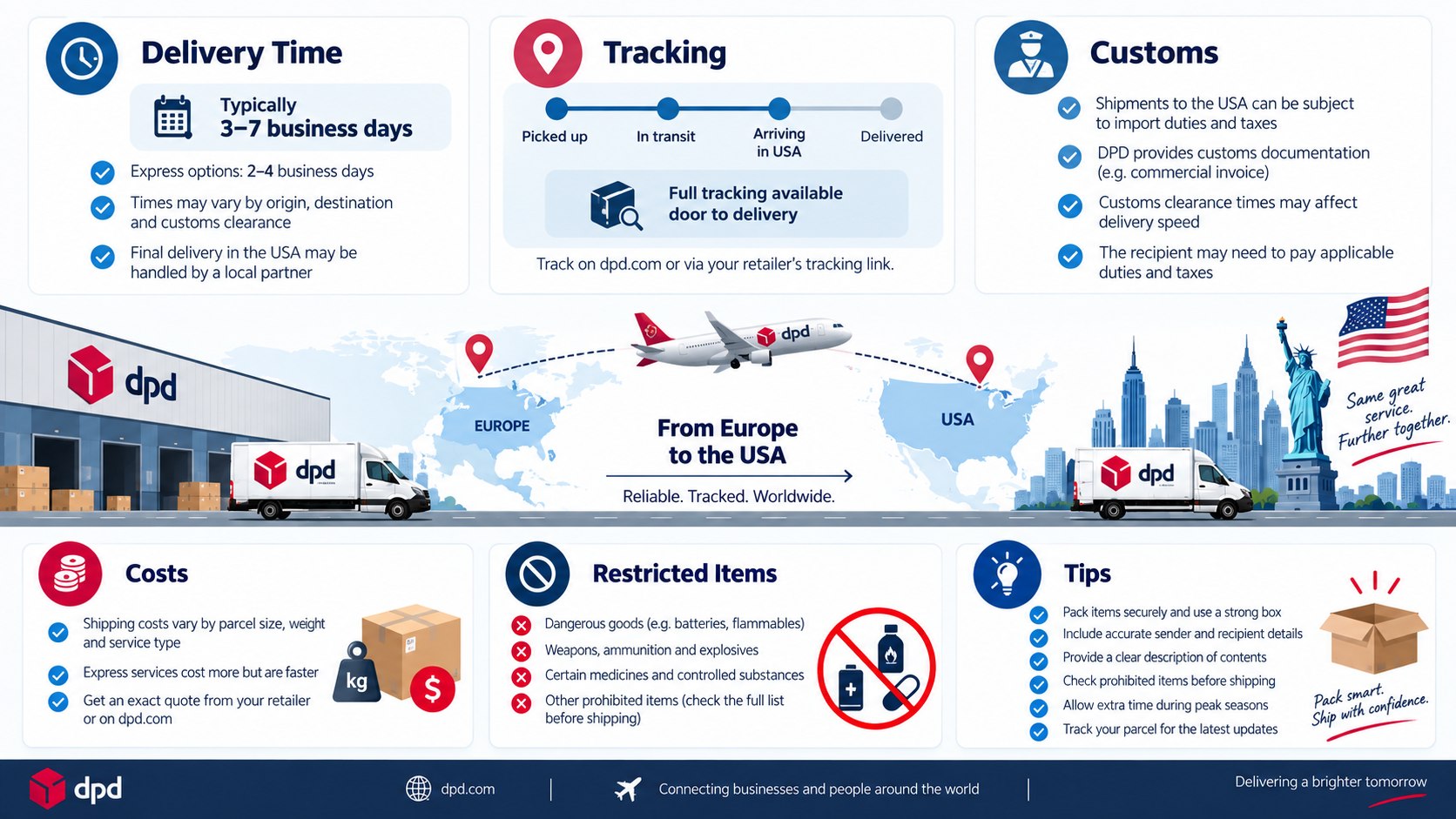
The journey starts in the sender’s country. DPD accepts the parcel, creates shipment data, and moves it through an export depot or international gateway. The exact route depends on the DPD country operation and service purchased.
Next comes international transport. DPD Germany states that its accelerated worldwide service can reach destinations in 2–5 working days, depending on the country. Standard worldwide services can take longer, and customs time sits outside many headline transit estimates. DPD’s international shipping guidance also confirms that partner networks are used for worldwide transport.
“Delivery takes 2–5 working days.”
DPD Germany, international shipping guidance, describing DPD Express Worldwide transit depending on destination.
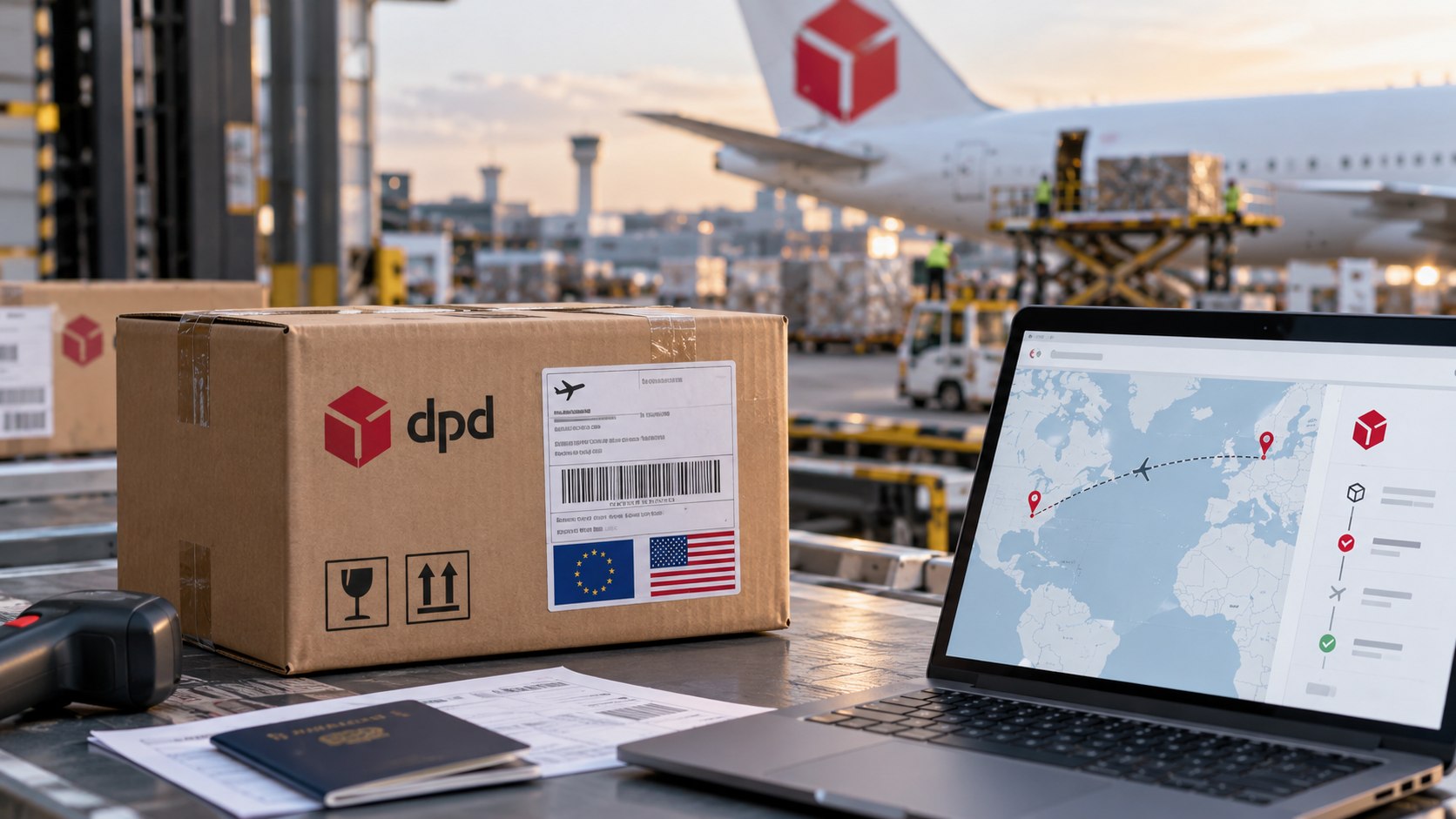
After arrival, shipment information is presented for US import processing. Commodity descriptions, declared value, country of origin, and classification can affect release. A vague description such as “parts” creates more risk than a precise description such as “cotton men’s T-shirt.”
Once released, the parcel enters the domestic delivery stage. The specific partner can depend on origin country, DPD product, destination, and commercial routing. Tracking is the safest place to identify the actual last-mile operator when a partner is disclosed.
- Measure and weigh the packed parcel before buying the label.
- Enter the recipient’s full US address and 5-digit ZIP Code accurately.
- Describe every item clearly and declare its actual transaction value.
- Add the correct country of origin and required customs information.
- Monitor tracking after the parcel reaches the United States.
These steps prevent several avoidable delays. Dimensions can change the transport price even when actual weight stays low. Incorrect values can create customs problems rather than savings. An incomplete apartment number can become a final-mile problem after successful customs clearance.
A working recipient phone number can also help when additional information is required. Senders should keep the commercial invoice until tracking confirms delivery.
DPD shipping to USA 2026 what you need to know about transit and partners
DPD delivery time to USA cannot be reduced to one national number. Departure country is the first major variable. Service level, flight availability, customs clearance, destination state, and remote-area delivery can then change the result.
A parcel bound for New York or New Jersey may reach its domestic destination faster after clearance than one going to rural Montana. California, Alaska, and Hawaii can require substantially different onward routing.
A published international estimate should therefore be treated as transport guidance rather than a guaranteed doorstep date unless the purchased service explicitly provides a guarantee.
| Cost or timing factor | What it means in 2026 | What the sender should check |
|---|---|---|
| Base DPD rate | Depends on origin, weight, dimensions, destination, and account terms | Final quote from the originating DPD operation |
| Worldwide energy surcharge | DPD Germany listed 31% for CLASSIC worldwide in its September 2026 update | Current origin-country surcharge before payment |
| Air energy surcharge | DPD Germany listed 40% in the same 2026 update | Whether the selected product uses chargeable air transport |
| US import charges | Can depend on product, origin, value, and current tariff treatment | Commodity classification and customs terms |
| Transit | Express worldwide guidance can be 2–5 working days for eligible destinations | Origin-specific estimate plus customs time |
There is no credible single “DPD to USA price” for every sender in 2026. A 2-pound parcel from Germany does not share the same tariff as a shipment originating in Poland or the United Kingdom.
Business contracts can also produce different base rates from occasional-shipping prices. Energy surcharges can move during the year. Duties and clearance costs are separate from the carrier’s basic transportation price.
The final payable quote from the originating DPD operation should control the shipping decision. US readers comparing the domestic side can use Baltimore Chronicle’s FedEx vs. UPS vs. USPS 2026 comparison to understand how distance, dimensions, and residential delivery affect carrier pricing.
What 2026 customs changes mean
The biggest practical change concerns DPD customs clearance USA. The old assumption that ordinary merchandise below $800 automatically enters duty-free under the de minimis rule is outdated. CBP says the broad duty-free treatment for qualifying low-value merchandise was suspended from August 29, 2025. The suspension continued into 2026.
This does not mean every $40 parcel receives the same charge. Duties depend on the merchandise, origin, applicable tariff rules, and entry method. It does mean that senders should stop treating $800 as a universal “no customs cost” threshold.
“The value on a commercial invoice should be the price the buyer in the United States paid.”
U.S. Customs and Border Protection, commercial invoice valuation guidance, updated July 12, 2026.
CBP also requires meaningful commercial information for merchandise entries. Its guidance identifies descriptions, quantities, values, and appropriate tariff classification among relevant invoice details. CBP’s current guidance on mailed goods and duties explains the 2026 treatment of low-value imports.
A cheap item can still become an expensive shipment when the customs description, origin, or tariff treatment is wrong.
Who it matters to in 2026
Online shoppers receiving European orders
A US buyer may see DPD at checkout even though the final delivery is handled through another network. Keep both the merchant order number and DPD tracking number. If tracking later identifies another operator, save that reference as well.
Freelancers and small businesses
Designers, resellers, Etsy-style merchants, and small importers need cleaner customs data than before. A vague invoice can create delays that wipe out any savings from a lower shipping rate. Repeat sellers should maintain consistent product descriptions, origin information, and classification records.
Families sending gifts or personal items
Sending a parcel to USA with DPD still requires customs information when goods cross the border. Marking merchandise as a “gift” does not automatically remove every import rule.
Food, medication, plants, batteries, alcohol, and regulated products can face additional restrictions. Households should also think about delivery conditions after customs release. Apartment access, gated communities, weather, holidays, and rural addresses can affect the last stage.
Common myths
- Myth: DPD itself always delivers the package to the US front door. Correction: international partners can handle later stages.
- Myth: Every shipment below $800 is duty-free. Correction: broad de minimis treatment was suspended.
- Myth: A 3-day estimate includes customs. Correction: border processing can sit outside normal transit estimates.
- Myth: Package weight alone determines price. Correction: dimensions, origin, service, and surcharges also matter.
- Myth: “Gift” is enough for customs paperwork. Correction: contents and value still require accurate declaration.
The most expensive mistakes usually begin before the parcel leaves the sender. An inaccurate invoice follows the shipment into customs. A wrong ZIP Code follows it into the domestic network.
Oversized packaging can increase carrier charges before either problem appears. Missing origin information can affect tariff treatment. Accurate data therefore matters more than trying to predict one universal DPD transit time.
FAQ
Does DPD deliver directly in the United States?
DPD provides international shipping to US destinations through the Geopost network and delivery partners. The final operator can vary by route and service, so check tracking after arrival.
How long does DPD take to ship to the USA?
DPD Germany advertises 2–5 working days for eligible Express Worldwide destinations. Standard services may take longer. Customs processing and remote-area delivery can add time.
How much does DPD shipping to the USA cost in 2026?
There is no single nationwide DPD price because the shipment starts outside the United States. Origin, package size, weight, service, energy surcharges, and account pricing determine the quote.
Will I pay customs charges on a DPD package?
Possibly. US duties and fees depend on the merchandise, origin, value, classification, and current trade rules. The former broad $800 de minimis exemption cannot be assumed in 2026.
Can I track a DPD parcel after a US carrier receives it?
Usually, tracking continues through the international shipment record. A partner reference may also appear once the package enters the domestic network. Save both numbers when a second reference is provided.
What should I do if DPD tracking stops after arrival in the USA?
Check whether the last event mentions customs, clearance, or a partner handoff. Confirm the invoice and recipient details are correct. Contact the sender or originating DPD office when no new event appears beyond the expected processing window.
Earlier we wrote about DIY Exterior House Painting in 2026: Primer, Weather, Costs and the Right Order of Work