


Home equity loan vs HELOC 2026 comes down to one practical choice: certainty or flexibility. Most homeowners with a known, one-time expense should favor a fixed home equity loan, while a HELOC usually fits costs arriving in stages, as the Baltimore Chronicle editorial team notes.
A home equity loan gives you one lump sum and usually a fixed interest rate. A HELOC works more like revolving credit, allowing repeated draws during an agreed period. Both use your house as collateral, so missed payments carry more serious consequences than ordinary credit-card debt.
Key takeaways
- Choose a home equity loan when the amount is known and predictable monthly payments matter more than borrowing flexibility.
- Choose a HELOC when expenses arrive gradually and you want interest charged only against amounts actually borrowed.
- Compare total costs, rate structure, fees, repayment rules, and tax treatment before putting home equity behind any expense.
The product name matters less than the structure of the debt. A homeowner replacing a roof under a signed $35,000 contract faces a different problem from someone remodeling several rooms over 18 months. The first borrower already knows the bill. The second may not know when each payment will be due.
That difference between a fixed obligation and an open credit line is the real starting point for the decision.
At a glance
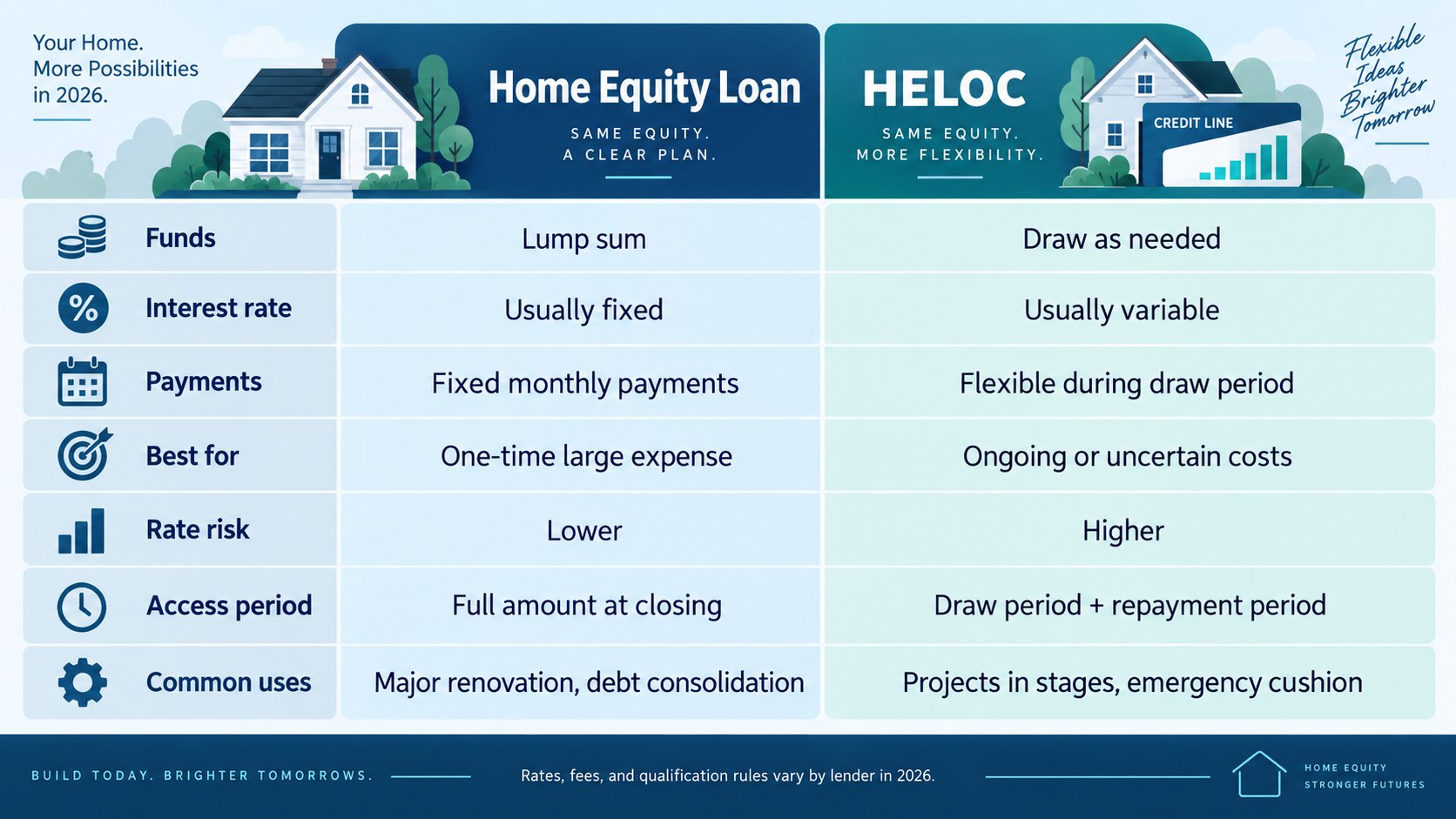
The comparison below focuses on the terms that affect household cash flow. Actual offers vary by credit score, property value, lender, state, debt level, and the amount of usable equity.
| Feature | Home equity loan | HELOC |
|---|---|---|
| How money arrives | One lump sum | Repeated draws up to a credit limit |
| Typical rate structure | Usually fixed | Usually variable |
| Monthly payment | Generally predictable | Can change with balance and rate |
| Interest charged on | Full amount borrowed | Outstanding balance drawn |
| Best use | Known one-time expense | Phased or uncertain expenses |
| Access to additional funds | New loan usually required | Available during draw period |
| Rate risk | Lower with fixed rate | Higher when benchmark rates rise |
| Common fees | Closing and appraisal costs may apply | Closing, annual, inactivity, conversion, or cancellation fees may apply |
| Collateral risk | Home secures the debt | Home secures the debt |
Neither product is automatically cheaper. A HELOC may charge less interest when only part of the approved line is used. A home equity loan can still win when the borrower needs the entire amount immediately.
Fees deserve equal attention. The Consumer Financial Protection Bureau says HELOC agreements may include application, appraisal, annual, inactivity, conversion, or early-cancellation charges. A low advertised rate can lose its appeal once those expenses enter the calculation.
The repayment schedule can also change the result. Some HELOCs begin with relatively small payments during the draw period. Payments can rise after borrowing stops and principal repayment begins.
Borrowers comparing renovation financing can also review Baltimore Chronicle’s guide to how a HELOC works in 2026. Homeowners estimating project size may find the publication’s 2026 kitchen remodel cost guide useful before deciding how much equity to borrow.
Home equity loan: fixed payments for a known expense
A fixed-rate home equity loan is often the cleaner option when the bill is already known. The lender advances the approved amount at closing, and repayment begins under the contract’s schedule.
Suppose a homeowner needs $80,000 for a major addition. A hypothetical 15-year loan at 8.25% would require roughly $776 monthly for principal and interest. That example is not a current lender quote, but it shows why fixed pricing helps with budgeting.
Where a home equity loan works well
Fixed borrowing is most useful when uncertainty creates more problems than flexibility solves. Common examples include:
- a roof replacement under a signed contract;
- a one-time foundation repair;
- a major medical bill with a known balance;
- a fixed-price home addition;
- consolidation of qualifying debt after careful cost comparison.
A fixed payment makes long-term planning easier. The rate does not normally move with short-term market benchmarks when the loan itself is fixed.
The weakness is equally clear. Borrowing $80,000 means paying interest on $80,000, even if the contractor will not need every dollar immediately. Returning unused money does not turn the loan into revolving credit.
A second limitation appears when project costs expand. An owner who borrows $60,000 and later needs another $15,000 may require separate financing. That could mean another application, additional underwriting, or different pricing.
Homeowners already considering broader mortgage changes should compare this option with the economics of refinancing in 2026. Replacing an entire first mortgage to raise cash is a different decision from adding a smaller second mortgage.
HELOC: variable borrowing for expenses that arrive over time
A HELOC in 2026 gives the borrower access to an approved line rather than a single mandatory withdrawal. During the draw period, money can generally be borrowed, repaid, and borrowed again under the lender’s terms.
That structure fits construction stages particularly well. A homeowner might draw $12,000 for demolition, $18,000 for cabinets, and another $9,000 months later for flooring.
Interest generally applies to the amount actually outstanding, not unused credit. Someone with a $100,000 line and a $25,000 balance therefore has a very different obligation from someone who borrowed the full $100,000.
“Monthly payments are often significantly higher once you enter repayment.”
Consumer Financial Protection Bureau, consumer guidance on home equity lines of credit. Official CFPB guidance.
The warning matters because the draw period can make a HELOC look easier than it eventually becomes. Borrowing stops once that period ends. The lender then applies the repayment terms written into the agreement.
A HELOC should be stress-tested against a higher payment, not judged only by its first monthly bill.
Fixed vs variable rates: where the risk actually sits
The most important difference in the home equity loan versus HELOC debate is interest-rate exposure. A fixed home equity loan transfers more rate uncertainty to the lender. A variable HELOC leaves more of it with the borrower.
Most HELOC pricing combines an external benchmark with a lender margin. When the benchmark changes, the borrower’s rate can change according to the contract. Introductory rates can complicate comparisons because they may expire after a limited period.
Before accepting a line, request these terms in writing:
- the current interest rate and underlying index;
- the lender margin added to that index;
- the duration of any introductory offer;
- periodic and lifetime rate caps;
- the payment formula during the draw period;
- the repayment term after draws stop;
- fees for closing, conversion, inactivity, or early closure.
Comparing APR alone is not enough. Two HELOC offers can advertise similar pricing while using different repayment formulas or fees.
Some lenders allow part of a HELOC balance to convert from variable to fixed pricing. That feature can reduce uncertainty after money has been borrowed. Conversion charges or higher fixed rates may apply.
A fixed loan has another advantage for homeowners with tight monthly margins. They can model the payment before closing and know what the scheduled principal-and-interest obligation should be.
The HELOC offers the opposite advantage. Borrowers can delay draws until money is genuinely needed. That can reduce interest expense on projects stretching across several months or years.
Which should you buy in 2026?
The decision becomes simpler when the financing product follows the expense. These rules cover most ordinary homeowner situations.
- If the cost is fixed and due immediately, choose a home equity loan for predictable repayment.
- If bills arrive in stages, consider a HELOC so unused credit remains undrawn.
- If variable payments would strain the household budget, favor fixed-rate borrowing.
- If the final project cost is uncertain, a HELOC provides more room for changing invoices.
- If the expense is discretionary and short-lived, reconsider whether home-secured borrowing is appropriate at all.
Debt consolidation needs additional care. A lower rate can reduce interest expense, but moving unsecured credit-card debt onto a house changes the risk. The balance becomes secured by real property.
Emergency borrowing deserves similar scrutiny. Home equity can provide access to substantial funds, but it is not an ordinary emergency account. A lender can also limit additional HELOC draws under circumstances described in the agreement.
Location affects the economics without changing the core decision. Homeowners in California, New York, Texas, Florida, Maryland, or Ohio may face different property values and closing costs. Lender competition also varies by market.
Credit unions, national banks, regional lenders, and online lenders may quote different terms to the same borrower. Compare offers on the same day whenever possible. That reduces distortions caused by changing benchmarks.
Taxes, home improvements and the IRS rule
Tax treatment is often misunderstood. Interest on a home equity loan for renovations or HELOC is not automatically deductible simply because a house secures the debt.
The IRS says interest can generally qualify only when applicable requirements are met. The borrowed funds must be used to buy, build, or substantially improve the home securing the debt. Itemization and other mortgage-interest rules also matter.
“Interest on home equity loans and lines of credit are deductible only if the borrowed funds are used to buy, build, or substantially improve” the qualifying home.
Internal Revenue Service, Publication 936 guidance. Official IRS publication.
Using a HELOC to remodel a kitchen can therefore have different tax consequences from using the same line to buy a vehicle. Documentation matters because the purpose of the borrowed funds matters.
Keep contractor invoices, receipts, loan statements, and records connecting each draw to the improvement. Tax rules can depend on individual circumstances, so borrowers with large balances should verify treatment before relying on a deduction.

What to check before signing
A homeowner can eliminate many unpleasant surprises before closing. The goal is not simply finding the lowest advertised rate.
- Estimate usable equity from a realistic property value and current mortgage balance.
- Decide whether the expense is one-time or spread across several stages.
- Request comparable written offers from at least 3 lenders.
- Compare fixed rates, variable formulas, fees, caps, and repayment periods.
- Calculate payments using a higher HELOC rate than today’s quoted rate.
- Confirm whether an appraisal or automated valuation will be required.
- Review early-closure, inactivity, annual, and fixed-rate conversion fees.
- Do not borrow the maximum merely because the lender approves it.
Qualification remains borrower-specific. Lenders examine equity, credit history, income, debts, property characteristics, and other underwriting factors.
Home equity itself is not the same as borrowing capacity. A house worth $500,000 with a $300,000 mortgage contains about $200,000 in gross equity. The lender may still approve substantially less.
The difference comes from combined loan-to-value limits and underwriting rules. Existing liens also count against available collateral. A strong property value cannot replace sufficient income or acceptable credit.
Finally, remember what secures both products. The CFPB warns that failure to repay a home equity loan or HELOC can put the property at risk.
FAQ
Is a HELOC better than a home equity loan in 2026?
Neither is universally better. A HELOC generally fits changing or phased expenses, while a home equity loan fits a known lump-sum cost. Payment predictability often favors the fixed loan.
Which has a lower interest rate, a HELOC or home equity loan?
It depends on the lender and borrower. HELOCs usually have variable rates, while home equity loans commonly use fixed rates. Compare same-day offers rather than relying on national averages.
Can a HELOC rate increase after I open it?
Yes. Most HELOCs use variable pricing tied to an index plus a lender margin. Review rate caps and adjustment terms before signing.
Can I deduct HELOC interest on my taxes?
Potentially, when IRS requirements are satisfied and proceeds are used to buy, build, or substantially improve the qualifying home securing the debt. Personal spending generally does not receive the same treatment.
Is a HELOC good for a remodel?
A HELOC can suit a remodel with several payment stages because funds can be drawn when invoices arrive. A fixed loan may fit better when the contractor provides one firm price.
What is the biggest risk with either option?
Both products are secured by the home. Falling behind can create foreclosure risk, making affordability more important than the maximum amount a lender offers.
Earlier we wrote about Which Robot Vacuum Is Best in 2026? Roborock, Dreame, ECOVACS and Roomba Compared