


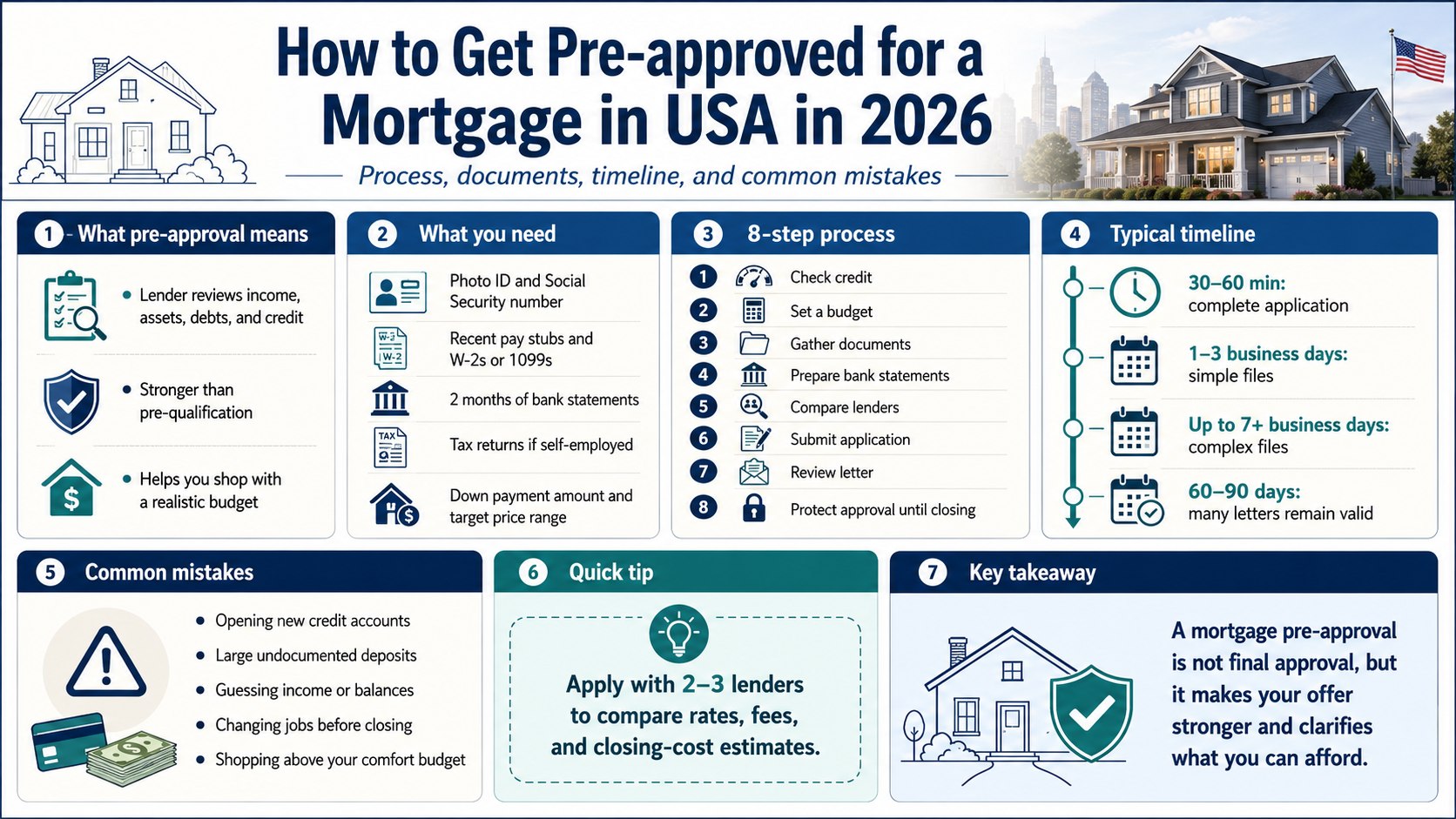
Learning how to get pre-approved for a mortgage in USA in 2026 takes one to seven business days for most borrowers if documents are ready. The practical path is simple: check credit, gather income and asset records, compare lenders, submit a complete application, and use the pre-approval letter before it expires, аs noted by Baltimore Chronicle.
A pre-approval helps a buyer understand the likely loan amount before making an offer. It also gives sellers and real estate agents a stronger signal than a casual affordability estimate, especially in competitive markets such as California, Texas, Florida, Maryland, and New York.
Key takeaways
- Pre-approval is not final mortgage approval, but it shows that a lender has reviewed your financial profile.
- Most delays come from missing pay stubs, unexplained deposits, frozen credit files, or self-employment income gaps.
- Apply with more than one lender so you can compare rates, fees, credits, and closing-cost estimates.
What you need before you apply
A clean application starts with documents. Lenders such as Chase, Bank of America, Rocket Mortgage, Wells Fargo, Navy Federal Credit Union, and local credit unions may use different portals, but the core paperwork is similar.
- Government ID, Social Security number, and current address history.
- Recent pay stubs, W-2 forms, 1099 forms, or profit-and-loss records for freelancers.
- Two months of checking, savings, brokerage, and retirement account statements.
- Federal tax returns if self-employed, commission-based, or using rental income.
- Estimated purchase price, down payment amount, and target ZIP code.
- Permission for a hard credit pull.
- About 30–60 minutes to complete one lender application.
- Money for possible credit report fees or application-related fees, usually disclosed by the lender.
Before applying, buyers should also understand the full purchase sequence. Baltimore Chronicle’s guide on how to buy a house in USA in 2026 explains how budgeting, lender comparison, home tours, offers, inspections, and final documents fit together.

How to get pre-approved for a mortgage in USA before house hunting
A mortgage pre-approval is a lender’s conditional statement that it may lend up to a certain amount based on the information reviewed. The Consumer Financial Protection Bureau says a preapproval letter is not a guaranteed loan offer, but it can show a seller that financing is likely if the borrower and property meet final underwriting conditions.
The process is different from mortgage pre-qualification. Pre-qualification often uses self-reported numbers. Pre-approval usually includes a credit check and document review.
| Item | Pre-qualification | Pre-approval |
|---|---|---|
| Main purpose | Quick affordability estimate | Stronger buying signal before an offer |
| Credit review | May be soft or not required | Usually hard credit inquiry |
| Documents | Often limited | Income, asset, debt, and ID documents |
| Seller value | Lower | Higher in competitive listings |
| Final approval? | No | No, final underwriting still required |
For official consumer guidance, the CFPB explains what a preapproval letter does and why sellers may ask for one before accepting an offer.
Step 1: Check your credit and fix obvious errors
Pull your credit reports and look for wrong balances, duplicate accounts, old collections, or accounts that do not belong to you. A lender will review credit history, monthly debt, payment patterns, and recent inquiries.
This matters because credit affects eligibility, pricing, mortgage insurance, and the loan programs available to you. A higher score can also help when comparing conventional, FHA, VA, USDA, jumbo, and non-QM options.
Borrowers who are close to a lender’s minimum score should review Baltimore Chronicle’s breakdown of what credit score is needed to buy a house in USA in 2026 before submitting applications.
A common mistake is opening a new auto loan, store card, or “buy now, pay later” account just before applying. New debt can change your debt-to-income ratio and reduce the amount a lender is willing to approve.
Step 2: Estimate your budget before asking for the maximum
Use your monthly income, debt payments, down payment, property taxes, homeowners insurance, HOA dues, and estimated maintenance to set a comfortable price range. A lender may approve more than you want to spend each month.
This matters because a pre-approval should support a real purchase plan, not just the largest possible number. A $425,000 home in Phoenix, a $650,000 townhouse in Maryland, and a $900,000 condo in California can produce very different monthly payments because taxes, insurance, and HOA costs vary.
A common mistake is comparing only principal and interest. The full payment can include taxes, insurance, mortgage insurance, HOA dues, flood insurance, and escrow adjustments.
Step 3: Gather income documents by employment type
Collect the documents that prove stable income. Salaried employees usually need recent pay stubs and W-2s, while freelancers, gig workers, landlords, and business owners often need tax returns, 1099s, bank statements, and year-to-date profit-and-loss reports.
This matters because lenders must document the borrower’s ability to repay. The CFPB says lenders generally verify income, employment, assets, debts, and credit history when evaluating mortgage eligibility.
A common mistake is applying with incomplete self-employment records. If income comes from Uber, DoorDash, Etsy, consulting, rental property, or an S corporation, the lender may average income over time instead of using the best recent month.
Documents by borrower profile
| Borrower type | Likely documents | Common issue |
|---|---|---|
| W-2 employee | Pay stubs, W-2s, bank statements | Recent job change or unpaid leave |
| Freelancer or contractor | 1099s, tax returns, invoices, bank statements | Income varies month to month |
| Business owner | Business returns, K-1s, P&L, balance sheet | Large write-offs reduce qualifying income |
| Rental-property owner | Leases, tax returns, mortgage statements | Vacancy, repairs, or irregular deposits |
| Retiree | Social Security, pension, IRA or brokerage statements | Asset withdrawal rules vary by lender |
Step 4: Prepare bank statements and explain large deposits
Download complete statements for checking, savings, brokerage, retirement, and gift-fund accounts. Lenders look for the source of down payment funds, cash reserves, recurring obligations, overdrafts, and unusual deposits.
This matters because unexplained cash can delay underwriting. A $12,000 deposit from selling a car, a family gift, or a business transfer may need a paper trail.
A common mistake is moving money between accounts without documentation. Keep transfer records, sale receipts, gift letters, and screenshots from payment platforms such as PayPal, Venmo, or Cash App when funds are used for closing.
Step 5: Compare lenders before submitting a full application
Contact at least two or three lenders: a national bank, an online lender, and a local credit union or mortgage broker. Ask each one about loan programs, estimated rates, lender credits, origination charges, discount points, and expected closing costs as of 2026.
This matters because the same borrower can receive different pricing from different lenders. A lender with a lower advertised rate may charge higher points, while another may offer a higher rate with lower upfront cash.
A common mistake is choosing the first lender because the online quote looks fast. The better comparison is the Loan Estimate, including rate, APR, points, lender fees, prepaid taxes, insurance, and cash to close.
A pre-approval should help you shop with a realistic ceiling, not pressure you into the most expensive house a lender will consider.
Step 6: Submit the mortgage pre-approval application
Complete the lender’s application with legal name, income, Social Security number, address history, debts, assets, target property type, estimated purchase price, and down payment. The CFPB says lenders must provide a Loan Estimate after receiving six pieces of information: name, income, Social Security number, property address, estimated property value, and desired loan amount.
This matters because missing or inconsistent details cause follow-up requests. If the application says $90,000 income but tax records show variable 1099 income, the lender needs time to reconcile the file.
A common mistake is guessing. Use actual balances, exact employer names, correct addresses, and current account statements.
Step 7: Review the pre-approval letter and conditions
Read the letter carefully. It should show the borrower name, loan amount, expiration date, loan type, down payment assumption, and any major conditions.
This matters because an offer should match the letter. If the letter assumes a conventional loan with 10% down, it may not support a low-down-payment FHA offer without lender updates.
A common mistake is sending sellers a letter with a number far above the offer price. Ask the lender for a property-specific letter that matches the bid when appropriate.
Step 8: Protect the approval until closing
Keep finances stable after receiving the letter. Do not take on new debt, change jobs without telling the lender, move large sums without documentation, miss payments, or make major cash withdrawals.
This matters because final approval happens later, after the purchase contract, appraisal, title review, updated credit checks, and underwriting. A buyer can lose approval after an accepted offer if the financial profile changes.
A common mistake is buying furniture, appliances, or a pickup truck before closing. Even a 0% promotional account from Home Depot, Lowe’s, Best Buy, or a car dealer can affect approval.
Timeline, costs, and how long pre-approval lasts
Most straightforward files can receive a mortgage pre-approval letter in one to three business days after documents are uploaded. Complex files can take a week or more, especially with self-employment income, multiple properties, recent credit events, or large gift funds.
Many pre-approval letters last 60 to 90 days, but lenders set their own expiration rules. If the house search runs longer, the lender may refresh pay stubs, bank statements, credit, and employment verification.
As of 2026, some lenders charge no upfront pre-approval fee, while others may charge for a credit report or application-related costs. Borrowers should verify the fee schedule before authorizing payment.
Closing costs can also change the amount of cash needed before final approval. Baltimore Chronicle’s guide to closing costs on a house in USA in 2026 explains common buyer charges, including lender fees, title fees, insurance, taxes, and prepaid expenses.
FHA borrowers should also check program limits. HUD lists FHA mortgage-limit information and notes that FHA loans can allow low down payments for eligible buyers through approved lenders; program details depend on property location and borrower qualifications.
Troubleshooting common pre-approval problems
- Credit score dropped: Pay down revolving balances if possible, correct report errors, and avoid new inquiries until the lender reviews the file.
- Debt-to-income ratio is too high: Ask whether paying off a credit card, reducing the price range, or adding documented income changes eligibility.
- Self-employment income is lower than expected: Request a review using full tax returns, year-to-date records, and business bank statements.
- Large deposit cannot be documented: Use funds with a clear paper trail or wait until seasoned funds meet the lender’s policy.
- Pre-approval expired: Refresh documents before making an offer, especially in fast-moving markets such as Dallas, Tampa, Baltimore, and San Diego.
If the lender needs tax transcript access, the IRS explains that a taxpayer can authorize a lender to request transcript information through the Income Verification Express Service or related IRS transcript processes.
FAQ
Does mortgage pre-approval hurt your credit?
A mortgage pre-approval usually involves a hard credit inquiry, which can affect a credit score. Credit scoring models often treat multiple mortgage inquiries within a shopping window as rate shopping, but borrowers should confirm timing with the lender or credit bureau.
Can I get pre-approved without choosing a house?
Yes. Many buyers get pre-approved before touring homes. The final Loan Estimate for a specific property requires a property address, estimated value, and desired loan amount.
Is pre-approval the same as final mortgage approval?
No. Final approval comes after a signed purchase contract, appraisal, title review, updated financial checks, and underwriting. A pre-approval can still be withdrawn if the borrower, property, or loan terms fail final review.
How much income do I need to get pre-approved?
There is no single national income number. The answer depends on purchase price, down payment, debts, credit profile, taxes, insurance, HOA dues, loan type, and market rates as of 2026.
Should I get pre-approved by more than one lender?
Yes. Comparing lenders can reveal differences in rate, APR, lender fees, points, credits, and service speed. Keep applications close together when rate shopping to reduce credit-score disruption.
What should I do after getting pre-approved?
Ask for a letter that matches the target offer, keep documents current, avoid new debt, and coordinate with the real estate agent before submitting offers. The next stage usually includes the purchase contract, inspection, appraisal, title review, and final underwriting.
Earlier we wrote about How to Buy a Sofa Online in 2026: Dimensions, Returns, Reviews