


Capital gains tax when selling a house in USA 2026 is the federal tax that may apply to the profit remaining after eligible selling expenses and the home’s adjusted cost basis are deducted from the sale proceeds, as noted by Baltimore Chronicle.
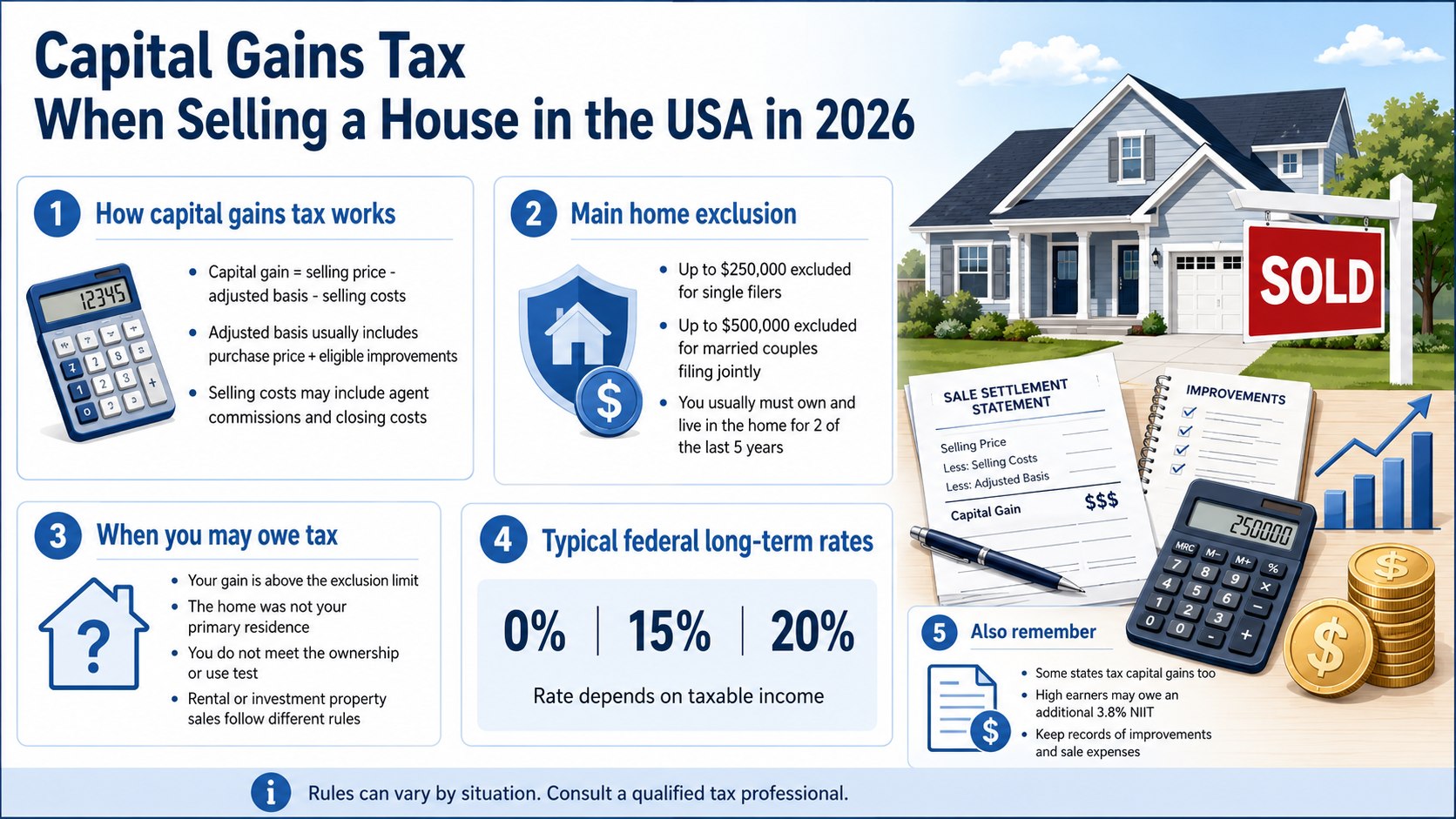
The practical answer is favorable for many homeowners. A single filer may exclude up to $250,000 of qualifying gain, while a married couple filing jointly may exclude up to $500,000. The exclusion applies to profit, not the home’s total sale price.
To qualify for the full exclusion, the seller generally must have owned and used the property as a primary residence for at least 2 of the 5 years before the sale.
Key takeaways
- The $250,000 or $500,000 exclusion applies to qualifying profit, not the full sale price.
- Ownership, residence, rental use, improvements and filing status can change the taxable amount.
- Renovation invoices, settlement statements and depreciation records can reduce errors and support the tax calculation.
These rules resolve the central question for many sellers. A married couple selling a primary residence with a $300,000 gain may owe no federal capital gains tax if both spouses satisfy the applicable requirements.
A single homeowner with the same gain could have $50,000 remaining after the exclusion. Eligible expenses and basis adjustments may reduce that amount further.
In plain English
Think of the home-sale exclusion as a protected container. The IRS allows an eligible single seller to place up to $250,000 of profit inside it. An eligible married couple filing jointly may protect up to $500,000.
Only the profit that does not fit within the exclusion remains potentially taxable. Before applying the exclusion, however, the seller must calculate the actual gain.
That calculation includes more than subtracting the original purchase price from the final sale price.
Suppose a homeowner bought a Maryland property for $350,000, spent $70,000 on qualifying improvements and sold it for $720,000. If eligible selling expenses totaled $45,000, the simplified gain would be $255,000.
A qualifying married couple could exclude the full gain. A qualifying single seller could have $5,000 remaining before other adjustments.
The home-sale exclusion is not a lifetime allowance. A seller may use it again after satisfying the requirements for a later sale.
Sellers should also distinguish tax calculations from the money required at closing. The Baltimore Chronicle guide to closing costs on a house in 2026 explains transfer expenses, title charges and other transaction costs.
How it actually works
The calculation begins with the amount realized from the sale. Start with the sale price, then account for eligible commissions, legal fees and other seller expenses.
The settlement statement or Closing Disclosure usually contains much of the required information.
Next, calculate the home’s adjusted cost basis. The starting point is normally the original purchase price. Certain acquisition costs and permanent property improvements may increase the basis.
Depreciation, insurance reimbursements and some other adjustments may reduce it.
Subtract the adjusted basis from the amount realized. The result is the gain before applying the primary-residence exclusion.
The IRS provides worksheets and detailed guidance in Publication 523, Selling Your Home.
After calculating the gain, apply the available exclusion. Any remaining taxable long-term gain may be taxed at 0%, 15% or 20%, depending on income and filing status.
Depreciation-related gains may receive different treatment.
Use the following sequence:
- Confirm that the property was your primary residence.
- Check the 2-year ownership requirement.
- Check the 2-year residence requirement.
- Review whether you claimed another home-sale exclusion during the previous 2 years.
- Calculate the amount realized after eligible selling expenses.
- Calculate the adjusted basis.
- Subtract the adjusted basis from the amount realized.
- Apply the available exclusion.
- Review federal and state reporting requirements.
Do not begin with the amount deposited into your bank account. Mortgage payoff, escrow adjustments, commissions and tax calculations serve different purposes.
Your net proceeds may be lower than your taxable gain. In other situations, they may be higher.
Documentation becomes especially important after a long ownership period. Contractors may close, receipts may fade and older bank records may become unavailable.
Collect permits, invoices, canceled checks, credit card statements, architectural plans and dated photographs before listing the property.
Routine maintenance usually does not increase the home’s basis. Painting a room, repairing a faucet or replacing a broken window generally differs from adding a bedroom or replacing an entire roof.
Qualifying improvements may include central air installation, a major kitchen renovation, new plumbing, electrical replacement or a substantial bathroom remodel.
Homeowners planning improvements can compare their records with Baltimore Chronicle’s guide to bathroom remodeling costs in 2026.
After preparing the documents, every claimed amount should connect to an invoice, settlement statement, contract, tax return or reliable payment record.
Estimates can help during early planning. They provide weaker support during an IRS examination.
A CPA or enrolled agent should review inherited homes, mixed-use properties, divorce transfers and properties with substantial depreciation.
Capital gains tax when selling a house in USA 2026: the $250,000 and $500,000 rules
The federal exclusion is generally limited to $250,000 for an eligible individual. Eligible spouses filing a joint federal return may qualify for a maximum exclusion of $500,000.
For the $500,000 exclusion, at least 1 spouse generally must satisfy the ownership test. Both spouses generally must satisfy the residence test.
Neither spouse should have used another home-sale exclusion during the restricted 2-year period.
| Condition | Single filer | Married filing jointly |
|---|---|---|
| Maximum federal exclusion | $250,000 | $500,000 |
| Ownership requirement | Seller generally owns the home for 2 of the previous 5 years | At least 1 spouse generally meets the ownership test |
| Residence requirement | Seller generally uses the home as a main residence for 2 of 5 years | Both spouses generally meet the residence test |
| Previous exclusion | No exclusion claimed during the previous 2 years | Neither spouse generally used the exclusion during the previous 2 years |
| Filing status | Single, head of household or another eligible status | Joint federal return required for the $500,000 maximum |
The limits do not increase with the property’s market value. A qualifying seller receives the same maximum exclusion whether the house sells for $400,000 or $4 million.
This creates greater tax exposure for long-term owners in expensive markets such as California, New York, Massachusetts, New Jersey, Washington and parts of Florida.
Marriage alone does not automatically produce a $500,000 exclusion. Each spouse’s residence history remains relevant.
A recently married couple may receive a lower exclusion if only 1 spouse lived in the property for the required period.
The closing date controls the 5-year review period. Sellers approaching the 2-year threshold should count actual dates rather than calendar years.
Closing several weeks too early can materially change the available exclusion.
State tax treatment is separate. California, New York, Maryland, Oregon and other states may tax home-sale gains differently.
Sellers should verify the rules for the state where the property is located and for the year of sale. Moving after closing does not necessarily eliminate state tax liability.
Who it matters to in 2026
Long-term homeowners in high-appreciation markets
Owners who purchased before a major increase in property prices may have gains exceeding the federal exclusion.
This often affects homes purchased for $250,000 and later sold for $900,000 or more. Detailed improvement records become especially valuable because eligible basis increases can reduce taxable gain.
Couples marrying, divorcing or selling after a spouse dies
Filing status, ownership transfers, residence periods and inherited basis rules can substantially change the result.
A surviving spouse may face specific timing rules involving the joint exclusion and the home’s basis after death.
Owners who rented part or all of the home
A former rental property may still qualify if the ownership and residence tests are satisfied.
However, depreciation claimed or allowable for rental or business use after May 6, 1997, generally cannot be excluded under the primary-residence rule.
A house can be both a family residence and a tax record. Rental periods, home-office deductions, improvements and ownership changes must be reconstructed before closing.
A homeowner selling with an outstanding mortgage should calculate the tax separately from the loan payoff.
Baltimore Chronicle’s guide to choosing a real estate agent in 2026 also explains which documents sellers should prepare before interviewing listing agents.
Partial exclusions and special situations
Failing the full 2-year test does not always eliminate the exclusion. The IRS may permit a reduced exclusion when the sale is primarily caused by a qualifying employment change, health issue or unforeseen circumstance.
A simplified partial exclusion is often calculated using the shortest qualifying period.
For example, a single seller who satisfies the relevant requirements for 12 months may potentially qualify for half of the $250,000 maximum. That would equal a possible exclusion of $125,000.
The reason for the sale must still satisfy IRS standards.
Situations that require additional review include:
- A qualifying job relocation.
- A health-related move.
- Divorce or legal separation.
- Death of a household member.
- Multiple births from the same pregnancy.
- Unemployment or a major income disruption.
- Certain casualty events or natural disasters.
- Military, Foreign Service or intelligence assignments.
- A home received through inheritance, divorce or gift.
- Separate business space that was not used as living space.
A reduced exclusion is not a general hardship exemption. The facts must connect the sale to a circumstance recognized by the IRS.
A desire for a larger kitchen, a different school district or a shorter commute may not qualify without additional circumstances.
Military personnel and certain government employees may suspend the standard 5-year period for up to 10 years during qualified extended duty.
This can preserve eligibility after a long assignment away from the home.
Divorce-related sales also require careful review. One former spouse may receive credit for another spouse’s use of the home under certain conditions.
Transfers connected to divorce may receive nonrecognition treatment rather than creating an immediate taxable sale.
Inherited property follows different basis rules. The basis may generally reflect the property’s fair market value at the former owner’s death.
A professional appraisal or another reliable date-of-death valuation may therefore be essential.
These situations should be reviewed before signing a listing agreement. Tax consequences can influence the closing date, occupancy plans and record-collection strategy.
Documents to collect before the sale
A reliable tax calculation begins with evidence.
Tax software from TurboTax, H&R Block, TaxAct or another provider can process the figures. It cannot reconstruct missing renovation records or determine how a room was used.
Prepare the following documents:
- Original purchase contract.
- Original Closing Disclosure or settlement statement.
- Deed and title records.
- Documents showing changes in ownership.
- Invoices for additions, roofing, HVAC, windows, plumbing and electrical work.
- Records of major kitchen and bathroom renovations.
- Insurance reimbursement documents.
- Casualty repair records.
- Rental or home-office depreciation schedules.
- Sale contract.
- Seller’s Closing Disclosure.
- Real estate commission statement.
- Legal and title invoices.
- Form 1099-S, when issued.
- Previous tax returns showing an earlier home-sale exclusion.
Keep digital copies in at least 2 secure locations.
Use filenames that include the date, contractor, project and amount. A file named “2021-08-kitchen-electrical-invoice-8500.pdf” is more useful than a folder simply labeled “kitchen.”
Ask the closing agent whether Form 1099-S will be issued.
Receiving the form generally creates a reporting requirement even when the entire gain is excluded. The sale may need to be reported on Form 8949 and Schedule D.
Retain the documents after closing. Basis records may become relevant during an audit, amended return, divorce, estate administration or state tax dispute.
Do not treat a Zillow, Redfin or Realtor.com estimate as proof of basis. Online estimates describe possible market value.
Tax basis depends on the property’s acquisition history and qualifying adjustments.
The strongest file connects each claimed amount to a specific improvement. It should show when the work was completed and whether any part of the cost was reimbursed.

Common myths
Home-sale taxation is often explained using outdated rules or assumptions that apply only in limited cases.
- Myth: You must buy another home. Reinvesting the proceeds is not required under the current primary-residence exclusion.
- Myth: Tax applies to the full sale price. Tax applies to taxable gain after basis adjustments, eligible expenses and exclusions.
- Myth: Every married couple receives $500,000. Ownership, residence, filing and previous-exclusion requirements still apply.
- Myth: Every renovation reduces the gain. Routine repairs and maintenance are not automatically capital improvements.
- Myth: A loss on a primary home reduces taxable income. A loss on a personal-use residence is generally not deductible.
The old rollover concept remains especially persistent. Before 1997, sellers often discussed postponing gain by purchasing another home.
Current federal law focuses on the primary-residence exclusion rather than mandatory reinvestment.
Another common mistake is treating the mortgage balance as the home’s cost basis. Debt does not determine the gain.
A homeowner may have little equity but a significant taxable gain. Another homeowner may have substantial equity and no taxable gain.
Online calculators should be treated as preliminary tools. They may omit depreciation, inherited basis, partial exclusions, casualty adjustments or state taxes.
The federal tax result depends on profit, eligibility and documentation—not simply the selling price or the amount received at closing.
This summarizes the IRS position in Topic No. 701 and Publication 523 regarding home-sale gains, exclusions and reporting.
FAQ
How much capital gains tax will I pay when selling my house in 2026?
You may owe $0 if the gain falls within your available $250,000 or $500,000 exclusion.
Any remaining long-term gain may face a federal rate of 0%, 15% or 20%, depending on taxable income and filing status. State taxes and depreciation rules may increase the final amount.
Do I pay capital gains tax if I use the money to buy another house?
Buying another property does not determine whether the gain is taxable.
The federal exclusion depends mainly on ownership, residence, filing status, previous exclusions and the total gain.
Can closing costs reduce capital gains on a home sale?
Certain selling expenses may reduce the amount realized. Some acquisition costs may also increase the property’s basis.
Eligible items can include commissions, title charges, legal fees and certain transfer expenses. Each cost should be reviewed under IRS guidance.
What happens if I lived in the house for less than 2 years?
You may still qualify for a partial exclusion if the sale was primarily caused by employment, health or another recognized unforeseen circumstance.
Without a qualifying reason, part or all of the gain may remain taxable.
Do I report the sale if the entire gain is excluded?
You may not need to report a fully excluded sale unless Form 1099-S was issued.
When the form is issued, the sale generally must be reported even when the taxable gain is $0.
Does the $250,000 or $500,000 exclusion cover rental depreciation?
Generally, no.
Gain connected to depreciation allowed or allowable for rental or business use after May 6, 1997, generally cannot be excluded. It may face an unrecaptured Section 1250 tax rate of up to 25%.
Earlier we wrote about How to Replace a Light Switch with Dimmer: 6 Safe Steps and Common Wiring Mistakes