

How to sell on Poshmark 2026 starts with 3 practical decisions: choose items buyers already search for, calculate your earnings after fees, and publish listings that answer questions before they are asked. A new seller can create an account and post several items within 1–2 hours, although building a reliable closet usually requires weekly listing, pricing, and shipping routines, as noted by Baltimore Chronicle.
For most beginners, the fastest route is not uploading every unwanted item at once. Start with 5–10 clean, recognizable pieces from brands such as Nike, Levi’s, Coach, Lululemon, Madewell, Free People, or Patagonia. Photograph each item carefully, check comparable sold listings, and price above your minimum acceptable amount so buyers can make offers.
Key takeaways
- Calculate the Poshmark commission before listing, especially when selling lower-priced clothing under $15.
- Use clear photographs, searchable titles, measurements, and accurate condition notes to reduce questions and return disputes.
- Ship promptly, retain purchase records, and track proceeds because marketplace income may create federal or state reporting obligations.
A disciplined listing process matters more than owning expensive inventory. Sellers who understand pricing, presentation, and customer expectations can test demand without turning a spare bedroom into a warehouse.
What You Need Before Creating a Poshmark Listing
You do not need professional studio equipment. A smartphone made within the past several years, natural window light, and a neutral background are sufficient for most clothing and accessory listings.
You will need:
- A Poshmark account with verified contact and payment information
- A smartphone with a clean camera lens
- A plain wall, poster board, or uncluttered floor
- A tape measure marked in inches
- A lint roller, steamer, and basic cleaning supplies
- USPS-compatible packaging and packing tape
- A spreadsheet or notebook for cost, sale price, fees, and profit
- About 10–15 minutes for each detailed listing
Keep purchase receipts when you source inventory for resale. Record the item, acquisition date, purchase cost, platform fee, shipping-related expenses, and final payout. This information helps you determine whether a $40 sale produced real profit or merely recovered the original cost.
Casual sellers should also separate items bought for resale from personal clothing. The distinction can matter when calculating taxable gains and business expenses. Baltimore Chronicle’s guide to selling through Amazon in 2026 explains a similar inventory-first approach for marketplace beginners.
Prepare the item completely before opening the listing screen. Cleaning, measuring, and photographing in one session prevents incomplete drafts and inconsistent descriptions.
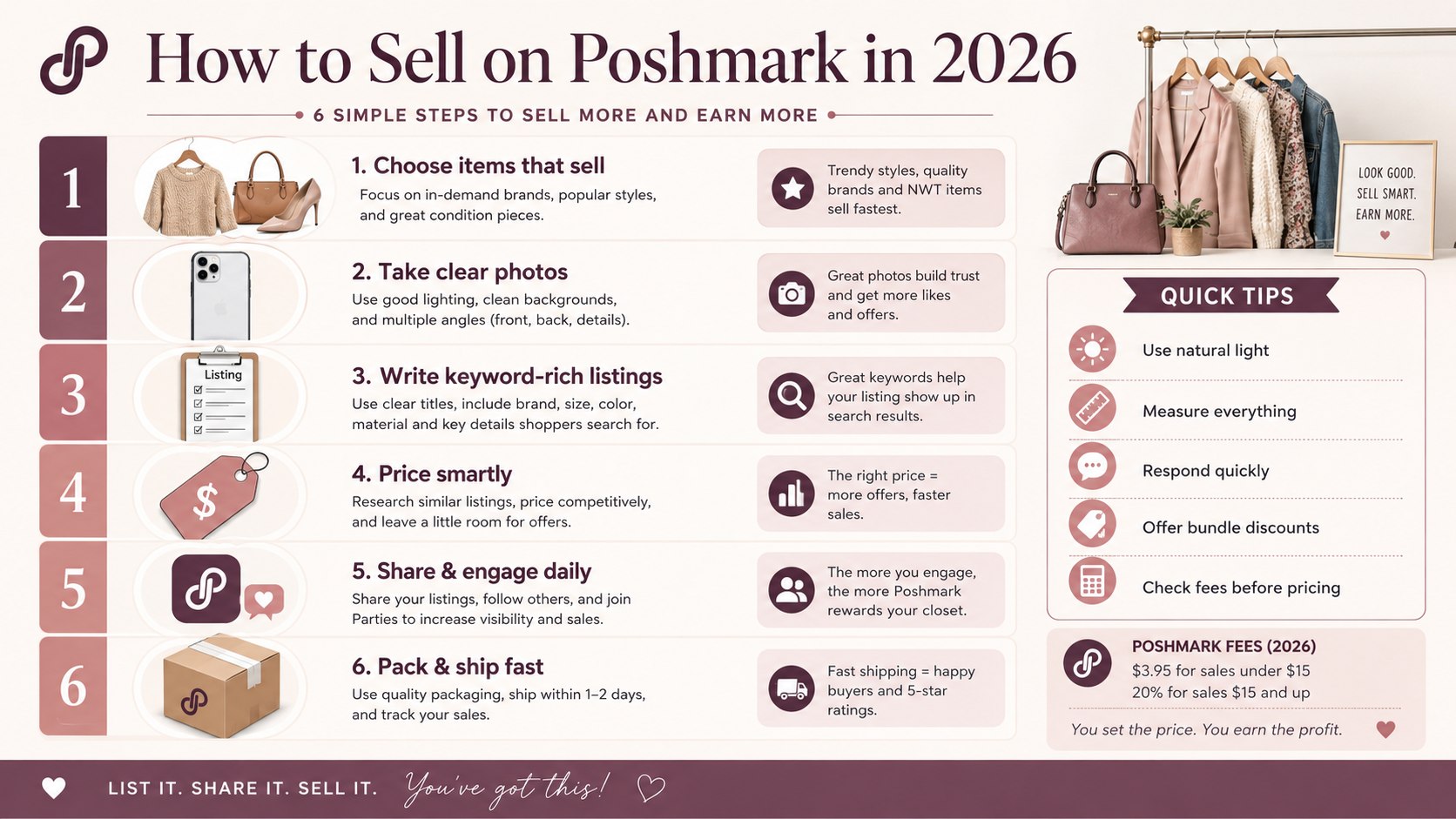
Step 1: Choose Items With Realistic Resale Demand
Begin with items in good condition from brands buyers can identify quickly. Search Poshmark for the exact brand, category, size, style, and material, then compare active listings with recently sold items when that information is available.
This research matters because an original retail price does not establish resale value. A $180 dress may sell for $35, while a discontinued jacket from a sought-after collection may command more.
Avoid listing stained basics, heavily worn fast-fashion items, counterfeit products, or pieces that cost more to prepare than they can return. The common mistake is assuming that every branded item has strong demand simply because it was expensive when new.
Step 2: Photograph Every Detail Buyers Need
Use a bright location without direct glare. Capture the front, back, brand label, size tag, fabric label, closures, soles, corners, hardware, and every visible flaw. Shoes should include outsole wear, while bags should show interiors and strap condition.
Good photographs reduce uncertainty. They also support your description if a buyer later claims that an imperfection was not disclosed.
Do not overedit colors, blur fabric texture, or conceal damage with flattering angles. A common failure is using only 2–3 distant images that make a buyer ask for information the seller could have shown immediately.
Readers selling larger household items can compare this process with Baltimore Chronicle’s guide to selling used furniture through US marketplaces. The products differ, but clear condition photographs remain decisive.
Step 3: Write a Searchable Title and Precise Description
A strong title identifies the brand, item type, model or style, color, size, and defining feature. “Levi’s 501 Original Straight Jeans Women’s 29 Blue Button Fly” is more useful than “Cute Levi’s Jeans.”
The description should state the labeled size, fit, material, measurements, condition, alterations, flaws, and included accessories. For tops and jackets, provide pit-to-pit width and length. For pants, include waist, rise, inseam, and leg opening.
This detail supports Poshmark listing optimization because buyers search with specific terms. Natural phrases such as women’s linen blazer, men’s vintage Levi’s jeans, Coach leather shoulder bag, or Lululemon high-rise leggings help the platform understand the listing.
Do not pack unrelated keywords into the description. The common mistake is adding popular brand names that do not describe the item, which can mislead buyers and weaken trust.
Step 4: Set a Price After Calculating Poshmark Seller Fees
As of July 31, 2026, Poshmark’s published US fee structure charges sellers $2.95 on sales below $15. For sales of $15 or more, the platform retains 20%, leaving the seller with 80% before other applicable deductions. Sellers should verify the current Poshmark fee policy before pricing because platform rules can change.
The figures below show how the standard commission affects several common sale prices. They do not include inventory cost, seller-funded discounts, packaging purchases, taxes on fees, or other account-specific adjustments.
| Sale price | Standard Poshmark fee | Estimated seller earnings | Earnings rate |
|---|---|---|---|
| $10 | $2.95 | $7.05 | 70.5% |
| $14 | $2.95 | $11.05 | 78.9% |
| $15 | $3.00 | $12.00 | 80% |
| $25 | $5.00 | $20.00 | 80% |
| $50 | $10.00 | $40.00 | 80% |
| $100 | $20.00 | $80.00 | 80% |
A $10 item loses a larger percentage of its price than a $25 item because the flat fee applies below $15. Bundling several inexpensive pieces may therefore produce a better result than selling each item separately.
Price with negotiations in mind. If your target sale price is $40, listing at $45–$52 may leave room for a reasonable offer. However, a price far above comparable listings can stop buyers from engaging at all.
Texas sellers may see an additional state-related tax on seller fees, depending on the applicable rules and shipping address. Sellers in California, Florida, Maryland, New York, and other states should review their own tax obligations rather than assuming every deduction is identical nationwide.
The common mistake is calculating profit from the gross price. Your actual result is the payout minus acquisition cost, preparation, packaging, discounts, and any related tax expense.
Step 5: Publish Consistently and Manage Offers Carefully
List items throughout the week instead of uploading 50 products and disappearing for a month. Regular activity gives you more chances to test titles, photographs, categories, and price points.
When an offer arrives, compare the proposed payout with your predetermined minimum. A quick sale can be sensible for common inventory, but rare or seasonal merchandise may justify waiting.
Do not negotiate emotionally. The buyer sees an item and a price, while the seller often remembers the original cost, the shopping trip, or the reason it was purchased.
Respond professionally and keep communication within Poshmark. Do not accept requests to move payment to Zelle, Cash App, email, text messages, or an unfamiliar website. The common mistake is treating off-platform contact as a serious sale rather than a warning sign.
Step 6: Pack, Ship, and Document the Completed Sale
After a sale, inspect the item again and compare it with the listing. Remove lint, fold it securely, protect delicate materials, and use the shipping label connected to the correct order.
Poshmark’s current US support information lists buyer-paid flat-rate shipping through USPS Ground Advantage, generally with a 2–5 business-day estimate. Package rules, weight limits, hazardous-material requirements, and label procedures can change, so sellers should review the order label and current platform instructions.
Beginning August 1, 2026, Poshmark says a seller may be charged $5 when USPS flags a shipment for hazardous-material noncompliance, while Poshmark covers the remaining portion of the stated USPS charge. Products such as perfume, aerosol cosmetics, nail polish, and certain electronics require particular attention.
Photograph the packed item and retain the acceptance receipt when possible. Shipping promptly protects your reputation and reduces cancellation risk. In 2026, Poshmark announced that sellers canceling more than 3% of orders during a rolling 90-day period may face account restrictions.
For a broader comparison of postal services and package costs, see Baltimore Chronicle’s overview of USPS rates and shipping options in 2026. The common mistake is reusing damaged packaging or mailing an item without checking whether the package matches current carrier rules.
Poshmark’s official policies require sellers to describe merchandise truthfully, ship eligible items correctly, and avoid prohibited or counterfeit goods.
Source context: paraphrased from Poshmark’s seller support pages and Terms of Service, reviewed July 31, 2026.

Troubleshooting Common Poshmark Selling Problems
Most slow closets do not have one dramatic problem. Sales usually stall because several small weaknesses appear together: vague titles, weak photographs, unrealistic pricing, incomplete measurements, or inconsistent activity.
- Your listing receives views but no offers: compare the price with sold alternatives and replace the cover photograph.
- Buyers repeatedly request measurements: add standard measurements to every description before publishing.
- You receive many low offers: set a private minimum payout and counter once without extended arguments.
- An item remains unsold for months: revise the title, update photographs, reassess demand, or cross-list elsewhere.
- A buyer reports a problem: keep messages factual and provide listing photographs, measurements, and shipping records.
A listing with no engagement may be categorized incorrectly. Confirm the department, category, subcategory, size, color, and brand fields. Search buyers often use filters before reading titles.
Seasonality also affects results. Coats, boots, formal dresses, vacation wear, and school clothing may sell at different speeds throughout the year. A weak June result does not prove that a winter coat has no value.
However, waiting is not always the best strategy. Storage has a cost, even when no monthly invoice appears. Merchandise occupies space, requires management, and can lose value as styles change.
Review every inactive listing after 30–60 days. Change 1 or 2 variables, then measure the response. Repeatedly lowering the price without improving the photographs or description can reduce earnings without fixing the real problem.
FAQ About How to Sell on Poshmark in 2026
How Much Does It Cost to Start Selling on Poshmark?
Creating a standard account and listing items does not require an upfront listing fee. Sellers pay the applicable platform commission after a sale, plus any optional or account-specific costs.
What Sells Fastest on Poshmark?
Demand changes by season, size, trend, condition, and price. Recognizable clothing, shoes, bags, activewear, and accessories from brands such as Nike, Coach, Levi’s, Lululemon, Free People, and Patagonia often attract searches, but brand recognition does not guarantee a sale.
How Should a Beginner Price an Item?
Review similar sold and active listings, calculate the fee, subtract your inventory cost, and establish a minimum acceptable payout. Add modest negotiating room rather than doubling the expected market price.
Does Poshmark Send Sellers a Form 1099-K?
An online marketplace may issue Form 1099-K based on federal reporting requirements, state thresholds, or its own reporting practices. As of 2026, the IRS states that receiving no form does not eliminate a seller’s duty to report taxable income. Review the IRS Form 1099-K guidance and retain purchase and sales records.
Can a Buyer Return an Item Because It Does Not Fit?
Poshmark generally treats sales as final, but buyers may open cases for qualifying problems such as undisclosed damage, incorrect items, or materially inaccurate descriptions. Exact measurements and honest condition notes reduce disputes.
How Quickly Should a Poshmark Seller Ship?
Ship as soon as reasonably possible after confirming the order and label. Prompt shipping improves the buyer experience, reduces cancellation concerns, and helps prevent a backlog of unfulfilled orders.
Earlier we wrote about Capital Gains Tax When Selling a House in USA 2026: $250K and $500K Exclusions