

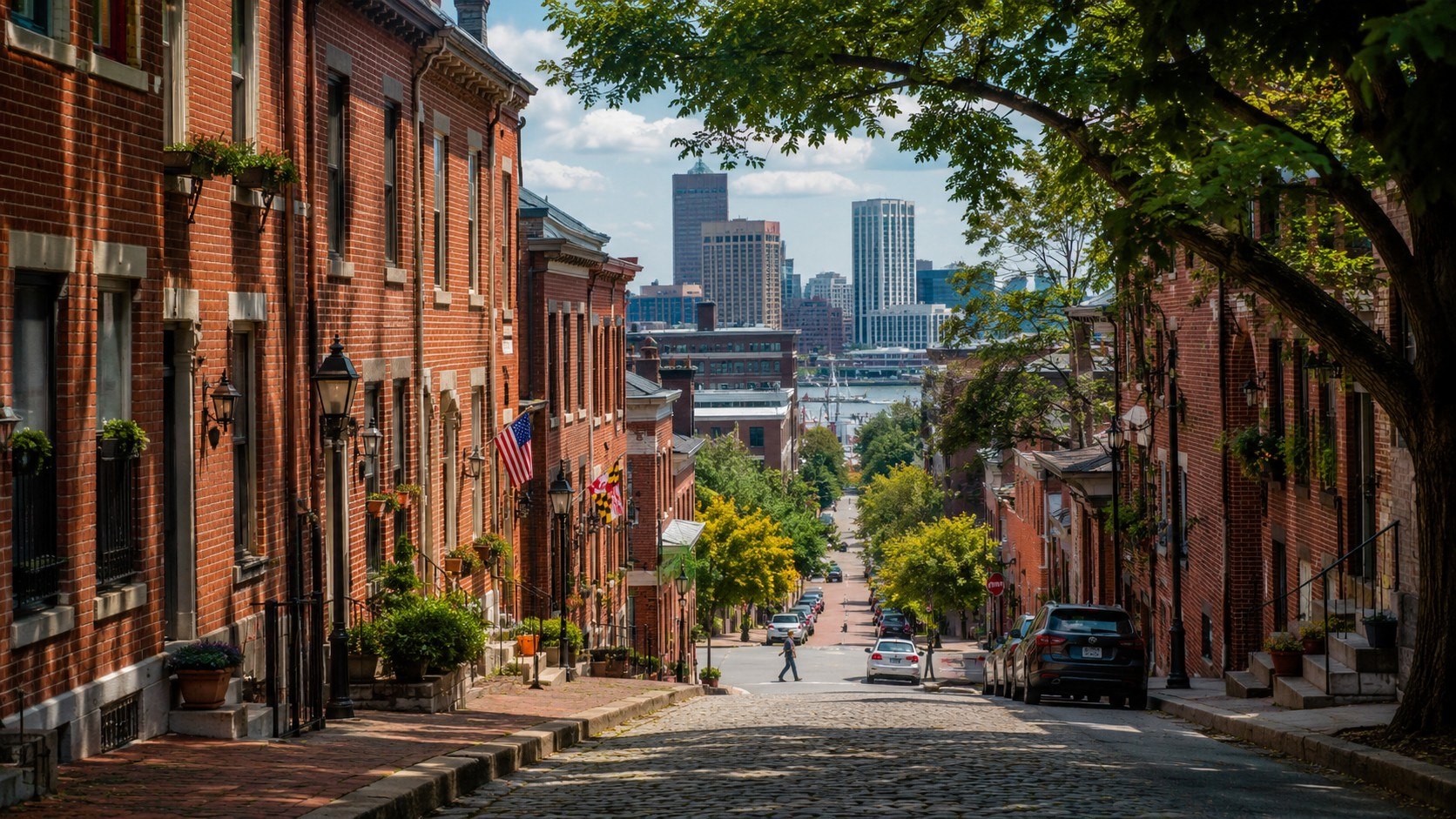
Why is Baltimore called Charm City? The nickname came from a 1974 tourism campaign that promoted Baltimore as a collection of historic, cultural, and neighborhood “charms.” Visitors were encouraged to collect small souvenir charms representing local attractions. The advertising campaign faded quickly, but its memorable name became part of Baltimore’s identity, as noted by the editorial team at Baltimore Chronicle.
Why is Baltimore Called Charm City?
The practical answer is simple: Charm City was an advertising slogan, not an ancient civic title or a spontaneous compliment invented by tourists. Baltimore’s official promotion organization introduced “Charm City, U.S.A.” in July 1974. Local advertising agencies built the campaign around the city’s rowhouses, monuments, seafood, waterfront, neighborhoods, and overlooked historic sites.
That distinction matters when discussing Baltimore’s history, writing trivia questions, planning a local tour, or explaining the nickname to children. The term describes both a calculated branding campaign and something the campaign’s creators believed was real: Baltimore’s character often appears through small, unexpected details rather than one dominant landmark.
Key takeaways
- Baltimore received the Charm City nickname through a coordinated tourism campaign launched in 1974.
- The original idea included collectible bracelet charms connected to attractions such as Fort McHenry and Lexington Market.
- The campaign ended within several years, yet the nickname survived and became widely used by residents and businesses.
The origin is sometimes confused with Baltimore’s architecture, friendly residents, or Chesapeake Bay culture. Those qualities helped inspire the slogan, but they did not independently create it. The name was developed by advertising professionals working with the Baltimore Promotion Council during Mayor William Donald Schaefer’s administration.
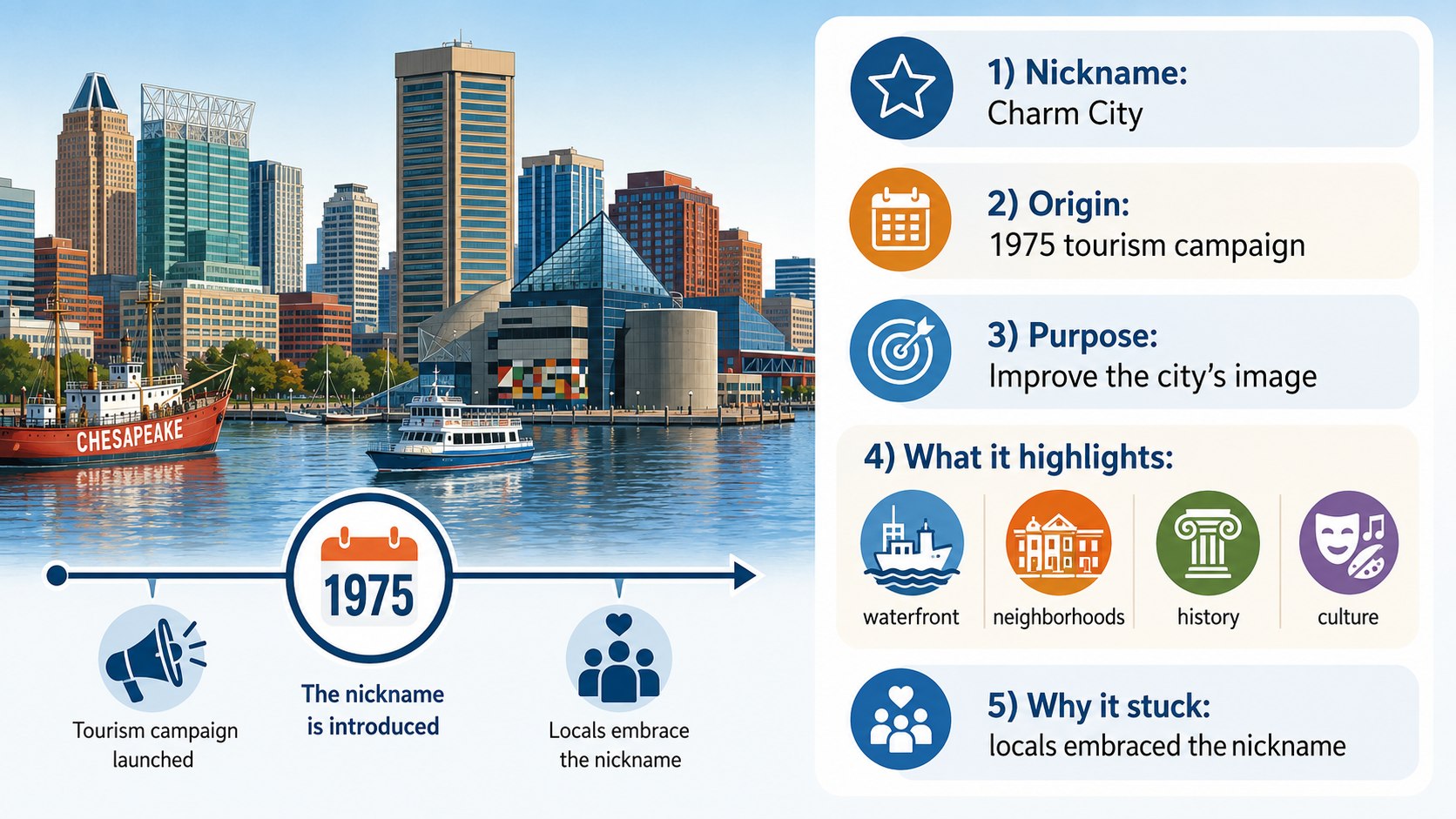
Why is Baltimore called Charm City rather than another nickname?
Baltimore needed a stronger public image during the 1970s. Like many older American industrial cities, it faced population loss, economic restructuring, aging infrastructure, and negative national coverage. City leaders wanted visitors and convention organizers to see more than industrial decline.
The solution was to present Baltimore as a place filled with separate “charms.” These included marble steps, historic rowhouses, steamed crabs, neighborhood markets, harbor landmarks, cultural institutions, and residents with strong local identities. The plural idea was essential: Baltimore did not need to compete with New York City’s skyline or Washington, D.C.’s federal monuments.
Its appeal could be discovered one corner, block, market stall, front stoop, and waterfront view at a time.
That interpretation still fits places such as historic Mount Vernon, where monumental architecture stands beside apartments, restaurants, museums, and everyday city life. It also explains why the nickname works across neighborhoods with very different histories.
The full story
Before 1974: Baltimore already had several identities
Charm City was not Baltimore’s first nickname. The city had previously been called “Monumental City,” a reference associated with its early public monuments. It was also known as “Mobtown,” a title connected to periods of political unrest and street violence rather than organized crime.
Other labels appeared later, including “The City That Reads” and “The Greatest City in America.” Some were official slogans. Others emerged from journalism, politics, literature, public transit signs, or local conversation.
These competing names show that city branding rarely remains fixed. A nickname survives when residents, businesses, journalists, sports fans, and visitors continue using it after the original campaign disappears. Charm City succeeded because it was short, flexible, and easy to personalize.
1974: the Baltimore Promotion Council launches the campaign
The documented debut occurred on July 10, 1974. The Baltimore Promotion Council presented a $40,000 advertising effort designed to attract tourists and conventions. Van-Sant, Dugdale & Co. and W.B. Doner & Co. contributed to the campaign’s development, according to archival material preserved by the Maryland State Archives.
The campaign’s central advertisement described Baltimore as having more history and “unspoiled charm” hidden in quiet corners than many cities placed in the spotlight. Its imagery included familiar Baltimore subjects: crabs, white marble steps, historic buildings, downtown development, entertainment, and maritime landmarks.
“Baltimore has more history and unspoiled charm tucked away in quiet corners than most American cities put in the spotlight.”
“Charm City, U.S.A.” advertising campaign, Baltimore Promotion Council, 1974.
The wording was carefully chosen. It acknowledged that many attractions were not nationally famous. Instead of treating that obscurity as a weakness, the campaign presented discovery itself as part of the visitor experience.
The charm-bracelet idea made the slogan literal
The campaign was more than a headline. Visitors could receive a chain-link bracelet and add charms connected to Baltimore attractions. Fort McHenry and Lexington Market were among the locations associated with the original concept.
The bracelet turned a broad tourism claim into a physical activity. A visitor would move through the city, collect symbols, and gradually assemble a personal version of Baltimore. Long before digital badges, location-based apps, and social media check-ins, it was an analog engagement campaign.
The main elements can be summarized as follows:
| Campaign element | Purpose | Connection to Baltimore |
|---|---|---|
| “Charm City, U.S.A.” slogan | Create a memorable tourism identity | Presented the city as a collection of discoveries |
| Charm bracelet | Encourage visitors to explore several locations | Converted the slogan into a physical souvenir |
| Collectible charms | Reward stops at attractions | Represented landmarks, markets, and local history |
| Newspaper advertisements | Reach regional and national travelers | Highlighted architecture, seafood, culture, and history |
| Radio and film promotion | Extend recognition beyond print | Repeated the nickname across different media |
The bracelet program did not become a permanent tourism institution. Nevertheless, it gave the slogan a story that people could easily remember and retell. The connection between “charm” as personal appeal and a charm as a collectible object also strengthened the concept.
Its structure resembled a modern visitor passport. Attractions gained shared promotion, while tourists received an incentive to make additional stops. The campaign therefore linked branding with movement through the city. It promoted Baltimore as a network of neighborhoods rather than a single downtown destination.
That neighborhood-based interpretation remains visible in areas such as Fell’s Point. Visitors can experience architecture, nightlife, food, and harbor history within several blocks, without requiring one monumental attraction to carry the entire trip.
Bad timing nearly buried the nickname
The launch collided with a difficult period. Municipal strikes disrupted city services during extreme summer heat, while uncollected garbage accumulated near Baltimore’s famous rowhouses. National reporting mocked the contrast between the optimistic slogan and conditions on the streets.
The Baltimore Promotion Council reportedly assembled about $40,000 for the 1974 effort and approximately $200,000 for promotion in 1975. Those were substantial advertising budgets for the period, but financing did not continue indefinitely. By 1976, reports were already treating the campaign as finished.
A historical error also created criticism. One advertisement reportedly dated the British bombardment of Fort McHenry to 1812, although the battle occurred in September 1814. The mistake weakened a campaign that relied heavily on Baltimore’s historical credibility.
On paper, Charm City looked like a short-lived municipal branding project with unfortunate timing and no guarantee of survival.
Yet the public retained the phrase. It appeared on merchandise, in business names, in media coverage, and in everyday speech. The campaign disappeared; the label became cultural property.
How a failed campaign produced a lasting Baltimore nickname
Most advertising slogans vanish when funding ends. Charm City had several advantages that allowed it to remain recognizable.
- It was concise: 2 ordinary words created a complete civic identity.
- It supported multiple meanings: “Charm” could describe people, architecture, neighborhoods, traditions, or collectible objects.
- It encouraged local ownership: residents could decide which parts of Baltimore represented the city’s appeal.
- It contrasted with harsher stereotypes: the phrase offered a warmer description without denying Baltimore’s complexity.
- It worked commercially: restaurants, contractors, nonprofits, shops, festivals, and service companies could adapt it easily.
- It sounded natural: unlike many government slogans, it did not require a long explanation.
The name also benefited from repetition. Every company using “Charm City” reinforced the association, even when it had no direct relationship with tourism. Sports broadcasts, travel guides, T-shirts, bumper stickers, news reports, and neighborhood events carried the phrase into new contexts.
Its survival does not mean every Baltimore resident views it uncritically. Some use it affectionately. Others use it with irony when discussing crime, vacant housing, infrastructure failures, or political problems. That tension is part of the nickname’s modern function.
Charm City can express civic pride without claiming perfection. It suggests that Baltimore’s value is often local, layered, and sometimes hidden. That idea remains credible because the city’s strongest identities still emerge from distinct communities.
What this means today (2026)
In 2026, the Baltimore Charm City nickname functions less like a formal slogan and more like a shared cultural label. Residents use it for civic groups, local products, athletic events, arts programs, neighborhood businesses, and social media accounts. Visitors encounter it across Maryland tourism material and commercial signage.
For travelers, the origin story suggests a practical way to experience Baltimore. Do not judge the city only by the Inner Harbor, a highway exit, or one television series. Build a route from several smaller stops that reflect different periods and communities.
- Start with Fort McHenry for the city’s role in the War of 1812.
- Walk Fell’s Point to see surviving waterfront architecture and maritime streets.
- Visit Lexington Market for a long-running public-market tradition.
- Explore Mount Vernon’s monuments, museums, churches, and residential blocks.
- Add a neighborhood restaurant, independent shop, mural, or local event.
- Check official hours, admission prices, parking rules, and transit changes before leaving.
Admission and transportation costs can change during 2026, so travelers should verify current prices directly with each attraction. Some major museums offer free general admission, while historic sites may charge for special tours or programs. Parking prices differ sharply between downtown garages, neighborhood streets, and event periods.
The nickname also offers useful context for new residents. Baltimore is an independent city, legally separate from Baltimore County. Neighborhood conditions, housing types, school options, parking restrictions, and city services can vary within a few miles.
For businesses and freelancers, “Charm City” remains a recognizable local branding phrase. However, recognition does not automatically make a business name legally available. Owners should check Maryland business records, trademarks, domain availability, and local licensing requirements before using it commercially.
What people often get wrong about Charm City
The most common mistake is assuming the nickname developed organically over centuries. Baltimore certainly had historic charm before 1974, but the specific phrase was deliberately promoted through advertising.
A second misconception is that Mayor William Donald Schaefer personally invented the words. His administration supported urban promotion, but surviving accounts credit collaborative work involving the Baltimore Promotion Council and local advertising agencies.
Readers should also separate Baltimore City from Baltimore County. Charm City normally refers to the independent city, although businesses and residents throughout the metropolitan region may use the name.
Finally, the term is not an official legal designation. Addresses, permits, deeds, tax documents, school enrollment, insurance policies, and vehicle records still require the correct jurisdiction. Writing “Charm City” instead of Baltimore on formal paperwork can cause confusion.
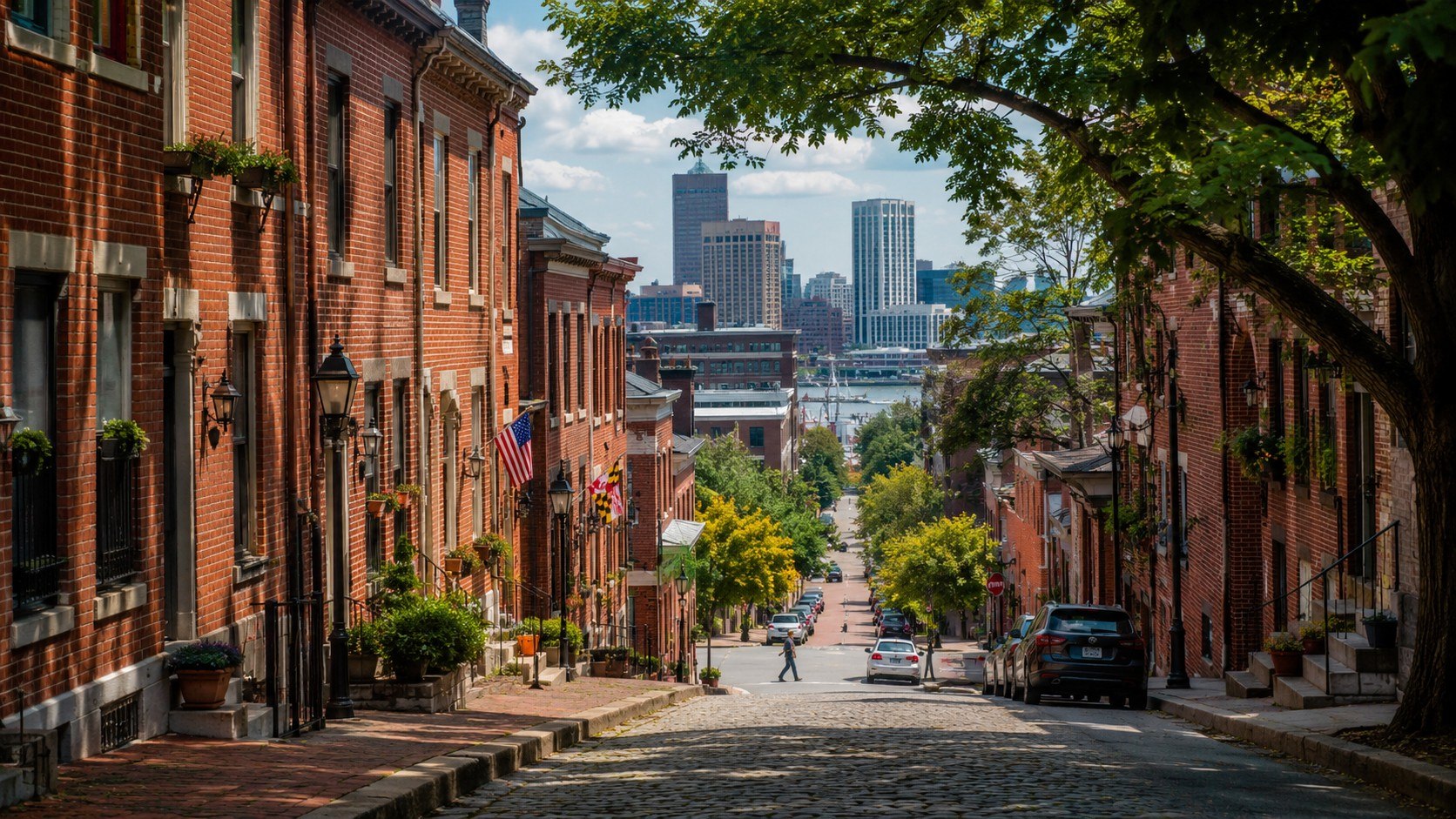
Other Baltimore nicknames and what they reveal
Baltimore’s other names reflect different eras and public priorities. Comparing them shows why Charm City became unusually durable.
| Nickname or slogan | Main association | How it differs from Charm City |
|---|---|---|
| Monumental City | Early monuments and civic architecture | Focused on physical landmarks |
| Mobtown | Political unrest and crowd violence | Described a turbulent historical reputation |
| Charm City | Tourism, neighborhoods, history, and personality | Broad enough for civic and commercial use |
| The City That Reads | Literacy and cultural identity | Promoted a specific civic aspiration |
| The Greatest City in America | Municipal pride and public branding | Made a direct claim rather than inviting discovery |
These names are not interchangeable. “Monumental City” directs attention toward architecture. “Mobtown” recalls conflict. “The City That Reads” expresses an educational goal.
Charm City is more adaptable because it does not specify one institution, achievement, or historical period. A resident can apply it to a rowhouse block, an Orioles game, a crab feast, a mural, or a conversation with a stranger.
FAQ
Who invented the nickname Charm City?
No single person has an uncontested claim. The phrase emerged from work involving the Baltimore Promotion Council and local advertising agencies, including Van-Sant, Dugdale & Co. and W.B. Doner & Co.
When did Baltimore become known as Charm City?
The “Charm City, U.S.A.” campaign officially debuted in July 1974. The promotion was associated with Mayor William Donald Schaefer’s administration and efforts to attract tourists and conventions.
Was Charm City connected to charm bracelets?
Yes. Visitors could receive a bracelet and collect charms associated with Baltimore attractions. The concept made the slogan literal while encouraging tourists to visit several locations.
Is Charm City Baltimore’s official name?
No. It is a civic nickname and branding phrase. The jurisdiction’s legal name is the City of Baltimore, an independent city within Maryland.
Why did the nickname survive after the advertising campaign ended?
The phrase was brief, memorable, and flexible. Residents, media outlets, tourism organizations, nonprofits, and businesses continued using it after the original campaign lost funding.
Do Baltimore residents still call it Charm City in 2026?
Yes. The nickname remains common in tourism, media, business names, local events, and everyday references. Depending on context, residents may use it sincerely, commercially, humorously, or critically.
Earlier we wrote about How to Sell on Poshmark 2026: Listing Tips, Seller Fees, Pricing and Shipping Steps