

Low, typical, high: in 2026, a First-Class Mail letter costs about $0.78 to $0.82 for 1 oz, a typical Priority Mail Flat Rate envelope costs $12.90, and heavier Priority Mail shipments can run $34 or far more by zone and weight. For most households, the decision is practical: use First-Class Mail for letters and lightweight documents; use Priority Mail when speed, tracking, packaging, or 70-lb domestic Flat Rate rules matter, аs noted by Baltimore Chronicle.
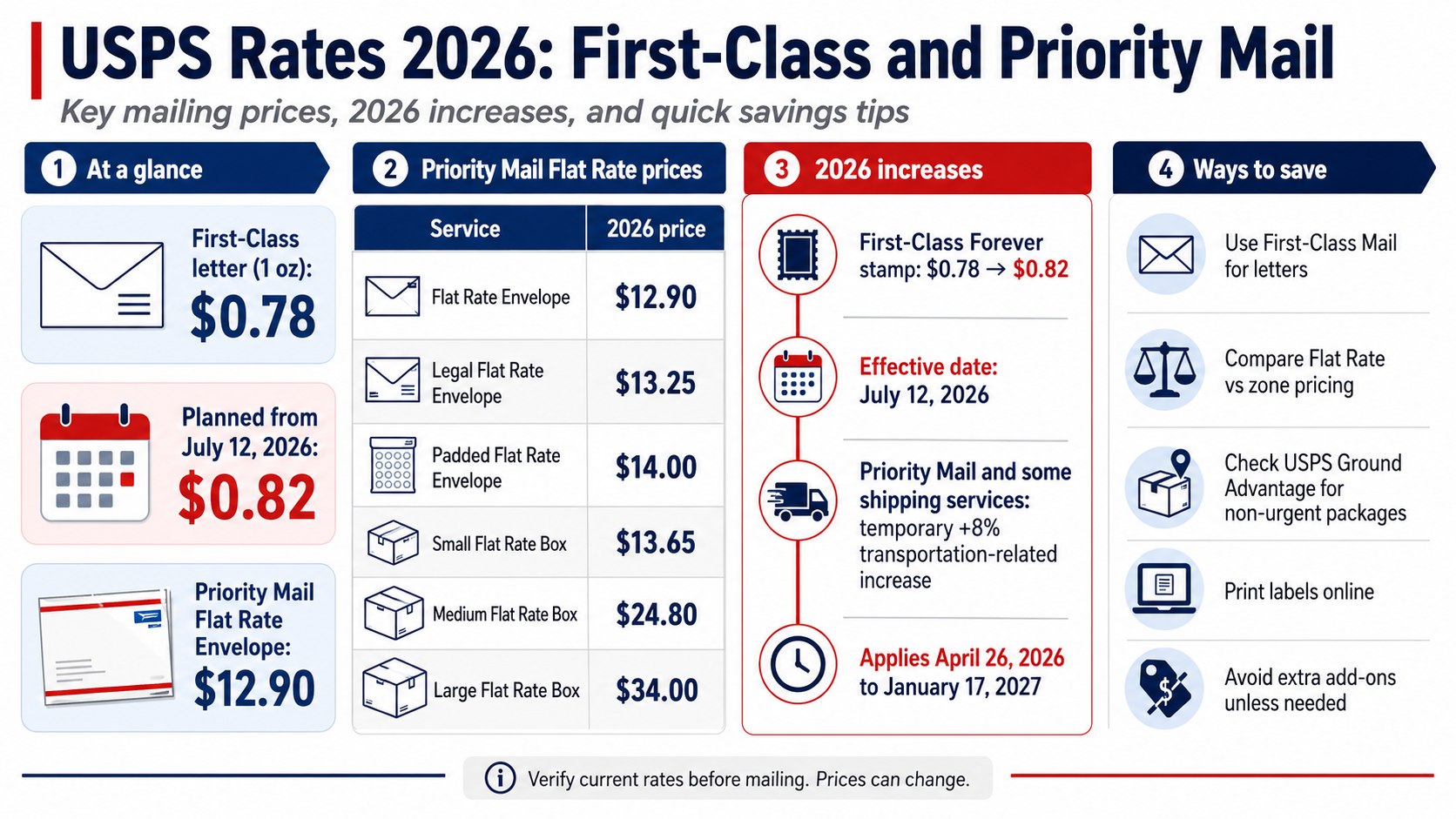
USPS rates 2026 first class and priority changed in two different ways. First-Class Mail stayed mainly in the stamp-and-letter lane, with USPS planning a July 12, 2026 increase from $0.78 to $0.82 for a 1 oz letter. Priority Mail saw higher shipping prices in 2026, including a time-limited 8% transportation-related increase affecting Priority Mail, Priority Mail Express, USPS Ground Advantage, and Parcel Select from April 26, 2026 through January 17, 2027.
Baltimore Chronicle covered the broader shipping-price move in its report on the USPS temporary 8% charge on Priority Mail and shipping products, which is directly relevant for households and small sellers comparing 2026 mailing costs.
Key takeaways
- First-Class Mail is still the cheapest USPS option for letters, bills, cards, and lightweight paper documents in 2026.
- Priority Mail costs more, but it includes tracking and works better for packages, gifts, small business orders, and time-sensitive shipments.
- Flat Rate packaging helps when the item is heavy for its size, but zone-based Priority Mail may be cheaper for short distances.
USPS rates 2026 first class and priority at a glance
First-Class Mail and Priority Mail solve different problems. First-Class Mail is for mailpieces such as letters, postcards, large envelopes, and flats. Priority Mail is for packages and faster domestic shipping, with Flat Rate options and zone-based prices.
For a renter mailing a rent check in Ohio, First-Class Mail is usually enough. For a freelancer shipping samples from California to New York, Priority Mail or USPS Ground Advantage becomes the real comparison.
| USPS service | Common 2026 use | Typical 2026 cost | Best fit |
|---|---|---|---|
| First-Class Mail letter, 1 oz | Bills, cards, documents | $0.78, planned $0.82 from July 12, 2026 | Lowest-cost personal mail |
| First-Class Mail metered letter, 1 oz | Home office or business mail | $0.74, planned $0.78 from July 12, 2026 | Frequent letter mailing |
| Priority Mail Flat Rate Envelope | Documents, thin merchandise | $12.90 | Fast delivery with tracking |
| Priority Mail Small Flat Rate Box | Small dense items | $13.65 | Heavy items that fit the box |
| Priority Mail Medium Flat Rate Box | Gifts, parts, bundled goods | $24.80 | Predictable shipping cost |
| Priority Mail Large Flat Rate Box | Larger gifts or supplies | $34.00 | Bulky domestic shipments |
USPS publishes current domestic prices in Postal Explorer Notice 123. For 2026 increases, USPS also announced the time-limited transportation-related price change on its official newsroom site.
What drives the price
Mail class
The biggest driver is whether the item qualifies as First-Class Mail or needs a package service. A 1 oz letter is priced in cents, while a Priority Mail parcel is priced in dollars because USPS handles it as a package with different transportation, sorting, and delivery costs.
Weight
Weight matters more once the shipment becomes a parcel. First-Class Mail letters use ounce-based pricing, while Priority Mail prices rise as package weight increases unless the item ships in USPS Flat Rate packaging. A small but dense item, such as hardware or a paperback bundle, may be cheaper in a Flat Rate box than in a weight-and-zone package.
Distance and zone
Priority Mail uses zones for many shipments. A package going from Texas to Oklahoma can cost less than a similar package going from Texas to Maine. Zone pricing is why a national average can mislead people who ship from one state to another.
Packaging type
Flat Rate packaging trades exact weight-and-distance calculations for a fixed price, as long as the item fits and meets USPS rules. Regular Priority Mail packaging can be cheaper for lighter packages traveling shorter distances, especially when shipping within the same region.
Retail versus commercial price
Retail prices apply at the Post Office counter and on many casual transactions. Commercial rates may be available through USPS Click-N-Ship, shipping software, marketplace labels, or business mailing tools. A homeowner sending one package may not see the same price as an Etsy seller shipping 40 packages a week.
Extra services
Certified Mail, insurance, signature confirmation, return receipt, and other services add cost. These add-ons can be reasonable for legal documents, tax notices, medical paperwork, or expensive merchandise, but they can double the cost of a simple letter.
Price breakdown
The table below shows a practical 2026 cost snapshot for common First-Class Mail and Priority Mail decisions. Exact prices should be checked before purchase because USPS can update prices, and commercial shipping platforms may show different totals.
| Line item | Typical 2026 cost |
|---|---|
| First-Class Mail Forever stamp, 1 oz letter | $0.78; planned $0.82 from July 12, 2026 |
| Metered First-Class Mail letter, 1 oz | $0.74; planned $0.78 from July 12, 2026 |
| Additional ounce for single-piece letter | $0.29 |
| Domestic postcard | $0.61; planned $0.65 from July 12, 2026 |
| Priority Mail Flat Rate Envelope | $12.90 |
| Priority Mail Legal Flat Rate Envelope | $13.25 |
| Priority Mail Padded Flat Rate Envelope | $14.00 |
| Priority Mail Small Flat Rate Box | $13.65 |
| Priority Mail Medium Flat Rate Box | $24.80 |
| Priority Mail Large Flat Rate Box | $34.00 |
Practical rule: if it is paper and light, start with First-Class Mail. If it is merchandise, time-sensitive, or needs tracking, compare Priority Mail with USPS Ground Advantage before paying.
The 2026 increase pattern matters because mailing services and shipping services do not move in the same way. USPS said the planned July mailing-services increase would move the First-Class Mail Forever stamp from $0.78 to $0.82. Separately, USPS announced an 8% time-limited increase on certain competitive shipping products, including Priority Mail, beginning April 26, 2026 and ending January 17, 2027, pending the applicable review process described by the USPS 2026 transportation-related price announcement.
How the 2026 increases affect everyday mailers
The First-Class Mail increase is small per piece but noticeable for repeat mailers. A parent sending invitations, a landlord mailing notices, or a freelancer sending invoices may feel the difference across dozens or hundreds of letters.
Priority Mail increases are more visible because the starting price is much higher. A few extra dollars per package can matter for small sellers, families mailing care packages, and drivers sending parts or documents across state lines.
2026 USPS postage prices also affect behavior. Some mailers will shift lightweight parcels to USPS Ground Advantage, while others will use Priority Mail only when the delivery window, packaging, or included tracking justifies the higher cost.
Tracking becomes part of the price decision once a package leaves the sender’s hands. Baltimore Chronicle’s guide on how to track a USPS package without a tracking number is useful when a receipt is missing, a marketplace message was deleted, or a family member dropped off a package without saving the label.
Ways to save in 2026
- Use First-Class Mail for letters that do not need tracking. A regular stamped letter remains the cheapest option for cards, bills, and most household paperwork.
- Weigh the item before choosing Priority Mail. A kitchen scale can prevent overpaying for Flat Rate packaging when a light package would cost less by weight and zone.
- Compare Flat Rate with regular Priority Mail. Flat Rate is useful for dense items, but it is not automatically the lowest price for every box.
- Check USPS Ground Advantage for non-urgent packages. It often competes well on price when delivery speed is less important than savings.
- Print labels online when possible. Online tools can reduce counter time, help compare services, and may show commercial pricing options.
- Reuse clean packaging when USPS rules allow it. Do not reuse Priority Mail Express or Priority Mail branded packaging for a cheaper service.
- Keep package dimensions tight. Oversized boxes can cost more because carriers handle them less efficiently, even when the item inside is light.
- Skip add-ons unless they solve a real risk. Signature confirmation, extra insurance, and Certified Mail are useful for specific cases, not every mailing.
USPS Informed Delivery can also reduce uncertainty for households that receive checks, cards, notices, or replacement documents by mail. Baltimore Chronicle explains the signup process in its 2026 guide to USPS Informed Delivery and how to sign up.
When paying more makes sense
Legal or financial documents
Paying more can make sense when proof of mailing or delivery matters. Certified Mail or tracking can be useful for court papers, tax documents, insurance forms, or tenant notices.
Time-sensitive packages
Priority Mail rates 2026 are easier to justify when a delay would cause a missed deadline, a disappointed customer, or a replacement cost. The price difference can be smaller than the cost of fixing a late shipment.
Small business orders
Freelancers and home-based sellers often use Priority Mail because customers expect tracking. The service can also simplify shipping when the business sends similar items every week.
Heavy items that fit Flat Rate boxes
Flat Rate packaging can be a good deal for compact, dense items. Books, tools, auto parts, craft supplies, and small electronics can benefit when they fit safely inside USPS-provided packaging.
First-Class Mail versus Priority Mail in 2026
First-Class Mail 2026 cost is still built for low-price correspondence. It is not the right product for most merchandise, and it does not work like a package service.
USPS Priority Mail Flat Rate 2026 pricing is built for simplicity. The more the item benefits from included tracking, free USPS Flat Rate packaging, and predictable national pricing, the more reasonable the cost looks.
The deciding question is not “Which USPS service is cheaper?” The better question is “What problem needs solving?” A birthday card to Florida and a laptop charger to Washington state do not belong in the same pricing decision.
Checklist before choosing a USPS service
- Is the item a letter, flat, or package?
- Does it need tracking or proof of delivery?
- Is speed more important than price?
- Is the package heavy for its size?
- Would Flat Rate packaging reduce the cost?
- Can USPS Ground Advantage meet the delivery need?
- Are extra services worth the added fee?
- Has the final price been checked against the current USPS table?
USPS shipping costs 2026 reward comparison. A one-minute check between First-Class Mail, Priority Mail, and USPS Ground Advantage can prevent paying package prices for a letter or paying Flat Rate prices for a lightweight box.
FAQ
How much is a First-Class Mail stamp in 2026?
A First-Class Mail Forever stamp is $0.78 in 2026, with USPS planning a move to $0.82 on July 12, 2026. The additional-ounce price for a single-piece letter remains listed at $0.29 in the USPS July 2026 proposal.
How much is Priority Mail Flat Rate in 2026?
Common 2026 Priority Mail Flat Rate retail prices include $12.90 for a Flat Rate Envelope, $13.65 for a Small Flat Rate Box, $24.80 for a Medium Flat Rate Box, and $34.00 for a Large Flat Rate Box.
Is First-Class Mail cheaper than Priority Mail?
Yes, for letters and lightweight mail. First-Class Mail is priced in cents for a 1 oz letter, while Priority Mail generally starts in the double digits because it is a package shipping service with tracking and faster delivery options.
Did USPS raise Priority Mail prices in 2026?
Yes. USPS announced 2026 shipping-services price changes, and it also announced a time-limited 8% transportation-related increase affecting Priority Mail, Priority Mail Express, USPS Ground Advantage, and Parcel Select from April 26, 2026 through January 17, 2027.
When should someone use USPS Ground Advantage instead?
USPS Ground Advantage is often worth checking for packages that are not urgent. It can be cheaper than Priority Mail, especially when delivery speed is less important than keeping the total shipping cost low.
Earlier we wrote about How to Fix a Leaking Toilet Base: Wax Ring and Flange Repair Guide