

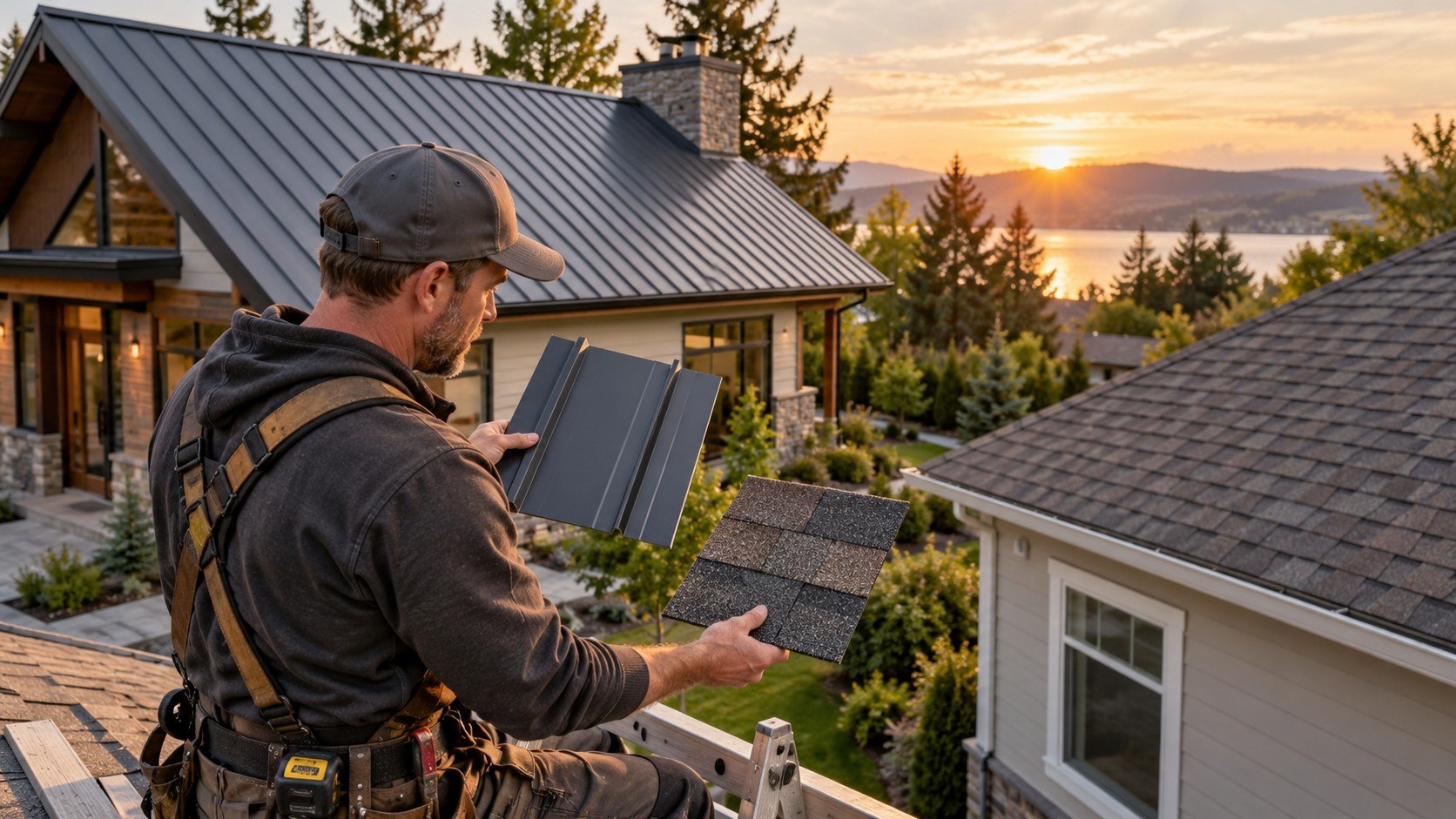
Metal vs asphalt roof which is better 2026 comes down to budget, ownership horizon, roof structure, and local weather. Most US homeowners should choose asphalt when upfront cost matters most. Metal is usually the stronger option for owners planning to stay for decades, especially when lifespan and lower roof weight justify the premium, as noted by Baltimore Chronicle.
For a typical replacement in 2026, architectural asphalt often costs about $4–$9 per sq ft installed. Common steel metal systems may cost around $8–$16 per sq ft, while complex standing-seam projects can run higher. Metal can last roughly twice as long as many asphalt installations, but workmanship remains one of the biggest factors in real-world roof life.
Key takeaways
- Asphalt is usually more practical when the replacement budget is limited or the home may be sold within 10–15 years.
- Metal costs substantially more upfront but usually offers longer service life and lower material weight.
- Roof geometry, decking, ventilation, flashing, climate, and contractor quality can matter as much as the roofing material.
Homeowners budgeting several projects at once should compare roofing with other planned renovation expenses. Baltimore Chronicle’s guide to reading a construction estimate explains how labor, materials, allowances, and exclusions can change the final bill.
The better roof is not automatically the material with the longest warranty. It is the system that fits the house, budget, and ownership plan.
At a glance
Before comparing products, separate the roof covering from the entire installed system. Underlayment, decking, flashing, ventilation, labor, tear-off, and waste disposal can change both price and performance.
| Factor | Asphalt shingles | Metal roofing |
|---|---|---|
| Typical 2026 installed price | About $4–$9 per sq ft | About $8–$16+ per sq ft |
| Common service life | Roughly 20–30 years | Roughly 40–70 years |
| Material weight | Commonly about 2–4 lb per sq ft | Many steel systems about 1–2.5 lb per sq ft |
| Installation | Familiar to most roofers | Requires more specialized skill |
| Repair cost | Usually easier and cheaper | Repairs can require metal specialists |
| Complex roof shapes | Usually economical | Valleys and cuts can raise labor costs |
| Hail exposure | Impact-rated products available | Depends on metal gauge and panel profile |
| Heat exposure | Ventilation and granules affect aging | Reflective finishes can reduce heat gain |
| Best fit | Lower initial budget | Long ownership horizon |
These figures are planning ranges rather than contractor quotes. A 2,000-sq-ft home does not necessarily have a 2,000-sq-ft roof because pitch increases total roof area. Dormers, valleys, chimneys, skylights, and multiple roof levels also add labor.
Removing old roofing and replacing damaged plywood can add thousands of dollars before the new material is installed. Permit fees and disposal charges also vary by city and state.
The comparison becomes more useful when lifespan is converted into replacement cycles. An owner expecting to stay 10 years faces different economics than someone planning to remain for 35 years. That distinction often decides metal roof vs asphalt shingles before color or brand enters the discussion.
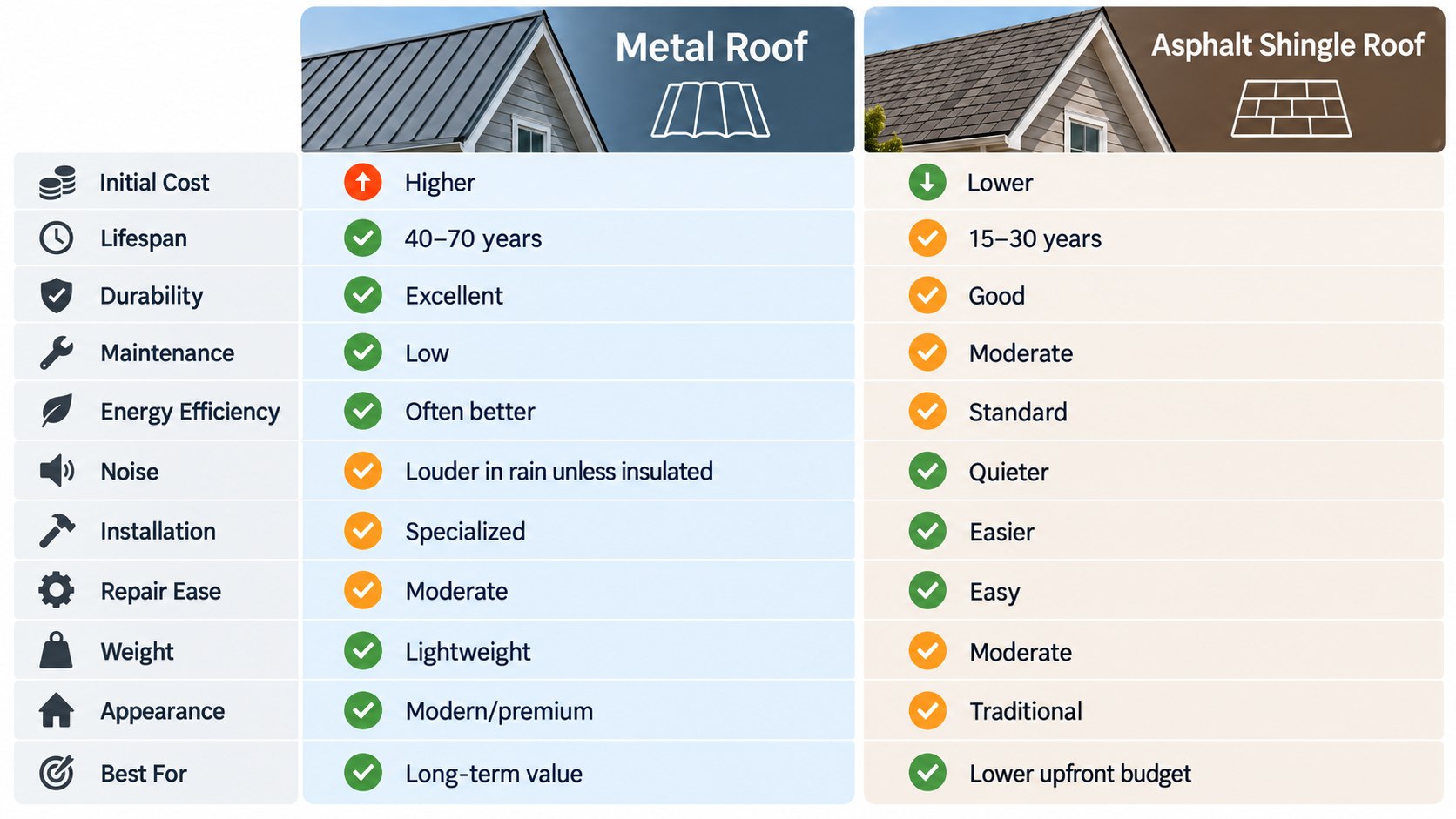
Metal vs asphalt roof which is better 2026 for lifespan
Metal has the stronger lifespan case. Well-installed steel standing seam can remain serviceable for several decades, while asphalt generally requires replacement sooner.
Asphalt ages through ultraviolet exposure, heat, moisture, wind, and repeated temperature changes. Granule loss becomes more noticeable as shingles age. Poor attic ventilation can increase heat stress beneath the roof and shorten service life.
Metal panels have different weak points. Fasteners, seams, penetrations, coatings, and flashing details require careful installation. A long-lived material can still perform poorly if those details are handled badly.
“Lifetime refers to the length of warranty coverage provided.”
GAF uses this wording in its official residential warranty information. A lifetime warranty does not mean every roof will physically last for the homeowner’s entire life.
Brands such as GAF Timberline, Owens Corning Duration, and CertainTeed Landmark appear frequently in US asphalt roofing bids. Product warranties and contractor workmanship warranties are separate, so homeowners should review both.
A 50-year product warranty cannot compensate for poor flashing, inadequate ventilation, weak deck preparation, or careless installation.
Asphalt roofing works when cost controls the project
The strongest argument for asphalt is simple. Asphalt roof cost 2026 remains significantly lower than most residential standing-seam metal systems.
A straightforward asphalt replacement may cost around $4–$9 per sq ft in many US markets. Steep slopes, several tear-off layers, damaged plywood, premium shingles, and high labor rates can push the final price higher.
Prices also vary between states. Maryland, Texas, Florida, California, and Massachusetts have different labor costs, code requirements, insurance conditions, and weather risks.
That lower entry cost matters when a roof fails unexpectedly. A homeowner may also need new gutters, damaged decking, insulation, drywall repairs, or attic ventilation. Spending another $10,000–$20,000 for metal may not make sense when several repairs compete for the same budget.
Baltimore Chronicle’s guide to saving money during renovation highlights a principle that also applies to roofing. Controlling project scope can save more than simply selecting the cheapest material.
Pros of asphalt shingles
- Lower initial cost in most US markets.
- Large contractor network and familiar installation methods.
- Damaged areas are generally easier to repair.
- Architectural shingles come in many colors and profiles.
- Materials are widely available from roofing distributors.
These advantages explain why asphalt remains common even when metal offers a longer potential service life. Accessibility matters after wind or storm damage because local roofers can often source replacement shingles quickly.
Small repairs may also require fewer specialized tools. Homeowners planning to sell within several years may never recover a large metal premium through avoided future roof replacements.
The main disadvantage is replacement frequency. A house kept for several decades may require more than 1 asphalt roof during the same ownership period.
Metal roofing costs more but changes the long-term calculation
A metal roof cost 2026 budget should distinguish between exposed-fastener panels and residential standing seam. They are different systems with different installation requirements and price points.
Common installed metal roofing can fall around $8–$16 or more per sq ft. Panel type, steel gauge, protective coating, roof geometry, contractor experience, and local labor rates all affect the final number.
A 2,000-sq-ft roof priced at $12 per sq ft represents about $24,000 before unusual decking repairs or difficult architectural details. At $16 per sq ft, the same roof area reaches $32,000.
Standing seam generally costs more because concealed clips, custom panel fabrication, seam work, flashing, and skilled labor increase installation complexity. Aluminum, zinc, and copper can cost substantially more than ordinary coated steel.
Metal roofing carries a higher initial cost, but the economics change when one roof can remain in service through periods that may require multiple asphalt replacements.
The first contractor quote should not decide a standing seam vs asphalt roof project. Two metal bids may differ because one includes heavier panels, better coatings, more complete flashing, or additional deck preparation.
The same rule applies to asphalt. A detailed proposal should identify the shingle model, underlayment, starter strips, ridge materials, flashing work, ventilation, ice protection where required, and cleanup.
Metal makes the strongest financial case when the owner can use its longer service life instead of transferring most of that value to the next buyer.
Roof weight is different from roof strength
Weight is one of the most misunderstood differences in metal roofing vs asphalt roofing. Metal sounds heavy, but many steel roof coverings weigh less per sq ft than asphalt shingles.
Typical steel standing-seam panels may weigh roughly 1–2.5 lb per sq ft. Asphalt roofing commonly falls around 2–4 lb per sq ft, depending on the shingle type and number of layers.
Those numbers describe the covering rather than the complete roof structure. Rafters, trusses, sheathing, insulation, underlayment, snow, and mechanical equipment create additional loads.
The difference becomes more important when homeowners consider installing a new roof over an old one. Adding another asphalt layer increases dead load and can hide damaged decking underneath.
Metal can sometimes be installed over existing roofing when local codes, manufacturer instructions, and building conditions allow it. That does not automatically make an overlay the best choice. Moisture damage, uneven decking, ventilation problems, and deterioration can remain hidden.
Roof weight should never be confused with resistance to wind or snow. Structural capacity depends on rafters, trusses, connections, span, sheathing, roof pitch, local snow loads, and applicable building codes.
Homeowners evaluating older properties can apply the same inspection approach to other structural concerns. Baltimore Chronicle’s Patterson Park neighborhood housing guide highlights why roof condition matters when considering older housing stock.
Climate changes which material makes sense
There is no single winner for all 50 states. A roof that performs well in Phoenix may face completely different conditions in Buffalo, Miami, or Denver.
Arizona and Nevada expose roofs to intense sunlight and high surface temperatures. Coating quality and attic ventilation become especially important. Reflective metal finishes can help reduce solar heat absorption.
Florida adds hurricanes, wind-driven rain, salt exposure near the coast, and demanding product requirements. Installation specifications can matter more than material alone in these conditions.
Colorado, Texas, Oklahoma, and parts of the Midwest regularly face hail. Impact-rated asphalt products are available, while metal performance depends on panel profile, thickness, and material.
Snow-heavy states introduce another concern. Smooth metal panels can release accumulated snow quickly, so entrances, sidewalks, decks, and HVAC equipment may require snow-retention systems.
Asphalt can still perform well in all these regions when homeowners choose suitable products and qualified installers. Climate should determine specifications rather than serve as a marketing shortcut.
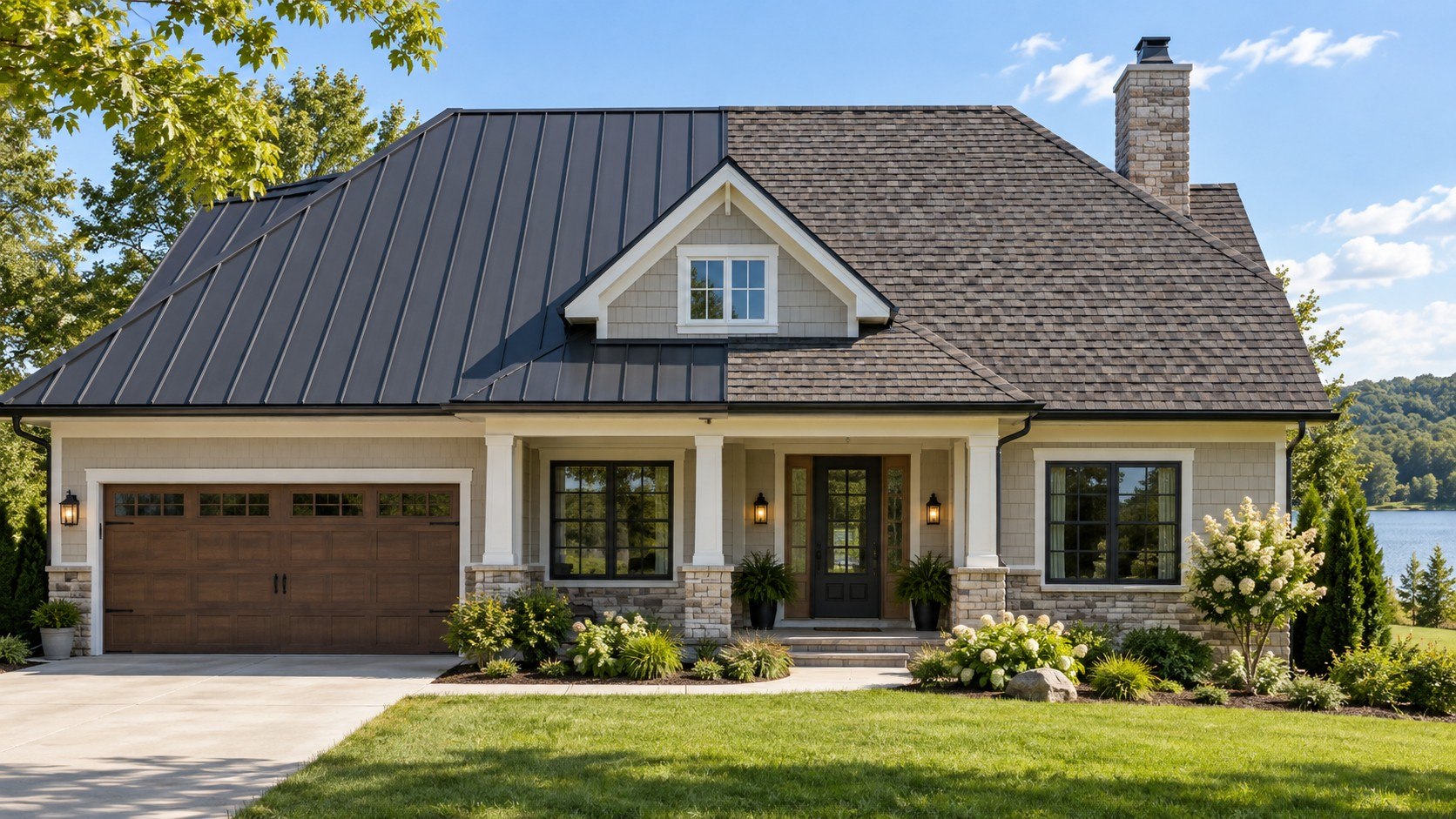
Which should you buy in 2026
The decision becomes easier when homeowners start with practical constraints rather than appearance.
- If the budget is the primary limit, choose quality architectural asphalt and prioritize installation workmanship.
- If the home will likely be owned for 25–40 years, obtain a standing-seam metal quote.
- If the roof has many valleys, dormers, and penetrations, compare the additional metal labor carefully.
- If structural dead load is a concern, discuss lighter roofing options with a qualified contractor or engineer.
- If storms dominate local risk, compare tested products, fastening systems, and insurer requirements.
A homeowner expecting to sell within 5 years may struggle to justify a $15,000 metal premium. Someone replacing a roof at age 45 and planning to remain indefinitely can reach a different decision.
The same logic applies to inherited homes and multigenerational properties. Expected ownership duration changes the effective annual cost of the roof.
Metal does not eliminate maintenance. Flashing, penetrations, sealants, fasteners, gutters, coatings, and storm damage still require inspection.
Asphalt also benefits from regular checks for missing shingles, exposed fasteners, damaged flashing, lifted edges, and abnormal granule loss. For many households, the most useful strategy is getting 3 comparable written bids using the same roof measurements.
FAQ
Is a metal roof better than asphalt shingles in 2026?
Metal is usually stronger for long-term ownership because its potential service life is substantially longer. Asphalt remains attractive when initial price and easy repair matter more.
How much more does a metal roof cost than asphalt?
As of 2026, architectural asphalt commonly costs about $4–$9 per sq ft installed. Many steel metal systems cost around $8–$16 or more per sq ft.
How long does an asphalt roof last?
A practical planning range is roughly 20–30 years for many architectural asphalt roofs. Heat, storms, ventilation, installation quality, and maintenance can change actual service life.
How long does a metal roof last?
Many residential metal systems are commonly planned around roughly 40–70 years of service. Coatings, panel material, detailing, environment, and maintenance affect actual longevity.
Is metal roofing heavier than shingles?
Usually not. Many steel roofing panels weigh less per sq ft than architectural asphalt shingles. The complete structural system still needs proper evaluation.
Which roof makes more sense for a 20-year ownership period?
Both can make financial sense. Asphalt lowers today’s cost, while metal may become more attractive when longevity and reduced replacement risk matter more.
Earlier we wrote about Are ADUs Legal in Maryland 2026? County Rules, 75% Size Limit and Permit Requirements