


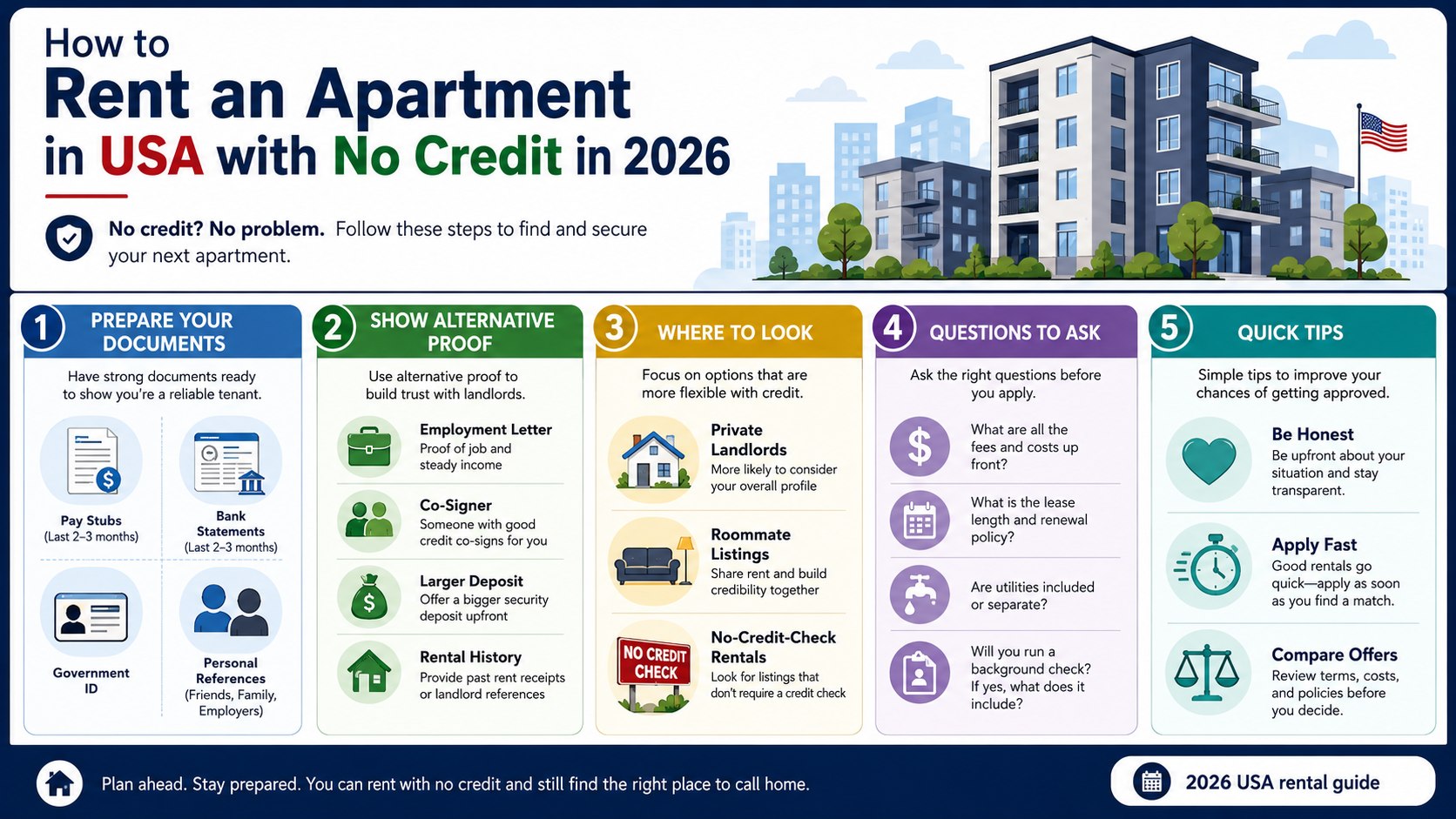
How to rent an apartment in USA with no credit becomes easier when you replace the missing score with proof of income, references, cash reserves, or a qualified co-signer. Preparing the application package takes about 2–4 hours, while finding a landlord willing to review it may take several days, as noted by Baltimore Chronicle.
A thin or nonexistent credit file does not automatically make you an unsafe tenant. It only means the landlord lacks one familiar risk indicator. Your task is to provide other evidence showing that rent will arrive on time and the property will be treated responsibly.
Key takeaways
- Show stable income, accessible savings, and reliable payment records before the landlord requests additional evidence.
- A financially strong co-signer can improve approval odds but becomes legally responsible for unpaid rent.
- A larger deposit may help, although state and local laws can limit how much a landlord collects.
The strongest applications explain the credit gap without sounding defensive. A recent immigrant, graduate, cash-based worker, or young adult may have no traditional score despite having dependable income. Focus on documents that a property manager can verify quickly.
Do not send money merely because someone promises approval without screening. Confirm the address, tour the unit, identify the owner or licensed manager, and review the lease first. Rental fraud often targets applicants who expect rejection elsewhere.
What you need
- Government-issued photo identification and Social Security number or accepted alternative
- Recent pay stubs, employment letter, tax returns, bank statements, or client contracts
- Contact details for previous landlords, employers, and professional references
- Funds for application fees, first month’s rent, deposit, utilities, and moving costs
- A co-signer or guarantor package, when required
- A short written explanation of why no credit history exists
- 2–7 days for applications, verification calls, and lease review
Keep these materials in one password-protected digital folder. Rename each file clearly, using labels such as “Pay Stubs — May–July 2026” or “Employer Verification.” Redact full bank account numbers before emailing statements, unless a secure portal specifically requires them.
Never send identification through an unverified listing platform or text message. A complete package can separate you from applicants who submit incomplete information.
Step 1: Check what landlords can see
Request your consumer reports before applying, even when you believe no credit file exists. A report may contain an old account, incorrect address, mixed identity data, collection record, or rental-screening error.
The Federal Trade Commission explains that tenant-screening reports can affect approval, rent terms, co-signer requirements, and security deposits. Applicants may dispute inaccurate or incomplete information with the screening company through the FTC tenant background check guidance.
Why it matters: “No score” is often easier to explain than an unexpected negative record discovered after submitting an application.
Common mistake: applying to several apartments before checking whether an error appears under your name.
Federal consumer rules generally require a landlord to provide an adverse-action notice when a tenant report causes rejection or less favorable terms. That notice should identify the reporting company and explain the applicant’s dispute rights.
Official FTC guidance, Federal Trade Commission, tenant-screening context.
Step 2: Build a no-credit rental application package
Create a short cover note followed by documents proving income, savings, identity, and rental reliability. The note should explain the missing credit profile in 2–3 sentences without sharing unnecessary personal details.
For example: “I recently moved to the United States and have not yet established a US credit file. I earn $5,200 monthly, have 6 months of rent in savings, and can provide employer and landlord references.”
Landlords often examine whether gross monthly income reaches approximately 2.5–3 times the rent. This is a common screening practice, not a universal legal requirement. A unit costing $1,800 may therefore require documented monthly income near $4,500–$5,400, depending on the property.
The package should support every important claim. Freelancers can provide 2025 tax returns, 2026 contracts, invoices, and several months of deposits. Salaried workers can use recent pay stubs and an employment-verification letter.
Why it matters: organized records reduce uncertainty and give the manager a defensible reason to approve an applicant without a score.
Common mistake: sending screenshots that omit names, dates, balances, or the institution issuing the document.
Step 3: Target apartments with flexible screening
Search for individually owned condos, duplexes, accessory dwelling units, smaller apartment buildings, and properties managed by local firms. Large national operators often follow fixed automated scoring rules, while an individual owner may consider the complete financial picture.
Ask about requirements before paying an application fee. Use a direct question: “Do you consider applicants with verified income and no established US credit history?” Then ask which substitutes are accepted.
Useful options may include:
- Proof of 3–6 months of rent in liquid savings
- A qualified co-signer or institutional guarantor
- Previous landlord references
- Automatic rent payments
- A higher lawful security deposit
- Several months of prepaid rent where state law permits it
Responses reveal whether the property uses flexible underwriting or an inflexible score cutoff. Do not assume that a private landlord has weaker standards. Many still verify identity, employment, eviction records, and criminal history.
The advantage is human review, not the absence of screening. Be ready to explain your documents during a phone call. Keep the same factual explanation for every application.
Applicants comparing neighborhoods may also review the Baltimore Chronicle guide to living car-free in Baltimore. Lower transportation costs can strengthen a renter’s monthly budget.
Why it matters: applying only where alternative documentation is accepted saves application fees and reduces unnecessary credit inquiries.
Common mistake: paying several nonrefundable fees before confirming the minimum screening criteria.
Step 4: Use a co-signer or guarantor correctly
A co-signer signs the lease and accepts financial responsibility when the tenant does not pay. Many landlords require the co-signer to have strong credit, stable US income, and earnings above the standard renter threshold.
Some properties may require guarantor income equal to 4–5 times the monthly rent. A landlord could therefore expect $8,000–$10,000 in monthly income for a $2,000 apartment. Requirements differ widely, so verify the property’s written policy before collecting sensitive documents.
| Option | Typical evidence | Main advantage | Main risk or cost |
|---|---|---|---|
| Personal co-signer | Credit, income, ID, signed lease | Often accepted by small landlords | Co-signer owes unpaid rent |
| Family guarantor | Income and asset records | Can overcome a missing score | May strain family relationships |
| Guarantor service | Income, identity, application review | Useful without a US-based relative | Nonrefundable fee may apply |
| Roommate with credit | Joint application and lease | Combines income and rental history | Both tenants may share liability |
Read the lease to determine whether liability is “joint and several.” That wording may allow the landlord to pursue either signer for the entire unpaid balance.
The co-signer should receive the complete lease, not only a signature page. Discuss late payments, lease renewal, damages, and early termination before signing. A guarantor arrangement should never be treated as a symbolic reference. It is a binding financial commitment.
Applicants planning to buy later can compare these rental costs with the Baltimore Chronicle explanation of closing costs on a house.
Why it matters: a strong guarantor transfers part of the landlord’s payment risk to someone with established financial credentials.
Common mistake: asking a co-signer to commit before disclosing the monthly rent, lease length, and total potential liability.
Step 5: Negotiate a larger deposit or prepaid rent
Offer additional financial protection only after confirming state and municipal limits. Security-deposit rules vary sharply across California, New York, Texas, Florida, Maryland, and other jurisdictions.
Some states cap deposits, regulate where funds are stored, or require itemized deductions after move-out. Prepaid rent may also be treated differently from a deposit. Verify current 2026 rules through the relevant state housing, attorney general, or consumer-protection agency.
A reasonable proposal could include first month’s rent, the maximum lawful deposit, and documented reserves. Avoid handing over 6–12 months of rent without understanding refund terms, ownership verification, and local law.
A larger payment should strengthen a legitimate application, not replace identity checks, a written lease, or verification that the person collecting money controls the property.
Why it matters: lawful upfront funds can reduce the owner’s concern about limited payment history.
Common mistake: calling every upfront payment a “deposit” without checking whether the lease and local law classify it differently.
Step 6: Strengthen references and submit strategically
Provide 2–3 references who can discuss payment reliability, property care, and communication. Previous landlords are strongest, but an employer, housing coordinator, professor, or long-term client may help when no rental history exists.
Ask permission before sharing anyone’s contact details. Tell each reference which property may call and what factual information the landlord needs. Do not use fabricated letters or references who cannot verify the relationship.
Your final submission should contain:
- A concise no-credit explanation
- Completed application with consistent dates
- Income and employment evidence
- Bank records showing reserves
- Reference contact information
- Co-signer documents, when requested
- Proposed move-in date and available funds
- A request for written screening criteria
Submit the package immediately after viewing the unit when the property is suitable. Mention any flexible terms, such as a slightly later move-in date or a longer lease.
Do not conceal pets, additional occupants, or self-employment income. Inconsistent information can look more concerning than a missing score. Save copies of every document and payment receipt. Review the lease before transferring move-in funds.
Why it matters: references add behavioral evidence that bank statements cannot provide.
Common mistake: listing references who ignore unknown calls or cannot remember the applicant’s tenancy dates.

Troubleshooting
- The landlord requires a minimum score: ask whether a co-signer, guarantor service, or manual review can override the threshold.
- Your income is irregular: provide tax returns, contracts, invoices, recurring deposits, and a larger cash-reserve history.
- You have no rental references: use employer, academic, military, client, or housing-program references with verifiable contact details.
- You were rejected after screening: request the adverse-action notice and review the report for incorrect or outdated information.
- The listing demands immediate payment: stop until ownership, management authority, unit access, and lease terms are verified.
A rejection does not prove that every landlord will reject the same package. Ask which criterion caused the decision and whether additional documentation could change it.
Keep adverse-action notices because they identify the screening provider. Dispute factual errors directly with that company and notify the landlord. Avoid repeatedly applying to properties with identical automated requirements.
Shift toward listings that advertise flexible qualification standards or individual review.
FAQ
Can you rent an apartment with no credit score?
Yes. Approval may depend on income, savings, rental history, references, a co-signer, or additional lawful upfront funds. Policies vary by landlord and location.
How much income do landlords require?
Many properties look for gross monthly income around 2.5–3 times the rent. This is a common screening benchmark rather than a nationwide legal rule.
Does paying a larger deposit guarantee approval?
No. The landlord may still examine income, identity, rental history, eviction records, and other criteria. State law may also restrict the deposit amount.
Can an international renter qualify without US credit?
Yes. A passport, visa documents, employment letter, US bank records, foreign landlord references, and a guarantor may support the application.
Will every rental application hurt my future credit?
It depends on the screening method. Ask whether the landlord performs a hard credit inquiry, soft inquiry, or tenant-screening report before applying.
What should I do if a tenant report contains an error?
Request a copy, identify each incorrect item, and dispute it with the screening company. Keep supporting documents and inform the landlord that the report is contested.
Earlier we wrote about How to Fix iPhone Stuck on Apple Logo 2026: Recovery and DFU Steps