


How to build credit from nothing in USA 2026 starts with 2 practical moves: open 1 account that reports payments and never miss its due date. A secured credit card or authorized-user account can create the first records within several weeks, while a usable credit score often requires about 6 months of reported history, as noted by Baltimore Chronicle.
You do not need to carry debt or pay interest to establish credit. Put 1 small recurring charge on the card, keep the balance low, enable automatic payment, and review all 3 credit reports for errors.
Key takeaways
- Start with 1 secured card that reports to Equifax, Experian, and TransUnion.
- Authorized-user status can help, but only when the primary account has clean payment history.
- Pay the statement balance in full and keep reported utilization below 10% when practical.
A thin credit file affects more than card approvals. It can influence apartment applications, auto financing, insurance pricing in some states, utility deposits, and mortgage options. Readers preparing for homeownership can also review what credit score is needed to buy a house in 2026.
What you need before building credit
Prepare the basic information before applying. A careful first application is better than sending requests to several issuers and collecting unnecessary hard inquiries.
- A Social Security number or eligible Individual Taxpayer Identification Number.
- A US residential address and government-issued identification.
- A checking account for the deposit and automatic payments.
- Proof of income, including wages, benefits, freelance earnings, or household income you may legally report.
- About $50 to $300 for a refundable secured-card deposit.
- Access to email, online banking, and account alerts.
- 15 minutes each month to review statements and credit reports.
Freelancers should use consistent income figures supported by bank records, tax returns, or invoices. Renters may also need proof of identity and address when requesting credit reports. Parents adding an adult child as an authorized user should first inspect the age, balance, and payment record of their own account.
Do not use rent, food, or emergency-fund money for a security deposit. Build the deposit into a monthly plan using a realistic personal budget and savings framework.
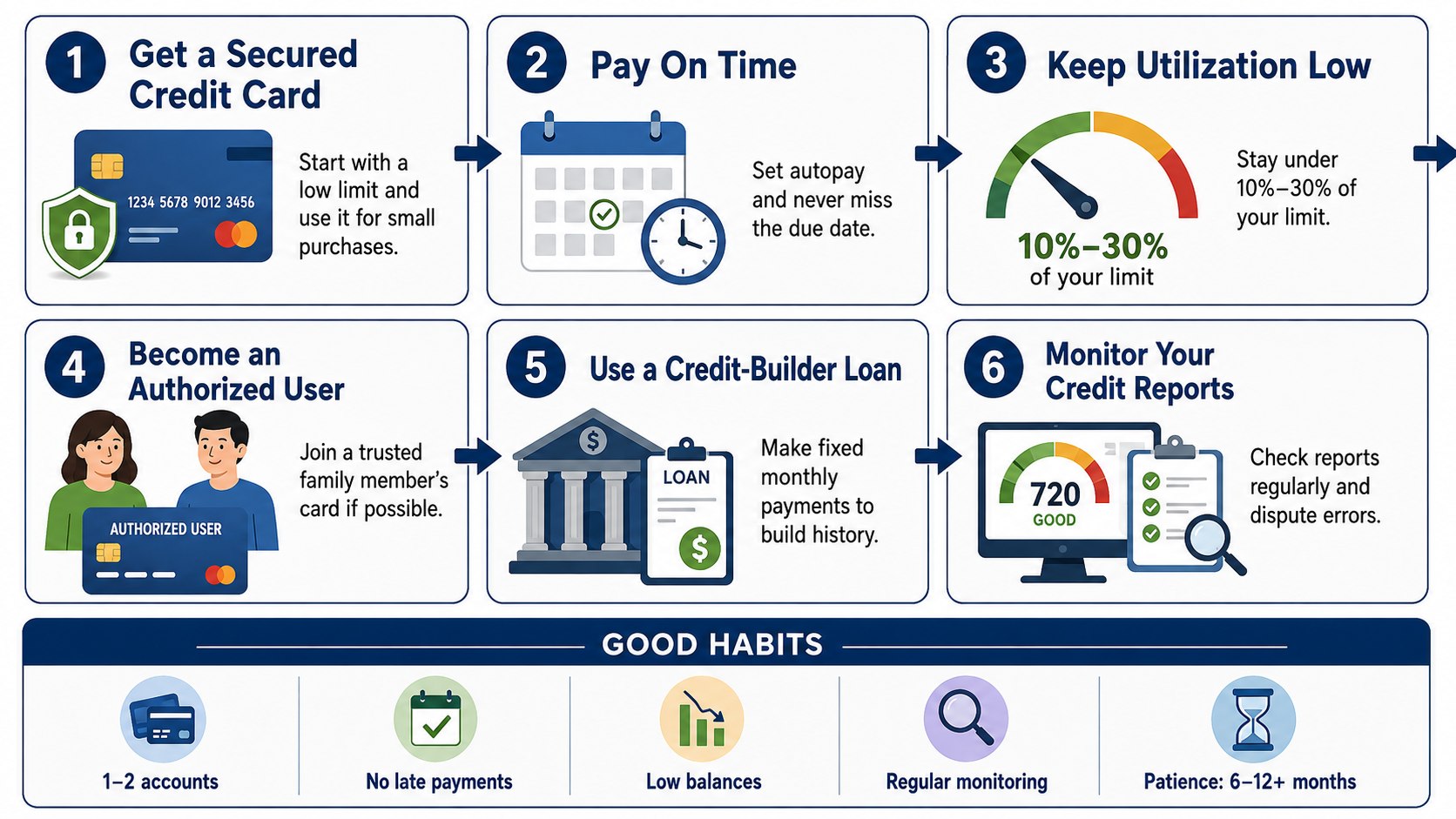
Step 1: Check whether you truly have no credit file
Request your reports from AnnualCreditReport.com, the federally authorized source for reports from Equifax, Experian, and TransUnion. Checking your own report does not create a hard inquiry or lower your score.
This matters because an old student loan, retail account, collection, or authorized-user card may already appear. You may have a credit file without having a score.
Common mistake: paying a commercial monitoring service before checking the official free source. Also verify your name, Social Security number, addresses, balances, and account status.
A blank report is not evidence of financial irresponsibility. It only means the scoring system lacks enough reported information to evaluate you.
Step 2: Choose a secured card that reports to all 3 bureaus
A secured credit card for beginners requires a refundable deposit, usually equal to or connected with the credit limit. The deposit protects the issuer, but it does not pay your monthly bill.
As of 2026, Capital One Platinum Secured may require a $49, $99, or $200 minimum deposit for an initial line of at least $200. Its Quicksilver Secured card generally requires a $200 deposit. Terms, APRs, and eligibility can change, so verify the issuer’s current disclosure before applying.
| Starting method | Typical 2026 cost | Main advantage | Main risk |
|---|---|---|---|
| Secured credit card | $50–$300 refundable deposit | Account remains under your control | High APR if you carry debt |
| Authorized user | Often $0 | May inherit established account history | Primary user can damage the account |
| Credit-builder loan | Interest and possible fees | Creates installment-payment history | Missed payments hurt credit |
| Rent reporting | $0–$15 monthly, depending on service | Uses an existing housing payment | Not every bureau or scoring model uses it |
The cheapest product is not automatically the best. Confirm that the issuer reports to all 3 nationwide bureaus and offers online account alerts. Look for a $0 annual fee, a manageable deposit, and a possible path to an unsecured card.
Read the Schumer box before applying. It shows the annual percentage rate, late fee, annual fee, and other material terms. Avoid cards with application fees, monthly maintenance charges, or expensive credit-protection add-ons.
A 25% to 35% APR range is not unusual among cards for limited credit in 2026. The rate becomes irrelevant when you pay the full statement balance by its due date. It becomes expensive when you carry even a modest balance.
Step 3: Use authorized-user status carefully
Ask a trusted relative or partner to add you as an authorized user on an older credit card. The primary cardholder does not need to give you the physical card or permission to make purchases.
This option matters because some issuers report the account’s age, limit, balance, and payment record under the authorized user’s credit file. A mature account with low utilization can strengthen a thin profile faster than a brand-new account alone.
Common mistake: joining an account with late payments or a balance close to its limit. Negative activity can appear on your reports, while some issuers may not report authorized users to every bureau.
Before accepting, ask 4 questions:
- Has the account ever had a payment 30 days late?
- Is the current balance usually below 10% of the limit?
- How old is the account?
- Does the issuer report authorized users to all 3 bureaus?
The ideal primary user pays in full, keeps the card open, and rarely approaches the limit. A $500 balance on a $10,000 limit is less concerning than $450 on a $500 limit.
Do not buy authorized-user access from an online tradeline company. Paid tradeline schemes can be expensive, temporary, and viewed unfavorably by lenders conducting manual reviews.
Step 4: How to build credit from nothing in USA 2026 through small purchases
Place 1 predictable expense on the card, such as a $15 streaming plan, cell phone bill, or tank of gas. Set automatic payment for the full statement balance from your checking account.
This matters because on-time payment history is more important than spending volume. A $20 monthly charge can establish the same pattern of timely payments as hundreds of dollars in unnecessary purchases.
Common mistake: believing that carrying a balance improves a score. It does not create a special scoring benefit and can trigger interest charges.
“Pay on time, every time.”
Consumer Financial Protection Bureau, consumer guidance on rebuilding credit.
Set 2 alerts: 1 several days before the due date and another when the balance exceeds a chosen amount. Automatic payment protects against forgetfulness, while alerts catch failed transfers or unexpected charges.
Your card is a reporting tool, not additional income. Spend only money already available in your checking account.
Step 5: Control credit utilization before the statement closes
Credit utilization compares the reported card balance with the credit limit. A $150 reported balance on a $300 card creates 50% utilization, even when you plan to pay it days later.
This matters because issuers commonly report the balance shown around the statement-closing date. Paying before that date can reduce the amount that reaches the bureaus.
Common mistake: focusing only on the payment due date. Paying on time prevents delinquency, but an earlier payment may also keep the reported balance low.
- Find the statement-closing date in your account.
- Use the card for 1 or 2 planned purchases.
- Pay most of the balance before the statement closes.
- Allow a small balance to appear if convenient, but do not pay interest for scoring purposes.
- Pay the full statement balance by the due date.
There is no need to chase an exact percentage every month. Below 30% is generally safer than a nearly maxed-out card, while below 10% can be useful before an apartment, auto, or mortgage application.
With a $200 limit, even a $70 grocery purchase creates 35% utilization. Make an early payment instead of opening another account solely to increase available credit. A higher limit may come later after responsible use.
Homebuyers should avoid new credit applications during mortgage underwriting. Baltimore Chronicle’s guide to mortgage pre-approval in the USA explains how inquiries and new debts may affect the file.
Step 6: Let the account age and add credit slowly
Keep the first account open, use it lightly, and review progress each month. A FICO score generally requires at least 1 account open for 6 months and recently reported activity, although lenders may use different models.
This matters because account age cannot be accelerated through heavier spending. Time and clean records are the essential ingredients of a credible credit profile.
Common mistake: applying for 3 or 4 cards after the first approval. Multiple hard inquiries and young accounts can weaken the profile you are trying to build.
After 6 to 12 months, consider a second product only when it serves a clear purpose. Options include a no-annual-fee unsecured card, a credit-builder loan from a credit union, or rent reporting accepted by the relevant bureau.
A resident of Texas, Florida, California, Maryland, or Ohio follows the same national bureau framework. However, insurance scoring, tenant screening, and state consumer protections can differ. Verify state rules before paying for optional reporting services.

Troubleshooting common credit-building problems
Early credit building is usually uneventful, but reporting delays, denials, and high utilization can create confusion. Use the following responses before submitting another application.
- Your application was denied: read the adverse-action notice, correct the stated problem, and avoid immediate repeat applications.
- The new account is missing: allow 30 to 60 days, then ask the issuer which bureaus receive its data.
- Your score dropped after a purchase: pay down the balance and wait for the next reporting cycle.
- An authorized-user account looks harmful: ask the issuer to remove you and dispute incorrect continuing data.
- Autopay failed: make a manual payment immediately and contact the issuer before the account becomes 30 days late.
A denial is not a signal to apply everywhere. The notice should identify factors such as limited history, insufficient income, excessive inquiries, or inability to verify identity.
Reporting delays are also normal. Issuers usually send data monthly rather than after every purchase or payment. Scores can therefore change several weeks after you reduce a balance.
If an account contains information that is not yours, dispute it with the bureau displaying the error. Keep copies of reports, confirmation numbers, letters, and supporting documents.
Most importantly, do not pay a credit-repair company to remove accurate, current information. Accurate late payments and collections generally cannot be erased merely because a company sends a template dispute.
FAQ
How long does it take to build credit from nothing?
A reportable account may appear within 30 to 60 days. A traditional FICO score generally needs about 6 months of account history, while meaningful improvement often takes 6 to 12 months.
Can I build credit without a credit card?
Yes. A credit-builder loan, reported student loan, or eligible rent-reporting service can create history. Confirm that payments reach at least 1 major credit bureau before paying fees.
Does becoming an authorized user guarantee a credit score?
No. Reporting depends on the issuer, and scoring models may treat authorized-user accounts differently. The strategy works best when combined with an account in your own name.
Should I leave a small balance on my card?
You may allow a small statement balance to report, but pay the statement in full by its due date. Carrying debt and paying interest are not required to build credit.
What credit score can a beginner expect after 6 months?
There is no guaranteed starting number. The result depends on payment history, utilization, inquiries, account type, reported data, and the scoring model used.
When should I upgrade a secured credit card?
Ask after 6 to 12 months of responsible use. Confirm whether the issuer can return the deposit without closing the account, since closing an older card may reduce available credit.
Earlier we wrote about FedEx Ground vs Home Delivery 2026: Prices, Speed and Weekend Service