

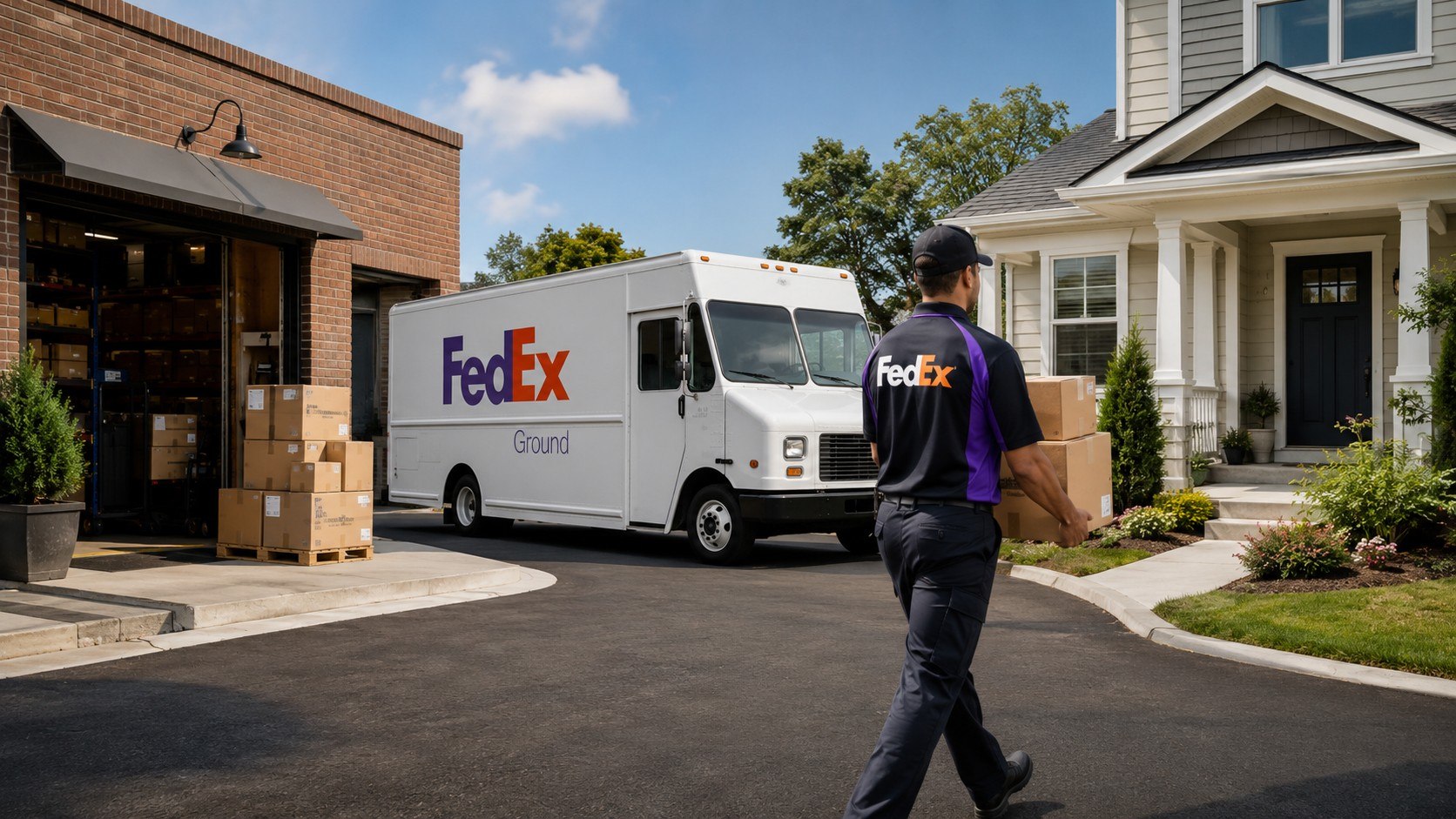
FedEx ground vs FedEx home delivery 2026 comes down mainly to the destination address. Most readers should choose FedEx Home Delivery for houses and apartments. FedEx Ground is better for offices, stores, warehouses, and other commercial addresses, as noted by Baltimore Chronicle.
Both services use the FedEx ground network and offer similar transit times. However, Home Delivery adds residential handling and broader weekend service. Selecting the wrong address type can produce a corrected charge later.
Key takeaways
- Choose FedEx Ground when the recipient operates from a verified commercial address.
- Choose FedEx Home Delivery for houses, apartments, home offices, and most residential buildings.
- Compare the complete quote because residential, fuel, remote-area, and oversized-package fees may apply.
The service name does not determine whether the parcel travels faster. The destination, shipping zone, tender date, and operational conditions matter more. Both options generally cover the contiguous United States within 1–5 days.
Weekend availability creates the clearest practical difference. Home Delivery operates every day in many locations. Ground deliveries to businesses normally follow the commercial working week.
Readers comparing carrier costs should also review USPS rates for First-Class and Priority Mail in 2026. Small parcels may produce a different result under USPS pricing.
FedEx Ground vs FedEx Home Delivery 2026 at a glance
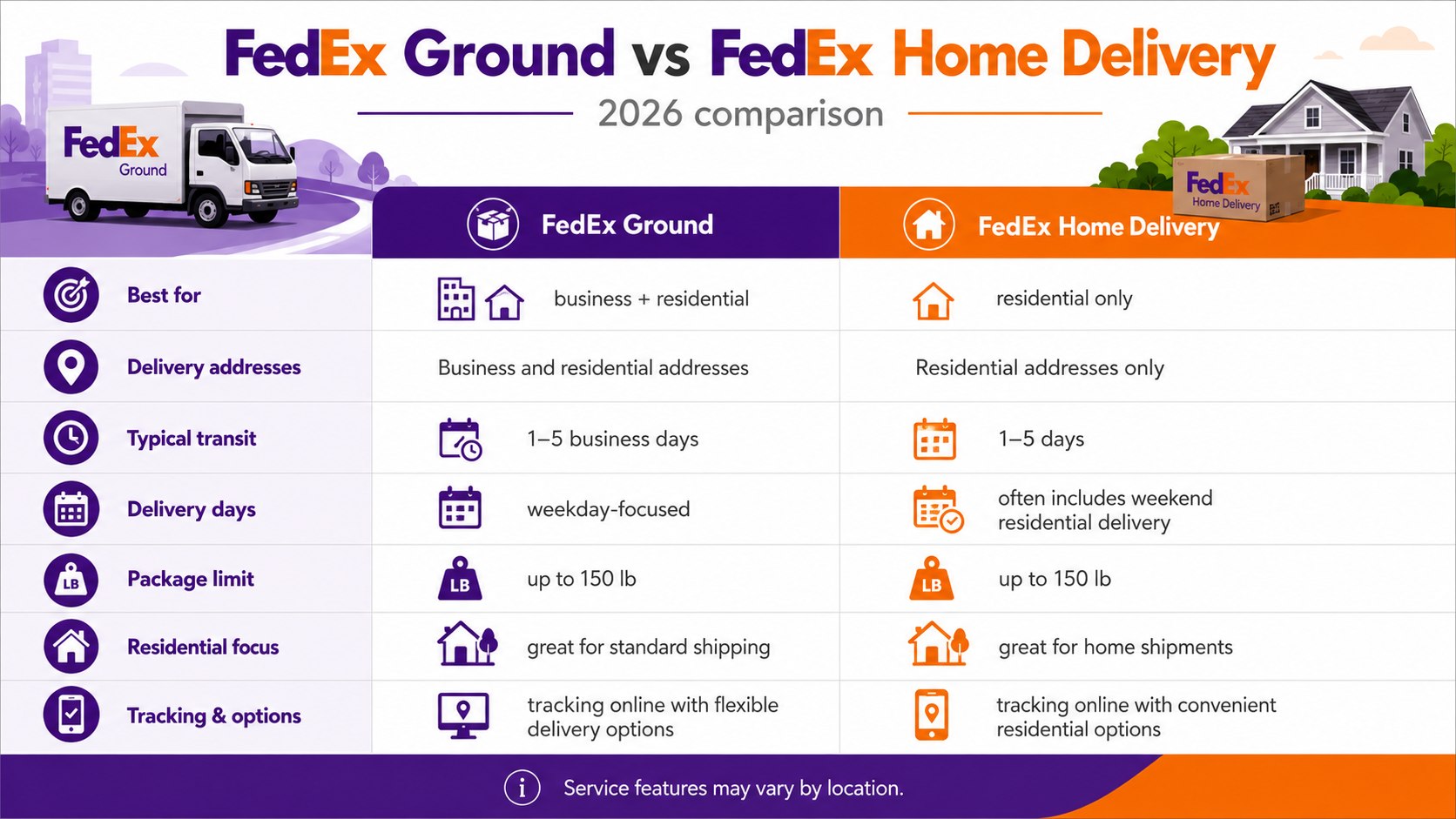
The 2 services share weight and size limits. Their main differences involve address classification, operating days, and residential charges. The figures below describe standard service conditions during 2026.
| Feature | FedEx Ground | FedEx Home Delivery |
|---|---|---|
| Primary destination | Commercial addresses | Residential addresses |
| Typical contiguous US transit | 1–5 business days | 1–5 days |
| Alaska and Hawaii transit | Usually 3–7 business days | Usually 3–7 days |
| Standard delivery days | Primarily Monday–Friday | Available 7 days in many areas |
| Residential surcharge | May apply after address correction | Built into the applicable quote |
| Maximum package weight | 150 lbs. | 150 lbs. |
| Maximum package length | 108 inches | 108 inches |
| Maximum length plus girth | 165 inches | 165 inches |
| Best fit | Business-to-business shipments | Orders sent to homes |
This comparison does not represent a universal price quote. FedEx rates depend on the origin ZIP code, destination ZIP code, weight, dimensions, and account discounts. Fuel surcharges can also change during the year.
The published January 2026 list rate for a 1 lb. Zone 2 package started at $11.99. A Zone 8 shipment started at $15.01 before relevant additions. FedEx listed a $6.45 residential surcharge for Home Delivery in its 2026 service guide.
These amounts are reference points, not guaranteed checkout prices. FedEx updated several surcharge rules and ZIP code lists during 2026. Always request a current quote before printing the label.
Large boxes may cost more than their scale weight suggests. FedEx can calculate dimensional weight using the package’s exterior measurements. A light but bulky comforter can therefore cost more than a compact box of tools.
Remote destinations can also attract delivery-area charges. This matters in parts of Alaska, Hawaii, Montana, Wyoming, and rural Texas. Similar differences can appear within the same state.
FedEx Ground: the practical option for commercial addresses
FedEx Ground shipping is designed primarily for deliveries to businesses. Typical destinations include offices, retail stores, repair shops, clinics, factories, and staffed warehouses.
The service usually takes 1–5 business days within the contiguous United States. Shipments involving Alaska or Hawaii commonly require 3–7 business days. The exact commitment depends on the origin and destination ZIP codes.
FedEx Ground advantages
- Appropriate service classification for verified business addresses.
- Competitive zone-based pricing for non-urgent commercial parcels.
- Coverage across all 50 states for eligible business destinations.
- Packages can weigh up to 150 lbs.
- Tracking is included with standard package shipments.
Ground works especially well for routine business replenishment. A Baltimore contractor might ship replacement parts to a Virginia supplier. A California freelancer could send printed materials to a corporate office in Arizona.
The recipient does not need to own the building. A leased office suite still qualifies when FedEx classifies it as commercial. The carrier’s address database determines the final classification.
A business name alone does not make an address commercial. Many sellers operate from houses or apartments. Their deliveries may still require Home Delivery treatment.
Delivery normally occurs by the end of the service day. Ground does not usually provide a precise morning arrival time. Time-critical documents may require an express service instead.
The service is less suitable when a household needs weekend delivery. It is also unsuitable when the shipper knowingly enters a residential address as commercial. That choice can trigger billing adjustments.
FedEx Ground disadvantages
- It is not the correct default for houses or apartments.
- Weekend coverage is less flexible than Home Delivery coverage.
- Delivery times are generally end-of-day commitments.
- Fuel and delivery-area surcharges can change the final amount.
A corrected-address fee can erase the apparent saving from choosing Ground. The invoice may arrive after the package has already moved. This creates accounting problems for freelancers and small online stores.
Apartment leasing offices create another complication. A parcel addressed directly to the leasing company may be commercial. A parcel addressed to a resident remains residential, even when staff accept it.
FedEx provides an address-checking function during label creation. Use it whenever the classification remains uncertain. The system’s result is more reliable than guessing from the street address.
FedEx Ground is best viewed as an address-specific service, not a slower version of Home Delivery.
FedEx Home Delivery: built for houses and apartments
FedEx Home Delivery handles packages sent to residential addresses. That includes detached houses, condos, apartments, student housing, and many home-based businesses.
The service operates throughout all 50 states. Delivery takes 1–5 days across the contiguous United States. Alaska and Hawaii shipments generally take 3–7 days.
FedEx says Home Delivery reaches more than 98% of the US population on Saturdays. Sunday delivery reaches nearly two-thirds of the population. Local availability still depends on the destination ZIP code.
“With home delivery every day of the week, shipping is flexible and easy.”
FedEx, official FedEx Home Delivery service page, residential shipping overview.
The quoted statement describes network availability rather than a promise for every address. A Sunday delivery date may not appear for some rural ZIP codes. Holidays can also alter operating schedules.
Home Delivery suits retailers sending clothing, household goods, electronics, gifts, and replacement parts. It also works for parents mailing belongings to college students. Renters can use the service without owning the residence.
Delivery usually occurs by the end of the day. FedEx states that packages are typically delivered by 8 p.m. Weather, demand, address access, and route conditions can affect arrival.
FedEx Home Delivery advantages
- Correct service for most houses, apartments, and residential buildings.
- Saturday delivery reaches most of the US population.
- Sunday service is available across many metropolitan areas.
- The package limits match standard FedEx Ground limits.
- Recipients can manage eligible deliveries through FedEx Delivery Manager.
Weekend availability is useful when nobody is home during the working week. It can also reduce missed handoffs for signature-required shipments. However, a weekend date is not guaranteed everywhere.
Home Delivery is not necessarily an express service. A Friday shipment from Maryland to nearby Pennsylvania may arrive quickly. A California-to-Florida parcel can require several days.
Packages still move according to network distance. The word “Home” describes the destination category. It does not create priority handling over every Ground parcel.
For delayed postal items, Baltimore Chronicle also explains how to start a USPS Missing Mail Search. FedEx claims follow a different process.
FedEx Home Delivery disadvantages
- A residential surcharge increases the published transportation rate.
- Sunday delivery is unavailable in some ZIP codes.
- End-of-day delivery may be too late for urgent items.
- Remote-area and oversized-package fees may still apply.
The residential charge is the main pricing disadvantage. However, avoiding that charge through incorrect address entry is not a reliable saving. FedEx can reclassify the destination after processing.
Home-based businesses should use the residential designation when the carrier identifies the property as residential. An LLC registration does not automatically change a house into a commercial destination.
For a normal front door, apartment unit, or residential mailbox area, Home Delivery is usually the correct selection.
What FedEx Ground and Home Delivery cost in 2026
The base transportation rate is only the starting point. A complete FedEx shipping cost comparison must include the package’s billable weight and every applicable surcharge.
FedEx published shared Ground and Home Delivery rates for Zones 2–8 during 2026. The Home Delivery residential charge was added per package. Negotiated account pricing can produce lower amounts.
| 2026 pricing example | Published base rate | Possible Home Delivery total |
|---|---|---|
| 1 lb., Zone 2 | $11.99 | $18.44 before other charges |
| 1 lb., Zone 5 | $14.00 | $20.45 before other charges |
| 1 lb., Zone 8 | $15.01 | $21.46 before other charges |
| 10 lbs., Zone 2 | $15.85 | $22.30 before other charges |
| 20 lbs., Zone 5 | $27.47 | $33.92 before other charges |
The Home Delivery totals add the published $6.45 residential surcharge. They exclude fuel, remote-area, additional-handling, oversize, signature, and pickup charges. Retail-counter prices may also differ.
FedEx adjusts its fuel surcharge weekly. The percentage follows a published fuel-price index. A quote created next month may therefore differ from today’s estimate.
Additional handling can apply to unusual packaging or large dimensions. Long tubes, metal containers, exposed tires, and poorly secured items can require special treatment. The rules should be checked before tendering the parcel.
Dimensional weight deserves special attention. Measure the finished carton after sealing it. Entering the product dimensions instead of the carton dimensions can understate the charge.
Commercial accounts may receive negotiated discounts. Those discounts do not automatically remove every surcharge. Review the final rated amount rather than the headline percentage.
FedEx publishes current rules through its official rate changes page. The company’s quote tool remains the best source for a specific shipment.
How to select the correct FedEx service
Begin with the destination, not the desired delivery date. FedEx’s system can identify whether an address is commercial or residential. Use that result when creating the label.
- Enter the complete destination address, including the unit or suite number.
- Select the detailed address-checking option during label creation.
- Confirm whether FedEx identifies the address as residential.
- Choose Home Delivery for a confirmed residential destination.
- Choose Ground for a confirmed commercial destination.
- Review transit time, surcharges, and the final billed amount.
- Save the receipt and tracking number until delivery completes.
Do not omit an apartment number to simplify the label. Missing unit information can delay delivery or cause a return. It may also prevent the driver from reaching the recipient.
Use the recipient’s complete business name when shipping commercially. Add a department or contact name when the building has a central receiving desk. This reduces internal routing delays.
Measure the box in inches and weigh it after packing. Cushioning, tape, and the carton add weight. Round measurements according to the carrier’s instructions.
Check whether a signature is genuinely necessary. Signature services increase control but can create missed-delivery attempts. They are useful for expensive, sensitive, or age-restricted items.
Finally, compare the promised arrival date against the recipient’s actual needs. Standard service may be sufficient for routine goods. Deadlines involving contracts or events may justify FedEx Express.
Which should you buy in 2026?
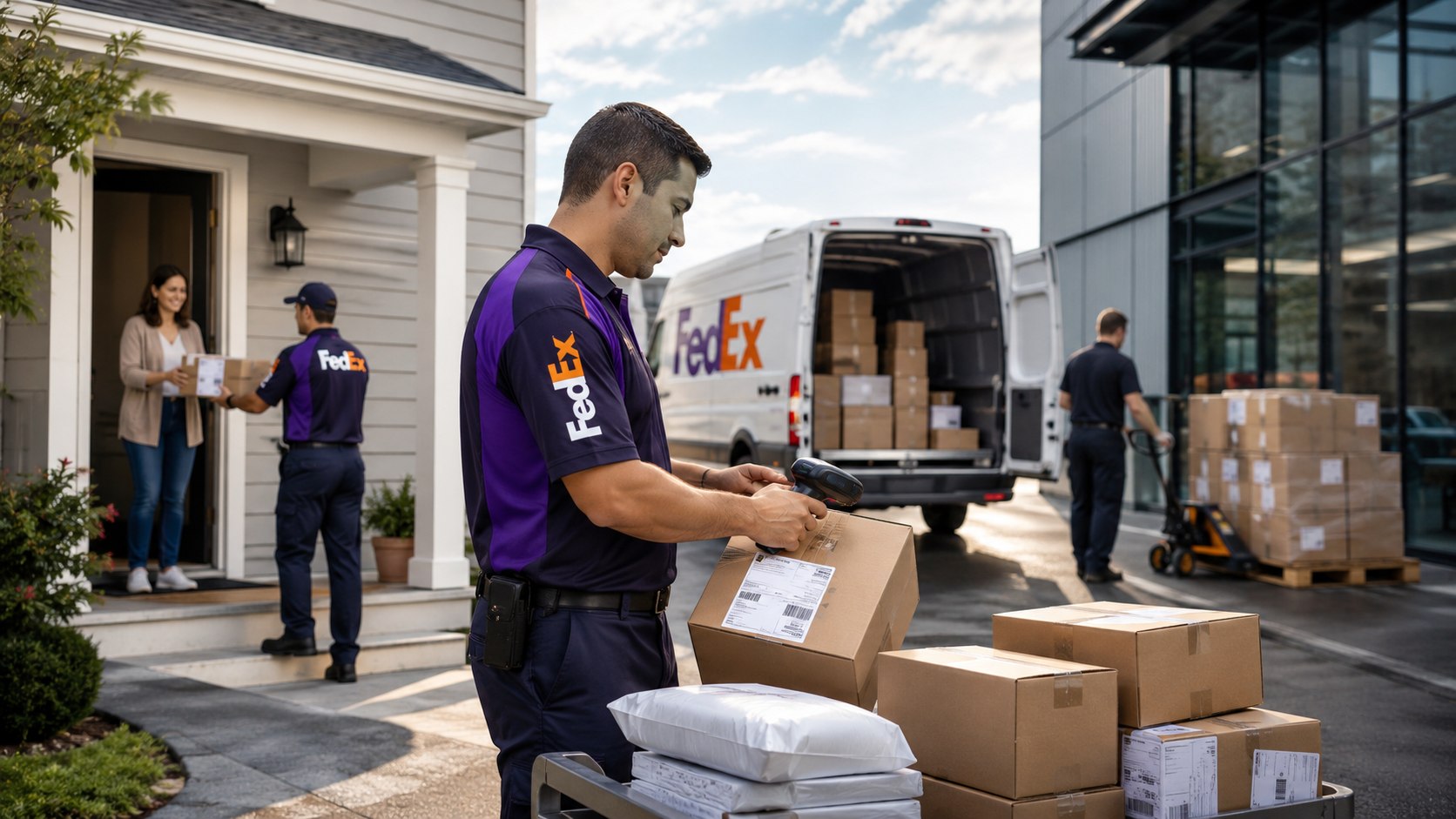
The decision rarely requires a complex carrier analysis. Use these rules before purchasing the label.
- If the parcel goes to a house or apartment, choose FedEx Home Delivery.
- If the parcel goes to a verified office or warehouse, choose FedEx Ground.
- If Saturday or Sunday matters, check Home Delivery availability for that ZIP code.
- If arrival requires a specific hour, compare FedEx Express services instead.
- If price controls the decision, compare the complete FedEx and USPS quotes.
A seller shipping to a Maryland townhouse should use Home Delivery. A manufacturer sending parts to an Ohio factory should use Ground. The item inside does not change that distinction.
A residential customer can receive a Ground-network parcel without choosing the wrong service. Home Delivery already uses FedEx’s ground infrastructure. Its name reflects the final destination and delivery schedule.
For frequent shipping, record the address classification in the customer profile. This reduces repeated mistakes. Recheck the address after a customer moves.
Low-volume shippers should compare rates for every parcel. A service that won last month may lose after a zone change. Different box dimensions can also reverse the result.
The safest rule is simple: let the verified address type determine the service. Then compare the final cost and arrival date before payment.
Frequently asked questions
Is FedEx Home Delivery faster than FedEx Ground?
Not automatically. Both commonly take 1–5 days within the contiguous United States. The route and destination determine the estimated arrival date.
Can I use FedEx Ground for a residential address?
FedEx may reclassify the shipment and apply residential charges. Home Delivery is the correct standard option for most houses and apartments.
Does FedEx Home Delivery operate on Sundays?
Yes, in many locations. FedEx reports Sunday coverage for nearly two-thirds of the US population. Check the destination ZIP code before promising delivery.
Do both services accept 150 lb. packages?
Yes. The published limit is 150 lbs. per package. Maximum length is 108 inches, with a 165-inch length-plus-girth limit.
Why did my final FedEx charge exceed the quote?
Possible causes include dimensional weight, fuel surcharges, address correction, residential classification, remote-area fees, or additional handling. Compare the invoice measurements with the packed carton.
Which FedEx service is better for a home-based business?
Use the classification returned by FedEx’s address-checking system. A business operated from a house usually remains a residential delivery address.
Earlier w erwote about Best Paint Colors for Small Rooms 2026: 10 Expert Picks That Open Up a Space