


How does mortgage forbearance work 2026? It lets eligible US homeowners temporarily pause or reduce mortgage payments during a documented financial hardship. The request can start with one call or online application, often taking under an hour to prepare. The unpaid amount remains owed, so the exit plan matters as much as the initial approval, as noted by Baltimore Chronicle.
A homeowner facing job loss, medical bills, disaster damage, or another temporary setback should contact the mortgage servicer before simply missing payments. A formal forbearance agreement can protect options that disappear when a borrower stops paying without authorization.
Key takeaways
- Forbearance pauses or reduces payments temporarily. It does not cancel principal, interest, taxes, insurance, or other valid obligations.
- Credit treatment depends heavily on the loan’s status before forbearance and whether the servicer reports payments correctly.
- Before accepting terms, ask exactly how missed amounts can be handled when regular payments resume.
The decision also affects future housing plans. Someone considering a later sale should understand how selling a house with an existing mortgage works. A borrower planning another purchase should also review the 2026 mortgage pre-approval process.
How does mortgage forbearance work 2026 before you request it?
The Consumer Financial Protection Bureau defines forbearance as an arrangement that temporarily pauses mortgage payments or allows smaller payments. The missing amount is still owed. That distinction separates mortgage forbearance in 2026 from forgiveness.
Terms depend on the mortgage owner, insurer, servicer, hardship, and program rules. FHA, VA, USDA, Fannie Mae, Freddie Mac, and privately held mortgages can follow different procedures. A Chase customer may therefore receive different documentation from a Rocket Mortgage or Wells Fargo borrower.
“You still owe the full amount.”
Consumer Financial Protection Bureau, federal consumer agency, explaining mortgage forbearance in its 2026 homeowner guidance.
Borrowers should never assume that every skipped payment becomes immediately due in one lump sum. Many programs provide other loss-mitigation options after the temporary pause.
What you need
Gather basic financial information before contacting the servicer. The first conversation becomes more useful when current payment details and hardship dates are already available.
- Latest mortgage statement and loan number
- Mortgage servicer online account and contact information
- Approximate date when the financial hardship began
- Recent income information, if requested
- Estimated monthly amount affordable during the hardship
- Insurance and property-tax information when escrow is involved
- About 30–60 minutes for the initial request and notes
Some borrowers receive an initial offer without submitting a large financial package. Others may need additional records for later loss-mitigation options. Keep copies of every letter, secure message, uploaded document, and confirmation number. Record the date and name of every representative involved. Ask for the approved terms in writing before changing a scheduled payment. Continue checking monthly statements during the plan. Escrow items also deserve attention because taxes and homeowners insurance do not disappear during hardship.
Step 1: Contact the mortgage servicer before missing payments
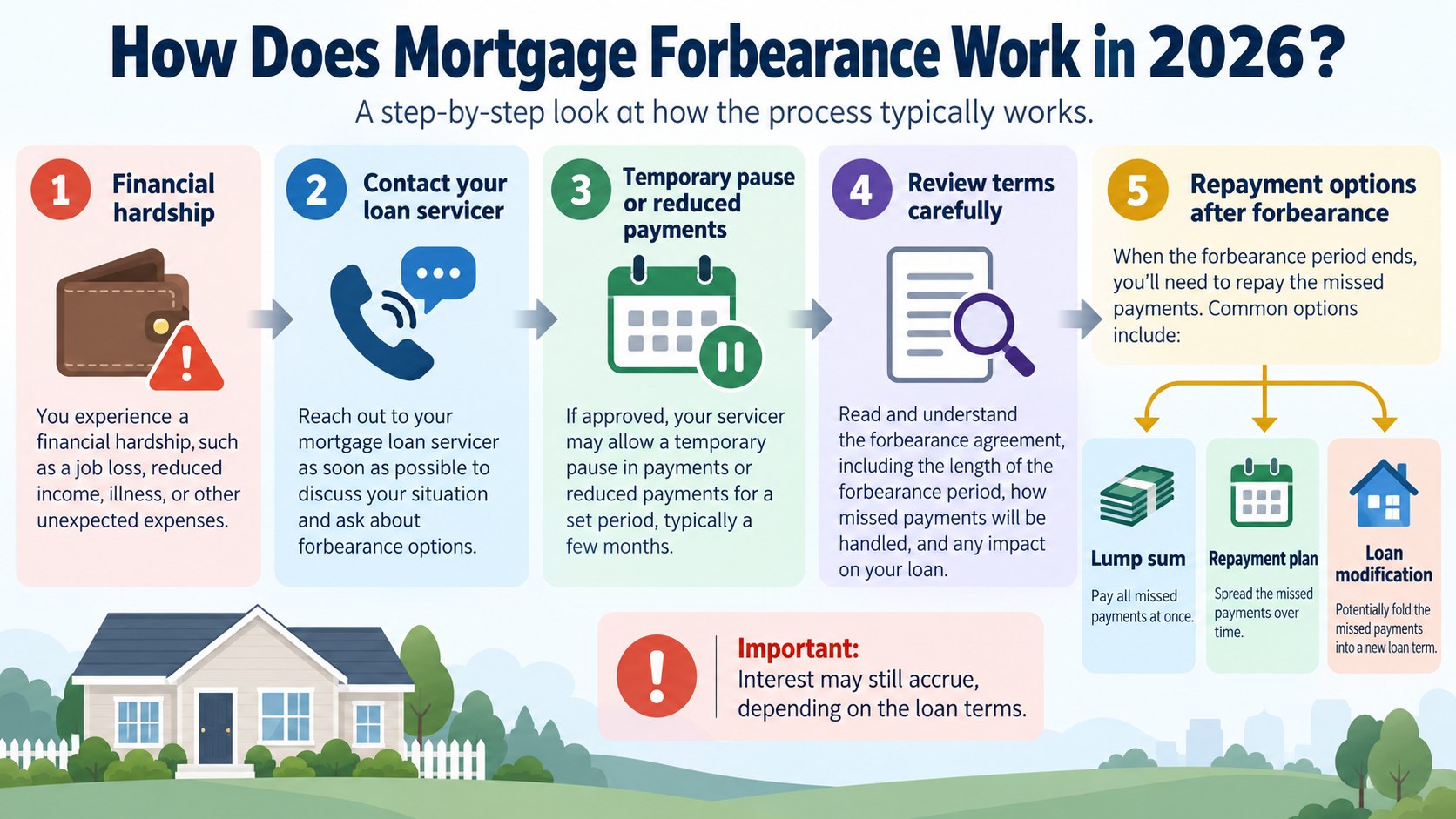
Call the company collecting your monthly mortgage payment or use its official hardship portal. Explain what happened, when the hardship began, and whether the problem appears temporary or long term.
This matters because requesting mortgage forbearance is different from independently deciding to stop payments. Unauthorized missed payments can become ordinary delinquencies.
A common mistake is calling the original lender instead of the current servicer. Check the latest statement if servicing rights have changed.
Step 2: Ask exactly what the proposed terms cover
Request the start date, end date, required payment, extension rules, and treatment of escrow. Ask whether the agreement suspends payments completely or merely reduces them.
The numbers can become substantial. A homeowner with a $2,400 monthly payment could defer $14,400 after 6 fully suspended payments. That example excludes any special servicing adjustments.
| Issue | Question to ask | Why it matters |
|---|---|---|
| Monthly payment | Is it paused or reduced? | Determines cash relief during hardship |
| Plan length | When does the current period end? | Prevents an accidental missed review date |
| Escrow | How are taxes and insurance handled? | Can affect future payment calculations |
| Repayment | What options exist after forbearance? | Shows whether extra monthly cash may be required |
| Credit reporting | How will account status be reported? | Helps detect reporting errors quickly |
The written agreement should match the conversation. Save a PDF or paper copy instead of relying on a phone summary. Check whether automatic payments must be canceled manually. Do not assume the servicer will stop an existing ACH withdrawal. Confirm how partial payments are treated if some money remains available. Ask when the servicer will review the account before the plan ends. That review can determine the next available option.
Step 3: Confirm how forbearance may affect your credit
Mortgage forbearance credit impact depends partly on account history and reporting rules. CFPB guidance says a servicer can report that an account is in forbearance.
The federal agency also states that an otherwise current borrower must be reported as current in circumstances covered by applicable reporting requirements. Existing delinquency before entering the plan can produce a different result.
The safest habit is checking all credit reports during and after forbearance instead of assuming the reporting is correct. A reporting error should be disputed with supporting account records.
Someone expecting to refinance or buy another property should plan more carefully. Lenders can apply separate eligibility rules after mortgage assistance. The broader financing environment also matters, including current mortgage-rate conditions.
Step 4: Track every payment and statement during the plan
Review each monthly statement even when the approved payment is $0. Compare the principal balance, escrow activity, fees, and recorded account status with the agreement.
Monitoring matters because servicing errors are easier to challenge when records are current. Keep bank statements if reduced payments continue.
A common mistake is ignoring the account until the last month. That leaves little time to correct errors or request an extension.
- Save every monthly mortgage statement.
- Keep proof of any reduced payment made.
- Review property-tax and homeowners-insurance activity.
- Check secure messages from the servicer.
- Mark the forbearance end date on a calendar.
- Contact the servicer well before the final scheduled month.
A payment pause should not become an information pause. Open every servicing letter, including notices that appear routine. Confirm that insurance remains active throughout the period. Homeowners in Florida, Texas, California, Maryland, and disaster-prone areas may face separate insurance pressures. Check escrow shortages before agreeing to a post-forbearance payment. Save records outside the servicer portal in case online access changes. Clear documentation becomes valuable if the loan transfers to another servicer.
Step 5: Choose the right repayment option before forbearance ends
Missed payments usually must be resolved, but that does not always mean writing one large check. Depending on the loan and eligibility, alternatives can include reinstatement, repayment plans, deferral, partial claims, or modification.
The CFPB advises homeowners to contact the servicer before the forbearance period ends. FHA borrowers also have specific loss-mitigation structures administered under HUD rules.
| Option | How it generally works | Potential fit |
|---|---|---|
| Reinstatement | Past-due amount is paid at once | Cash flow recovered and savings are available |
| Repayment plan | Extra amount is added to regular payments | Income recovered enough to support higher payments |
| Payment deferral | Eligible missed amounts move to a later payoff point | Regular payment is affordable, catch-up payment is not |
| Loan modification | Loan terms are changed under applicable rules | Existing payment remains unaffordable |
| FHA loss mitigation | HUD program rules determine available retention options | Mortgage is FHA-insured |
Do not choose a repayment plan only because it ends the delinquency faster. Calculate the actual new monthly obligation first. A $2,300 normal payment plus $700 catch-up amount creates a $3,000 monthly commitment. That may fail if income only partially recovered. Ask whether a payment deferral or modification is available when appropriate. FHA borrowers should use current HUD loss-mitigation information when reviewing federal program options. Private loans require the servicer’s own available terms.
Step 6: Get the final agreement in writing and test the budget
Before leaving forbearance, ask for a written explanation of the selected solution. Confirm the new payment, first due date, deferred balance, fees, and any maturity-date consequences.
This step determines whether mortgage payment relief options actually solve the hardship. A plan that produces another unaffordable payment can merely postpone default.
“Forbearance does not erase or decrease the amount you owe.”
Consumer Financial Protection Bureau, homeowner guidance, reviewed August 28, 2026.
Test the proposed payment against housing costs, utilities, insurance, transportation, food, and other debt. Leave room for irregular expenses rather than using every available dollar. If the numbers fail, contact the servicer again before signing. A HUD-approved housing counselor may also help assess options. Homeowners facing foreclosure deadlines should treat every official notice as time-sensitive.

Troubleshooting common mortgage forbearance problems
Most serious problems come from unclear dates, missing records, or assumptions about repayment. These scenarios deserve immediate attention rather than waiting for the plan to expire.
- The servicer says no request exists. Provide confirmation numbers, secure messages, letters, and call records showing when assistance was requested.
- Your credit report shows a new delinquency you believe is wrong. Compare reporting dates with the written forbearance terms and dispute inaccuracies.
- You cannot resume the normal payment. Ask about available loss-mitigation options before accepting an unaffordable repayment schedule.
- The mortgage was transferred during forbearance. Send the new servicer copies of the agreement and verify that the approved terms transferred correctly.
- A disaster caused the hardship. Ask about disaster-specific programs and check current CFPB mortgage forbearance guidance.
Do not solve a servicing dispute by simply stopping communication. Continue responding in writing where possible. Keep dated screenshots if an online portal displays conflicting information. Request explanations for unexpected fees or payment changes. Escalate unresolved servicing issues through formal complaint channels when appropriate. Borrowers near a foreclosure deadline may need housing counseling or legal assistance. The central goal is preserving a documented record before deadlines pass.
FAQ
Does mortgage forbearance forgive missed payments?
No. Forbearance normally pauses or reduces payments for a limited period. The unpaid amount remains owed and must later be resolved through an available repayment or loss-mitigation option.
Will mortgage forbearance hurt my credit in 2026?
Not automatically. Reporting depends on account status, applicable law, and servicing circumstances. Check credit reports during the plan and dispute inaccurate information promptly.
Do I have to repay every missed payment immediately?
Not necessarily. Depending on the mortgage and eligibility, options may include reinstatement, a repayment plan, payment deferral, partial claim, or loan modification.
How long does mortgage forbearance last?
There is no single term for every US mortgage. The period depends on the loan program, servicer, hardship, and applicable 2026 rules.
Should I request forbearance before missing a payment?
Yes, when possible. Contacting the servicer early gives more time to document the hardship and understand available terms before an unauthorized delinquency develops.
What should I do 30 days before forbearance ends?
Contact the servicer, confirm the exact end date, review repayment options, and calculate the proposed payment against your household budget. Get the final arrangement in writing.
Earlier we wrote about Best Interior Paint Brands 2026 USA: Sherwin-Williams Emerald Tops $100 as Behr Marquee Starts Near $54