


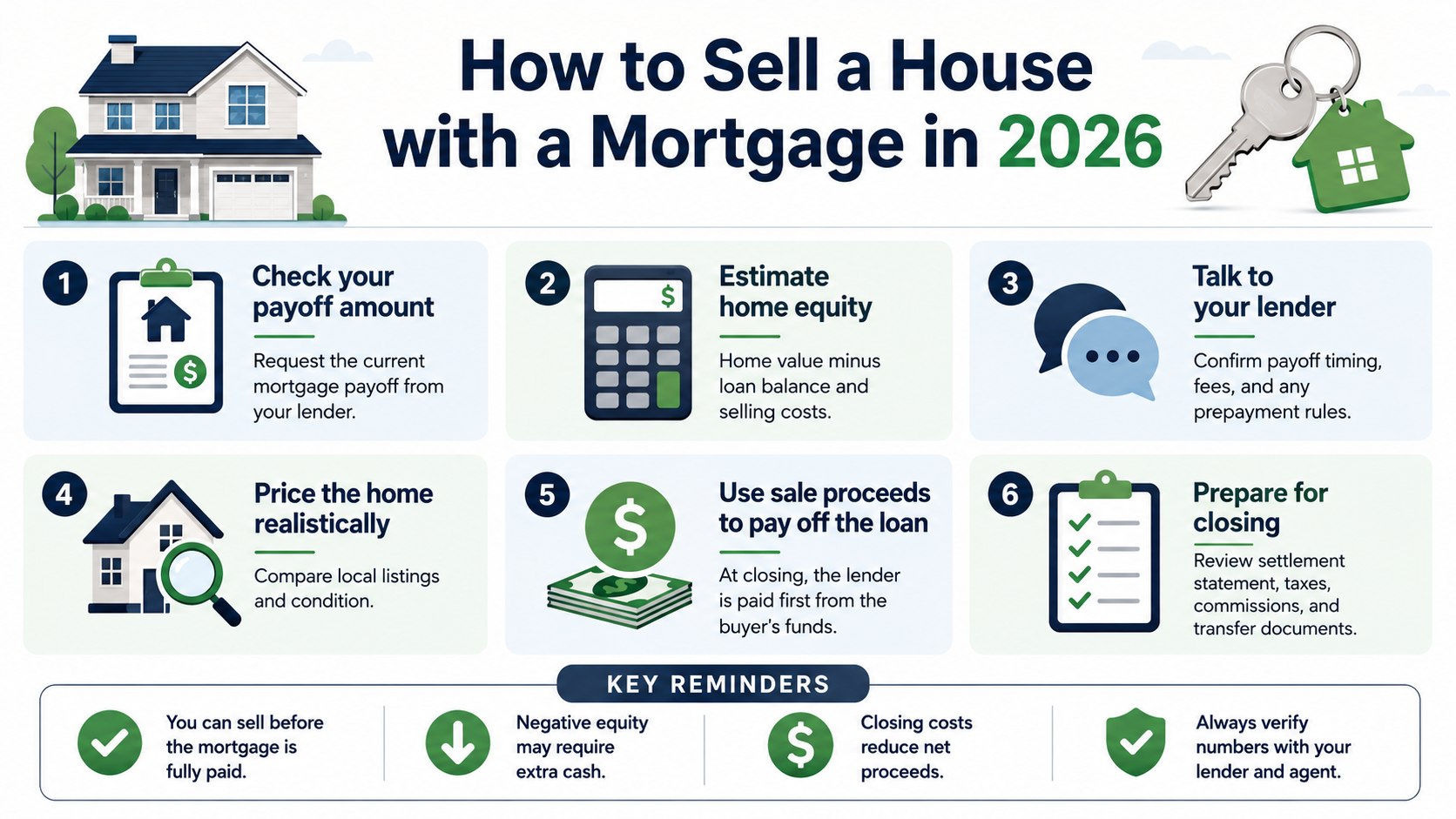
How to sell a house with a mortgage comes down to 3 numbers: the expected sale price, the lender’s payoff amount, and total selling costs. Most homeowners can collect the documents and estimate their proceeds within 1–2 days. The full sale usually takes several weeks, depending on the market, financing, inspections, and title work, as noted by Baltimore Chronicle.
You do not normally need to pay off the mortgage before listing the property. At closing, the settlement agent uses the buyer’s funds to repay your lender, release the lien, cover transaction expenses, and send the remaining proceeds to you. The main risk is discovering too late that your equity cannot cover the payoff and selling costs.
Key takeaways
- Request an official payoff statement because your mortgage balance is not the final amount required at closing.
- Calculate equity after commissions, repairs, taxes, concessions, liens, and closing charges rather than using the listing price.
- Time the closing carefully when buying another property, moving between states, or facing a possible prepayment penalty.
What you need before selling
Collect the financial and property records before interviewing agents or accepting an offer. A complete file makes the net-proceeds estimate more reliable and helps the title company identify liens early.
- Your latest mortgage statement and servicer account details
- An official mortgage payoff statement or payoff request instructions
- Statements for a HELOC, second mortgage, solar loan, or other property lien
- Recent property tax, homeowners insurance, and HOA statements
- Your purchase closing documents and records of major improvements
- A realistic estimate of the home’s current market value
- Cash for repairs, staging, moving, and any closing shortfall
- About 1–2 hours for initial calculations and document collection
A current mortgage statement is only the starting point. Daily interest, late charges, recording expenses, and other permitted fees may change the amount needed to release the lender’s lien. The Consumer Financial Protection Bureau explains that a mortgage payoff amount can differ from the current principal balance.
Check every debt connected to the property. A home equity line from Bank of America, Chase, Wells Fargo, Navy Federal Credit Union, or another lender may create a separate lien. The title company usually cannot transfer clear ownership until each valid lien is resolved.
Do not set your moving budget by subtracting the mortgage balance from an online home-value estimate. That calculation ignores the expenses most likely to reduce your final cash.
Step 1: Request the exact mortgage payoff amount
Contact the company that services your mortgage and request a written payoff statement for an estimated closing date. Ask how long the quote remains valid and how additional daily interest is calculated.
The payoff amount matters because it represents the sum required to satisfy the loan and release the mortgage lien. It may include unpaid principal, accrued interest, authorized fees, and a prepayment charge when the contract permits one.
A common mistake is using the principal balance displayed in an app. That figure may exclude interest accruing between your latest payment and the closing date.
Step 2: Estimate the home’s realistic sale price
Compare recent sales involving similar homes within the same local market. Focus on property type, condition, lot size, school district, bedroom count, and finished square footage.
Prices can differ sharply between Baltimore, Austin, Phoenix, Miami, Chicago, and suburban New Jersey. A national housing trend cannot replace local comparable sales from the previous 3–6 months.
Interview at least 2 listing agents and request a comparative market analysis. Baltimore Chronicle’s guide to finding a real estate agent explains which experience, services, and contract terms sellers should compare.
Avoid choosing the agent who suggests the highest listing price without supporting evidence. An inflated price can produce fewer showings, longer market time, and later reductions that weaken your position.
Step 3: Calculate equity and expected net proceeds
Home equity is the property’s market value minus debts secured by the property. Your usable sale proceeds are lower because the transaction also includes commissions, taxes, title charges, concessions, repairs, and moving expenses.
Use this calculation:
Expected sale price − mortgage payoff − other liens − seller expenses = estimated net proceeds.
The following example shows why the payoff, equity, and selling-cost calculations must be completed together.
| Item | Example amount | Effect on seller |
|---|---|---|
| Contract sale price | $500,000 | Starting proceeds |
| First mortgage payoff | −$318,000 | Paid to mortgage servicer |
| HELOC payoff | −$22,000 | Clears second lien |
| Broker compensation | −$25,000 | Example negotiated total |
| Title, transfer, and closing costs | −$9,000 | Varies by state and locality |
| Repairs and buyer credit | −$11,000 | Depends on contract negotiations |
| Estimated cash to seller | $115,000 | Before moving costs and possible taxes |
This example is not a national fee schedule. Compensation is negotiable, and transfer taxes vary by state, county, and city. Maryland, Pennsylvania, New York, Florida, Texas, and California use different closing practices and local charges.
Ask the agent, title company, escrow company, or closing attorney for a seller net sheet. Review it before listing and again after accepting an offer. The final contract price, buyer credits, repair agreements, tax prorations, and closing date will change the result.
Baltimore Chronicle’s detailed breakdown of the cost of selling a house in 2026 can help identify expenses missing from an early estimate. Owners should also review the site’s guide to buyer and seller closing costs.
Step 4: Check for liens, penalties, and title problems
Ask the title company or real estate attorney to begin a preliminary title review. The search may reveal unpaid property taxes, contractor liens, judgments, HOA balances, second mortgages, or ownership errors.
A valid lien usually must be paid, released, transferred, or formally resolved before the buyer receives clear title. Problems found days before closing can delay the transaction and the seller’s next purchase.
Review your loan agreement for a prepayment penalty. These charges are uncommon on many standard residential mortgages, but they can exist under specific contracts. Verify the exact rule with the servicer rather than assuming the loan has no penalty.
The common mistake is ordering title work only after accepting an offer. Early review gives you more time to correct a misspelled name, obtain a lien release, or dispute an incorrect claim.
Step 5: Choose the right time to list and close
Timing affects both the price and the mortgage payoff. Every additional day before closing can add interest, property taxes, insurance costs, utilities, HOA dues, and maintenance.
Seasonal demand also varies. Spring may bring more buyers in many northern markets, while Arizona, Florida, and parts of Texas may follow different patterns. Local inventory and buyer competition matter more than a national rule.
If you are buying another home, compare 3 timing strategies:
- Sell first: reduces financial uncertainty but may require temporary housing.
- Buy first: simplifies moving but may require enough income and cash to carry 2 homes.
- Coordinate both closings: limits overlap but creates more risk if either transaction is delayed.
Selling first provides the clearest down-payment budget for the next property. However, storage, short-term rent, pet accommodation, and 2 moves may reduce the financial benefit.
Buying first can work for owners with substantial reserves, bridge financing, or a home equity line. The risk is carrying 2 mortgage payments if the original property takes longer to sell.
A coordinated closing can release sale proceeds shortly before the next purchase. Build additional time into the schedule because wire delays, lender conditions, title corrections, and recording procedures can disrupt a same-day plan.
A higher offer is not always the strongest offer. A slightly lower price with reliable financing and flexible timing may leave the seller in a safer position.
Step 6: List the property and compare offers by net value
Prepare the home, approve accurate listing details, and launch marketing with professional photographs. Price the property according to current comparable sales rather than the amount you need for your next purchase.
When offers arrive, compare the projected cash remaining after concessions and expenses. A $510,000 offer with a $15,000 seller credit may produce less than a $502,000 offer with no credit.
Review these terms before accepting:
- Offer price and earnest money deposit
- Loan type, down payment, and preapproval strength
- Inspection, appraisal, financing, and home-sale contingencies
- Requested repair allowances or closing-cost credits
- Proposed closing and possession dates
- Any request for seller-paid buyer-agent compensation
- Items included in the sale, such as appliances or furniture
The contract terms determine how easily a buyer can cancel and whether the seller may retain earnest money. FHA and VA financing may also involve appraisal or property-condition requirements that differ from conventional financing.
A cash offer can reduce lender-related uncertainty, but proof of funds still requires verification. A conventional offer with strong underwriting may be safer than an unverified cash proposal.
Ask the agent to prepare a separate net sheet for the strongest offers. This keeps the decision centered on proceeds, timing, and closing risk rather than the headline price alone.
Step 7: Complete inspections, appraisal, and payoff updates
Provide access for inspections and appraisal according to the contract. Respond to repair requests by comparing the cost of completing work against a credit or price adjustment.
Unresolved inspection issues can trigger cancellation rights, renegotiation, or lender objections. Large concessions also reduce the amount available to pay off the mortgage.
Request an updated payoff statement when the closing date becomes firm. The title or escrow company may obtain it directly after receiving your written authorization.
Avoid agreeing to several concessions separately without updating the complete net calculation. Small reductions can combine into a material loss of expected equity.

Step 8: Review the final settlement statement and close
Before signing, review the final settlement figures line by line. Confirm the sale price, mortgage payoff, commissions, taxes, title charges, repair credits, HOA balances, and cash due to you.
The closing agent sends the required payoff funds to the mortgage servicer. The servicer then processes the loan satisfaction and lien release, although county recording may occur later.
The IRS states: “You may be able to exclude from income all or a portion of the gain on your home sale.” The eligibility rules and worksheets appear in IRS Publication 523.
Federal tax treatment depends on gain, adjusted basis, property use, ownership history, prior exclusions, and filing status. Paying off the mortgage does not itself determine taxable gain because loan debt and tax basis are separate calculations.
Avoid assuming the wire has arrived until the title company and your bank confirm receipt. Real estate wire fraud can involve convincing messages that copy an agent’s or settlement company’s identity.
Troubleshooting common mortgage-sale problems
- The payoff exceeds expected proceeds: ask the servicer about a short sale and obtain written approval before promising clear title.
- A second lien appears: request a payoff and release from that creditor, even when the account appears inactive.
- The buyer’s appraisal is low: challenge errors with stronger comparable sales, renegotiate, or evaluate another offer.
- The closing date changes: order an updated payoff because daily interest and tax prorations may alter the final amount.
- You need sale proceeds for the next home: coordinate settlement timing and maintain backup funds for recording or wire delays.
An underwater property requires a different process from an ordinary sale. The mortgage lender must generally agree to accept less than the full amount owed before a short sale can close.
Do not assume the lender will waive the remaining deficiency. State law, loan type, investor rules, mortgage insurance, and the approval agreement can affect what happens after closing.
When foreclosure is possible, contact the servicer before missing additional payments. Early communication may preserve more loss-mitigation options and provide time to obtain housing or legal advice.
FAQ
Can you sell a house before the mortgage is paid off?
Yes. This is a standard US real estate transaction. The closing agent pays the mortgage from the sale proceeds and transfers the remaining money to the seller.
Do I need my lender’s permission to sell?
Usually not when the sale proceeds fully satisfy the mortgage and other liens. Lender approval is generally necessary for a short sale because the lender would receive less than the amount owed.
How much equity should I have before selling?
There is no universal minimum. Your equity must cover the mortgage payoff, other liens, selling expenses, and any amount needed for your next move.
What happens to my escrow account after the sale?
The servicer usually closes the mortgage escrow account after payoff and returns any eligible surplus. Processing time and refund methods vary, so verify the procedure with the servicer.
Does paying off the mortgage reduce capital gains tax?
No. Mortgage payoff affects your cash proceeds, not the basic calculation of taxable gain. Gain is generally based on the sale amount, eligible selling expenses, and adjusted tax basis.
Can I sell if the home is worth less than the mortgage?
Possibly, but you may need cash to cover the shortage or written lender approval for a short sale. Do not list the home as a standard sale without calculating the deficiency.
Earlier we wrote about US Lumber Price Outlook 2026: Housing Demand, Mill Closures and Trade Duties