


What happens if you miss a mortgage payment? Your loan becomes delinquent, but foreclosure does not begin after one missed payment, as noted by Baltimore Chronicle.
The practical answer depends on how late you are. A payment delayed several days may trigger only a late fee. At 30 days, the delinquency can reach credit reporting systems. At 60 or 90 days, the balance grows and lender contact becomes more urgent. For most covered mortgages, federal rules generally block the first foreclosure filing until the loan exceeds 120 days delinquent.
Key takeaways
- A short delay may cost a late fee, depending on your grace period and mortgage contract.
- A 30-day delinquency can affect your credit record and make future borrowing more expensive.
- Federal rules generally prevent foreclosure filing until more than 120 days of delinquency, with limited exceptions.
A missed payment should be treated as a financial deadline, not an immediate loss of the home. Contacting the servicer before another payment comes due preserves more options. It can also prevent confusion about partial payments, escrow shortages, or assistance applications.
Homeowners whose monthly bill includes taxes and insurance should also understand how mortgage escrow works. An escrow increase can raise the required payment even when the loan’s principal and interest remain unchanged. Baltimore homeowners may also face changes tied to local property tax assessments.
In plain English
Think of a mortgage delinquency as a staircase rather than a trapdoor. Missing one step does not instantly remove you from your home. Each additional missed payment, however, moves the account into a more serious stage.
The due date and the grace period are not necessarily the same thing. Many mortgage contracts allow a short grace period before charging a late fee. The exact deadline appears in the loan documents and monthly statement.
Homeowners who miss a payment on the 1st may still have several days to correct it without reaching a 30-day delinquency.
Late fees are controlled by the mortgage documents and may also be limited by state law. The Consumer Financial Protection Bureau advises borrowers to check their Closing Disclosure for the applicable terms.
“Your servicer can’t make a first notice or filing for foreclosure until you are more than 120 days behind.”
Consumer Financial Protection Bureau, foreclosure guidance.
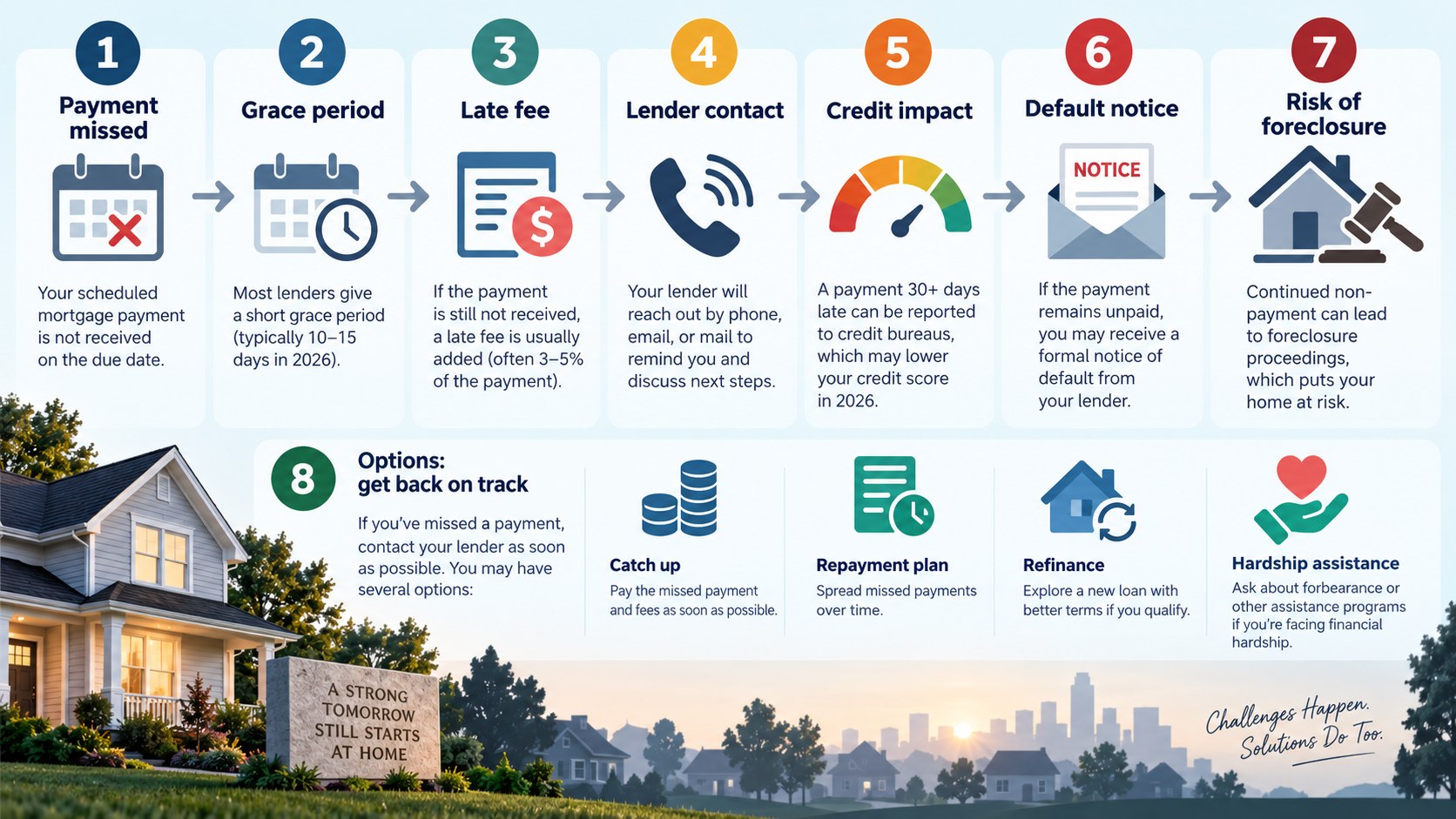
What happens if you miss a mortgage payment over 30, 60, or 90 days?
The missed mortgage payment timeline becomes more serious at each monthly milestone. Servicers track delinquency according to unpaid scheduled payments, not simply the number of reminder letters sent.
| Stage | What may happen | Best response |
|---|---|---|
| 1–29 days late | Grace period may expire and a contract-authorized late fee may apply | Pay promptly and confirm how the payment was credited |
| 30 days late | The loan enters a recognized delinquency stage and may be reported as 30 days late | Contact the servicer before another payment becomes due |
| 60 days late | Two scheduled payments may be outstanding | Request repayment, forbearance, or loss-mitigation options |
| 90 days late | The account becomes seriously delinquent | Submit requested financial documents without delaying another month |
| More than 120 days | A servicer may become eligible to begin foreclosure under applicable rules | Seek housing counseling or legal assistance immediately |
This timeline is not a promise that every servicer follows identical collection steps. Mortgage contracts, investor guidelines, loan programs, and state foreclosure laws differ. Judicial foreclosure states can also follow different procedures from nonjudicial states.
A 30-day late status matters because mortgage servicers may report delinquency information to credit repositories. Fannie Mae servicing guidance recognizes 30-, 60-, and 90-day delinquency categories. A later payment does not automatically erase an accurate previous late-payment record.
Negative payment history can generally remain on a consumer credit report for up to 7 years. Its practical effect depends on the rest of the credit file. Future mortgage underwriting also considers the severity and recency of previous mortgage delinquencies.
At 60 days, the problem becomes harder to solve with one ordinary payment. A servicer may require enough money to address the delinquency under the account’s current status. Partial payments may sometimes be held or handled differently from a complete periodic payment.
The cheapest month to solve a mortgage delinquency is usually the earliest month, before another scheduled payment joins the balance.
How it actually works
The process begins when the full scheduled mortgage payment is not received by its due date. That amount can include principal, interest, and escrow for property taxes or homeowners insurance.
First, check the payment history and current amount due. Compare them with your bank records. A returned ACH transfer or processing mistake can look similar to a cash-flow problem.
Second, contact the company listed as the mortgage servicer on your monthly statement. The servicer collects payments and handles delinquency communication. It may not be the company that originally issued the loan.
Federal servicing rules generally require attempts at live contact within 36 days of delinquency. Certain servicers must also provide written information about available loss-mitigation options by 45 days.
A borrower facing a temporary problem may encounter several possible solutions:
- Mortgage forbearance can temporarily reduce or pause required payments under approved terms.
- A repayment plan can spread overdue amounts across future scheduled payments.
- A loan modification can change eligible loan terms after the servicer evaluates the borrower.
- Some borrowers may qualify for loan-program-specific assistance, including FHA options.
- A sale, short sale, or deed-in-lieu may become relevant when keeping the home is unrealistic.
None of these options should be assumed automatic. Eligibility depends on the mortgage, investor, hardship, documentation, and servicer rules. FHA, VA, USDA, Fannie Mae, and Freddie Mac loans can follow different loss-mitigation frameworks.
Borrowers should save every statement, letter, email, and uploaded document. Keep confirmation numbers from telephone calls. Record the date each application document was submitted.
Homeowners already reviewing household costs may also benefit from understanding which housing expenses appear around a mortgage transaction. Taxes, insurance, HOA charges, and repairs can create pressure beyond the loan payment itself.
Who it matters to in 2026
Homeowners with a temporary income gap
A freelancer awaiting invoices or a worker between jobs may have enough income to recover within several weeks. The priority is preventing one missed payment from becoming 2 or 3. A servicer can explain whether a repayment arrangement is available.
Households facing a lasting financial change
A permanent income reduction requires a different calculation. Repeatedly borrowing from credit cards to cover a mortgage can shift the problem elsewhere. A formal loss-mitigation review may offer a more durable option.
Owners with FHA-insured mortgages
HUD states that FHA’s loss-mitigation program includes home-retention options for qualifying borrowers facing hardship. These can include repayment plans and forbearance arrangements. Borrowers should contact their servicer for the applicable 2026 requirements.
“The further behind you become, the harder it will be to reinstate your loan.”
U.S. Department of Housing and Urban Development, foreclosure-prevention guidance.
Free housing counseling is also available through HUD-approved agencies. HUD provides a housing counselor search and the phone number 800-569-4287. Paid foreclosure-rescue companies should not be the default first call.
What to do after a missed mortgage payment
A homeowner who already missed the due date needs a short action plan. Waiting for a collection letter gives the delinquency more time to grow.
- Check the exact amount due and the end date of any grace period.
- Confirm whether an automatic payment failed or was returned.
- Call the mortgage servicer using the number on the monthly statement.
- Explain whether the hardship is temporary or expected to continue.
- Ask which loss-mitigation programs apply to the specific loan.
- Gather income records, bank statements, expenses, and hardship documentation.
- Keep copies of every document submitted to the servicer.
- Contact a HUD-approved housing counselor when repayment is uncertain.
The servicer will usually need more than a statement that money is tight. Be prepared to explain current income and major household expenses. It may also ask about available savings or other assets.
Do not send an arbitrary partial payment without understanding how it will be handled. CFPB guidance notes that servicers are generally not required to accept payments below a complete periodic payment. Procedures can change once an account has been accelerated.
A borrower who receives foreclosure papers needs more targeted help. State law controls major parts of the foreclosure process. Deadlines in Maryland can differ from those in Texas, California, Florida, or New York.
Legal aid or a qualified local attorney becomes more relevant after a formal notice or filing. The 120-day federal protection does not create a nationwide 120-day foreclosure sale schedule. It generally restricts when the first foreclosure step may occur.
Ignoring servicer mail is risky because later notices can contain deadlines that affect available remedies.

Common myths
Mortgage delinquency attracts several persistent assumptions. Some are harmless for a few days, but dangerous when they delay action.
- “One missed payment means foreclosure.” No. A single delinquency starts a process, not an immediate home seizure.
- “The grace period changes the contractual due date.” Usually not. It may only delay the late fee.
- “A partial payment always stops delinquency.” Not necessarily. Servicers may have specific rules for incomplete periodic payments.
- “Foreclosure automatically starts on day 90.” Federal rules generally restrict the first filing until more than 120 days delinquent.
- “Avoiding the servicer buys time.” It can reduce options because assistance applications often require documents and review.
Another myth is that every late payment produces the same credit damage. Credit scoring models evaluate an entire file. The severity, recency, and frequency of delinquencies can matter.
The loan type also changes the assistance path. An FHA borrower may encounter HUD-backed options. Conventional loans owned by Fannie Mae or Freddie Mac operate under their respective servicing frameworks.
State law adds another layer. Some states use judicial foreclosure, while others permit nonjudicial procedures. The period from the first legal filing to an actual sale therefore varies widely.
Federal consumer protections remain important across these differences. The CFPB explains that most servicers cannot make the first foreclosure notice or filing before the loan exceeds 120 days delinquent.
FAQ
What happens if you miss one mortgage payment?
The loan becomes delinquent when the required payment is not made by its due date. A grace period may postpone a late fee. One missed payment does not normally trigger immediate foreclosure.
Will a mortgage payment that is 10 days late hurt my credit?
A payment made before reaching a reportable 30-day delinquency is different from a payment 30 days late. Your contract may still allow a late fee. Confirm the posting date with the servicer.
What happens when a mortgage is 30 days late?
A mortgage payment 30 days late reaches a recognized delinquency category. The status may be reported to credit repositories. Contact the servicer before the next payment also becomes overdue.
Can foreclosure start after 90 days?
For most mortgages covered by federal servicing rules, the first foreclosure notice or filing generally requires more than 120 days of delinquency. Limited exceptions exist. State procedures control what happens afterward.
Can a mortgage servicer refuse a partial payment?
Yes, in some circumstances. CFPB guidance says servicers generally need not accept less than a complete periodic payment. An accelerated loan can also have different payment requirements.
Who should I call if I cannot catch up?
Start with the mortgage servicer listed on the monthly statement. Homeowners can also use HUD-approved housing counseling at 800-569-4287. Formal foreclosure notices may justify contacting local legal aid or an attorney.
Earlier we wrote about How Many Lumens for a Kitchen in 2026? The Sq Ft Formula for 80 to 250 Sq Ft Rooms