


How much does it cost to sell a house in USA 2026? Most owners should budget roughly 6% to 10% of the sale price. A low-cost transaction may stay near 4%, while repairs, concessions, taxes, and full-service representation can push costs above 12%. On a $450,000 home, that means approximately $27,000 to $45,000 before paying off the mortgage, according to the Baltimore Chronicle editorial team.
The fastest way to estimate your proceeds is to subtract agent compensation, seller closing costs, repairs, concessions, and moving expenses from the expected sale price. Then subtract the remaining mortgage balance. Request a seller net sheet before listing, since local transfer taxes and title practices vary sharply between states.
Key takeaways
- Typical seller expenses in 2026 total about 6% to 10% of the final sale price.
- Real estate commissions remain negotiable, including any payment requested for the buyer’s representative.
- Repairs, buyer concessions, transfer taxes, and mortgage payoff fees can materially reduce the seller’s final proceeds.
How much does it cost to sell a house in USA 2026?
A homeowner selling for $300,000 could spend about $18,000 to $30,000. At $600,000, the likely range becomes $36,000 to $60,000. These figures are planning estimates, not mandatory charges.
The seller’s largest expense is usually brokerage compensation. However, there is no federal law setting a standard commission. A homeowner might negotiate a percentage, flat fee, limited-service package, or separate payment structure for each broker.
Since the real estate practice changes introduced in August 2024, offers of buyer-agent compensation cannot appear on Multiple Listing Services covered by National Association of Realtors rules. Sellers may still offer compensation outside the MLS or respond to a buyer’s request within a purchase offer. NAR states that broker compensation is not set by law and is fully negotiable.
The number that matters is not the listing price. It is the net amount remaining after every deduction, mortgage payoff, and negotiated credit.
Owners preparing another purchase should also review how mortgage preapproval works in 2026. Selling and buying timelines often overlap, creating temporary housing or financing costs.
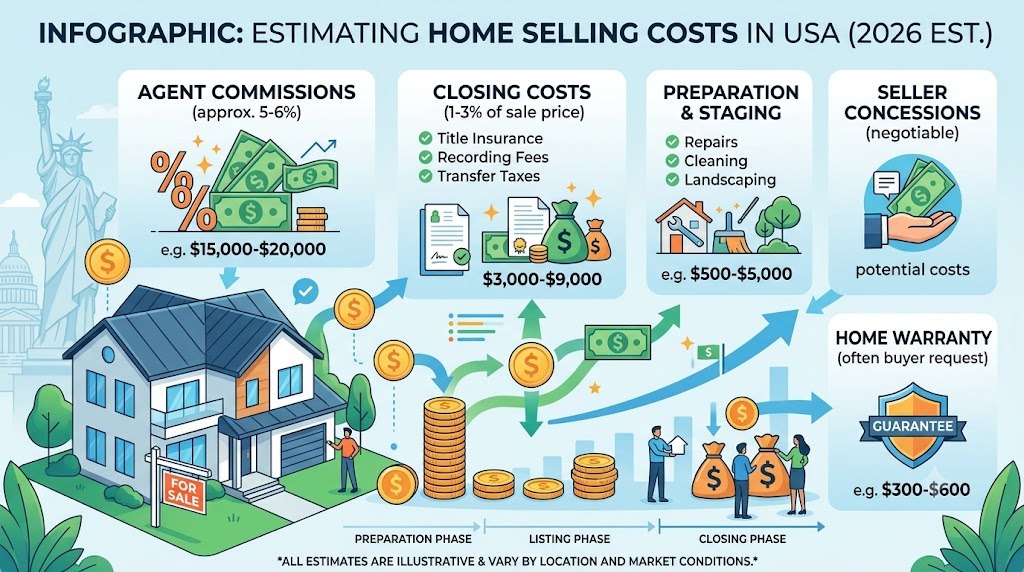
Price breakdown
The following ranges show common home selling costs in 2026. Actual charges depend on the contract, property condition, sale price, state law, and local market.
| Line item | Typical 2026 cost |
|---|---|
| Listing-agent compensation | About 1.5% to 3.5%, or a negotiated flat fee |
| Buyer-agent compensation | $0 to about 3%, depending on negotiations |
| Seller closing and title expenses | About 1% to 3% of the sale price |
| Transfer or documentary taxes | Varies by state, county, and city |
| Repairs before listing | $500 to $15,000 or more |
| Buyer concessions | Often 1% to 3%, subject to the contract and loan limits |
| Staging and photography | About $300 to $3,500 |
| Moving and temporary storage | About $1,000 to $8,000 |
| Mortgage payoff and release fees | Usually several hundred dollars, plus the remaining loan balance |
A $500,000 sale with 5% total broker compensation creates a $25,000 expense. Adding 2% for closing charges and $7,500 in repairs brings estimated selling costs to $42,500.
If the buyer also negotiates a $10,000 closing credit, total deductions reach $52,500. The seller would then receive $447,500 before the mortgage payoff, prorated property taxes, or HOA charges.
Seller costs and buyer costs are not identical. Closing costs on a house can include title work, transfer expenses, recording charges, attorney fees, escrow costs, and prorated taxes.
Ask the title company or closing attorney for an early estimate. Review it again after accepting an offer because concessions, commissions, taxes, and prorations may change.
What drives the price
Real estate commission rules
Real estate commission in 2026 is determined by written agreements and negotiation. Sellers should compare the total fee and the exact services included. Photography, open houses, advertising, transaction management, and negotiation support may be bundled differently.
A buyer may request that the seller pay some or all of the buyer broker’s fee. The seller can accept, reject, or counter that request. The effect should be measured against the offer price and expected net proceeds.
State and local closing charges
Transfer taxes differ widely. California sellers may encounter county documentary transfer taxes, while some cities impose additional charges. New York transactions can include state transfer tax and, for qualifying properties, additional local costs.
Maryland commonly divides certain transfer and recordation charges according to local practice or contract terms. Texas has no state real estate transfer tax, although sellers still face title, brokerage, tax-proration, and legal expenses.
Condition and repairs
A clean, functional home may need only paint, landscaping, and minor fixes. An older property could require roofing, HVAC, plumbing, electrical, foundation, or mold work.
Spending $2,000 on visible maintenance can prevent buyers from assuming the house needs $20,000 in repairs. Major renovations are riskier because sellers rarely recover every dollar immediately.
Buyer concessions
Concessions may cover allowable buyer closing expenses, prepaid costs, or rate-reduction points. They can keep a deal alive when buyers have sufficient income but limited cash.
Concession limits may depend on the mortgage program, down payment, occupancy type, and lender rules. Verify the permitted amount before agreeing to a credit.
Mortgage and ownership obligations
Your mortgage payoff is not technically a selling fee, but it determines the cash received. The payoff statement may include daily interest, recording costs, and a release fee.
Unpaid property taxes, HOA balances, liens, judgments, and municipal charges must usually be resolved. Discovering them late can delay closing or force an unexpected price adjustment.
Market conditions
Sellers have greater leverage when several buyers compete. They may reject repair demands or requests for closing credits. In a slower market, refusing a reasonable concession can cost more than accepting it.
Pricing strategy also matters. Review comparable sales and current competition before listing. Buyers will compare the property against recent sales, active listings, condition, location, and expected repair costs.
Commission rules sellers need to understand
The 2024 NAR settlement changed how compensation is communicated, but it did not create a fixed national rate. Listing brokers cannot place buyer-agent compensation offers on covered MLS platforms. Compensation can still be discussed through other lawful channels.
Buyers working with participating agents generally sign written agreements before touring homes. Those agreements must describe how the agent will be paid. A buyer may then include a compensation request in the purchase offer.
Sellers should compare offers using net proceeds rather than commission requests alone. A $510,000 offer requesting $10,000 toward buyer representation may be stronger than a $495,000 offer requesting nothing.
“Broker compensation is not set by law and is fully negotiable.”
National Association of Realtors, consumer guidance following the settlement-related practice changes.
The official NAR guidance for home sellers explains that sellers may negotiate compensation and are not required to make an offer to a buyer’s broker.
Ways to save in 2026
Reducing seller closing costs does not require stripping every service from the transaction. Focus first on charges with meaningful dollar value and limited effect on buyer confidence.
- Interview at least 3 agents. Compare fees, marketing plans, contract length, cancellation terms, and recent neighborhood results.
- Request a seller net sheet. Run estimates at several sale prices and include likely concessions.
- Negotiate services separately. Ask whether staging, photography, floor plans, or drone images are included.
- Complete targeted repairs. Fix safety hazards, leaks, broken fixtures, damaged flooring, and obvious exterior defects.
- Shop for closing services. State rules differ, but some title, escrow, legal, or settlement services may be selectable.
- Challenge incorrect liens. Resolve title defects before accepting an offer and facing a deadline.
- Compare offers by net value. Include price, financing, commission requests, concessions, repairs, and closing date.
- Avoid unnecessary renovations. Replace a failing system when necessary, but do not remodel solely for personal taste.
A lower commission is not automatically a better deal. An agent who secures a higher price with fewer concessions may produce better net proceeds.
Flat-fee MLS services can suit experienced sellers who can manage showings, disclosure documents, negotiations, and deadlines. Legal support may still be needed, particularly in attorney-closing states.
For-sale-by-owner transactions eliminate a listing-agent fee but not every brokerage expense. A buyer may request agent compensation, while title work, transfer charges, repairs, photography, and legal fees remain.
Schedule repairs before the listing goes live. Contractors often charge more when work must be finished before an inspection deadline.
Saving $1,000 on preparation can become expensive when poor presentation reduces competition or encourages aggressive repair demands.
When paying more makes sense
The property needs specialized marketing
Luxury homes, rural acreage, waterfront properties, and unusual architecture may need targeted advertising. Professional video, aerial photography, detailed floor plans, and regional exposure can justify a larger marketing budget.
The ownership history is complicated
Inherited homes, divorce sales, trusts, liens, bankruptcy issues, and boundary disputes require careful handling. Paying an experienced attorney or title professional can prevent delays and failed closings.
The home needs urgent work
Roof leaks, unsafe wiring, active plumbing failures, or structural problems may limit financing options. Correcting a documented defect can expand the buyer pool and reduce renegotiation risk.
The seller has little time
Relocation, military orders, financial deadlines, or an existing purchase may make speed more valuable than maximum price. Full-service coordination can reduce carrying costs and scheduling errors.
Taxes and final proceeds
Federal capital gains tax depends on profit, ownership, occupancy, filing status, and prior use of the exclusion. Eligible homeowners may exclude up to $250,000 of gain, or up to $500,000 for many married couples filing jointly.
The exclusion applies to gain, not the full sale price. The calculation generally considers the adjusted basis, qualifying improvements, and selling expenses. Review the current IRS Publication 523 before filing.
Keep invoices for additions, renovations, major systems, and other qualifying improvements. Routine cleaning and maintenance generally receive different tax treatment from capital improvements.
State taxes may also apply. A primary-home exclusion under federal rules does not guarantee identical state treatment.

Seller cost checklist
Collect the following figures before deciding whether an offer provides enough cash for your next move:
- Expected sale price based on recent comparable properties
- Listing-broker fee or flat service charge
- Possible buyer-broker compensation request
- Title, escrow, attorney, and recording charges
- State and local transfer taxes
- Repair, cleaning, staging, and photography costs
- Buyer concessions and home warranty expenses
- Mortgage payoff, liens, taxes, and HOA balances
- Moving, storage, temporary housing, and utility costs
Use conservative numbers when the property has not been inspected. Hidden defects frequently appear after a buyer orders professional inspections.
Prepare estimates for a strong offer, an average offer, and a low offer. This reveals the minimum price that still supports your financial plans.
Update the calculation whenever contract terms change. A price increase may be offset by a larger credit or additional repair obligation.
Do not spend expected proceeds before closing. Financing, appraisal, inspection, insurance, or title problems can still terminate the transaction.
The final settlement statement should match the negotiated contract. Question unfamiliar charges before signing rather than trying to correct them afterward.
FAQ
What percentage does it cost to sell a house in 2026?
Many sellers spend about 6% to 10% of the sale price. The total can be lower for a simple transaction or exceed 12% with major repairs and concessions.
Does the seller have to pay the buyer’s agent?
No national rule automatically requires it. A buyer may request compensation within an offer, and the seller may accept, reject, or negotiate the request.
How much are closing costs for a seller?
Seller closing charges often total about 1% to 3%, excluding broker compensation and major repairs. Local transfer taxes can materially change the amount.
Is selling without a Realtor cheaper?
It can remove the listing-agent fee. However, legal work, title services, marketing, repairs, transfer charges, and possible buyer-agent compensation may remain.
Can home-sale expenses reduce capital gains?
Certain selling expenses and qualifying improvements may affect taxable gain. Eligibility depends on IRS rules and the seller’s records.
How can I estimate the cash received at closing?
Subtract commissions, closing charges, concessions, repairs, taxes, liens, and the mortgage payoff from the sale price. A title company or agent can prepare a seller net sheet.
Earlier we wrote about Toilet Flapper Replacement: Find the Right Size, Adjust the Chain and Stop Leaks