


How to check your credit score for free 2026 starts with one practical distinction: AnnualCreditReport.com gives you free official credit reports, while free credit scores usually come from your bank, card issuer, lender, or a trusted financial app. You can finish the first check in about 15 minutes, spot errors before a mortgage, car loan, apartment application, or insurance renewal, and avoid paid “free trial” traps, as noted by Baltimore Chronicle.
The fastest safe path is this: pull your 3 reports from AnnualCreditReport.com, then check a free score from a current financial account such as Discover, Chase, Capital One, American Express, Wells Fargo, or a credit union. If you are applying soon in Maryland, California, Texas, Florida, New York, Illinois, or any other US state, review the reports first. A score means little if the underlying report has a wrong balance, a late payment you never missed, or an account opened by fraud.
Key takeaways
- AnnualCreditReport.com is for free credit reports from Equifax, Experian, and TransUnion, not usually your score.
- Free scores are often available through banks, credit cards, lenders, and legitimate credit monitoring tools.
- Check all 3 reports before major applications because lenders may use different bureaus and scoring models.
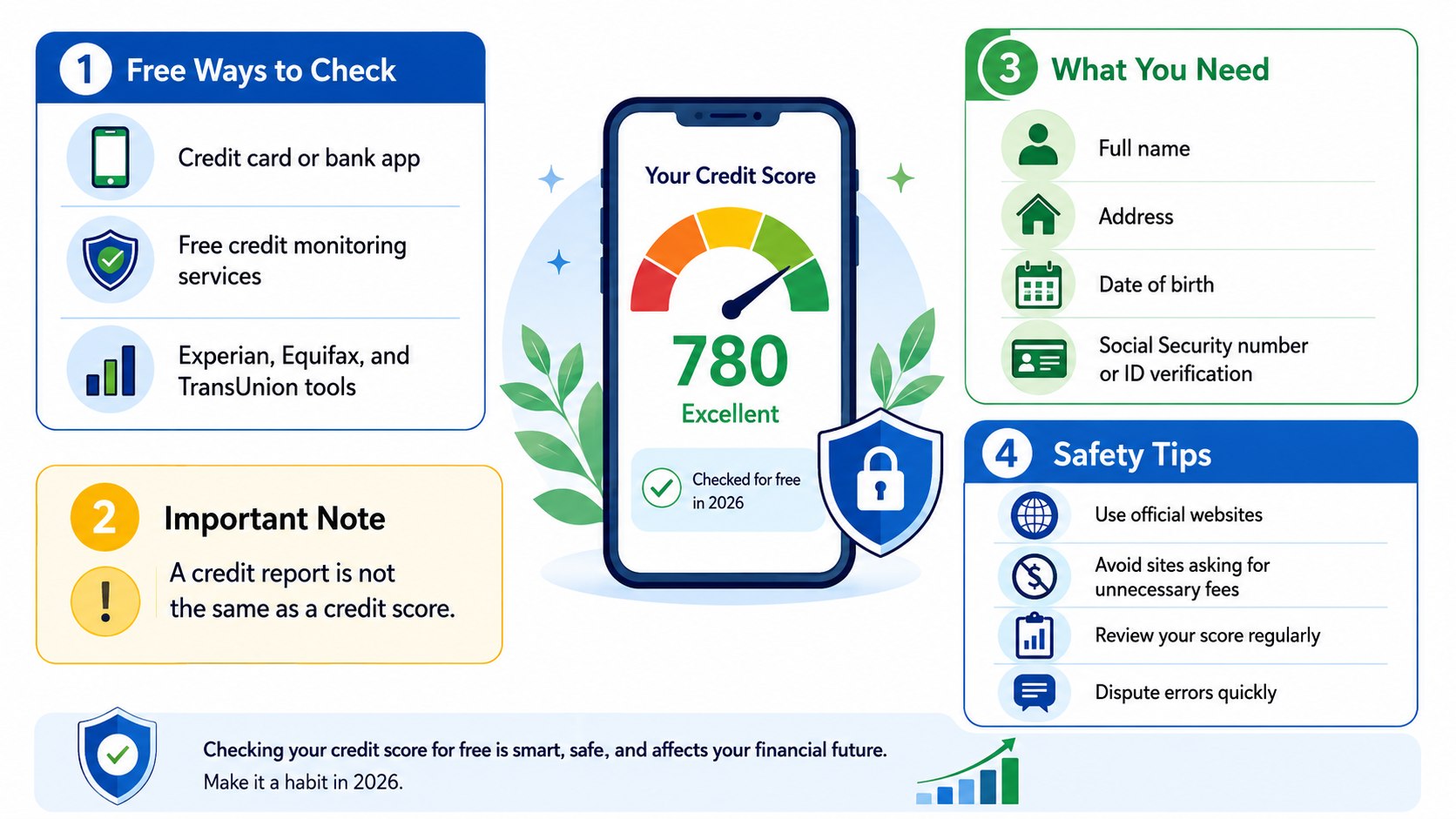
What You Need Before You Start
You do not need to pay to begin. You need enough information to verify your identity and enough time to read the report carefully. Most people can complete the online request quickly, but mailed reports can take longer.
- Legal name, current address, and previous address if you moved recently.
- Social Security number or Individual Taxpayer Identification Number where requested.
- Date of birth and access to your phone or email for verification.
- Existing bank, credit card, mortgage, auto loan, or student loan login.
- 15 to 30 minutes for online access; more time if identity questions fail.
- $0 for official reports through AnnualCreditReport.com.
Do not enter sensitive data on a search ad, lookalike domain, or random “free score” page. The FTC says AnnualCreditReport.com is the only authorized website for the free annual credit reports required by federal law. That point matters because fake or confusing sites may push subscriptions, trials, or paid monitoring after showing partial information.
If you are within 90 days of applying for a mortgage, auto loan, apartment, or private student loan, pull reports before chasing the score. The report is where the expensive mistakes usually hide.
How to Check Your Credit Score for Free 2026: AnnualCreditReport First
AnnualCreditReport.com should be the first stop because it shows the data behind credit scores. As of 2026, the official site says free weekly online credit reports are available from Equifax, Experian, and TransUnion. That gives consumers more room to monitor fraud, disputes, balance updates, and old accounts than the older once-a-year rhythm.
The catch is simple: a free credit report is not automatically a free credit score. A report lists accounts, balances, payment history, inquiries, addresses, and public-record information. A score is a calculated number based on data in one or more reports.
For readers preparing to buy property, Baltimore Chronicle’s guide on how to get pre-approved for a mortgage in USA in 2026 explains why lenders review credit, debt, and documents before issuing a serious pre-approval. Another related guide on how to buy a house in USA 2026 notes that stronger credit can affect mortgage pricing and approval strength.
| Source | What you get | Typical cost in 2026 | Best use |
|---|---|---|---|
| AnnualCreditReport.com | Reports from Equifax, Experian, TransUnion | $0 | Finding errors, fraud, account history |
| Bank or credit card app | Usually FICO or VantageScore | $0 for customers | Monitoring monthly score movement |
| Credit bureau account | Score, monitoring, alerts, optional upgrades | $0 to paid plans, verify before enrolling | Watching one bureau closely |
| Lender application | Score used in underwriting | May involve application or credit-pull costs | Mortgage, auto loan, personal loan decision |
This comparison helps avoid a common mistake. Many consumers look only at a free app score and assume every lender sees the same number. In reality, your mortgage lender, auto lender, card issuer, and landlord screening company may use different data, bureaus, or models.
AnnualCreditReport also helps renters and freelancers. A landlord may review a tenant screening report, while a business credit card issuer may check personal credit for a freelancer. The safest approach is to know what appears on all 3 bureau files before someone else reviews them.
Step 1: Go Directly to AnnualCreditReport.com
Type the official address into your browser or use the clean official link. Choose the online request option and select reports from Equifax, Experian, TransUnion, or all 3.
Why it matters: this is the federally authorized route for free credit reports from the 3 national credit reporting companies. The common mistake is clicking a search ad that looks official but pushes a paid service.
Step 2: Verify Your Identity Carefully
Enter your identifying details exactly as they appear on financial accounts. If you recently moved from Arizona to Maryland or changed your name after marriage, use consistent information.
Why it matters: identity mismatches can block online access and force a phone or mail request. The mistake to avoid is guessing at security questions or rushing through address history.
Step 3: Download and Save All 3 Reports
Save each report as a PDF or print it immediately after access. Some sessions expire, and returning later may require another verification process.
Why it matters: you need a record for disputes, lender conversations, or fraud reports. The common mistake is checking only one bureau because the first report looks clean.
Step 4: Check Accounts, Balances, and Late Payments
Review open credit cards, mortgages, auto loans, student loans, personal loans, collections, and closed accounts. Focus on balances, limits, dates, payment status, and unfamiliar creditors.
Why it matters: these items can influence FICO and VantageScore calculations. The mistake to avoid is ignoring a small wrong balance before a mortgage or car loan application.
Step 5: Get a Free Score From a Current Financial Account
Open your bank, card issuer, or lender app and look for a credit score section. Common providers include Discover Credit Scorecard, Capital One CreditWise, Chase Credit Journey, American Express MyCredit Guide, and many credit unions.
Why it matters: these tools can show a free FICO score or free VantageScore without a hard inquiry. The mistake is comparing 2 scores without checking the bureau, model, and date shown.
Step 6: Read the Score Details, Not Just the Number
Most scores range from 300 to 850, but the model matters. FICO says many credit scores use the 300 to 850 range, and VantageScore also uses that broad scale for current consumer scores.
Why it matters: a 710 VantageScore from TransUnion may not match a 710 FICO score used by a mortgage lender. The common mistake is treating every score as the exact number a lender will use.
A free score is a dashboard light, not the whole engine. The report explains why the light is on.
Step 7: Dispute Errors With the Bureau and the Furnisher
If you find a wrong late payment, unknown account, duplicate collection, incorrect balance, or outdated personal information, file a dispute. AnnualCreditReport.com says inaccurate information can be disputed for free with the credit reporting company or the business that supplied the data.
Why it matters: wrong data can raise borrowing costs or block approval. The mistake to avoid is disputing only by phone without keeping screenshots, letters, dates, and confirmation numbers.
Step 8: Set a 2026 Credit Check Routine
For normal monitoring, check one report every few months and a free score monthly. If your wallet was stolen, your data was exposed, or you are buying a home, check more often.
Why it matters: weekly report access gives you flexibility without paying for constant monitoring. The mistake is waiting until the lender has already pulled your file.
| Situation | Best timing | What to check first |
|---|---|---|
| Mortgage pre-approval | 90 to 180 days before applying | All 3 reports, balances, disputes |
| Auto loan | 30 to 60 days before shopping | Score range, recent inquiries, card balances |
| Apartment application | 2 to 4 weeks before applying | Collections, identity details, old addresses |
| Identity theft concern | Immediately | New accounts, inquiries, contact data |
| Freelancer business financing | 60 to 120 days before applying | Utilization, payment history, tax liens if any |
This schedule is realistic for busy adults. Parents can combine it with annual insurance reviews. Drivers can check before auto financing, while renters can check before submitting multiple apartment applications in a high-cost market.
The main goal is not perfection. It is knowing whether your file is accurate before a lender, landlord, insurer, or employer-permitted background process sees it. That control is worth more than refreshing a score every day.
Troubleshooting: When the Free Credit Check Does Not Work
Access problems are common, especially after moves, name changes, thin credit files, or fraud alerts. Do not keep submitting the same form repeatedly if verification fails. Switch to the official phone or mail path instead.
- Identity questions fail: request by phone at 1-877-322-8228 or use the mail form listed by the FTC.
- One bureau is unavailable: save the other reports and return later for the missing bureau.
- You see an unknown account: document it, dispute it, and consider a credit freeze.
- Your app score dropped suddenly: compare recent balances, inquiries, and payment updates across reports.
- A site asks for a card number: stop and verify whether you are enrolling in a paid service.
After a failed online request, patience helps. Verification systems may rely on older address, loan, or account data. If you lived in Pennsylvania, Ohio, or Georgia before moving, an old address may still appear in identity questions.
If fraud is possible, do not limit the response to a dispute. Consider freezing your credit with Equifax, Experian, and TransUnion. A freeze is different from monitoring because it restricts new-credit access until you lift it.

Free Report vs Free Score: What Readers Often Miss
The most useful habit is pairing reports and scores. A free app score can show direction: up, down, or flat. A credit report explains the cause, especially when balances, new inquiries, or late payments change.
There is no single universal score. Your card issuer may show VantageScore 3.0 based on TransUnion data. A mortgage lender may use a different FICO model and check multiple bureaus. An auto lender may use an auto-enhanced score that weighs past auto credit differently.
That is why check credit report free, free credit score USA, AnnualCreditReport 2026, and credit score without paying are related searches but not identical tasks. Reports protect accuracy. Scores help estimate how lenders may view risk.
The official FTC position is direct: AnnualCreditReport.com is the authorized website for free annual credit reports. For consumers, the practical lesson is to start there before paying any company for access.
FAQ
Does AnnualCreditReport.com show my credit score for free?
Usually, no. AnnualCreditReport.com provides free credit reports from Equifax, Experian, and TransUnion. Your free score usually comes from a bank, credit card issuer, lender, or credit monitoring account.
Can checking my own credit score hurt my credit?
No. Checking your own score or report is a soft inquiry. It does not lower your score. A lender application can create a hard inquiry.
Which free credit score is most accurate in 2026?
The most relevant score is the one your lender uses. For general monitoring, a free FICO or VantageScore from a bank or card issuer is useful, but it may not match a mortgage, auto, or rental screening score.
How often should I check my credit reports?
Check at least before major applications. As of 2026, free weekly online reports are available from the 3 national bureaus through AnnualCreditReport.com, so higher-risk periods justify more frequent checks.
What should I do if my credit report has a wrong late payment?
Save evidence, file a dispute with the bureau, and contact the creditor that reported the information. Keep copies of statements, confirmation numbers, and dates.
Do I need paid credit monitoring?
Not always. Many consumers can use free weekly reports, free bank-app scores, and credit freezes. Paid monitoring may help after identity theft, but verify price, cancellation terms, and coverage first.
Earlier we wrote about How Much Does a Vehicle Title Transfer Cost in 2026? DMV Fees, Taxes, and State Rules