


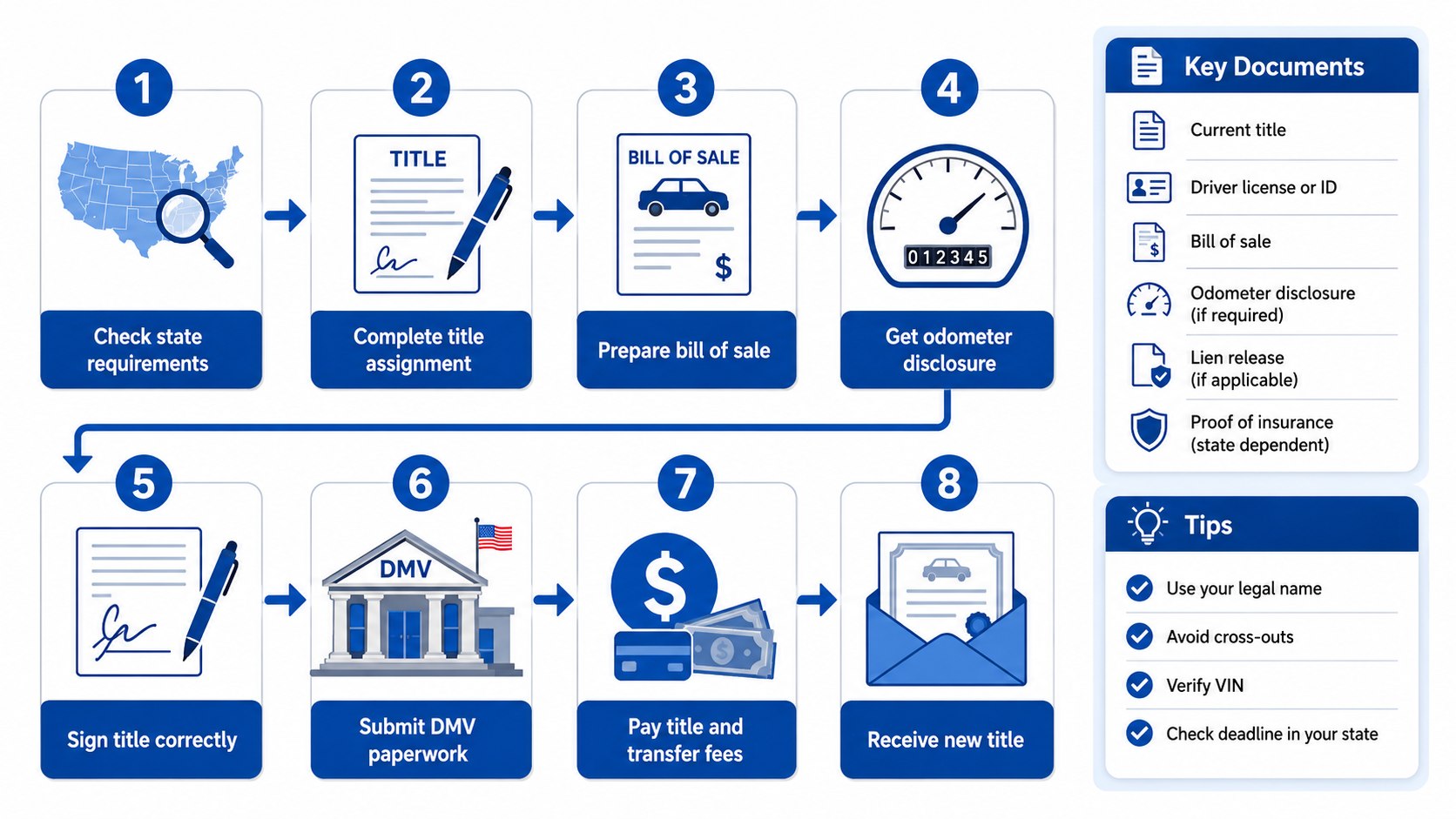
How to transfer car title in USA 2026 depends on the state, but the core process is the same: the seller signs the title, the buyer verifies the VIN and odometer, both sides document the sale, and the buyer files the paperwork with the DMV, MVA, county tax office, or tag agency. In a clean private-party sale, the handoff can take 30–60 minutes, while the official title update often takes days or weeks, as noted by Baltimore Chronicle.
The buyer’s first job is to make sure the title is real, signed correctly, and free of undisclosed liens. The seller’s first job is to report the sale and keep proof. Do those 2 things before money and keys change hands, and most title problems become preventable.
Key takeaways:
- Do not buy a car unless the seller can produce a valid title or a state-approved replacement process.
- Most states require the buyer to apply for a new title within 10–30 days after purchase.
- Fees vary sharply by state, county, vehicle value, registration status, liens, and whether plates transfer.
A car title is not the same as registration. The title proves ownership. Registration allows the car to be driven legally on public roads.
What you need before starting:
- Original vehicle title or approved electronic title release
- Buyer and seller legal names, addresses, and signatures
- Vehicle Identification Number, or VIN
- Current odometer reading, when required
- Bill of sale, especially for private-party sales
- Lien release if the vehicle was financed
- Buyer’s proof of insurance, where required
- State title application form
- Payment for title, tax, registration, plates, and county fees
After this checklist, the buyer should compare every document against the car itself. The VIN on the title must match the dashboard VIN and door-jamb label. The seller’s name must match the title unless a dealer, estate, lender, or power-of-attorney process is involved. A mismatch is not a small clerical issue; it can block the transfer. For related household paperwork, readers can also use Baltimore Chronicle’s guide to changing your address everywhere when you move.
Step 1: Confirm the seller has the right to sell
Ask to see the original title before agreeing on final payment. Check the owner name, VIN, brand status, lienholder field, and any “salvage,” “rebuilt,” “flood,” or “not actual mileage” notation.
This matters because vehicle title transfer fails when the seller is not the legal owner or cannot release a lien. A clean handshake does not fix a title defect.
The common mistake is accepting “I’ll mail the title later” unless the transaction is through a licensed dealer or verified lender payoff process.
In private sales, the safest meeting place is often a DMV office, county tax office, bank branch, or tag-and-title service. This gives both sides a place to verify documents before the buyer leaves with the car. In states such as Texas, official guidance warns that sellers may remain exposed to tickets, tolls, or other liability when the buyer never completes the title transfer. For buyers using driving work platforms, this documentation also matters for insurance and account verification, similar to Baltimore Chronicle’s Amazon Flex driver setup guide.
Step 2: Fill out the title exactly as your state requires
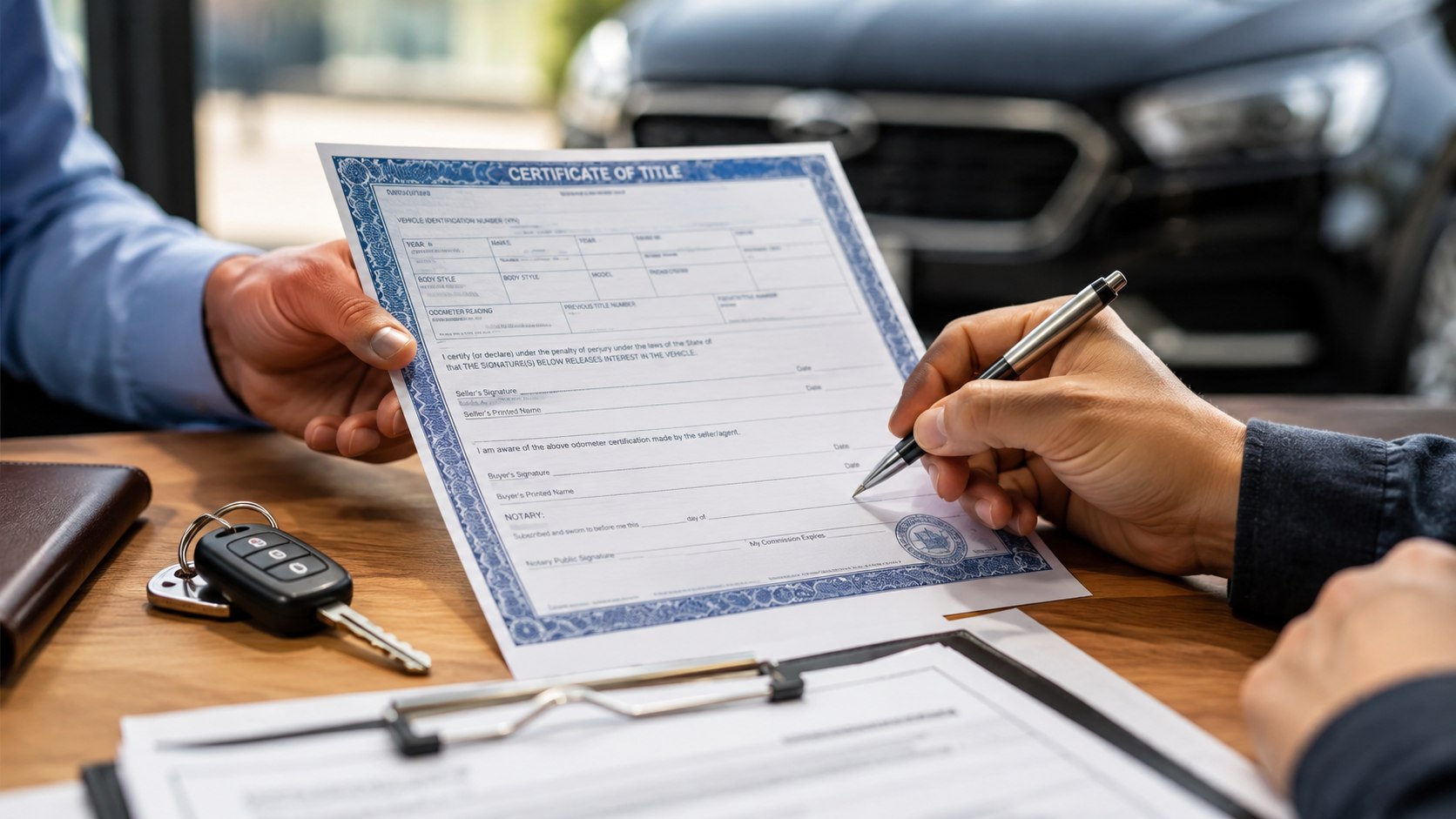
Complete the assignment section on the title with sale date, sale price, odometer reading, printed names, signatures, and buyer information. Some states require notarization or separate forms.
This matters because car title transfer USA rules are state-based. A missing middle initial, crossed-out price, or unsigned lien release can force a duplicate title request.
Do not use correction fluid or rewrite over an error. Ask the state agency how to fix a mistaken entry.
Federal odometer rules also matter in 2026. NHTSA says odometer disclosures are required for ownership transfers during the first 20 years for model year 2011 and newer vehicles. Older exemptions still apply to model year 2010 and older vehicles under the prior rule. Buyers should review the official NHTSA odometer disclosure notice before signing a high-value used-car deal.
Step 3: Estimate title transfer cost before money changes hands
Price the full transaction, not just the title fee. Add state title charges, sales tax, registration, plates, local county fees, lien recording, inspection, emissions, and late penalties.
A buyer can budget $50 for a title and still face several hundred dollars in total government charges. The final number depends on state law and vehicle details.
Do not assume online forum prices apply to your county, vehicle weight, plate status, or purchase price.
| State example | 2026 cost point to verify | Why the final bill can change |
|---|---|---|
| Florida | Electronic transfer or duplicate title is listed at about $75.25; paper handling and lien fees may apply. | Initial registration can add much more when no Florida plate is available to transfer. |
| New York | NY DMV lists a $50 title certificate fee in registration estimates. | Sales tax, plates, county surcharges, and registration choices can increase the total. |
| Texas | Title fees often run about $28–$33, plus a $2.50 registration transfer fee. | Texas motor vehicle sales and use tax is commonly 6.25% of the taxable price. |
| California | California DMV directs buyers to its fee calculator because transfer costs vary. | Vehicle value, registration status, county, smog rules, and penalties can affect cost. |
| Maryland | Passenger registration fees vary by vehicle weight and class. | Excise tax, title fee, inspection, lien, and plate needs can change the total. |
These examples show why a single national fee would be misleading. A $5,000 Toyota Corolla in Texas is not priced like a financed Ford F-150 in California. A Maryland buyer may also need inspection paperwork before registration. A Florida buyer without an existing plate may face an initial registration charge. Always verify the state agency fee page on the day you file.
The practical rule is simple: bring more than the title fee. Most delays at the counter happen because the buyer forgot tax, insurance, inspection, or lien paperwork.
Step 4: Protect the buyer before paying
Run the VIN through trusted history tools, compare the mileage, check recalls, inspect the title brand, and request written terms. If buying from a dealer, review the Buyers Guide.
This matters because private party car title transfer puts more verification work on the buyer. There is usually no finance office correcting mistakes later.
Do not let a low price rush the paperwork. Title jumping, unpaid liens, and odometer issues usually appear after payment.
Before payment, the buyer should:
- Ask whether the title is clean, rebuilt, salvage, flood, lemon, or bonded.
- Compare the seller’s ID with the title owner name.
- Confirm the lienholder section is blank or supported by a lien release.
- Photograph the signed title and bill of sale for records.
- Keep insurance active before driving away.
- Avoid leaving plates on the vehicle unless state law allows it.
After these checks, the buyer should slow down and read every field again. The FTC warns used-car buyers that spoken promises are hard to enforce, especially in dealer transactions. Its used-car buying guidance tells consumers to review warranties, payment terms, vehicle history, and written promises before signing. That advice also fits private sales, even when the paperwork is simpler.
Step 5: Protect the seller after the sale
Keep a signed bill of sale, remove or transfer plates as state law requires, cancel insurance only after the vehicle is no longer legally yours, and file a release of liability or sale notice.
This matters because seller title transfer responsibilities do not end when the buyer drives away. In some states, tolls, parking tickets, red-light camera notices, and crash records may still find the seller first.
Do not rely on the buyer’s promise to “handle the DMV tomorrow.” File your seller notice yourself.
Texas is a useful example. State guidance tells sellers to submit a Vehicle Transfer Notification and warns that vehicles must be titled in the buyer’s name within 30 days. California uses a shorter ownership-change reporting window, with DMV guidance stating that changes in ownership or lienholder must be reported within 10 days. Other states use different deadlines, so sellers should check their own DMV, MVA, RMV, DOL, or county tax office.
Step 6: File the buyer’s title application and keep proof
Submit the signed title, state application, ID, insurance, bill of sale, tax payment, lien documents, inspection or emissions certificate, and plate request. File online, by mail, at a DMV office, or through an approved tag service when allowed.
This matters because DMV title transfer 2026 is not complete until the state records the buyer as owner. Possession of the car is not enough.
Do not drive for weeks on old plates, expired temporary tags, or an unsigned title in the glove box.
The buyer should keep a paper trail:
- Make copies or scans of every submitted document.
- Save the receipt from the DMV, MVA, tax office, or tag agency.
- Track the mailed title if the state sends paper certificates.
- Confirm the lienholder is listed correctly when financing is involved.
- Update insurance once the new registration is issued.
- Store the title somewhere secure, not inside the vehicle.
Once the application is filed, processing time can vary by state and workload. Electronic titles may update faster, while paper titles can take longer by mail. If a lender financed the vehicle, the title may go directly to the lienholder. Buyers planning a move should also update DMV address records quickly, because a paper title mailed to the wrong address can become another duplicate-title problem.
Troubleshooting common car title transfer problems
Title transfers usually break down for predictable reasons. The fix depends on the state, but the warning signs are similar across the country.
Common scenarios include:
- Lost title: the legal owner usually must request a duplicate title before sale or use a state-approved replacement process.
- Open lien: the seller needs a lien release, payoff letter, or lender-handled transfer before the buyer can receive clear ownership.
- Wrong name: the person signing must have authority to sell, including estate, business, divorce, or power-of-attorney documentation.
- Out-of-state title: the buyer may need VIN verification, emissions testing, inspection, or extra tax forms.
- Dealer delay: keep the purchase contract, temporary tag record, financing papers, and all written communication.
After a problem appears, avoid informal fixes. A second bill of sale or private letter rarely replaces the state’s required form. Contact the agency that will process the title and ask which document solves the exact defect. For dealership purchases, ask for written status updates and keep every temporary registration record.
FAQ
How long do I have to transfer a car title after buying?
Many states use a 10–30 day deadline, but the exact rule depends on where the vehicle will be titled. Texas commonly uses 30 days for buyer title filing. California requires ownership or lienholder changes to be reported within 10 days. Verify your state deadline before the sale date.
Can I transfer a car title online in 2026?
Some states allow parts of the process online, especially duplicate titles, seller notices, electronic lien releases, or dealer transactions. Private-party transfers may still require mailed documents or an in-person visit. The answer depends on the state and title type.
Who pays title transfer fees, the buyer or seller?
The buyer usually pays title, tax, registration, and plate costs. The seller may pay for a duplicate title, lien release, notarization, or document correction if needed to deliver clear ownership. The bill of sale should state any unusual agreement.
Can I sell a car if I still owe money on it?
Yes, but the lender must be paid and the lien must be released. The safest process is usually handled through the lender, escrow-style payoff, or a branch visit. A buyer should not pay full price without proof that the lien will be cleared.
Do I need a bill of sale if the title is signed?
Often yes, or at least it is strongly recommended. Some states require it for tax or registration. Even where optional, it protects both sides by recording price, date, VIN, mileage, names, and sale terms.
What is the biggest mistake buyers make during title transfer?
The biggest mistake is paying before checking the title, lien status, seller ID, VIN, and odometer. Once money changes hands, title defects become harder and slower to fix.
Earlier we wrote about How to Set Up Screen Time iPhone 2026: Downtime, App Limits and Parent Controls