

UPS ground vs UPS surepost difference 2026 comes down to control, speed, and the final carrier. Most readers should pick UPS Ground for valuable, urgent, or easily damaged shipments. SurePost—renamed UPS Ground Saver—is better when an online retailer offers a lower price and the delivery date remains flexible, as noted by Baltimore Chronicle.
UPS Ground normally stays inside the UPS network until a UPS driver reaches the destination. Ground Saver can involve a carrier handoff, with UPS moving the parcel through most of the route before USPS completes delivery. That extra operational step may reduce shipping costs, but it can add time and make tracking appear less straightforward.
Key takeaways
- Choose UPS Ground when delivery timing, easier tracking, and end-to-end UPS handling matter more than the lowest available price.
- Choose Ground Saver for low-value residential orders that can arrive later and may require USPS final-mile delivery.
- “SurePost” is the former service name; UPS now presents the product to US customers as UPS Ground Saver.
After choosing a service, check the seller’s promised arrival window rather than comparing labels alone. Retailers negotiate different UPS rates, and customers may never see the carrier’s underlying price.
At a glance
The practical difference is not simply “fast shipping versus cheap shipping.” The services use different delivery structures, address rules, package limits, and customer-service paths. These distinctions become especially visible after a parcel reaches the destination ZIP Code.
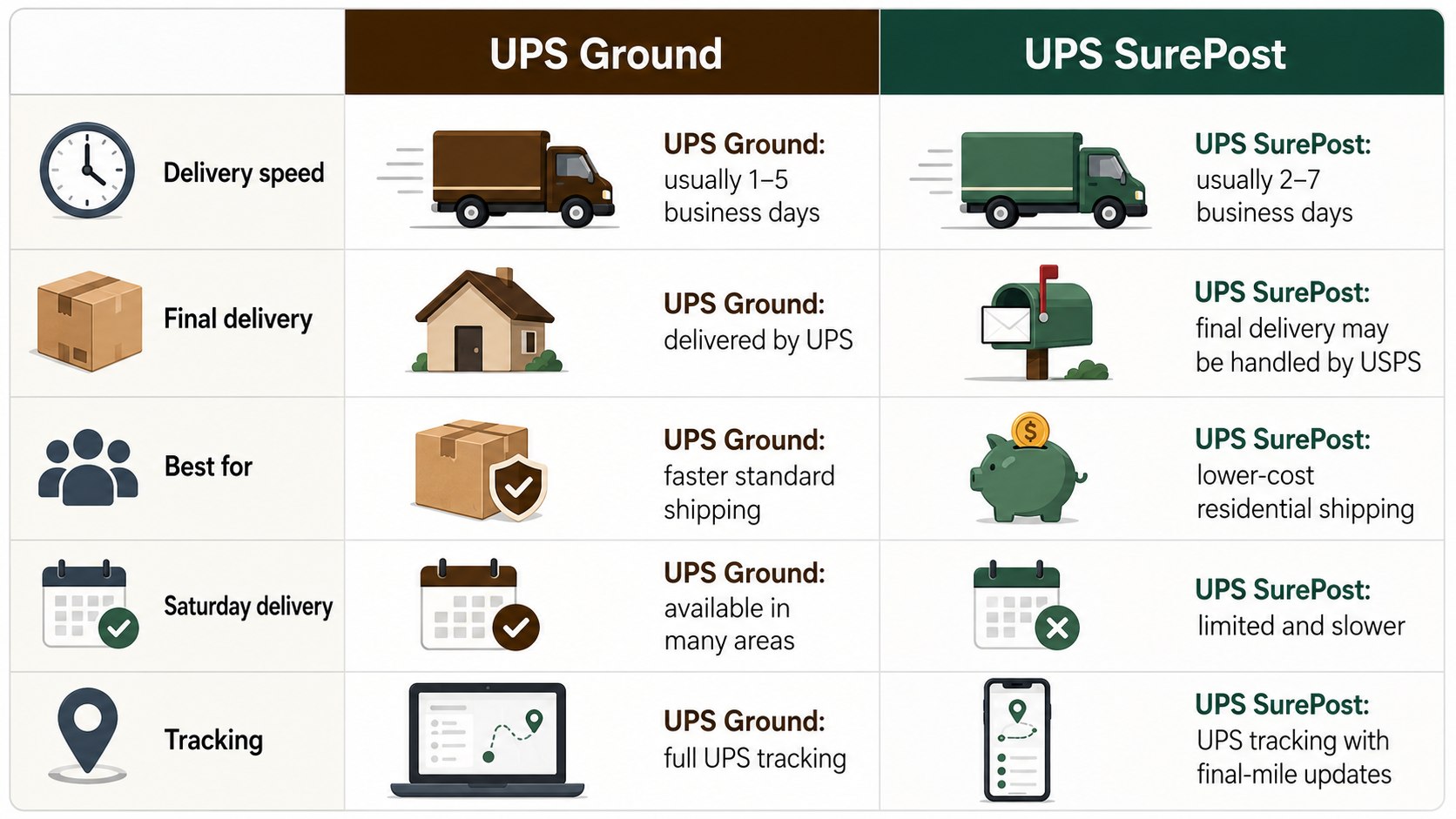
| Comparison point | UPS Ground | UPS Ground Saver, formerly SurePost |
|---|---|---|
| Typical purpose | Standard residential or commercial parcel delivery | Economy delivery for non-urgent residential shipments |
| Carrier handling | Usually UPS from pickup through final delivery | UPS transportation with possible USPS final-mile delivery |
| Published transit | Generally 1–5 business days | Often slower; use the checkout estimate for the specific shipment |
| Delivery days | Weekday service, with weekend delivery available in many areas | Monday through Saturday under current UPS service information |
| Destination types | Street addresses across all 50 states and Puerto Rico | Residential addresses, PO Boxes, and eligible APO, FPO, and DPO addresses |
| Package capacity | Up to 150 lb and 108 inches long under standard UPS Ground limits | More restrictive economy-service eligibility and shipper-specific rules |
| Tracking experience | Usually one continuous UPS movement history | May show a handoff or separate USPS activity near delivery |
| Best use | Important, heavier, higher-value, or deadline-sensitive shipments | Clothing, household goods, and other low-risk purchases |
| Price | Usually higher than the economy option | Usually discounted through participating retailers and business shippers |
UPS states that Ground reaches US destinations in 1–5 business days and accepts packages weighing up to 150 lb. Ground Saver is positioned as a lower-cost service for shipments that do not require the fastest arrival.
The displayed delivery estimate can still vary by origin, destination, package dimensions, fuel surcharges, and the shipper’s contract. A 4 lb box moving between neighboring states may produce a very different quote from the same box traveling from California to Maryland.
Consumers should also distinguish a retailer’s shipping charge from the carrier’s transportation rate. A store may advertise “free SurePost” while absorbing the cost, or charge a flat $7.99 even when its negotiated rate is lower.
For that reason, there is no universal 2026 price gap that applies to every checkout. The reliable comparison is the final price and promised arrival date shown for the exact address.
UPS Ground: pros, cons, and ideal user
UPS Ground delivery is the safer default when the parcel has financial, practical, or time-sensitive value. UPS controls the ordinary transportation chain, including sorting, line-haul movement, destination processing, and final delivery.
This structure matters when a package contains work equipment, replacement electronics, legal materials, or an item needed before a trip. Fewer carrier transitions generally mean fewer moments when tracking responsibility can appear unclear.
Advantages of UPS Ground
- Generally faster delivery, with published transit of 1–5 business days.
- UPS usually remains responsible through the final delivery attempt.
- Suitable for heavier packages weighing up to 150 lb.
- Better suited to business addresses and commercial receiving departments.
- More predictable when the recipient needs UPS delivery-management options.
- Ground time-in-transit maps help estimate delivery by origin ZIP Code.
These advantages are most useful when a missed day creates a real problem. A freelancer waiting for a replacement laptop should not select an economy service merely to save several dollars. The same logic applies to parents ordering medical equipment or homeowners waiting for a repair component.
Ground also makes more sense for awkward or heavier parcels. A merchant may restrict economy services by weight, dimensions, value, product category, or destination. UPS Ground has broader published capacity, although additional handling and large-package charges can still apply.
Tracking is another practical advantage. The status may still pause between facilities, but the parcel normally remains within one carrier’s operational system. Readers dealing with missing USPS numbers can separately use this guide to track a USPS package without the original tracking number.
Disadvantages of UPS Ground
- The checkout price is often higher than Ground Saver.
- Residential, delivery-area, fuel, and handling surcharges may affect the shipper’s cost.
- A Ground label does not guarantee delivery at a specific hour.
- PO Boxes are generally unsuitable for ordinary UPS Ground delivery.
Ground’s main weakness is price, particularly for merchants shipping thousands of low-value parcels. A retailer may accept slightly slower delivery because even a modest per-package reduction matters across a large order volume.
For an individual buyer, the better question is not whether Ground costs more. Ask whether the price difference is smaller than the cost of a late or complicated delivery.
UPS SurePost and Ground Saver: pros, cons, and ideal user
UPS SurePost final delivery searches now lead to UPS Ground Saver because UPS changed the service name. The current product keeps the same central economy concept: UPS transports the package, while eligible shipments may be delivered by UPS or handed to USPS for the final mile.
This arrangement uses the Postal Service’s extensive residential network. USPS already reaches mailboxes and addresses throughout urban, suburban, rural, and military communities, making the service attractive for high-volume e-commerce shipping.
UPS describes Ground Saver as the updated name for SurePost and says eligible packages may be delivered by either UPS or USPS.
Official UPS Ground Saver service information, accessed in 2026.
Advantages of Ground Saver
- Usually offers the retailer a lower-cost option for non-urgent orders.
- Can reach US PO Boxes and eligible military addresses through USPS.
- Works well for lightweight, replaceable, and lower-value merchandise.
- May use normal USPS delivery infrastructure for the final stop.
- Provides an economical choice when the customer has no fixed deadline.
The service is particularly reasonable for socks, books, basic clothing, inexpensive accessories, and household consumables. A 2-day delay on those products may be inconvenient but rarely creates a financial emergency.
Ground Saver may also be useful for rural destinations where USPS already provides routine last-mile service. However, the recipient should judge the checkout estimate, not assume the postal handoff will always make delivery faster.
Residents planning an absence should understand that a USPS request does not automatically control every private-carrier package. The Baltimore Chronicle guide to setting up USPS Hold Mail in 2026 explains the difference between USPS-handled items and parcels retained by private carriers.
Disadvantages of Ground Saver
- Delivery may take longer than standard UPS Ground.
- The UPS-to-USPS handoff can create a temporary tracking pause.
- Delivery changes may become harder after the parcel enters the postal network.
- The economy service is not appropriate for every size, destination, or commodity.
- Claims and support may begin with the retailer rather than the recipient.
The most common frustration is a tracking status that appears inactive near the destination. This does not automatically mean the package is lost. The parcel may be awaiting acceptance, sorting, or a new scan inside the USPS network.
When this happens, first check the complete tracking history. Look for language showing transfer to a local delivery agent or USPS. Then copy any displayed postal tracking number into the USPS tracking system.
Do not immediately open separate claims with both carriers. Contact the seller first when the promised delivery date has passed, since the merchant purchased the label and controls the shipping contract.
How the UPS-to-USPS carrier handoff works
The UPS to USPS handoff usually occurs near the destination rather than at the beginning of the route. UPS collects the parcel, processes it through its network, and transports it toward the receiving region.
- The retailer creates a Ground Saver label and gives the parcel to UPS.
- UPS scans, sorts, and moves the parcel through regional facilities.
- The system determines whether UPS or USPS will perform final delivery.
- If transferred, USPS accepts the package at an appropriate postal facility.
- USPS sorts the parcel for the recipient’s route and completes delivery.
- Tracking updates after the final carrier records acceptance and delivery scans.
The handoff does not occur on every Ground Saver shipment. UPS may complete final delivery itself when network conditions make that option more efficient. Consumers therefore should not assume that every former SurePost label will eventually produce a USPS scan.
A delay can appear between the UPS departure scan and USPS acceptance. The parcel may be physically moving while neither public tracking page shows a new event. Weekends, weather, holidays, destination workload, and missed sorting windows can extend that gap.
Address quality becomes especially important. Apartment numbers, unit designations, ZIP Codes, and recipient names should match the local delivery record. An incomplete address may be harder to correct once the package changes networks.
People moving between homes should update addresses directly with retailers and private carriers. USPS forwarding does not replace those changes, as explained in this guide to forwarding mail after a move.
A carrier handoff is not inherently unreliable. It simply adds another operating system, scanning process, and customer-service boundary to the delivery.
Which should you buy in 2026?
Use the checkout deadline, item value, address type, and consequences of delay. A useful decision takes less than a minute when those factors are clear.
- If the item is urgent or required for work, then choose UPS Ground.
- If the order is inexpensive and replaceable, then Ground Saver is usually acceptable.
- If delivery must reach a PO Box, then Ground Saver may be the eligible UPS economy choice.
- If the package is heavy or unusually large, then check UPS Ground eligibility first.
- If tracking simplicity matters, then select the service that remains with UPS.
Delivery date should outrank a small price difference. Saving $4 has little value when a replacement part arrives after a scheduled repair. Conversely, paying extra for Ground may be unnecessary when ordering a paperback without a deadline.
Consider theft exposure as well. A slower shipment may arrive while nobody is home, while a clearer Ground estimate can help a recipient plan. UPS My Choice options may be available, although eligibility varies by shipment and sender restrictions.
Businesses should compare negotiated rates rather than public retail prices. UPS publishes 2026 rate guides, but account discounts, dimensional weight, fuel charges, residential fees, and delivery-area surcharges can change the final amount.
The official UPS Ground Saver page and UPS domestic shipping page provide current service definitions.
What to do when Ground Saver tracking stops
A stalled scan is most concerning after the promised delivery date passes. Before that date, the package may still be moving between UPS and USPS systems.
- Read every UPS tracking event and identify the last physical facility.
- Look for a USPS number or a message showing transfer to a local agent.
- Check USPS Informed Delivery when the address is eligible.
- Wait until the merchant’s promised delivery date has fully passed.
- Contact the retailer with the order number and complete tracking history.
- Ask for a replacement or investigation under the seller’s delivery policy.
Keep screenshots when an expensive purchase shows inconsistent tracking. Save the order confirmation, promised arrival date, delivery photograph, and correspondence with the merchant. These records help establish whether the item was late, misdelivered, or never tendered correctly.
Check the property before reporting loss. Look near side doors, garages, parcel lockers, leasing offices, and neighbors sharing a similar address. USPS and UPS drivers may use different safe locations.
When tracking says “delivered,” confirm which carrier recorded the final scan. Contact that carrier only after checking the immediate property and household members. The retailer remains the most effective escalation point when the shipment cannot be located.
FAQ
Is UPS SurePost still available in 2026?
The service continues under the name UPS Ground Saver. Consumers may still see “SurePost” in older retailer pages, account records, shipping software, and search results.
Does USPS always deliver UPS Ground Saver packages?
No. UPS states that Ground Saver packages may be delivered by UPS or USPS. The final carrier depends on operational routing and destination conditions.
Is UPS Ground faster than SurePost?
Usually, yes. UPS Ground has a published transit range of 1–5 business days, while the economy service may require additional processing. Always use the shipment-specific estimate.
Can UPS Ground Saver deliver to a PO Box?
Yes, eligible Ground Saver shipments can reach US PO Boxes because USPS may perform final delivery. Standard UPS Ground generally requires a deliverable street address.
Can I change delivery after UPS transfers the package to USPS?
Options may become limited after the transfer. Check both tracking systems, then contact the sender when the address or delivery arrangement must be corrected.
Which service is better for an expensive item?
UPS Ground is generally the better choice because it offers faster movement and simpler carrier responsibility. Buyers should also review the seller’s insurance, signature, replacement, and claims policies.
Earlier we wrote about How to Dispute a Credit Report Error 2026: 8 Steps That Protect Your Paper Trail