

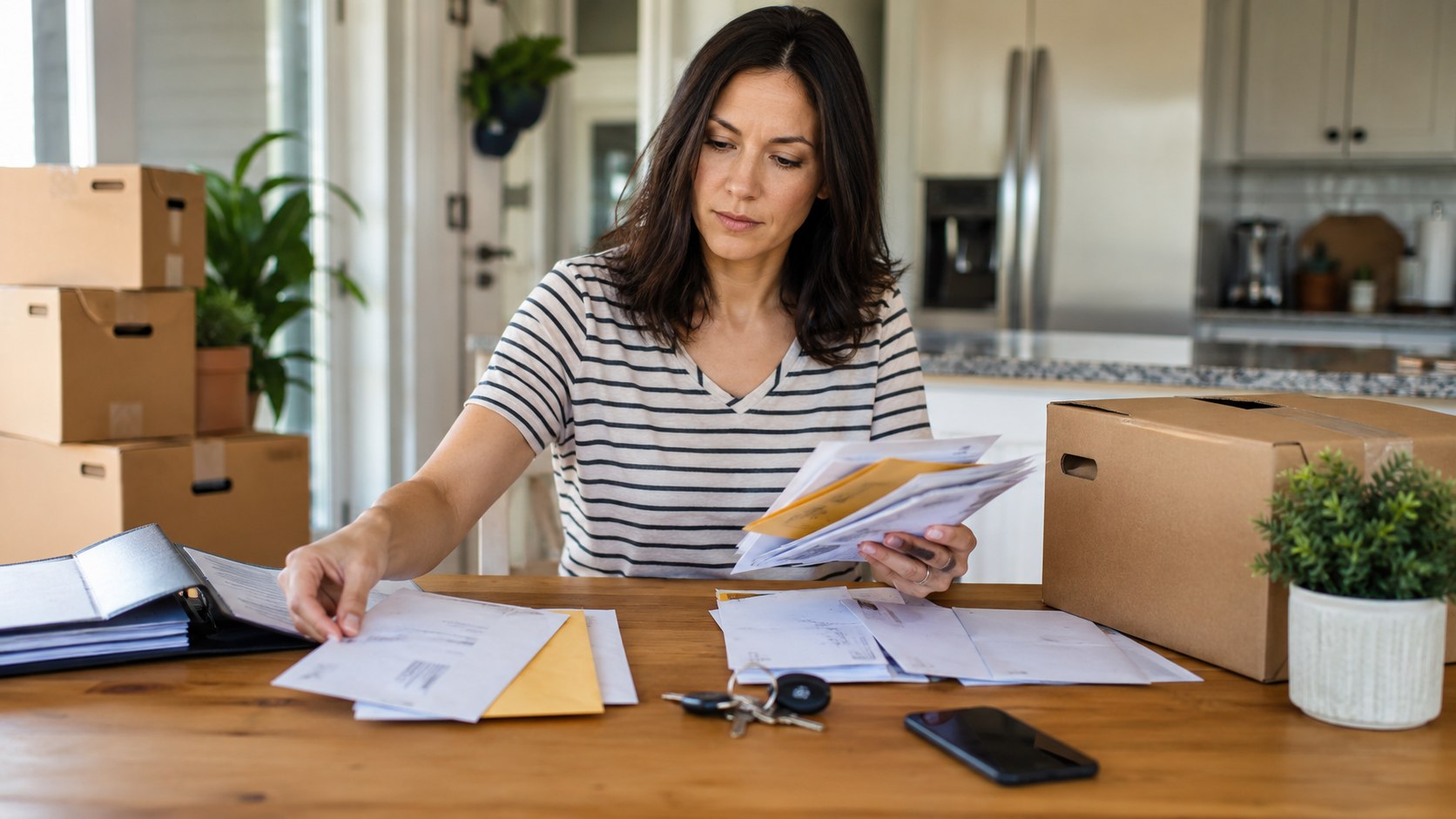
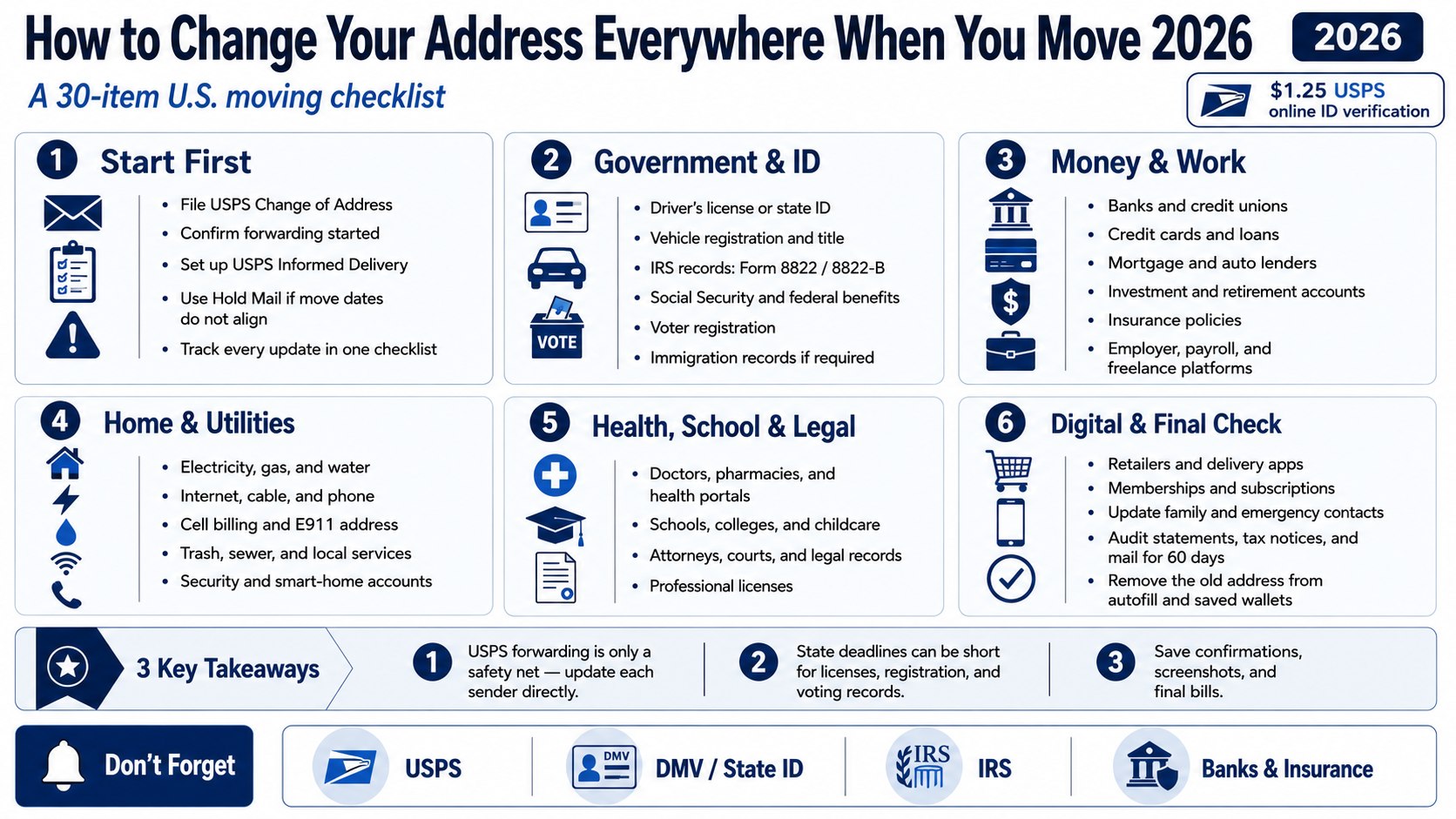
How to change your address everywhere when you move 2026 begins with 3 urgent steps. File a USPS request, update your state identification, and notify banks and insurers. Then use the 30-item checklist below to cover government, household, financial, and personal accounts, as the Baltimore Chronicle editorial team notes.
Do not treat USPS forwarding as a complete address update. It only redirects eligible mail for a limited period. Every agency, lender, utility, employer, school, and subscription service must receive the new address directly.
The checklist was built around records that affect identification, taxes, money, insurance, health care, voting, and essential services. Items appear in practical order, starting with changes that may carry legal deadlines.
Key takeaways
- Submit USPS forwarding before moving, but update every important sender separately.
- Check state deadlines for licenses, vehicle registration, insurance, and voter records.
- Save confirmation numbers, screenshots, emails, and the date of every request.
Address changes fail most often when people assume connected systems share information. A DMV update may not change vehicle registration. A bank profile update may not reach a separate mortgage or credit card account.
Use a spreadsheet or paper tracker during the first 60 days. Record the organization, request date, confirmation number, and next statement date. This provides evidence if a bill, tax notice, or insurance document reaches the wrong address.
How to Change Your Address Everywhere When You Move 2026: First Steps
1. Submit the official USPS change of address
Complete a permanent or temporary request through the official USPS Change of Address service. The online process includes a $1.25 identity-verification fee as of 2026.
Select an individual, family, or business move carefully. Family forwarding works only when everyone shares the same last name and moves to the same address.
The Baltimore Chronicle guide to forwarding mail when moving in the USA explains start dates, forwarding periods, eligibility, and common filing errors.
2. Confirm that forwarding has started
Watch for USPS confirmation at the old or new address. Check every detail, including the apartment number, directional prefix, city, state, and ZIP Code.
Forwarding does not cover every type of mail. Some government correspondence, marketing mail, packages, and mail marked with special sender instructions may be handled differently.
3. Activate USPS Informed Delivery
USPS Informed Delivery can show grayscale previews of eligible letter-size mail. It can also display tracking details for many incoming packages.
This provides an additional way to spot correspondence still using the old address. Follow the Baltimore Chronicle instructions for setting up USPS Informed Delivery in 2026.
4. Use USPS Hold Mail when dates do not align
A short mail hold may help when you leave the old home before gaining access to the new one. USPS Hold Mail generally stores eligible mail for pickup or later delivery.
It is not a substitute for permanent forwarding. The Baltimore Chronicle guide to setting up USPS Hold Mail explains timing, pickup choices, and the 30-day limit.
5. Create a change-of-address tracker
List every organization before submitting requests. Add separate rows for linked products, such as a checking account, credit card, mortgage, and investment account held by one company.
A submitted request is not necessarily a completed update. Mark an item finished only after the new address appears in the account or written confirmation arrives.
Update Federal, State, and Local Government Records
6. Driver’s license or state identification
Contact the DMV, BMV, MVD, DPS, or equivalent agency in your state. Deadlines differ, especially after an interstate move.
California, Texas, Florida, New York, Maryland, and other states use different procedures. Updating the agency database may not automatically produce a replacement card.
7. Vehicle registration
Update registration for every car, motorcycle, trailer, recreational vehicle, or boat covered by state rules. License and registration records may require separate transactions.
Interstate movers may need new plates, emissions testing, a VIN inspection, or proof of insurance. Verify requirements through the new state’s official website.
8. Vehicle title, lender, or leasing company
Check whether the title record also requires an update. Contact the lender or leasing company when it holds the title.
Use the vehicle identification number when submitting the request. A correct address reduces problems with lien notices, lease documents, and later title transfers.
9. IRS individual tax records
Individuals can report an address change using IRS Form 8822 or another method accepted by the agency. Filing a USPS request does not directly update the IRS account.
Married taxpayers who previously filed jointly may need separate forms after moving to different addresses. Submit the change before expecting a refund or identity-verification letter.
10. IRS business records
Business owners and freelancers should review Form 8822-B. It covers changes involving a business address, location, or responsible party.
Also update state revenue agencies, payroll services, registered agents, and local licensing offices. These systems do not automatically receive changes from the IRS.
11. Social Security and federal benefit accounts
Update Social Security records when receiving retirement, disability, Medicare-related, or Supplemental Security Income correspondence. Some beneficiaries can make changes through their online account.
Veterans should separately update the Department of Veterans Affairs. Other federal benefit programs may maintain independent address records.
12. Voter registration
Update voter registration through the state or local election authority. Moving across a precinct, county, or state line can change the ballot and polling location.
Do not assume DMV information will always update registration in time. Confirm voter status before the applicable election deadline.
13. Immigration records
Noncitizens should check current USCIS address-reporting requirements. Updating an attorney, employer, or pending application may not satisfy every reporting obligation.
Review pending petitions and appointment notices carefully. Immigration correspondence can include strict response or attendance deadlines.
The priorities below help separate urgent records from changes that can wait several days.
| Record | Best time to update | Main risk |
|---|---|---|
| USPS forwarding | Before the move | Mail reaches the former home |
| Driver’s license | Immediately after moving | Missing a state deadline |
| Vehicle registration | Immediately after moving | Renewal or enforcement notices fail |
| IRS records | As soon as practical | Tax notices reach the wrong address |
| Voter registration | Before the state deadline | Wrong precinct or inactive record |
Begin with any item governed by law or an agency deadline. Interstate moves usually create more requirements than moves within one city.
Keep digital copies of a lease, closing statement, utility bill, and insurance declaration. Agencies may request 1 or 2 proofs of residency.
Use official government websites rather than paid change-of-address services. Third-party sites may charge extra without updating every required record.
Check whether the address displayed online is residential, mailing, or both. Some agencies store these fields separately.
Review each confirmation for spelling and apartment details. A missing unit number can be enough to misdirect important correspondence.
Change Financial, Insurance, and Employment Accounts
14. Banks and credit unions
Update checking, savings, certificates of deposit, and safe-deposit records. Confirm both residential and mailing addresses.
Banks use address information for statements, identity checks, replacement cards, and fraud controls. Review person-to-person payment profiles as well.
15. Credit cards and retail financing
Change the address for every credit card and store financing account. The billing ZIP Code may be checked during fuel purchases and online transactions.
Do not update only the card used most often. Dormant cards can still produce renewal notices, tax records, or fraud alerts.
16. Mortgage, auto, student, and personal loans
Notify every lender or loan servicer. Homeowners leaving a financed property must distinguish the property address from the new correspondence address.
Confirm where annual tax statements and escrow documents will be sent. A lender may maintain several addresses within one customer profile.
17. Investment and retirement accounts
Update brokerage accounts, IRAs, 401(k) plans, pensions, stock plans, and education savings accounts. Check electronic and paper delivery settings.
Tax documents such as Forms 1099 and 5498 may arrive months after the move. Keep the address current through the next tax season.
18. Insurance companies
Contact auto, renters, homeowners, umbrella, health, dental, vision, life, and pet insurers. The new location can affect premiums and coverage.
For auto insurance, report where the vehicle is normally parked. An outdated garaging address can affect underwriting and claims.
19. Employer and payroll department
Give human resources the new residential and mailing addresses. Review state and local tax withholding after crossing jurisdictional lines.
Confirm the address used for Forms W-2, benefits, retirement plans, and emergency contacts. Remote workers should also check employer location policies.
20. Freelance clients and payment platforms
Freelancers should update W-9 details, invoices, contracts, and bookkeeping software. Review Stripe, PayPal, Square, QuickBooks, and marketplace accounts.
The public business address may differ from the tax or verification address. Keep those fields consistent with the documents used by each platform.
“Treat each financial product as a separate record, even when several products appear under one company login.”
Transfer Utilities and Property Services
21. Electricity, gas, and water
Schedule service termination at the old property and activation at the new one. Photograph accessible meter readings on the handover date.
Keep the final statement and deposit-refund confirmation. Verify that autopay stops after the closing bill.
22. Internet, cable, and home telephone
Check whether providers such as Xfinity, Spectrum, AT&T, or Verizon serve the new address. Available speeds, equipment, taxes, and plans may differ.
Return rented routers and modems using a trackable method. Save the receipt until the provider confirms removal from the account.
23. Cellphone billing and E911 address
Update the billing address for every mobile line. Then review the emergency address used for Wi-Fi calling.
The E911 address helps emergency services locate a caller. It should show the physical location, not only a mailing address.
24. Trash, recycling, sewer, and local services
Ask whether waste bins remain with the property. Homeowners may also need to change sewer, stormwater, parking, and local tax records.
Renters should confirm which services are included in the lease. Rules can differ between neighboring cities or counties.
25. Security and smart-home accounts
Notify ADT, Ring, SimpliSafe, and other monitoring providers. Update the emergency-service location and authorized contacts.
Remove access for former residents, contractors, or household members. Transfer equipment only when allowed by the service agreement.
Before closing the utility stage, review these practical details:
- Service dates match the lease or property closing schedule.
- Deposits and credits will reach the new address.
- Autopay ends after each final statement.
- Returned equipment has a tracking number.
- Emergency-service records show the physical address.
- Municipal permits and parking accounts are updated.
Review the first bill from every transferred provider. Some companies create a new account rather than transferring the old one.
Compare rates and fees before accepting a transfer offer. Promotional terms may not follow the customer to another service area.
Do not cancel internet before confirming installation at the new home. Appointment availability may be limited during busy moving periods.
Check old accounts for unexpected charges after the final billing date. Contact the provider immediately when a service remains active.
Keep equipment-return receipts for several billing cycles. Unreturned modem or router fees can exceed the value of the equipment.
Update Health, Education, Family, and Legal Records
26. Doctors, pharmacies, and health portals
Update primary care, specialist, dental, laboratory, pharmacy, and patient portal records. Confirm where prescriptions and medical supplies will be shipped.
Check whether the move changes the provider network under your health plan. Interstate moves may require selecting new local providers.
27. Schools, colleges, and childcare providers
Give the new address to schools, daycare centers, colleges, scholarship programs, and student-aid administrators. A district move may require proof of residency.
Review transportation routes, emergency contacts, meal accounts, and attendance boundaries. Do not rely only on a teacher or classroom update.
28. Attorneys, courts, and legal documents
Notify attorneys handling active cases and follow court procedures for changing a service address. Informal email may not satisfy formal filing rules.
Review wills, trusts, custody documents, powers of attorney, and business registrations. Some documents identify a residence or county.
29. Professional and occupational licenses
Doctors, nurses, contractors, attorneys, real estate agents, and other professionals may face reporting deadlines. Update state boards and public license profiles.
Review local permits and continuing-education accounts. An interstate move may require a new license rather than a simple address change.
Remove the Old Address From Digital and Personal Accounts
30. Retailers, subscriptions, memberships, and contacts
Remove the old default address from Amazon, Walmart, Target, Chewy, Instacart, DoorDash, and other delivery accounts. Review Apple Pay, Google Wallet, PayPal, and browser autofill.
Update gyms, libraries, clubs, charities, roadside assistance, and warehouse memberships. Pet owners should change microchip and local license records. Tell relatives and friends who mail cards, checks, gifts, or invitations. Parents should also review camps, sports leagues, and family location-sharing apps.
Continue checking forwarded mail for at least 2 billing cycles. Every envelope printed with the old address identifies another account requiring attention.
Final Address-Change Audit for 2026
Review bank statements, credit reports, insurance documents, voter registration, tax records, and vehicle accounts. Investigate any address change you did not authorize.
Search email for phrases such as “billing address,” “shipping confirmation,” “annual statement,” and “renewal notice.” These searches often reveal forgotten accounts.
Check your password manager and recurring card transactions. Both can uncover services that rarely send paper correspondence.
Keep the tracker active until every important account shows the new address. Direct verification remains more reliable than assuming systems exchanged information.
Honorable mentions
- Airline, hotel, loyalty, and event-ticket accounts.
- Storage units, magazine publishers, and meal-kit subscriptions.
- Hunting, fishing, pet, and community garden licenses.
These accounts are less urgent, but they can still create lost deliveries or renewal problems. Update those connected to automatic payments first.
Review memberships before renewing them. A move may make a local service unusable or change its tax treatment.
Delete the old address instead of leaving it as the default option. This prevents accidental delivery during rushed online purchases.
Check household accounts used by a spouse or another family member. Their saved addresses may remain unchanged.
Complete one last audit before the next tax season. Late-arriving tax and benefits documents frequently expose missed updates.
FAQ
Does changing my address with USPS update it everywhere?
No. USPS forwards eligible mail but does not update the databases of the IRS, DMV, banks, insurers, employers, or utility companies.
How early should I file a USPS change of address?
Submit the request before moving and select the date when forwarding should start. Allow time for identity verification and confirmation.
Which address changes should I complete first?
Prioritize USPS, driver’s license, vehicle registration, insurance, banks, employer, IRS records, utilities, and voter registration.
Do I need a replacement driver’s license after moving?
Requirements depend on state law. Some states require only a database update, while others require a replacement card or new license.
What documents can prove my new address?
Accepted documents often include a lease, closing statement, utility bill, insurance declaration, bank statement, or government letter.
How can I find accounts I forgot to update?
Review forwarded mail, recurring payments, email receipts, saved browser addresses, tax files, and entries in your password manager.
Earlier we wrote about Cash App Taxes 2026: What to Report, What Is Exempt, and How to File