

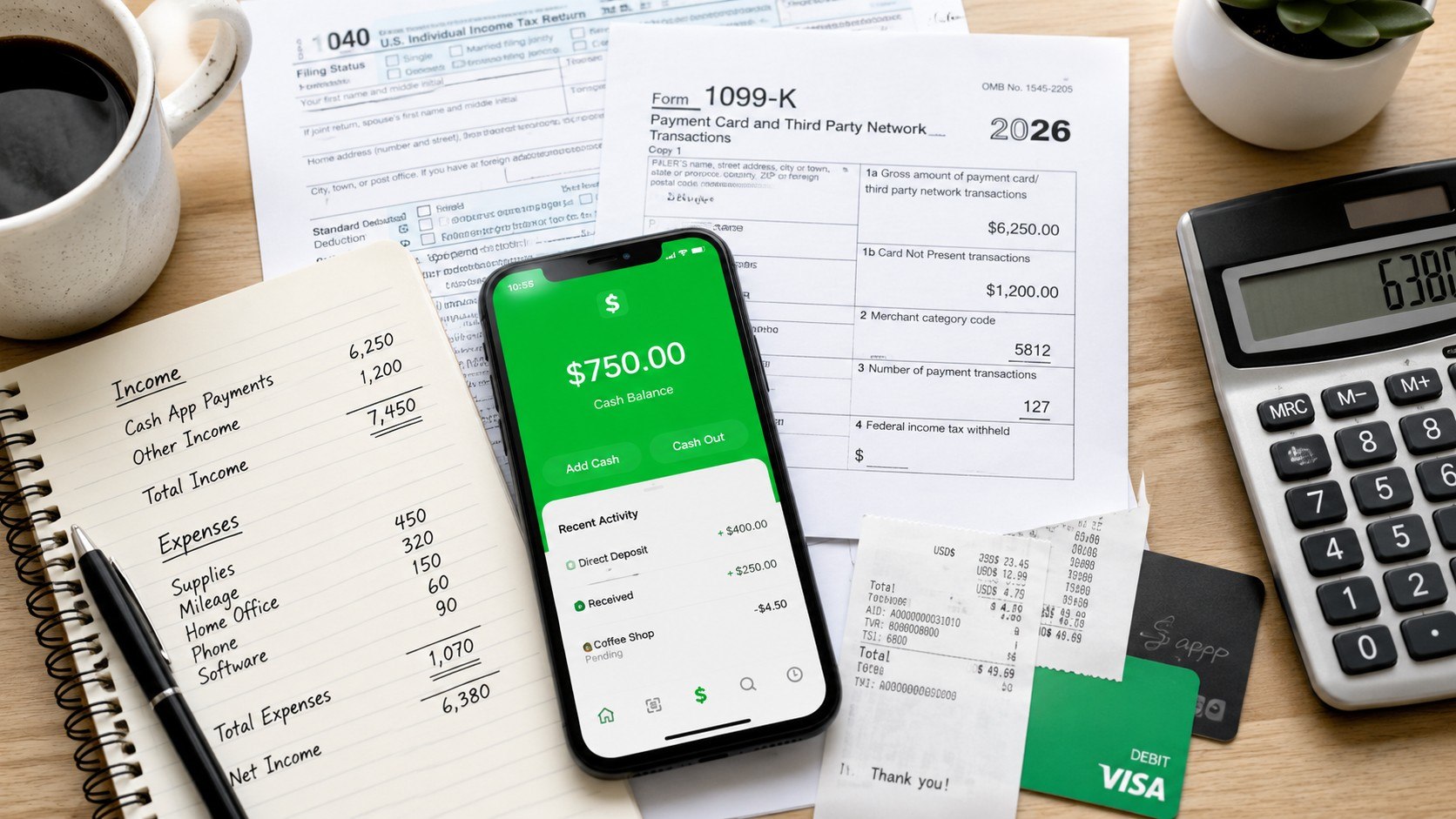
How to report Cash App on taxes 2026 starts with one distinction: why did you receive the money? Payments for work, services, rent, products, or profitable sales may be taxable. Gifts, shared expenses, and repayments usually are not. Most people can sort a year of basic transactions within 30–60 minutes, as the Baltimore Chronicle editorial team notes.
Do not wait for Form 1099-K before reporting income. The form is an information document, not the rule that makes money taxable. You must report qualifying income even when Cash App sends no tax form.
Key takeaways
- Cash App payments are taxed according to their purpose, not the payment method or account balance.
- The federal 1099-K threshold generally requires both more than $20,000 and over 200 transactions.
- Gifts, reimbursements, and transfers between your accounts are generally not taxable income.
What you need before reporting Cash App income
Gather the documents below before opening tax software. Complete records help distinguish business revenue from personal transfers and prevent duplicated income.
- Your complete Cash App transaction history for the tax year
- Form 1099-K, Form 1099-NEC, and Form 1099-MISC, when received
- Invoices, customer messages, contracts, and sales records
- Receipts showing the original cost of personal items later sold
- Business receipts, mileage logs, and records of Cash App fees
- Bank statements showing transfers from your Cash App balance
- Federal and state tax software or a qualified tax professional
Do not rely only on transaction notes entered by customers. A note such as “materials” or “repair” can provide context, but it is not complete proof. Match incoming payments with invoices, receipts, contracts, or messages.
Save copies outside the app. An exported spreadsheet or PDF is easier to reconcile and protects you if account access changes later.
Step 1: Download and classify every Cash App payment
Download your transaction history for the entire tax year. Review each incoming payment and assign it to a category, such as business income, rent, gift, reimbursement, refund, personal sale, or account transfer.
This step matters because the IRS considers the source and purpose of the payment. Receiving $500 through Cash App does not automatically make it taxable or nontaxable.
A $500 payment for photography services is generally business income. A $500 transfer from your spouse for household expenses usually is not.
Common mistake to avoid: reporting every Cash App deposit as self-employment income without removing personal payments.
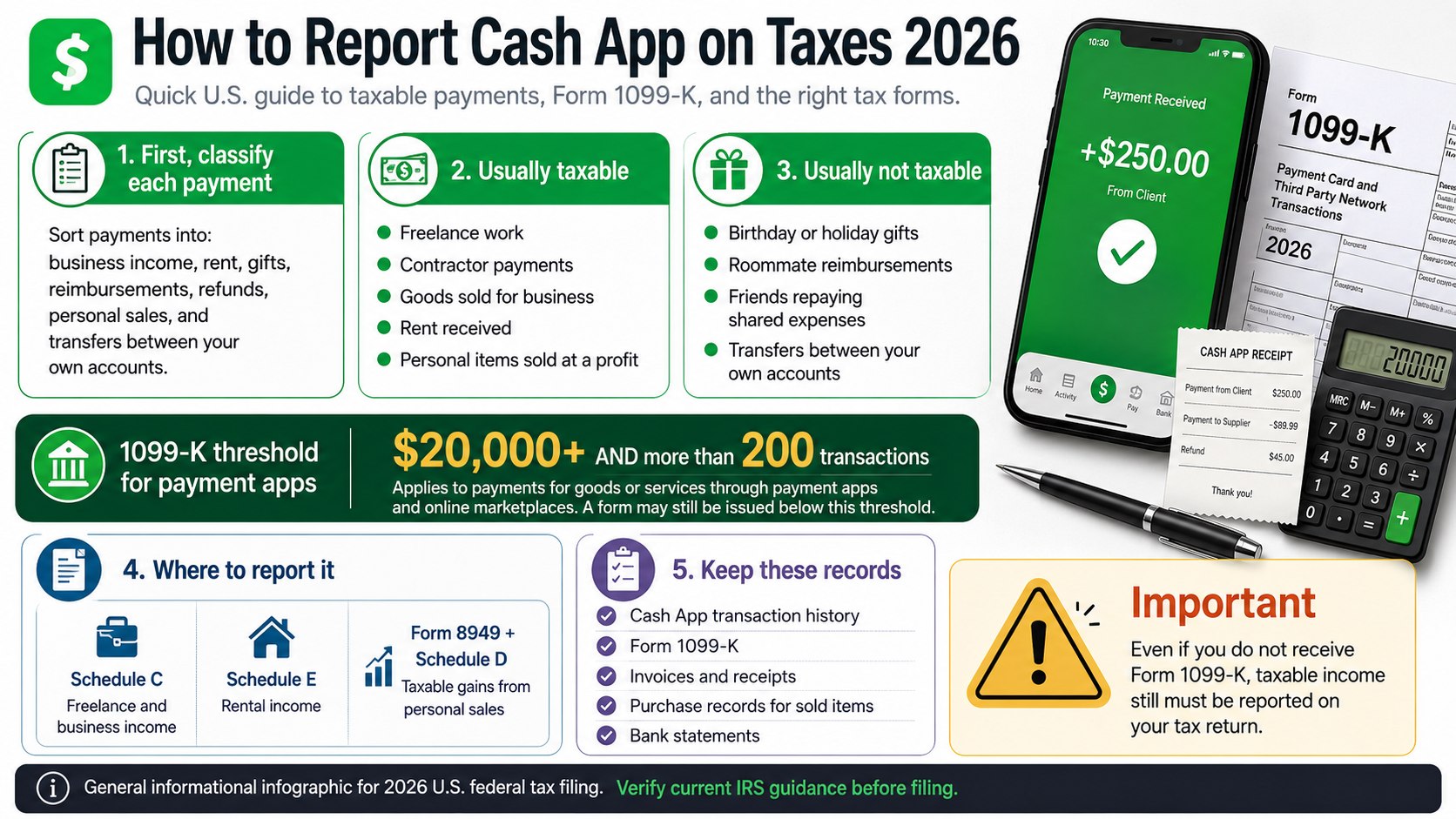
Step 2: Decide which Cash App payments are taxable
Money earned from freelance work, repairs, consulting, childcare, cleaning, landscaping, online sales, or other services generally must be reported. This remains true when the activity is part-time or occasional.
Personal transfers normally do not become taxable income. Common examples include a roommate repaying $750 for rent, a friend returning $60 for dinner, or a parent sending a $200 birthday gift.
Sales of personal belongings need separate treatment. Selling a used sofa for $400 after paying $1,000 creates no taxable gain. Selling a collectible for $1,600 after paying $700 generally creates a taxable gain of $900.
The following breakdown shows how common transactions are usually handled.
| Cash App transaction | Usually taxable? | Likely federal reporting location |
|---|---|---|
| Freelance or contractor payment | Yes | Schedule C |
| Revenue from regular product sales | Yes | Schedule C or business return |
| Roommate’s share of utilities | No | Usually not reported |
| Birthday or holiday gift | No | Usually not reported by the recipient |
| Personal item sold for a profit | Profit is taxable | Form 8949 and Schedule D |
| Personal item sold for a loss | Loss is generally not deductible | Special 1099-K adjustment may apply |
| Rent collected from a tenant | Generally yes | Schedule E |
The account label does not control the tax result. A customer may mark a commercial payment as personal, but the money can still represent taxable income.
The reverse also happens. A legitimate reimbursement may accidentally appear as a payment for goods or services. Keep supporting records showing what the transfer covered.
For resold property, preserve the original receipt whenever possible. Your purchase cost determines whether the sale produced a gain or a nondeductible personal loss.
Review each item separately rather than applying one rule to the entire account. Mixed-use accounts often contain several tax categories.
Step 3: Understand the 2026 Form 1099-K threshold
The central issue in how to report Cash App on taxes 2026 is the restored federal reporting threshold. A third-party payment network generally must issue Form 1099-K when payments for goods or services exceed $20,000 and involve more than 200 transactions during the calendar year.
Both conditions generally must be met. Receiving $24,000 through 80 qualifying transactions may fall below the federal third-party network threshold because the transaction count does not exceed 200.
However, Cash App or another payment processor may issue a form below the federal threshold. State reporting requirements can also differ.
The threshold determines when a payment platform must report activity. It is not a tax-free allowance. A freelancer who receives $4,000 for design work may owe tax even without Form 1099-K.
Whether you receive Form 1099-K or not, taxable income from goods and services must still be included on your federal return.
Common mistake to avoid: assuming Cash App income below $20,000 does not need to be reported.
Step 4: Compare Form 1099-K with your own records
Review Box 1a of Form 1099-K and compare it with your exported Cash App history. The form generally shows gross payment activity before deductions.
It may not subtract refunds, chargebacks, shipping, platform fees, or business expenses. A seller might receive a form showing $28,000 despite keeping only $21,500 after refunds and operating costs.
Begin with accurate gross receipts, then record eligible expenses separately. Do not simply replace the gross amount with the amount transferred to your bank.
Check for duplicate reporting as well. A customer might issue Form 1099-NEC while the same payment is already included within the 1099-K total.
For example, adding a $3,000 Form 1099-NEC to a 1099-K that already includes that payment would overstate revenue by $3,000. Create a reconciliation showing every duplicated amount.
Common mistake to avoid: entering every information form as separate income without checking the underlying transactions.
Step 5: Report business income on the correct tax form
Freelancers, independent contractors, and sole proprietors usually report Cash App revenue on Schedule C, Profit or Loss From Business. Enter gross business receipts and then claim qualified business expenses in the correct categories.
Possible deductions include advertising, supplies, software, professional fees, insurance, transaction fees, and eligible vehicle expenses. Each deduction needs a business purpose and supporting documentation.
Net self-employment earnings of at least $400 generally trigger Schedule SE. The resulting self-employment tax covers Social Security and Medicare contributions.
Not every payment belongs on Schedule C. Rental income normally appears on Schedule E, while farm income may require Schedule F. Partnerships, S corporations, and C corporations use their relevant business returns.
Taxpayers who want to avoid unnecessary filing costs can review Baltimore Chronicle’s guide on how to file taxes for free in the USA in 2026. It explains IRS Free File, Free File Fillable Forms, VITA, TCE, and other options.
Common mistake to avoid: reporting only the amount transferred from Cash App to your bank. Transfers do not determine when business income was received.
Step 6: Report personal sales and correct inaccurate forms
When a personal item sells for more than its documented cost, the profit is generally taxable. The transaction may need to be reported through Form 8949 and Schedule D.
Suppose you bought a concert poster for $300 and sold it for $1,100. The potential taxable gain is $800 before considering applicable selling costs.
A personal loss works differently. If you paid $1,200 for a laptop and sold it for $450, the $750 loss generally cannot reduce your taxable income.
If that $450 appears on Form 1099-K, you may need an offsetting entry under the IRS instructions for the relevant filing year. This prevents gross proceeds from being treated as taxable profit.
Contact the issuer when the form contains gifts, reimbursements, duplicate transactions, or activity belonging to another taxpayer. Request a corrected Form 1099-K and keep copies of messages and supporting documents.
Do not ignore an incorrect form. The IRS receives its own copy and may compare it with the amounts on your return.
Common mistake to avoid: removing a disputed 1099-K amount without documenting why it was excluded or adjusted.
Step 7: Check filing deadlines and estimated taxes
Most federal individual income tax returns for the 2025 tax year are due on April 15, 2026. The same date usually applies to any remaining federal balance.
Baltimore Chronicle’s guide to federal tax deadlines in the USA for 2026 explains filing dates, quarterly estimated payments, and extension deadlines.
Self-employed workers should review income throughout the year. Quarterly estimated tax payments may be required when withholding and credits will not cover the expected liability.
Keep transaction histories, receipts, invoices, tax forms, and reconciliation worksheets with your return records. Taxpayers generally retain supporting documents for at least 3 years, although longer periods apply in certain cases.
Opening a separate Cash App account for business transactions can simplify next year’s records. It reduces the time spent distinguishing customer payments from family transfers.
Common mistake to avoid: waiting until filing week to classify hundreds of mixed personal and business payments.
Step 8: File an extension when records are incomplete
Do not guess when Form 1099-K is missing, incorrect, or still under review. An inaccurate return can create more work than filing a valid extension.
Taxpayers can generally request an automatic federal filing extension using Form 4868. Baltimore Chronicle explains how to file a tax extension in 2026 through an electronic request, tax software, or an IRS payment option.
An extension normally moves the filing deadline to October 15, 2026. It does not extend the deadline for paying tax.
Estimate the expected liability and pay as much as possible by the original April deadline. Interest and possible penalties can apply to unpaid balances.
Common mistake to avoid: assuming Form 4868 provides an additional 6 months to pay the tax bill.
Troubleshooting common Cash App tax problems
Most Cash App reporting problems can be solved by matching the payment’s purpose with supporting documents. Use these responses when your records and tax forms do not agree.
- No Form 1099-K arrived: calculate and report taxable income using your transaction history, invoices, and bank records.
- The form includes personal payments: ask the issuer for a correction and preserve evidence showing gifts or reimbursements.
- The same payment appears twice: reconcile Form 1099-K with Forms 1099-NEC or 1099-MISC before entering income.
- You sold several used items: calculate the cost, selling price, and gain or loss for each item separately.
- Your account mixes personal and business activity: create a spreadsheet and classify every incoming transaction.
Do not use an unsupported estimate for large adjustments. A line-by-line reconciliation creates a defensible record and gives a tax preparer usable information.
When several people use one account, identify who earned each payment. A form issued under the wrong Social Security number or employer identification number may need correction.
Complex situations can involve partnerships, nominee payments, inherited property, cryptocurrency, or transactions collected for another person. These cases may require additional forms.
A certified public accountant, enrolled agent, or tax attorney can review the facts. Bring the complete transaction export rather than selected screenshots.
State rules also matter. Residents of Maryland, California, New York, Virginia, and other income-tax states should verify current instructions with their state revenue agency.
FAQ
Does Cash App report personal payments to the IRS?
Gifts and repayments for personal expenses should not be treated as payments for goods or services. Users should label transactions correctly and keep records proving their purpose.
Do I pay tax on Cash App payments under $600?
Possibly. Taxability depends on why you received the payment, not whether it exceeded $600. Income from services or profitable sales can still be taxable.
What is the Cash App 1099-K threshold for 2026?
The federal threshold for third-party payment networks generally requires more than $20,000 in qualifying payments and over 200 transactions. Forms may still be issued below those limits.
Where should I report Cash App income?
Freelancers and sole proprietors commonly use Schedule C. Rental income may use Schedule E, while gains from personal property may require Form 8949 and Schedule D.
Are Cash App reimbursements taxable?
A genuine repayment for dinner, utilities, shared rent, tickets, or another personal expense is generally not income. Save receipts and messages supporting the reimbursement.
What happens if Cash App does not send Form 1099-K?
You must still report taxable payments. Use your Cash App history, invoices, sales records, receipts, and bank statements to calculate the correct amount.
Earlier we wrote about How to Become an Uber Driver in USA 2026: Requirements, Documents and Signup Steps