


When is the best time to sell a house in USA? For most homeowners, the strongest 2026 listing window runs from late February through May. March leads historical seller premiums, while April and May usually bring more active buyers. Start preparing 6–8 weeks earlier, then list before local inventory becomes crowded, as the Baltimore Chronicle editorial team notes.
Homeowners seeking the highest possible price should usually target spring. Those prioritizing speed may benefit from listing before the seasonal rush. A seller facing job relocation, divorce, carrying costs, or an expiring rate lock should not delay solely for a better month.
“For homeowners thinking about selling, timing still matters.”
ATTOM Team, property-data analysts, ATTOM, April 2026 annual review of US home sales.
Key takeaways
- March produced the strongest historical seller premium, but preparation should begin during January or early February.
- April through June brings broad buyer demand, longer daylight, easier inspections, and family-driven summer moving plans.
- Local inventory, mortgage rates, home condition, and personal carrying costs can outweigh national seasonal patterns.
Timing affects the result, but it cannot rescue an overpriced or poorly presented property. Before choosing a date, calculate your likely proceeds using the Baltimore Chronicle guide to home-selling costs in 2026. Sellers should also review current real estate commission rules before signing a listing agreement.
Calendar at a glance
The following overview uses ATTOM’s analysis of more than 11 years of single-family home and condo transactions. The percentages compare median sale prices with ATTOM’s estimated market values. They do not promise that an individual property will earn the same premium.
| Month | Historical seller premium | Practical 2026 assessment |
|---|---|---|
| January | 9.6% | Lower competition, but a smaller buyer pool in colder states |
| February | 10.0% | Strong early window in California, Arizona, Florida, and Texas |
| March | 10.7% | Highest historical premium and growing spring demand |
| April | 10.2% | Excellent balance of demand, weather, and buyer urgency |
| May | 10.2% | Large buyer pool, but rapidly increasing listing competition |
| June | 10.0% | Strong family demand before the next school year |
| July | 8.5% | Active market, although heat and vacations can reduce showings |
| August | 8.4% | Useful final window for buyers seeking a summer move |
| September | 8.0% | Demand softens after school resumes in many districts |
| October | 7.9% | Lowest historical premium, with fewer casual buyers |
| November | 8.3% | Smaller buyer pool, but remaining buyers may be serious |
| December | 9.1% | Limited inventory can help well-priced homes stand out |
March ranks first by premium, although sellers rarely decide on a Monday and close immediately. A typical transaction includes preparation, marketing, negotiations, inspections, appraisal, title work, and financing. Therefore, a March closing may require a January or February listing.
May remains attractive because buyer activity is usually broad. Families often want to close before summer ends, while longer daylight improves photography and evening showings. However, May also brings more competing listings.
October shows the weakest historical premium in this dataset. That does not mean October sellers lose money. A scarce, updated home in Boston, Denver, or Seattle may outperform an average spring listing with poor photographs and deferred maintenance.
The useful question is not simply which month ranks first. It is when your property can enter the market in its strongest condition.
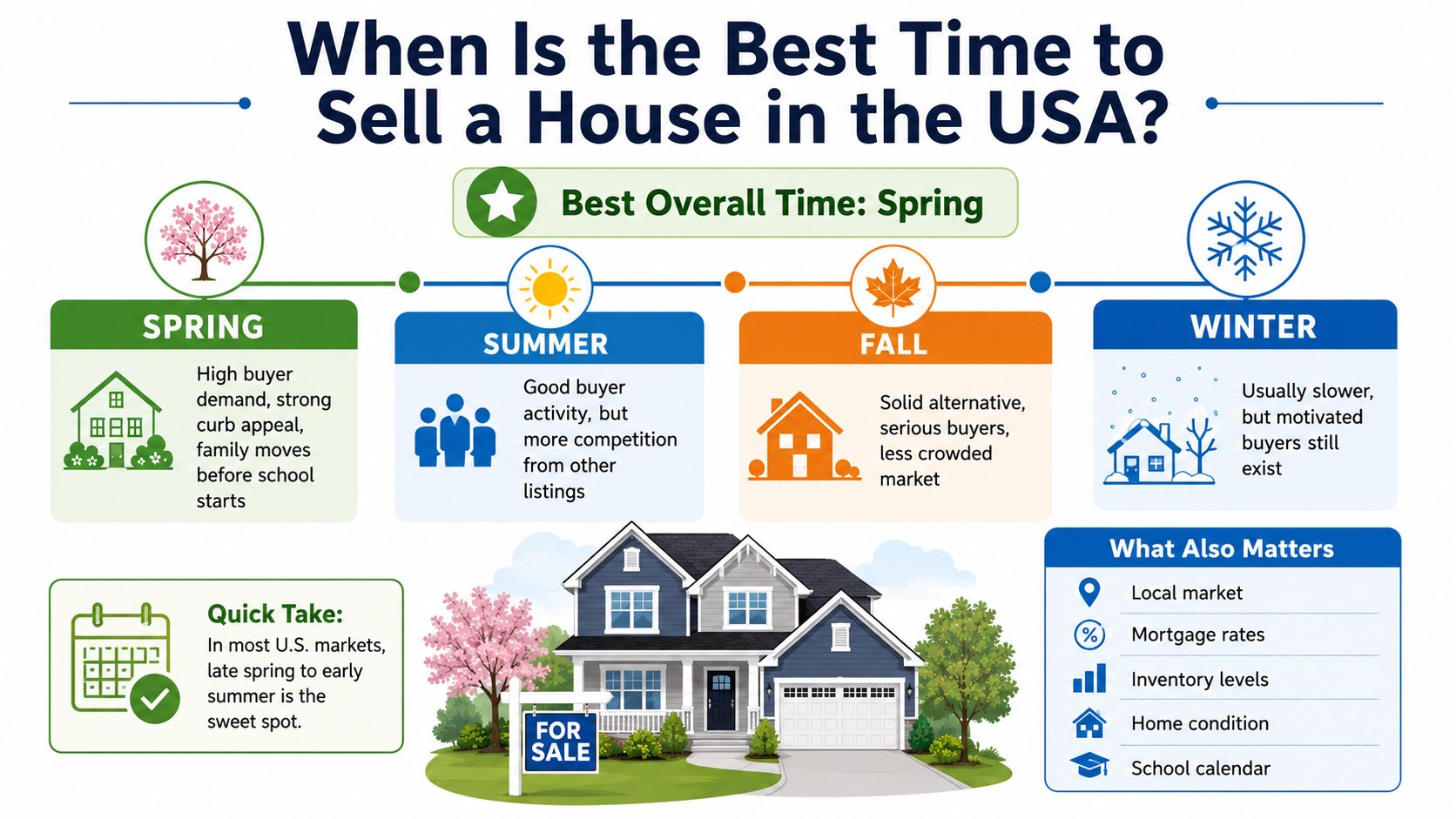
When is the best time to sell a house in USA by seller goal?
The best month changes when the seller’s priority changes. Maximum price, fast closing, low competition, and convenient moving dates require different strategies.
| Seller’s priority | Recommended listing period | Main reason |
|---|---|---|
| Highest possible price | Late February through April | Targets historically strong spring closing periods |
| Largest buyer pool | April through May | More households shop before summer moves |
| Less listing competition | January or early February | Fewer comparable homes may be available |
| Fast family-oriented sale | May through June | Buyers often want to settle before school starts |
| Motivated buyers | November through December | Holiday-period buyers often have firm deadlines |
A homeowner in Minneapolis may wait for snow to clear before scheduling exterior photography. A seller in Phoenix may prefer February or March, before extreme heat reduces afternoon tours. Coastal Florida also follows different seasonal patterns because winter residents and second-home buyers can increase demand earlier.
In expensive California markets, a small percentage change can equal tens of thousands of dollars. In lower-priced markets across Ohio, Indiana, or Missouri, avoiding another month of mortgage payments may matter more than waiting for a modest seasonal premium.
Calculate the daily cost of waiting. Include mortgage interest, property taxes, homeowners insurance, utilities, HOA dues, lawn care, and maintenance. A home costing $3,200 monthly to carry adds about $106 for every extra day before closing.
Why timing matters
Buyer demand changes during the year
More buyers usually search during spring because weather improves and families begin planning summer moves. Increased traffic can produce more showings, stronger offers, and fewer demands for concessions. Buyers also have more daylight for weekday appointments.
Demand does not rise equally everywhere. Snowbelt markets often experience pronounced spring increases. Sunbelt and resort markets can attract buyers during winter, particularly in Arizona and Florida.
Competing inventory affects leverage
Spring brings buyers, but it also brings sellers. Listing too late may place the home beside several renovated competitors. An early spring launch can capture demand before buyers have dozens of alternatives.
Monitor active listings within the same school district, price band, property type, and approximate square footage. National trends matter less than whether 4 similar homes or 40 similar homes are competing locally.
Mortgage rates change purchasing power
Freddie Mac reported an average 30-year fixed mortgage rate of 6.55% on July 16, 2026. Rates can move weekly, and actual borrower offers vary by credit profile, loan type, points, and lender.
When rates increase, buyers may lower their maximum price or request seller-paid closing assistance. Falling rates can restore demand quickly. Sellers should check the latest Freddie Mac mortgage-rate data before finalizing a listing date.
The effect becomes visible in monthly payments. On a large mortgage, even a modest rate change can reduce a buyer’s purchasing capacity. A seller who ignores financing conditions may choose an ambitious price that no longer matches the qualified buyer pool.
How to choose your exact listing date
Choose a target week only after reviewing property readiness and local competition. The following process reduces the risk of entering the market too early or missing the strongest demand period.
- Ask 2 or 3 local agents for comparable sales from the previous 90 days.
- Count competing listings within your neighborhood, school district, and price range.
- Estimate repairs, staging, photography, landscaping, and cleaning time.
- Request a seller net sheet using at least 2 realistic sale prices.
- Review mortgage rates and the number of recent price reductions nearby.
- Select a launch date 7–10 days after all work is scheduled to finish.
- Prepare a backup price and concession strategy before the first showing.
Do not schedule photography immediately after contractors are supposed to finish. Delays are common, and rushed photographs remain online through listing portals such as Zillow, Realtor.com, Redfin, and brokerage websites.
A Thursday launch often gives agents time to schedule weekend tours. However, local MLS behavior matters more than a universal weekday rule. Your agent should identify which days produce the strongest first-week traffic in that market.
The first 7–14 days carry unusual weight. Buyers watching saved searches receive alerts quickly, while agents notice new inventory. Repeated price cuts cannot fully recreate the attention earned by a properly priced new listing.
A seller should enter the market when the home, pricing strategy, disclosures, photographs, and moving plan are ready at the same time.
Preparation timeline before the spring market
A homeowner targeting March or April should begin months earlier. Major repairs, estate paperwork, title defects, contractor delays, and tenant notice requirements can disrupt an otherwise strong listing plan.
- 10–12 weeks before listing: interview agents, inspect the property, and identify title or ownership problems.
- 8–10 weeks before listing: approve essential repairs and obtain contractor schedules.
- 6–8 weeks before listing: declutter rooms, storage areas, garage space, and exterior structures.
- 4–6 weeks before listing: complete paint, lighting, landscaping, cleaning, and minor maintenance.
- 2–3 weeks before listing: stage rooms, prepare disclosures, and confirm pricing.
- 7–10 days before listing: complete photography, floor plans, video, and marketing copy.
- 1–2 days before listing: clean again, secure valuables, and verify showing instructions.
Preparation should focus on defects buyers can see or smell. Peeling paint, stained carpet, damaged trim, overgrown landscaping, and broken fixtures create doubts about hidden maintenance. Small repairs can also reduce inspection disputes.
Large renovations require caution. A $45,000 kitchen project does not automatically add $45,000 to the sale price. Local buyers may prefer different materials, colors, or layouts.
Staging costs vary by region and property size. Virtual staging may help an empty room online, but it should be clearly disclosed. Physical staging can improve scale and flow during tours, particularly in vacant or unusually shaped homes.
Review estimated transaction expenses before approving upgrades. Baltimore Chronicle’s explanation of buyer and seller closing costs outlines how title fees, taxes, credits, and other charges affect settlement figures.

Edge cases in 2026
A required move before August 2026
A seller relocating for work should compare seasonal upside with carrying costs and temporary housing. Waiting until May is rarely sensible when an empty property requires several additional mortgage payments. Listing earlier at a realistic price may protect total net proceeds.
A late-summer listing after August 15, 2026
Family demand may decline once schools reopen, but the market does not disappear. Focus marketing on buyers without school-calendar constraints, including retirees, remote workers, investors, and relocating professionals. Price against current competition rather than spring sales alone.
A property not ready by October 1, 2026
Owners should compare an autumn launch with waiting until January or early spring 2027. The decision depends on local inventory, winter weather, vacancy risk, taxes, insurance, and repair exposure. A warm-climate market may not justify waiting.
Other exceptions deserve separate analysis. Probate sales may require court or estate approval. Divorcing owners may need written agreement on price and expenses. Landlords must comply with state and local notice rules before delivering a vacant property.
Owners facing foreclosure deadlines, unaffordable payments, or serious property damage should obtain professional advice immediately. Seasonal optimization becomes secondary when delay creates legal costs, penalties, or additional deterioration.
FAQ
What is the single best month to sell a house in the USA?
March produced the highest historical seller premium in ATTOM’s 2015–2025 analysis. However, a seller seeking a March closing may need to list during January or February. April and May also remain strong national periods.
Is May still a good month to sell a house in 2026?
Yes. May combines a large buyer pool with summer-moving demand. Competition from other sellers also increases, so pricing and presentation must be ready before the listing appears.
What is the worst month to sell a house?
October recorded the lowest premium in ATTOM’s annual dataset at 7.9%. Local results can differ, and reduced inventory may help an attractive property stand out during autumn.
Should I wait for mortgage rates to fall before selling?
Not necessarily. Rate forecasts are uncertain, and lower rates may attract both more buyers and more competing sellers. Compare potential demand gains with monthly carrying costs and your personal deadline.
How early should I prepare for a spring sale?
Begin 8–12 weeks before the intended listing date. Older homes, inherited properties, tenant-occupied units, and houses requiring major repairs may need a longer schedule.
Can I sell successfully during winter?
Yes. Winter usually brings fewer shoppers, but remaining buyers may have stronger deadlines. Clean access, bright interior photography, realistic pricing, and flexible showing times become particularly important.
Final decision
For most US homeowners, the best season to sell a house begins in late winter and continues through May. March has delivered the highest historical premium, while April and May offer broad buyer activity. The right listing date should still reflect local supply, mortgage conditions, carrying costs, property readiness, and the seller’s moving deadline.
Ask local agents for recent data rather than a generic annual average. Compare net proceeds under an immediate sale, a spring sale, and a delayed sale. Then choose the date that protects your total financial result, not merely the highest possible headline price.
Earlier we wrote about Steel Framing vs Wood Framing 2026: Costs, Durability and the Better Choice