

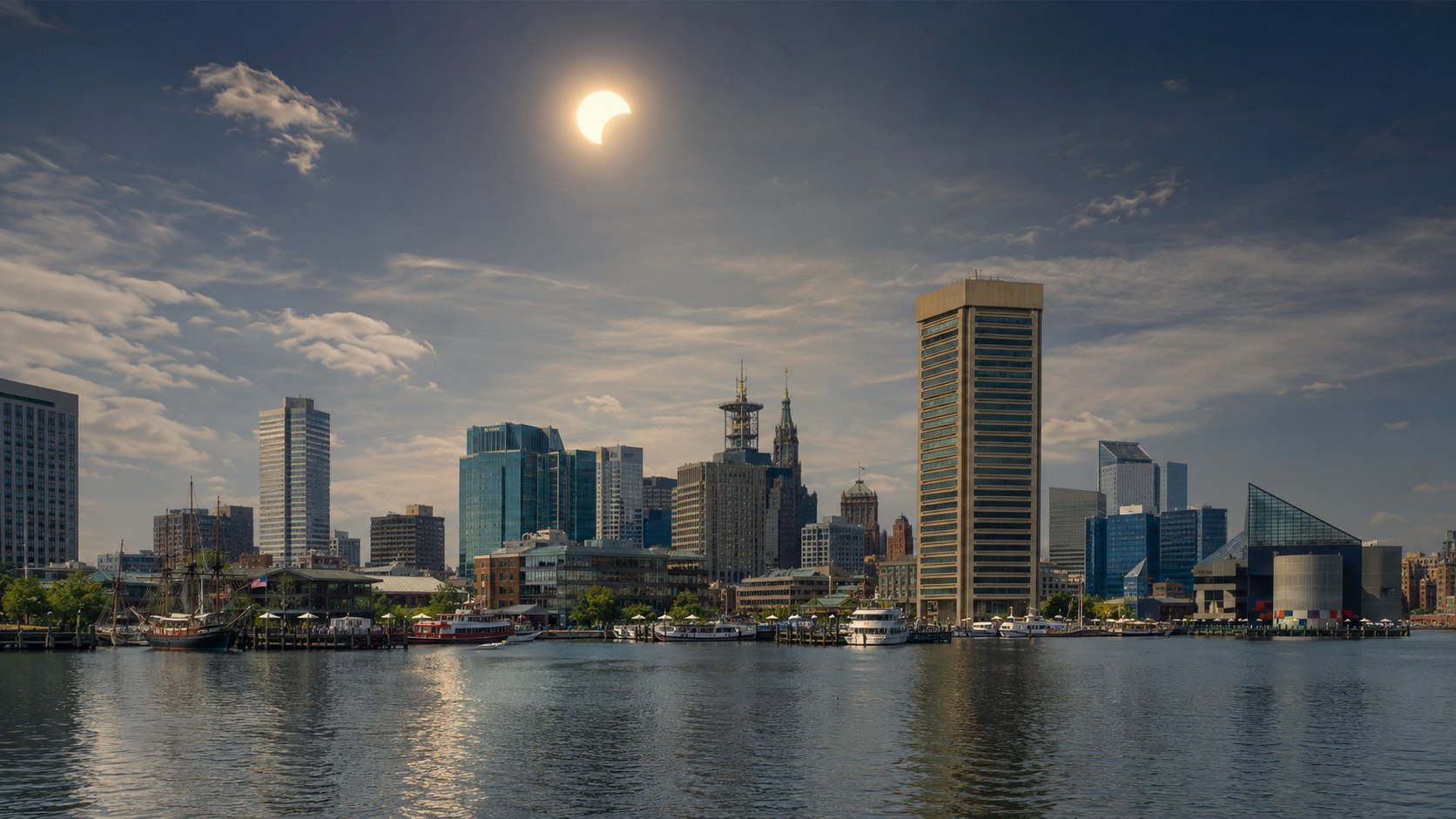
August 12 solar eclipse will appear over Maryland as a brief and shallow partial eclipse. Baltimore residents can watch it during early afternoon, weather permitting, reports the Baltimore Chronicle.
What time is the 2026 solar eclipse in Maryland?
The astronomical calculator from Timeanddate provides local times for Baltimore.
| Eclipse stage | Baltimore time |
|---|---|
| Partial eclipse begins | 1:15 p.m. EDT |
| Maximum eclipse | 1:52 p.m. EDT |
| Partial eclipse ends | 2:29 p.m. EDT |
| Total duration | 1 hour 14 minutes |
The Moon will cover only a small section of the Sun. The eclipse magnitude in Baltimore will reach 0.114.
That corresponds to approximately 4% to 5% of the Sun’s visible disk. The daylight level will barely change.
Observers should expect a small dark notch along the Sun’s edge, not dramatic midday darkness.
Will the August 12 solar eclipse be visible in Baltimore?
Baltimore lies far outside the path of totality. Total darkness will cross Greenland, Iceland, northern Spain and parts of Russia.
Maryland residents will see only the partial phase. Visibility will depend on clouds and an unobstructed view of the Sun.
The main local details are:
- the eclipse starts at 1:15 p.m.;
- maximum coverage occurs at 1:52 p.m.;
- approximately 4% to 5% of the Sun will be covered;
- totality will not be visible anywhere in Maryland.
NASA also predicts 4% coverage in Washington and 7% in Philadelphia. Baltimore’s expected coverage falls between those figures.
How to watch the solar eclipse safely
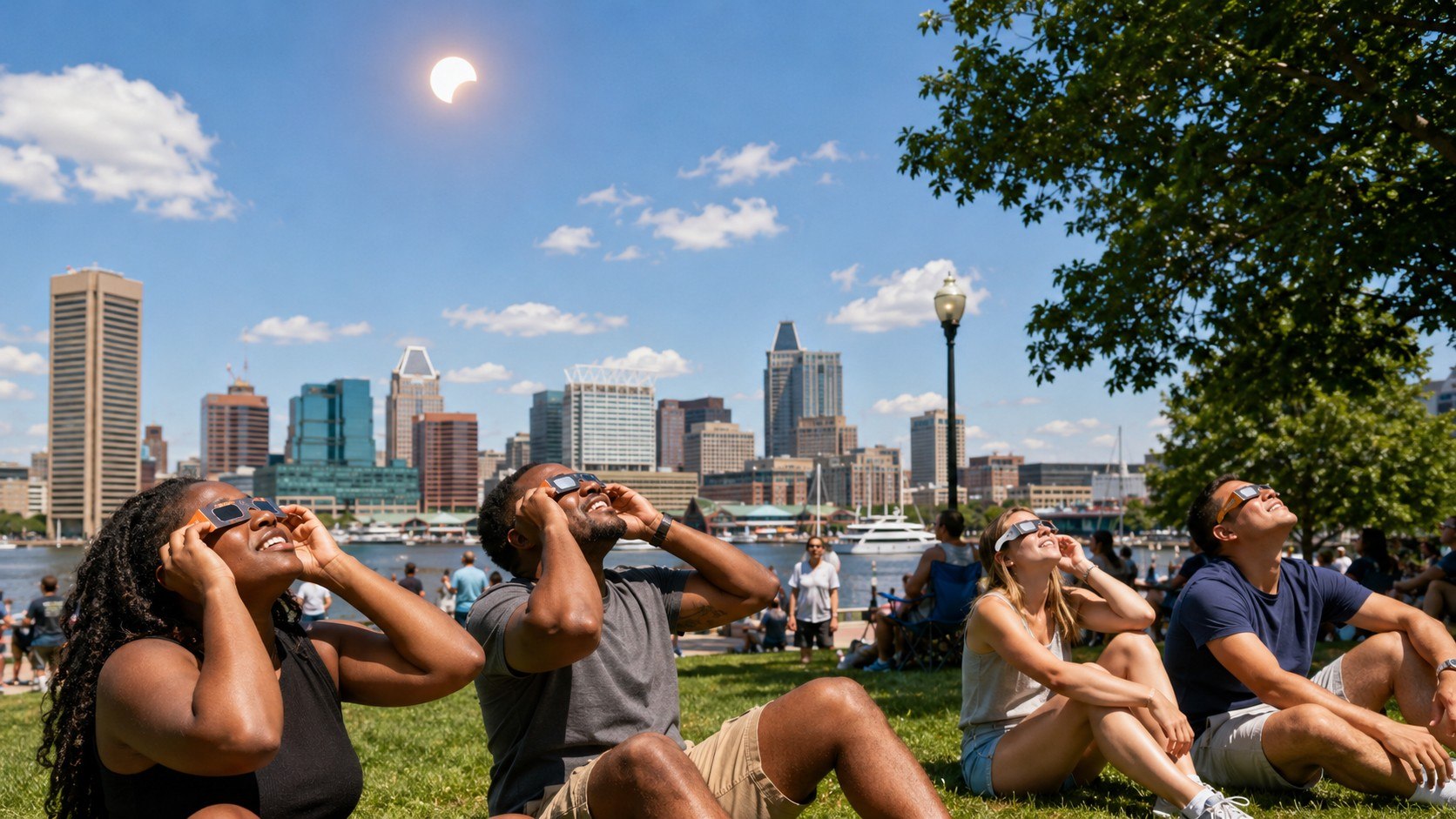
Regular sunglasses cannot protect viewers during a partial eclipse. Maryland observers must use proper solar viewers throughout the entire event.
NASA’s official eclipse guidance recommends viewers complying with the ISO 12312-2 safety standard.
Before watching:
- inspect glasses for scratches, holes or torn filters;
- buy viewers from established astronomy suppliers;
- supervise children throughout the observation;
- keep solar glasses over the eyes before looking upward;
- use a pinhole projector when certified glasses are unavailable.
Never watch through binoculars, telescopes or cameras without front-mounted solar filters. Concentrated sunlight can damage eyes and equipment.
Eclipse glasses worn behind binoculars provide no protection. The optical device requires its own professional solar filter.
Solar eclipse and Perseid meteor shower on the same day
The eclipse occurs several hours before the Perseid meteor shower reaches its peak. These are separate events requiring different observation methods.
Solar viewers are essential during the afternoon eclipse. No eye protection is needed for watching meteors after dark.
Maryland skywatchers should check the local cloud forecast on August 12. Even thin clouds will not make direct solar viewing safe.
Earlier we wrote that Maryland reports first human West Nile virus case of 2026