


How to negotiate a car price at a dealership 2026 comes down to one rule: negotiate the vehicle’s total out-the-door price before discussing monthly payments, financing, or a trade-in. With online research and written quotes, preparation usually takes 60–90 minutes and can prevent unwanted fees from entering the contract, as noted by Baltimore Chronicle.
Ask the dealer to show the selling price, taxes, registration charges, documentation fee, dealer-installed products, and every other mandatory charge. Then compare that number with written offers from competing stores. Your strongest sentence is simple: “I will buy today if you can confirm this out-the-door total in writing.”
Key takeaways
- Negotiate the out-the-door total, not a monthly payment that can hide a longer loan or added products.
- Ask whether the documentation fee is negotiable, then offset it through a lower vehicle selling price.
- Keep the car price, trade-in value, financing, and add-ons as 4 separate negotiations.
What You Need Before Negotiating
A dealership negotiation works better when the buyer can support every counteroffer with documents. You do not need specialist automotive knowledge, but you do need comparable prices and a firm spending limit.
Prepare the following:
- The exact year, make, model, trim, drivetrain, options, and stock number.
- Online listings from at least 3 dealerships within a reasonable driving distance.
- A bank or credit-union preapproval showing the maximum amount, APR, and term.
- A screenshot or printed copy of the advertised vehicle price.
- Your estimated sales tax, title, registration, inspection, and state charges.
- A calculator or spreadsheet for comparing out-the-door totals.
- A separate trade-in estimate when replacing an existing vehicle.
- About 2–4 hours for quotes, calls, a test drive, and contract review.
Buyers planning to finance should review their credit before requesting loan offers. Baltimore Chronicle’s guide to checking a credit score for free in 2026 explains how reports and scores differ. Correcting an error before applying may strengthen your position with lenders.
Do not reveal your maximum budget at the beginning. A salesperson who knows your ceiling can structure the offer around that ceiling instead of the vehicle’s market value.
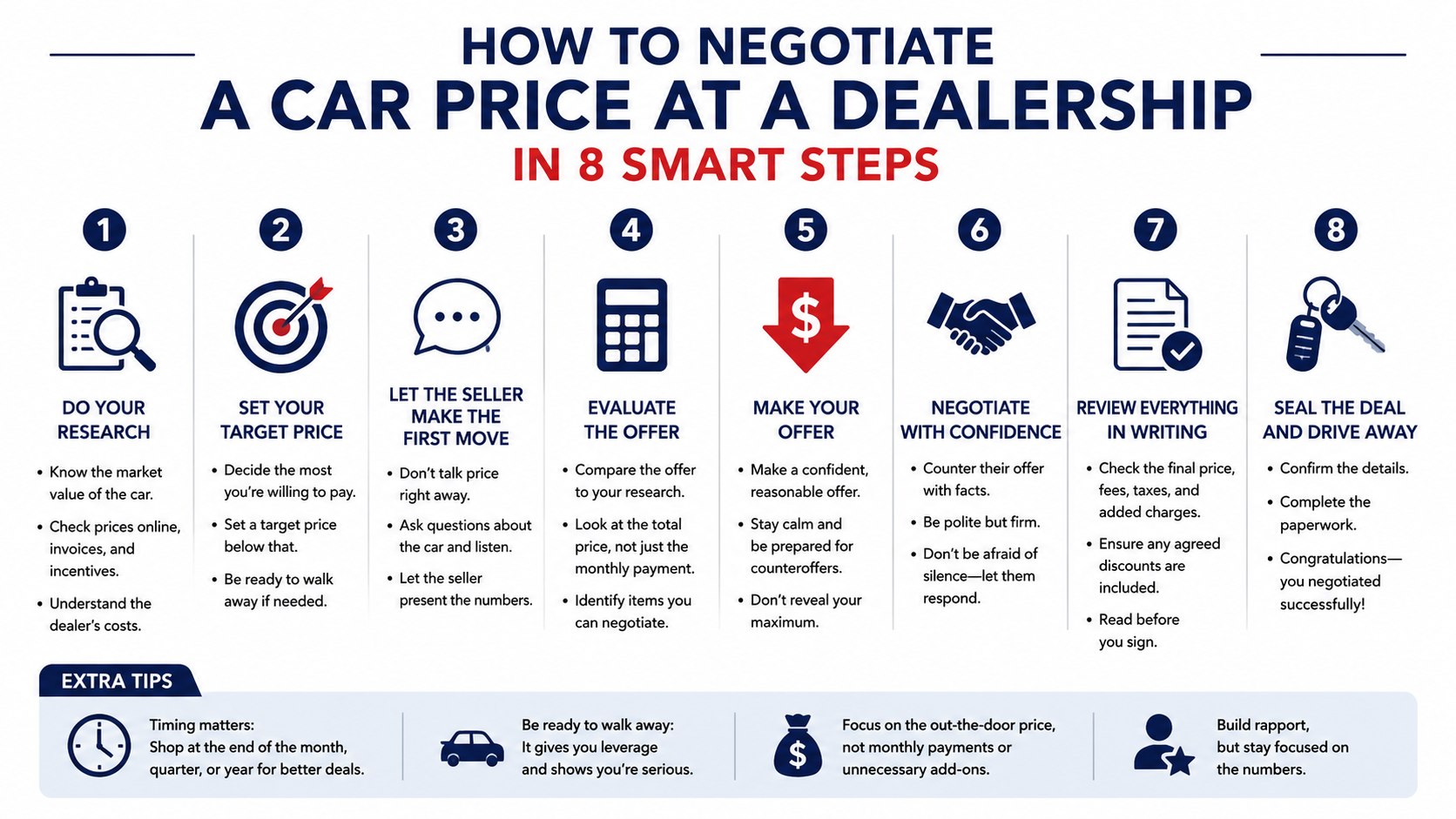
Step 1: Research the Exact Car and Its Real Market Price
Compare identical or closely matched vehicles, not merely the same model name. A front-wheel-drive Toyota RAV4 LE cannot be priced accurately against an all-wheel-drive RAV4 XLE with a convenience package.
This matters because dealers can dismiss vague comparisons. A stronger statement is: “Dealer A has the same trim, drivetrain, and package for $31,400 before tax.”
The common mistake is comparing a base model with a better-equipped vehicle and treating the price difference as dealer markup.
Check manufacturer incentives separately. Ford, Chevrolet, Toyota, Honda, Hyundai, Kia, Subaru, and other brands may offer regional programs, loyalty discounts, military incentives, or promotional financing. Eligibility can vary by ZIP code and delivery date in 2026.
Step 2: Request an Itemized Out-the-Door Quote
Contact several dealerships by email or text before visiting. Ask for the out-the-door price, which should include the selling price, required dealer charges, taxes, title, registration, and government fees.
The Federal Trade Commission advises buyers to obtain the out-the-door amount in writing before going to the lot. This makes competing offers easier to compare and exposes charges that were absent from the advertisement.
“Get an ‘out-the-door’ price of the car in writing before you visit the lot.”
Federal Trade Commission, consumer guidance on financing or leasing a vehicle.
Use this script:
“I am comparing the same vehicle at several dealerships. Please send the complete out-the-door price, including every mandatory fee and dealer-installed product. I am not discussing monthly payments yet.”
The mistake to avoid is accepting a quote that says “plus fees” without identifying those fees. Ask for a buyer’s order or itemized worksheet rather than a verbal estimate.
Step 3: Negotiate the Vehicle Price Before the Monthly Payment
Start with the selling price and the final out-the-door amount. Do not begin with: “I need to stay under $550 per month.”
A dealer can reach that payment by extending the loan, increasing the down payment, or changing the financing structure. A lower payment does not necessarily mean a cheaper vehicle.
A 72- or 84-month loan can make an expensive deal appear manageable while increasing total interest exposure.
Use a direct script:
“I am negotiating the total purchase price, not the payment. My offer is $34,800 out the door, with no additional products. Can you approve that total?”
The common mistake is negotiating against yourself. State the offer, stop speaking, and let the salesperson respond. Do not immediately raise your number because the room becomes quiet.
Step 4: Challenge the Doc Fee Without Getting Stuck on Its Name
A dealership documentation fee may appear as a doc fee, processing fee, dealer service fee, administrative fee, or conveyance fee. State rules differ.
Some states limit these charges, while others allow dealers broad discretion if the fee is disclosed consistently.
Florida dealerships, for example, may show higher processing charges than stores in states with stricter limits. California, Maryland, Virginia, Texas, New York, and Illinois apply different rules and disclosure systems.
Verify current 2026 requirements with the appropriate state motor vehicle agency or attorney general.
| Charge | Usually negotiable? | Best response |
|---|---|---|
| Vehicle selling price | Yes | Compare written prices for matching inventory |
| Documentation or processing fee | Sometimes fixed by dealer policy | Request an equal reduction in the vehicle price |
| Sales tax | No | Verify the correct state and local calculation |
| Title and registration | Usually no | Compare the amount with the state fee schedule |
| Dealer-installed accessories | Often | Remove them or reduce the price |
| Extended warranty | Yes | Decline it or compare coverage and cancellation terms |
| Loan APR | Yes | Use a bank or credit-union preapproval as leverage |
A salesperson may say that the doc fee cannot be removed because every buyer pays it. Do not spend 20 minutes arguing about the label. Negotiate the same amount from the vehicle price.
For example, suppose the dealership lists a Honda CR-V at $32,600 and adds a $699 processing fee. Your response can be: “Keep the fee on the form, but reduce the selling price by $699 so the out-the-door total remains unchanged.”
Ask whether the charge is paid to the state or retained by the dealership. Government title and registration charges should correspond with official schedules.
Maryland buyers can compare the paperwork with Baltimore Chronicle’s guide to registering a car in Maryland in 2026.
The mistake to avoid is treating every line marked “fee” as mandatory. Some charges are government assessments. Others are dealership revenue presented with official-sounding names.
Step 5: Remove Dealer Add-Ons and Protection Packages
Review each product separately. Common add-ons include:
- Nitrogen-filled tires.
- Window etching.
- Paint protection.
- Fabric protection.
- Wheel-and-tire coverage.
- Key replacement.
- Prepaid maintenance.
- Theft devices.
- Service contracts.
- Guaranteed asset protection.
Some products may have value for a particular driver, but they should not appear without clear consent. The FTC has repeatedly warned dealerships against unwanted add-ons and deceptive pricing practices.
Use this script:
“I did not request this product. Remove it from the vehicle and contract. If it cannot be physically removed, reduce the selling price by the full charge.”
This matters because several small products can add thousands of dollars. The common mistake is reviewing only the monthly-payment change, which can make a costly add-on appear insignificant.
After the dealer removes the products, request a new printed worksheet. Do not rely on a promise that the finance office will “fix everything later.”
Step 6: Negotiate the Trade-In as a Separate Transaction
Agree on the purchase price before discussing the trade-in. Obtain independent estimates from multiple dealers or vehicle-buying services, then compare those figures with the dealership’s offer.
This separation matters because a dealer can show an attractive trade allowance while refusing to discount the new car. The final difference between the 2 transactions may remain unfavorable.
Use this script:
“We have agreed on the new vehicle’s out-the-door price. Now I want a separate written offer for my trade, without changing the purchase price.”
The common mistake is focusing on a headline trade value without checking the loan payoff. If you owe more than the vehicle is worth, the negative equity may be added to the new loan.
Step 7: Compare Dealer Financing With Your Preapproval
Bring a current preapproval from a bank, credit union, or online lender. After the vehicle price is settled, allow the dealership to compete with that offer.
The Consumer Financial Protection Bureau states that an auto loan interest rate can be negotiable. A dealership may receive a lender’s buy rate and offer the customer a higher contract rate.
Use this script:
“My credit union approved this amount at this APR and term. Can you beat the APR without adding products, changing the vehicle price, or extending the loan?”
Compare APR, loan length, amount financed, finance charge, and total payments. The common mistake is accepting a lower monthly payment produced by a longer repayment period.
Drivers balancing car payments with rent, utilities, insurance, and commuting costs can also review Baltimore Chronicle’s analysis of the cost of living in Baltimore in 2026.
Step 8: Audit the Contract Before Signing
Compare the final purchase agreement with the last approved worksheet. Check the following:
- VIN.
- Vehicle price.
- Down payment.
- Trade allowance.
- Loan payoff.
- Taxes.
- Registration.
- Doc fee.
- Add-ons.
- Amount financed.
- APR.
- Loan term.
- Total of payments.
This matters because the finance office creates a new opportunity for numbers to change. A verbal agreement with the salesperson does not replace the written contract.
Use this final script:
“I will sign after the contract matches the agreed buyer’s order. Please print the full documents so I can review every charge before using the electronic signature screen.”
The mistake to avoid is signing on a tablet without seeing the complete document. Ask for printed or fully visible copies, and confirm that financing is final before taking the vehicle home.

Troubleshooting Common Dealership Negotiation Problems
Negotiations often slow down when the dealership shifts the discussion away from the total price. These responses keep the conversation focused.
- The dealer refuses to provide an out-the-door quote: contact another store and explain that written totals determine where you buy.
- The advertised price requires impossible discounts: ask which incentives are included and whether you personally qualify for each one.
- A mandatory protection package appears: request removal or an equal price reduction, then obtain a revised worksheet.
- The salesperson discusses only payments: repeat that price and financing are separate decisions.
- The finance office changes the terms: stop signing and compare the contract against the approved buyer’s order.
Walking away remains a legitimate negotiating tool. A vehicle is not a unique opportunity merely because a salesperson says another buyer may arrive soon.
Keep screenshots, emails, text messages, worksheets, and advertisements. These records can support a complaint when the final terms materially differ from the offer used to bring you into the store.
If a dealer appears to use deceptive pricing, unwanted add-ons, or misleading financing representations, consumers can report the issue through the Federal Trade Commission. Auto-loan complaints can also be submitted through the Consumer Financial Protection Bureau.
FAQ
How much can you negotiate off a car in 2026?
There is no reliable national percentage. The negotiable amount depends on inventory, incentives, model demand, vehicle age, dealer competition, and whether the car is new or used.
Compare matching vehicles and negotiate from written market evidence.
Can a dealer refuse to remove the doc fee?
Yes. A dealership may claim that its policy requires the charge on every contract.
You can still negotiate an equivalent reduction in the vehicle selling price and compare the resulting out-the-door total.
Should I tell the dealer I am paying cash?
Not at the beginning. First settle the vehicle price. Then discuss payment.
Cash does not always produce a discount because dealerships may earn revenue from arranging financing.
Is the MSRP the same as the out-the-door price?
No. MSRP is the manufacturer’s suggested retail price.
The out-the-door price includes the negotiated vehicle price, mandatory dealer charges, sales tax, title, registration, and other required costs.
What is the best sentence to use when negotiating?
Say: “I will buy today if you confirm this out-the-door total in writing, with no additional products or charges.”
The sentence establishes a specific number and a clear condition.
Can I leave after signing a buyer’s order?
That depends on the document, state law, and whether a binding purchase contract has been completed.
Read every document before signing. Do not assume a general 3-day cancellation period applies to dealership vehicle purchases.
Earlier we wrote about Gas vs Induction vs Electric Stove 2026: Costs, Speed and Installation Compared