

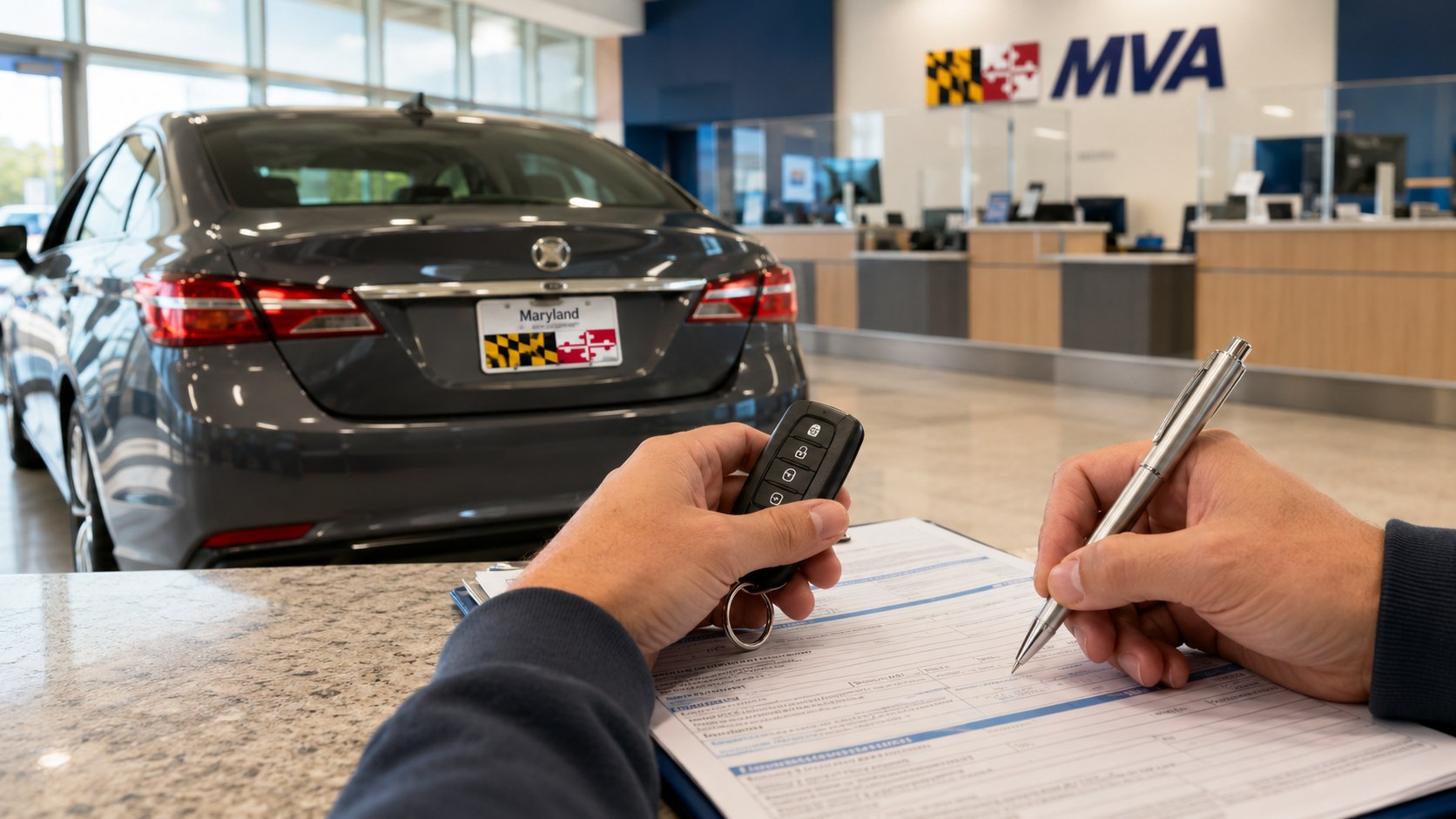
How to register a car in Maryland 2026 starts with Maryland insurance, a state safety inspection, and a title-and-registration appointment. Most applicants can complete the MVA visit in less than 1 hour when every document is prepared, although inspection repairs may extend the process, as noted by the Baltimore Chronicle editorial team.
New Maryland residents must title and register their vehicles within 60 days. Buyers usually complete both transactions together. Expect to pay a $200 title fee, an annual registration charge based on vehicle weight, and any applicable 6.5% excise tax.
“You must update the vehicle’s title and registration within 60 days of moving to Maryland.”
MDOT Motor Vehicle Administration, guidance for new Maryland residents, accessed July 2026.
Key takeaways
- Obtain Maryland auto insurance before visiting the MVA because out-of-state coverage may not satisfy registration requirements.
- Complete the Maryland safety inspection before your appointment unless the vehicle qualifies for an exemption.
- Budget for the $200 title certificate, weight-based registration, inspection, taxes, and possible electric-vehicle surcharges.
These charges can make the first registration more expensive than a normal renewal. Preparing the title, insurance details, inspection record, and lien information prevents most rejected applications.
What you need
Before starting the registration process, collect the following documents and information:
- Original vehicle title or acceptable ownership document
- Maryland driver’s license or proof of a Maryland residential address
- Maryland insurance company name and policy or binder number
- Maryland Safety Inspection Certificate, when required
- Completed Form VR-005 if the online pre-application was not submitted
- Lienholder or leasing-company account and mailing details
- Payment for title, registration, tax, plates, and related charges
- About 2–4 hours for inspection and document preparation
Do not cancel your previous insurance policy until Maryland coverage is active and your old plates have been returned properly. An insurance gap can trigger penalties.
Step 1: How to register a car in Maryland 2026 — confirm your deadline and transaction type
Determine whether you are registering after moving, buying from a private seller, purchasing from a dealership, or transferring a vehicle between relatives. The paperwork and tax treatment can differ significantly.
New residents receive 60 days to complete the Maryland title transfer and registration. Missing that deadline can eliminate credit for tax paid to another state. New enforcement measures taking effect October 1, 2026, may also expose owners with out-of-state plates to warnings and daily fines.
A Maryland dealership normally submits the title and registration paperwork for the buyer. Private-sale buyers and new residents usually handle the transaction through an MVA branch or licensed title service.
Common mistake: assuming a valid Virginia, Pennsylvania, Delaware, or Washington, D.C. registration extends Maryland’s 60-day deadline.
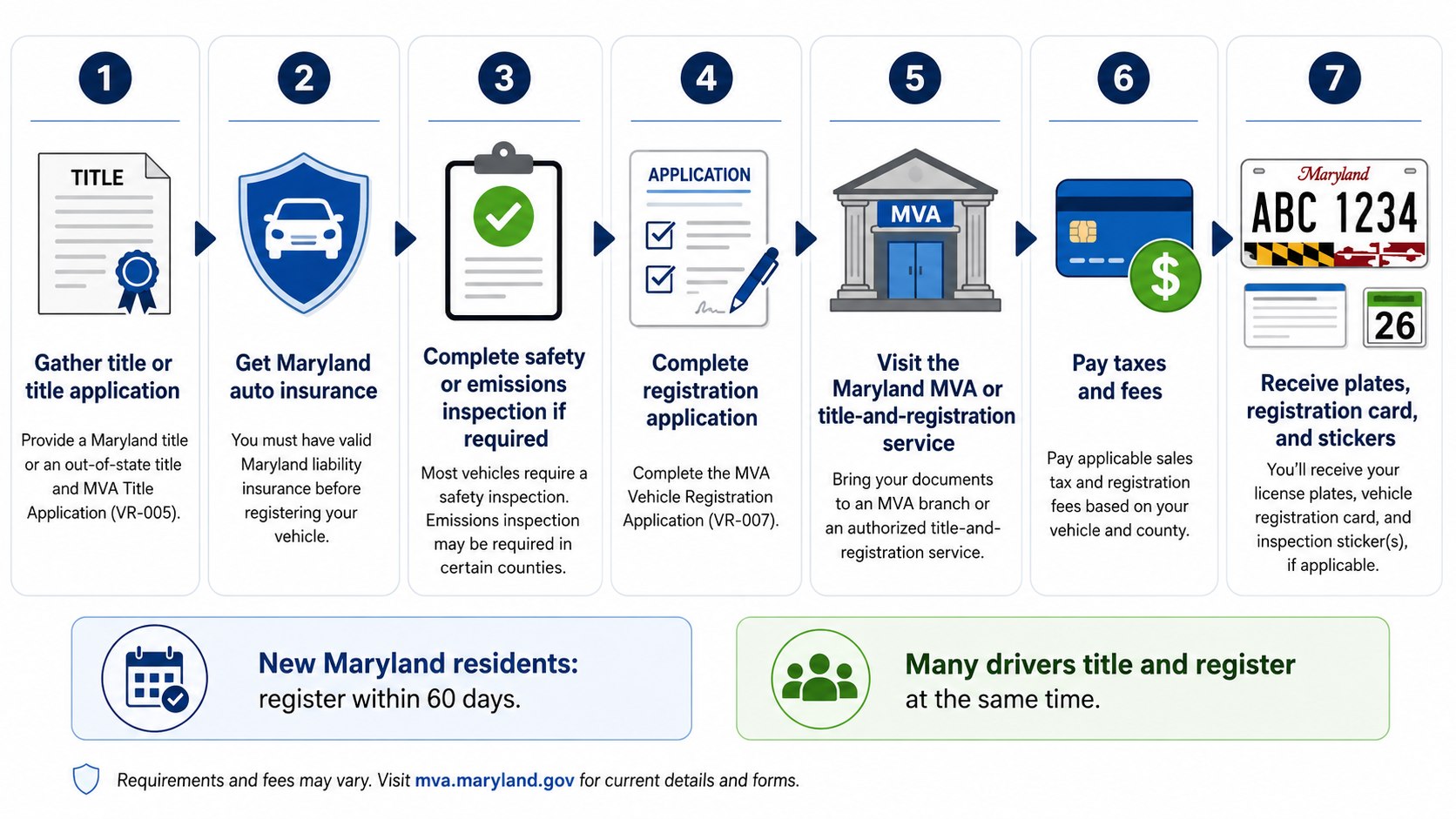
Step 2: Buy Maryland vehicle insurance before registration
Contact an insurer authorized to write policies in Maryland. Companies such as State Farm, GEICO, Progressive, Allstate, Erie Insurance, and USAA commonly serve Maryland drivers, but prices vary by ZIP code and driving history.
The MVA needs the insurer’s name and your policy or binder number. The vehicle identification number must match the title exactly. Review the Baltimore Chronicle guide to Maryland car insurance requirements before changing policies.
Maryland electronically monitors insurance coverage. The MVA lists a $200 uninsured penalty for the first 30 days and $7 for each additional day. The annual maximum is $3,500.
Common mistake: presenting an insurance card from another state without confirming that the policy has been converted to Maryland coverage.
Step 3: Complete the Maryland safety inspection
Most vehicles being titled in Maryland must pass an inspection at a station licensed by the Maryland State Police. The inspection covers brakes, steering, tires, lights, glass, suspension, exhaust equipment, and seat belts.
Inspection stations set their own prices. Many passenger-car inspections cost roughly $80–$130 in 2026, before repairs. Ask for the full inspection price when scheduling because reinspection policies also vary.
The station sends a passing certificate electronically to the MVA. A Maryland inspection certificate remains valid for 90 days, so complete the registration before it expires.
If the car cannot legally reach the station, the owner may apply for one 30-day temporary registration. The current MVA fee is $50. Learn how this differs from a normal plate in the Maryland temporary tags guide.
Common mistake: confusing the safety inspection with the Vehicle Emissions Inspection Program. VEIP testing normally occurs after registration.
Step 4: Gather the title, address, lien, and purchase documents
Bring the original title with every required seller and buyer signature. Names, dates, mileage, sale price, and VIN details must remain readable. Avoid corrections, white-out, or overwritten figures.
New residents should bring their out-of-state title. When a lender holds it, provide the lienholder’s fax number, mailing address, account number, and current registration card. The MVA may need to request the title directly.
Private buyers should retain a signed bill of sale. Maryland may require a notarized Bill of Sale, Form VR-181, when the declared price affects the tax calculation.
Documents commonly required include:
- Title or ownership certificate
- Odometer disclosure, when required
- Bill of sale showing the purchase price
- Maryland address documentation
- Insurance policy or binder details
- Inspection confirmation
- Lien release for a paid-off loan
- Power of attorney when another person signs
Compare every name against the identification documents before leaving home. A missing middle initial is not always fatal, but a different legal name may require supporting records.
Check the VIN on the dashboard and driver-side door label. It must match the title, insurance binder, and application. Even 1 incorrect digit can stop the transaction.
Married couples and co-owners should confirm whether both signatures are required. The title’s ownership wording controls who must authorize a sale or transfer.
Leased vehicles create another layer because the leasing company is usually the titled owner. Ask the lessor for its Maryland registration procedure before booking an appointment.
Keep copies of the signed documents. The MVA may retain original forms, while your copies can support later corrections or tax questions.
Step 5: Estimate Maryland title, registration, and tax charges
Maryland’s 2026 registration prices depend mainly on vehicle class and shipping weight. Most passenger cars fall within 3 annual price bands. SUVs and other multipurpose vehicles use similar bands.
| Charge or vehicle category | 2026 amount | What affects it |
|---|---|---|
| New or used title certificate | $200 | Charged when Maryland issues the title |
| Passenger car, 3,500 lbs or less | $120.50 annually | Shipping weight |
| Passenger car, 3,501–3,700 lbs | $125.50 annually | Shipping weight |
| Passenger car, over 3,700 lbs | $191.50 annually | Shipping weight |
| Registration or tag transfer | $15 | Existing eligible Maryland plates |
| Temporary registration | $50 | Generally issued once for 30 days |
| Vehicle excise tax | Usually 6.5% | Purchase price, value, age, and prior tax |
| Battery-electric vehicle surcharge | $125 annually | Zero-emission vehicles |
| Plug-in hybrid surcharge | $100 annually | Qualifying PHEVs |
The registration amounts already include Maryland’s annual $40 EMS surcharge where applicable. Drivers may select 1-, 2-, or 3-year terms for many vehicle classes.
A recently purchased car is generally taxed at 6.5% of the qualifying purchase price or value. Maryland’s minimum taxable value can apply when a low sale price lacks acceptable documentation.
New residents who act within 60 days may receive credit for vehicle tax paid elsewhere. For a vehicle 6 model years old or newer, Maryland generally collects the difference between the previous state’s rate and 6.5%.
For example, a qualifying recent arrival from Virginia may owe the rate difference applied to the vehicle’s retail value. Someone moving from a state with no vehicle tax may owe Maryland’s full rate.
Because tax calculations depend on age, prior payments, purchase details, and exemptions, use the official Maryland MVA fee schedule before the appointment. The related Baltimore Chronicle explainer covers Maryland vehicle excise tax calculations in greater detail.
A $25,000 used car could generate a substantial tax bill even before the title, registration, inspection, and insurance costs are added.
Step 6: Submit the pre-application and finish the MVA appointment
Start the transaction through myMVA and complete the title-and-registration pre-application. The system collects owner, vehicle, and insurance details while producing a document checklist and fee estimate.
Book the appropriate title and registration appointment. Bring the pre-application confirmation and barcode, plus every original document. Applicants who skip the online form should complete the Certificate of Title Application, Form VR-005.
At the branch, an employee reviews ownership, inspection, insurance, lien, and tax records. Approved applicants receive a registration card, stickers, and plates at the service counter or by mail.
The MVA accepts major credit cards, mobile wallet payments, cash, and qualifying checks. Verify the accepted payment rules before visiting through the official Maryland vehicle registration page.
Common mistake: scheduling a driver’s license appointment instead of the title-and-registration service needed for the vehicle.
Troubleshooting Maryland car registration problems
Several problems can delay or block a registration:
- The lender holds the title: bring the account number and complete lienholder contact details so the MVA can request it.
- The car failed inspection: complete the listed repairs and return under the station’s reinspection terms.
- The title contains an error: obtain corrected seller documents rather than altering names, mileage, dates, or prices yourself.
- The inspection expires soon: secure the earliest MVA appointment or confirm whether another approved completion method is available.
- The car has no valid plates: ask whether the one-time 30-day temporary registration fits your circumstances.
Do not drive an unregistered or uninsured car merely because an appointment has been scheduled. An appointment confirmation does not replace valid registration.
When documents are missing, call the MVA Contact Center at 410-768-7000 before traveling to a branch. Explain whether the vehicle is financed, leased, inherited, gifted, or purchased privately.
For a VIN mismatch, compare the title against the vehicle itself. Contact the issuing state or seller when the original ownership record contains the error.
Owners moving from another state should preserve receipts showing previous tax payments. Those records can determine whether Maryland grants a credit.
After registration, keep the card inside the vehicle. Display both plates and current stickers as directed, then watch for the later VEIP notice.
FAQ about registering a car in Maryland
Can I register a car in Maryland entirely online?
Most first-time Maryland title transactions still require an appointment or authorized title-service transaction. The online pre-application reduces paperwork but does not replace every in-person review.
How much does it cost to register a car in Maryland in 2026?
A typical passenger car carries a $200 title fee and annual registration of $120.50–$191.50. Excise tax, inspection, insurance, liens, and EV surcharges can increase the total.
Do I need a Maryland driver’s license first?
The MVA asks for a valid Maryland license or acceptable proof of a Maryland residential address. New residents often coordinate their license and vehicle appointments.
How long do new residents have to register a car?
Maryland gives new residents 60 days to title and register an out-of-state vehicle. Missing the deadline may affect tax credits and trigger enforcement.
Does every vehicle need a Maryland safety inspection?
Most vehicles first titled in Maryland require one. A vehicle returning to Maryland under the same owner may qualify for an exemption.
When is the emissions test required?
The safety inspection comes first. Qualifying owners generally receive a VEIP notice after registration, with testing usually required every 2 years.
Earlier we wrote about How to Cancel SiriusXM Before Renewal: 8 Steps, Phone Number and Refund Rules